How Much Car Insurance Do I Need? A Practical Guide to Choosing Coverage
Learn how much car insurance you may need based on your state’s requirements, liability limits, vehicle value, financing or leasing, deductibles, and optional coverage. This guide helps U.S. drivers choose coverage based on their own situation rather than relying on a one-size-fits-all recommendation.
In this article
- Start With Your State’s Minimum Requirements
- Why the State Minimum May Not Be Enough
- Understand What the Main Types of Car Insurance Do
- How Much Liability Coverage Should You Carry?
- Understanding Numbers Such as 25/50/25 and 100/300/100
- Why Higher Liability Limits Can Make Sense
- Do You Need Collision and Comprehensive Coverage?
- If Your Car Is Financed or Leased
- If Your Car Is Paid Off
- When an Older Car Changes the Calculation
- Choose a Deductible You Can Actually Afford
- Consider Uninsured and Underinsured Motorist Coverage
- Think About PIP and MedPay Based on Your Situation
- Match Coverage to Your Situation
- A Simple Way to Decide How Much Car Insurance You Need
- Step 1: Check Your State's Requirements
- Step 2: Check Your Loan or Lease
- Step 3: Evaluate Your Liability Exposure
- Step 4: Evaluate the Vehicle
- Step 5: Choose a Manageable Deductible
- Step 6: Review Optional Protection
- Compare Quotes Using the Same Coverage
- Common Mistakes to Avoid
- Buying Only the State Minimum Without Considering Your Risk
- Assuming “Full Coverage” Means Everything Is Covered
- Dropping Collision and Comprehensive Solely Because the Car Is Paid Off
- Choosing a Deductible You Cannot Afford
- Comparing Only Monthly Prices
- Forgetting to Revisit Coverage
- The Bottom Line
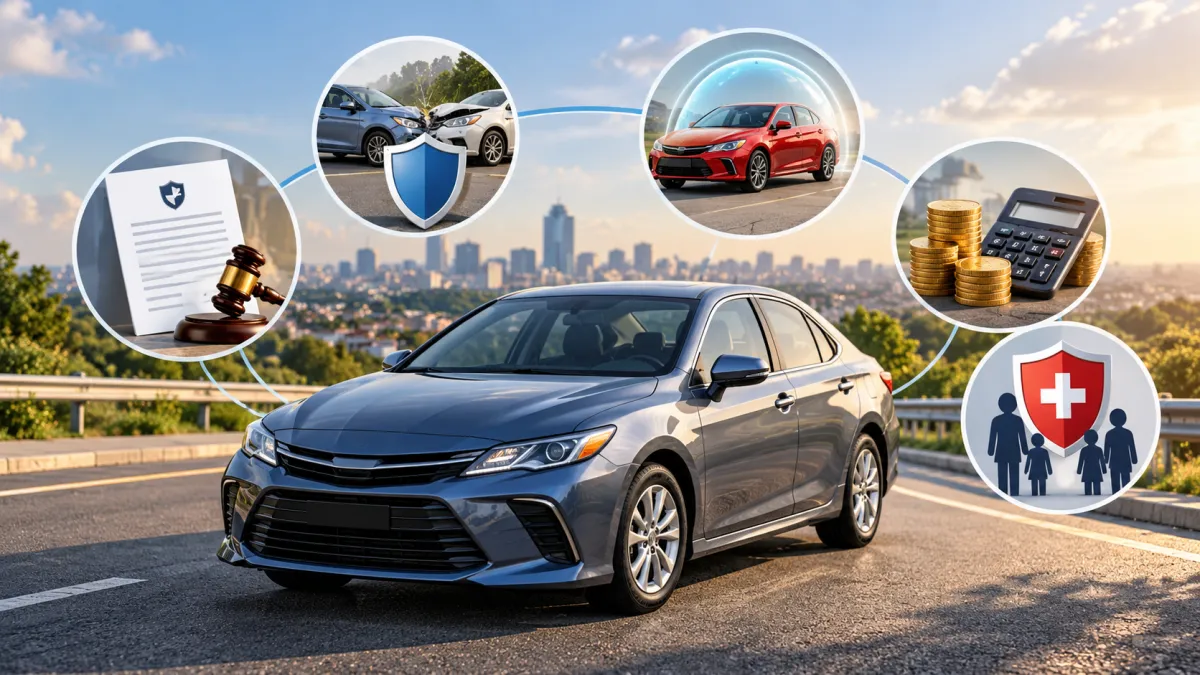
The right amount of car insurance depends on more than the minimum your state requires. Your coverage decision should account for your state’s laws, your financial situation, the value of your vehicle, whether the car is financed or leased, and how much you could afford to pay out of pocket after an accident.
A useful way to think about car insurance is to separate the decision into five questions:
- What coverage does my state require?
- How much liability protection do I need beyond that minimum?
- Do I need protection for damage to my own vehicle?
- Which medical and uninsured-driver protections make sense for me?
- What deductible can I comfortably afford?
There is no single coverage limit that is right for every U.S. driver. The goal is to build a policy that meets your legal and contractual obligations while reducing the financial risks you would have difficulty handling yourself.
Start With Your State’s Minimum Requirements
Every state has its own auto insurance rules, and the required coverage can differ significantly from one state to another. Some states use traditional liability requirements, while others have different systems and requirements for medical or personal injury protection.
Your first step should therefore be checking the current requirements where your vehicle is registered.
State minimums are a starting point, not necessarily a recommendation for how much protection you should carry.
For example, liability insurance generally helps pay for injuries or property damage you cause to other people in a covered accident, up to your policy limits. If the damages are greater than your limits, you may remain financially responsible for amounts that are not covered.
That is why simply buying the cheapest policy that satisfies the law can leave some drivers with considerably less protection than they actually need.
Why the State Minimum May Not Be Enough
Imagine that you cause an accident involving another vehicle. The other driver has significant medical bills, and the damaged vehicle is expensive to repair or replace.
Your state minimum liability limits might satisfy the legal requirement, but that does not necessarily mean they would cover the entire loss.
This is the important distinction:
Legal minimum = the amount required to comply with your state's rules.
Adequate coverage = an amount that makes sense for your potential financial exposure.
Those two numbers can be very different.
Before choosing limits, check your state insurance regulator or motor vehicle agency for the current legal requirements. State rules can change, so an older online article or quote comparison page should not be treated as the final authority.
Understand What the Main Types of Car Insurance Do
Before deciding how much coverage you need, it helps to separate the major types of protection. Different coverages solve different problems.
| Coverage | What it generally protects against | Main question to ask |
|---|---|---|
| Bodily injury liability | Injuries you cause to others in a covered accident | How much financial risk could I face if I seriously injure someone? |
| Property damage liability | Damage you cause to another person's property or vehicle | Could I handle a large property-damage claim myself? |
| Uninsured/underinsured motorist | Certain injuries or losses caused by drivers without enough insurance | How much protection do I want if the other driver cannot adequately pay? |
| Collision | Damage to your vehicle from a collision | Could I afford to repair or replace my car after a collision? |
| Comprehensive | Certain non-collision losses, such as theft or weather-related damage | Is protecting the vehicle from non-collision losses worthwhile? |
| PIP or MedPay | Certain medical expenses, depending on the coverage and state | What medical protection does my state and existing health coverage leave me needing? |
Not every state treats these coverages the same way. Some may be required, some optional, and some subject to specific rules or circumstances.
The important point is that car insurance is not one single form of protection. You are choosing several layers that address different risks.
How Much Liability Coverage Should You Carry?
Liability coverage deserves particular attention because it protects against claims arising from harm you cause to other people or their property.
The amount you should carry depends partly on your financial exposure. A driver with substantial savings, investments, home equity, or other assets may have more to protect than someone with very limited assets. That does not mean assets automatically determine a specific insurance limit, but they are relevant to the risk-management decision.
Your future income and overall financial circumstances can also matter.
Understanding Numbers Such as 25/50/25 and 100/300/100
Auto insurance liability limits are commonly displayed using three numbers.
For example, 100/300/100 can represent:
- $100,000 of bodily injury liability per person
- $300,000 of bodily injury liability per accident
- $100,000 of property damage liability per accident
The exact meaning of the numbers should always be confirmed with the insurer and policy documents, but this notation is commonly used to describe liability limits.
Importantly, 100/300/100 is an example of how limits are expressed. It should not be treated as a universal legal requirement or as a one-size-fits-all recommendation for every driver.
A driver deciding between different liability limits should consider the difference in protection, the cost of the policy, and the financial consequences of being underinsured.
Why Higher Liability Limits Can Make Sense
Higher limits generally provide a larger amount of protection before you reach the policy limit.
Consider a hypothetical situation where you cause a serious accident and the resulting covered liability claim is much larger than your state's minimum liability limits.
With very low limits, your insurance may reach its policy limit quickly. You could then face additional financial exposure.
Higher limits do not eliminate every possible financial risk, and they do not guarantee that every claim will be covered. But they can provide a larger layer of protection against potentially expensive liability claims.
The right amount is therefore a risk-management decision rather than simply a search for the lowest premium.
Do You Need Collision and Comprehensive Coverage?
Liability coverage primarily protects you from covered claims involving other people. Collision and comprehensive coverage address a different question: What happens to your own vehicle?
Collision coverage generally applies to covered damage resulting from a collision, subject to the policy terms and deductible.
Comprehensive coverage generally addresses certain non-collision losses, such as theft, vandalism, falling objects, or weather-related damage, again subject to the policy terms.
Together, collision and comprehensive are often part of what consumers informally call “full coverage.”
However, “full coverage” is not a standardized legal package that automatically includes every possible type of insurance. When comparing policies, look at the individual coverages, limits, exclusions, and deductibles instead of relying only on the phrase “full coverage.”
If Your Car Is Financed or Leased
Financing or leasing can change your decision significantly.
A lender or leasing company has a financial interest in the vehicle. Your loan or lease agreement may therefore require certain physical-damage coverage, such as collision and comprehensive, in addition to the liability coverage required by state law.
The exact requirements depend on your agreement.
Before changing or removing coverage on a financed or leased vehicle, check the contract or contact the lender or leasing company.
You should think about this as two separate requirements:
State requirement: What you legally need to drive the vehicle.
Lender or lessor requirement: What you are contractually required to maintain because another party has a financial interest in the vehicle.
Meeting the first does not necessarily satisfy the second.
If Your Car Is Paid Off
Once you pay off a vehicle, the lender's contractual requirements generally no longer control your coverage decision.
That does not automatically mean you should remove collision or comprehensive coverage.
Instead, consider:
- What is the vehicle worth?
- How much would it cost to repair?
- How much would it cost to replace the vehicle?
- What is your deductible?
- Could you afford a major repair or replacement from savings?
- How much would you save by removing the coverage?
- Are theft, weather, vandalism, or other covered risks significant concerns for your situation?
For a relatively valuable vehicle, maintaining physical-damage coverage may still make sense even when there is no lender.
For a low-value vehicle, the calculation can be different.
When an Older Car Changes the Calculation
There is no universal vehicle age at which collision or comprehensive coverage should be dropped.
Instead, compare the financial value of the protection with what you would actually receive after a covered loss.
Suppose an older car has a relatively low market value. If you carry a substantial deductible and the potential insurance payout would be limited by the vehicle's value, paying for certain physical-damage coverage may become less attractive.
But the decision should not be based solely on age.
An older vehicle that you depend on every day may still be difficult to replace. If you have limited savings, losing the vehicle could create a significant financial and transportation problem.
The better question is not simply, “How old is my car?”
It is:
“If this car were seriously damaged or stolen tomorrow, could I comfortably handle the financial consequences without this coverage?”
Choose a Deductible You Can Actually Afford
A deductible is the amount you generally pay out of pocket for a covered loss before the insurer pays the remaining covered amount, subject to the policy terms.
A higher deductible can generally reduce the premium for the applicable coverage, while a lower deductible generally means paying less out of pocket when a covered claim occurs.
Neither choice is automatically better.
Consider a hypothetical driver comparing a $500 deductible with a $1,000 deductible.
The $1,000 option might have a lower premium, but the driver must be prepared to pay up to $1,000 toward a covered loss when the deductible applies.
That creates a simple tradeoff:
Lower deductible: potentially higher premium, lower out-of-pocket cost after a covered loss.
Higher deductible: potentially lower premium, higher out-of-pocket cost after a covered loss.
The best deductible is one that fits both your budget and your emergency savings.
A deductible that looks attractive because it lowers your monthly premium is not necessarily a good choice if you would struggle to come up with that amount after an accident.
Consider Uninsured and Underinsured Motorist Coverage
Your insurance decision should not focus only on accidents you cause.
Another driver may cause an accident and have no insurance or not have enough insurance to cover the resulting losses.
Uninsured and underinsured motorist coverage can provide protection in certain situations involving drivers who lack sufficient insurance, depending on your state and policy.
The rules vary by state, so check how this coverage works where you live.
This coverage can be especially worth examining when comparing otherwise similar policies. A policy with a slightly lower premium is not necessarily the better value if it provides materially less protection in an important situation.
Think About PIP and MedPay Based on Your Situation
Personal injury protection, commonly called PIP, and medical payments coverage, often called MedPay, can help with certain medical expenses depending on the policy and state.
The role of these coverages varies considerably across the country.
Some states have no-fault insurance systems with specific requirements involving personal injury protection. Other states use different approaches.
Your existing health insurance can also be relevant when thinking about medical coverage, but it should not be assumed that health insurance and auto medical coverage work the same way.
Instead, determine:
- What your state requires or allows
- What your auto policy covers
- What your health insurance covers
- What out-of-pocket costs you could face
- Whether other people in your household may be affected by the coverage
This is another reason that choosing car insurance based only on the lowest advertised premium can be misleading.
Match Coverage to Your Situation
A useful way to choose coverage is to start with your circumstances rather than a predetermined package.
| Driver situation | What to examine closely |
|---|---|
| Newer financed vehicle | Lender requirements, collision, comprehensive, liability limits and deductible |
| Leased vehicle | Lease requirements, liability protection, collision and comprehensive |
| Paid-off newer vehicle | Vehicle replacement cost, liability exposure and physical-damage protection |
| Older low-value vehicle | Vehicle value, deductible, repair/replacement ability and cost of physical-damage coverage |
| Significant assets | Liability limits and protection against larger financial exposure |
| Limited emergency savings | Deductible and ability to repair or replace the vehicle |
| Household with multiple drivers | Liability exposure, driver history and applicable optional coverages |
| Driver in a state with PIP requirements | State rules and medical protection requirements |
These are decision factors, not automatic recommendations.
Two drivers with the same vehicle can reasonably choose different coverage because their finances, risk tolerance, state requirements, and contractual obligations are different.
A Simple Way to Decide How Much Car Insurance You Need
You can work through the decision in this order.
Step 1: Check Your State's Requirements
Find the current requirements from your state insurance regulator or motor vehicle agency.
Write down the required liability limits and any required or applicable medical, uninsured-motorist, or other coverage.
Step 2: Check Your Loan or Lease
If you finance or lease the vehicle, review the agreement for required physical-damage coverage and other insurance conditions.
Do not assume that state minimum coverage satisfies the lender or lessor.
Step 3: Evaluate Your Liability Exposure
Ask what could happen financially if you caused a serious accident.
Consider your assets, income, household circumstances, and ability to handle a liability claim beyond your insurance limits.
Then compare higher liability limits rather than automatically choosing the state minimum.
Step 4: Evaluate the Vehicle
Determine whether you could comfortably repair or replace the car after a covered loss.
For a newer or valuable vehicle, collision and comprehensive may provide meaningful protection.
For an older vehicle with a low market value, the cost-benefit calculation may be different.
Step 5: Choose a Manageable Deductible
Select a deductible that you could realistically pay after a covered loss.
Do not choose a high deductible solely because it makes the premium look cheaper.
Step 6: Review Optional Protection
Look at uninsured/underinsured motorist coverage, PIP, MedPay, and other available coverage based on your state and circumstances.
You do not necessarily need every optional coverage, but you should understand what risk each one addresses before declining it.
Compare Quotes Using the Same Coverage
One of the easiest mistakes when shopping for car insurance is comparing premiums without comparing the policies behind those premiums.
A quote that is $30 cheaper per month does not necessarily represent a better deal if it has substantially lower liability limits, different deductibles, or fewer protections.
When comparing quotes, keep the major variables as similar as possible:
- Liability limits
- Uninsured/underinsured motorist coverage
- Collision coverage
- Comprehensive coverage
- Deductibles
- PIP or MedPay
- Applicable optional coverages
Then compare the premiums.
This gives you a much more useful comparison than simply asking which insurer has the lowest price.
If you ever need to deal with vehicle damage after an accident, understanding repair costs can also help you make sense of the financial side of a claim. KnowBrook's guide on how to read a car repair estimate can help you understand common parts, labor, and repair-cost information.
Common Mistakes to Avoid
Buying Only the State Minimum Without Considering Your Risk
State minimums can be enough to satisfy the law while still leaving substantial financial exposure.
Treat them as your legal starting point, not automatically as your ideal coverage level.
Assuming “Full Coverage” Means Everything Is Covered
“Full coverage” is commonly used by consumers, but it does not describe one universal package of protection.
Review the actual coverages and limits in the policy.
Dropping Collision and Comprehensive Solely Because the Car Is Paid Off
Paying off a vehicle removes a lender's financial interest, but it does not remove the possibility that you may want to protect the vehicle yourself.
Consider its value, your deductible, and your ability to replace it.
Choosing a Deductible You Cannot Afford
Saving money on the premium is not helpful if a covered loss leaves you unable to pay the deductible.
Comparing Only Monthly Prices
A lower premium can come with lower limits, higher deductibles, or different coverage.
Compare policies on an apples-to-apples basis.
Forgetting to Revisit Coverage
Your insurance needs can change.
Paying off a loan, buying a different vehicle, accumulating savings, changing your household, or moving to another state can all affect the coverage decision.
Review your policy when your circumstances change instead of assuming the same setup will always remain appropriate.
The Bottom Line
How much car insurance you need depends on your specific situation, not on a single number that applies to every U.S. driver.
Start with your state's current legal requirements. Then check any lender or lease requirements, evaluate how much liability exposure you are comfortable carrying, consider whether your vehicle needs collision and comprehensive protection, review medical and uninsured-driver coverage, and choose deductibles that you could actually afford after a covered loss.
The key distinction is simple: the minimum insurance required by law is not necessarily the amount of insurance that gives you enough financial protection.
A good policy should fit your vehicle, finances, contractual obligations, state rules, and ability to handle unexpected costs. When comparing quotes, focus on the protection you are buying—not just the premium you are paying.
Frequently asked questions
Is state-minimum car insurance enough?
State-minimum coverage may satisfy your state’s legal requirement, but it may not provide enough protection for every driver. State minimums are a legal baseline, so drivers should also consider their potential financial exposure, vehicle, and ability to absorb costs beyond their policy limits.
What does 100/300/100 car insurance mean?
The three numbers represent liability limits: $100,000 for bodily injury to one person, $300,000 for bodily injury per accident, and $100,000 for property damage per accident. These limits are an example of how liability coverage is expressed, not a universal legal requirement or recommendation for every driver.
Do I need full coverage if my car is paid off?
Not necessarily. Paying off a vehicle generally removes the lender’s contractual coverage requirements, but you still need to decide whether protecting the vehicle with collision and comprehensive coverage is worthwhile based on its value, the coverage cost, deductible, and your ability to pay for repairs or replacement yourself.
Do I need collision and comprehensive insurance on an older car?
It depends on the vehicle’s value, the cost of the coverage, the deductible, and whether you could afford to repair or replace the vehicle after a covered loss. There is no universal vehicle age at which these coverages should automatically be dropped.
How much car insurance do I need if my car is financed?
A financed vehicle may require coverage beyond your state’s minimum because the lender has a financial interest in the vehicle. Check the loan agreement and lender requirements, then make sure the policy also provides appropriate liability protection.
What deductible should I choose for car insurance?
A higher deductible can generally reduce the premium but means you will pay more out of pocket after a covered loss. Choose a deductible that provides a reasonable balance between premium cost and an amount you could realistically afford if you needed to make a claim.
Should I carry more liability insurance than my state requires?
State minimums are the legal baseline, but some drivers may choose higher liability limits to provide greater protection against covered claims that exceed the minimum limits. The appropriate amount depends on factors such as financial exposure and personal circumstances rather than one universal limit.
Does my car’s value affect how much insurance I need?
1. Vehicle value is particularly important when deciding whether collision and comprehensive coverage make financial sense. Liability coverage is different because it protects against covered injuries or property damage you cause to others and should not simply be based on the value of your own car.

Olivia Bennett writes practical automotive content covering car buying, ownership costs, maintenance, vehicle features, reliability, and everyday driving decisions. Her work focuses on helping readers understand automoti...