What Documents Should a Car Dealer Give You When Buying a Used Car?
Buying a used car from a dealership involves more than signing a purchase agreement. Learn which documents to expect, including the FTC Buyers Guide, sales contract, financing paperwork, warranty documents, and title or registration records. This guide also explains what to check before leaving the dealership and which paperwork to keep.
In this article
- 1. The FTC Buyers Guide
- What information does the Buyers Guide contain?
- What does “as is” mean?
- Can the dealer change the Buyers Guide after negotiation?
- 2. The Vehicle Purchase Agreement or Sales Contract
- What should the sales contract include?
- Check the total purchase price—not just the monthly payment
- Get a copy of the signed contract
- 3. Warranty Documents and Service Contracts
- Dealer warranty
- Remaining manufacturer warranty
- Extended service contract
- 4. Financing Documents If You Take Out an Auto Loan
- Retail installment contract
- Truth in Lending disclosures
- Credit approval and financing status
- Payment schedule
- 5. Odometer Disclosure Statement
- What should you check?
- 6. Title and Registration Paperwork
- What should you receive before leaving?
- Confirm the title status
- 7. Receipt for Your Down Payment, Deposit, and Other Payments
- What should a receipt show?
- 8. Documents for Optional Add-Ons
- What to review in an add-on contract
- 9. Trade-In Documents If You Are Trading in Another Vehicle
- Verify the trade-in credit
- 10. A Practical Used-Car Paperwork Checklist Before Leaving the Dealership
- Step 1: Compare every document with the vehicle
- Step 2: Review the final price
- Step 3: Read the warranty terms
- Step 4: Review financing terms
- Step 5: Ask which documents will arrive later
- Step 6: Keep copies of everything you sign
- 11. What to Do If a Document Is Missing or Incorrect
- If the purchase price is wrong
- If the warranty information is incorrect
- If financing paperwork is incomplete
- If title or registration paperwork is delayed
- If the dealership refuses to provide copies
- 12. How to Organize Your Used-Car Purchase Documents
- Purchase and ownership
- Warranty and service contracts
- Financing
- Maintenance and repairs
- Digital copies
- Conclusion
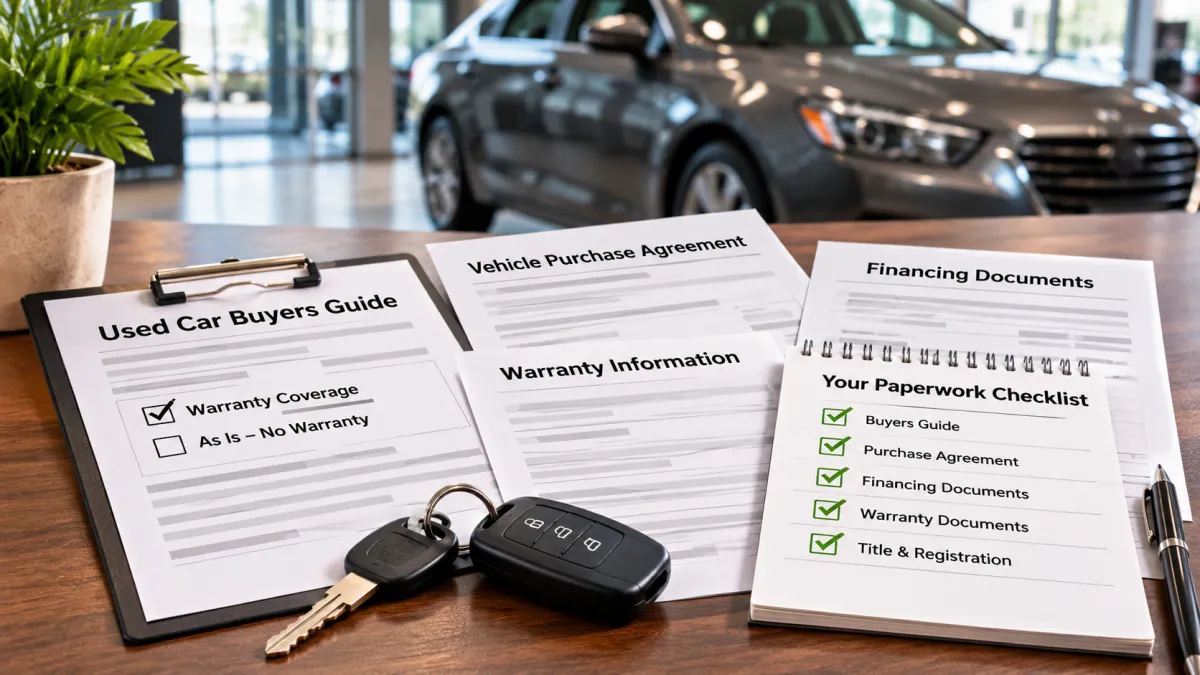
When you buy a used car from a dealership in the United States, you should receive paperwork that explains the vehicle’s condition, the agreed purchase price, any warranty coverage, and the ownership or registration process. If you finance the vehicle, you will also need documents showing the terms of your auto loan.
The exact paperwork depends on whether you pay cash or finance the car, whether the vehicle is sold with a warranty, and the requirements of your state. Some documents are required under federal law, while others are governed by state rules or apply only to certain transactions.
Before leaving the dealership, make sure you have copies of the documents you signed and a clear understanding of which paperwork you will receive later.
The most important documents to review include:
-
The FTC Buyers Guide
-
The vehicle purchase agreement or sales contract
-
Warranty documents, if applicable
-
Financing documents, if you take out an auto loan
-
Odometer disclosure
-
Title and registration paperwork
-
Receipts for payments, deposits, and optional products
Here is what each document does, what to check, and how to organize your paperwork after buying a used car.
1. The FTC Buyers Guide
The Buyers Guide is one of the most important documents associated with buying a used car from a dealership. Under the Federal Trade Commission’s Used Car Rule, covered dealers must display a Buyers Guide on used vehicles offered for sale.
The guide tells you whether the vehicle is being sold with a warranty or “as is,” where permitted.
It is usually displayed in the vehicle’s window before the sale. You should receive a copy of the Buyers Guide as part of the purchase process.
What information does the Buyers Guide contain?
The Buyers Guide generally identifies:
-
Whether the vehicle is sold “as is” or with a warranty
-
Whether the dealer provides a warranty
-
Whether a manufacturer’s warranty may still apply
-
The major systems covered by a warranty
-
The duration of any applicable warranty coverage
-
Whether the dealer recommends an independent inspection
-
The importance of obtaining all promises in writing
The Buyers Guide is intended to help buyers understand the warranty status of a used vehicle before making a purchase.
What does “as is” mean?
An “as is” sale generally means the dealer is not providing a warranty for the vehicle, subject to applicable federal and state law.
This can significantly affect your protection if the vehicle develops a mechanical problem after you purchase it.
However, “as is” does not automatically mean that every possible consumer protection disappears. State laws, applicable federal laws, and the facts of the transaction may still matter.
Some states restrict or prohibit certain “as is” sales by dealers. Maine and Wisconsin are exempt from the FTC Used Car Rule because they have similar regulations.
Before agreeing to an “as is” purchase, carefully review the vehicle’s condition, consider an independent inspection, and make sure you understand any remaining manufacturer coverage.
Can the dealer change the Buyers Guide after negotiation?
The Buyers Guide should reflect the final warranty terms of the transaction. If you negotiate a warranty or other coverage, make sure the final paperwork accurately reflects the agreement.
Do not rely solely on a salesperson’s verbal statement that a warranty will be included.
The Buyers Guide is important, but it is not necessarily the complete warranty contract. You may need separate warranty documents to understand coverage, exclusions, limitations, and claim procedures.
2. The Vehicle Purchase Agreement or Sales Contract
The vehicle purchase agreement is the main document showing the terms of your used-car purchase.
It records the price you agreed to pay and identifies the vehicle being sold. It may also include taxes, fees, optional products, trade-in information, and other transaction details.
This document is especially important if there is a disagreement about the price or terms of the sale.
What should the sales contract include?
Review the agreement for details such as:
| Contract detail | What to check |
|---|---|
| Vehicle identification number (VIN) | Matches the car you are purchasing |
| Vehicle description | Correct make, model, year, and trim where listed |
| Selling price | Matches the negotiated price |
| Taxes | Applicable taxes are accurately listed |
| Dealer fees | Understand each fee and whether it is required |
| Optional products | Confirm any add-ons you agreed to purchase |
| Trade-in details | Correct trade-in value and any payoff information |
| Deposit or down payment | Correct amount credited toward the purchase |
| Total amount due | Matches the agreed transaction |
| Signatures | Required parties have signed the agreement |
The contract may use different names depending on the dealership and state. It could be called a purchase agreement, retail installment contract, motor vehicle sales contract, or another title.
Check the total purchase price—not just the monthly payment
A common mistake is focusing only on the monthly payment.
A dealership may discuss a payment that seems affordable, but the total amount you pay can depend on the vehicle price, loan term, interest rate, fees, and optional products.
Review the itemized purchase price before signing. If you see an unexpected charge, ask the dealer to explain it.
You can also review KnowBrook’s guide on reviewing the dealer's itemized purchase price to understand advertised prices, fees, and add-ons.
Get a copy of the signed contract
Do not leave the dealership relying on the salesperson’s promise to email your contract later.
Ask for a complete copy of the signed agreement, including any pages containing additional terms, disclosures, or attachments.
If the contract includes a separate page for an optional product, warranty, or service agreement, make sure you receive that document too.
3. Warranty Documents and Service Contracts
If your used car comes with a dealer warranty, a remaining manufacturer warranty, or an extended service contract, you should receive the paperwork explaining the coverage.
These documents are not interchangeable. A warranty and a vehicle service contract can have different terms, protections, and responsibilities.
Dealer warranty
A dealer may provide a limited warranty covering specific repairs for a stated period or mileage limit.
The paperwork should help you identify:
-
What parts or systems are covered
-
How long the warranty lasts
-
Any mileage restrictions
-
What repairs are excluded
-
Whether a deductible applies
-
Where repairs must be performed
-
How to submit a claim
Do not assume that every mechanical problem is covered simply because the dealership says the vehicle includes a warranty.
Remaining manufacturer warranty
A used vehicle may still have coverage from its original manufacturer.
The actual coverage depends on the vehicle’s age, mileage, warranty terms, and other conditions. Ask the dealer for any relevant information they have and verify the coverage with the manufacturer when necessary.
Extended service contract
An extended service contract is often sold separately. It may cover certain repairs after the original warranty expires or provide additional coverage.
Before purchasing one, review the contract carefully.
Check:
-
The total cost
-
The coverage period
-
Covered components
-
Exclusions
-
Deductibles
-
Repair authorization requirements
-
Cancellation terms
-
Whether the contract is backed by the dealer or another provider
If you decline an optional service contract, verify that the purchase paperwork does not list it as a product you agreed to buy.
4. Financing Documents If You Take Out an Auto Loan
If you finance your used car, the dealership will typically provide loan paperwork describing your payment obligations.
The documents may be different depending on whether the dealer arranges financing, whether a lender has approved the loan, and whether the transaction is finalized.
Retail installment contract
A retail installment contract is commonly used when you finance a vehicle through a dealership.
It generally includes important loan terms such as:
-
Amount financed
-
Annual percentage rate (APR)
-
Finance charge
-
Total of payments
-
Number of payments
-
Payment amount
-
Payment schedule
-
Late-payment terms
-
Information about the lender or creditor
Review these details carefully. The monthly payment alone does not tell you the total cost of borrowing.
Truth in Lending disclosures
For many consumer auto loans, federal Truth in Lending requirements provide disclosures that help borrowers understand the cost of credit.
Important information may include the APR, finance charge, amount financed, and total of payments.
The applicable disclosures may be included in the retail installment contract or provided through related loan paperwork.
Credit approval and financing status
A dealership may arrange financing through a lender. In some transactions, the financing is not fully finalized when the buyer initially takes the vehicle.
Make sure you understand whether your financing is final and whether any conditions remain.
If the dealership later says the original financing could not be completed, review the documents before agreeing to new terms.
KnowBrook also explains how to check whether your car financing is final, including issues that can arise when financing arrangements change after delivery.
Payment schedule
Your loan paperwork should make it clear when payments begin and how they are to be made.
Confirm:
-
The first payment due date
-
The monthly payment amount
-
The payment frequency
-
The lender’s contact information
-
How to make payments
-
Whether automatic payments are optional
Keep the financing paperwork in a safe place. You may need it if you want to refinance, pay off the loan early, dispute a charge, or verify the balance.
5. Odometer Disclosure Statement
The odometer disclosure records the vehicle’s mileage at the time of transfer.
Federal law requires odometer disclosure for covered vehicle transfers, subject to applicable exemptions. The requirements depend in part on the vehicle’s model year.
For model year 2011 and newer vehicles, the federal odometer disclosure requirement generally applies for the first 20 years. Model year 2010 and older vehicles follow the earlier 10-year exemption framework.
State requirements may also affect how the disclosure is completed.
What should you check?
Review the odometer disclosure for:
-
The vehicle’s VIN
-
The reported mileage
-
The date of transfer
-
The seller and buyer information
-
Any required signatures
-
Whether the mileage is reported as actual, not actual, or exceeds mechanical limits, as applicable
The reported mileage should be consistent with what you were told about the vehicle.
If the odometer reading is inconsistent with the vehicle’s history or the dealer’s statements, ask for an explanation before completing the purchase.
Odometer paperwork is important because mileage can affect the vehicle’s value, maintenance needs, and resale value.
6. Title and Registration Paperwork
The vehicle title is the document that establishes ownership under the applicable state system. The process for transferring a title varies from state to state.
When buying a used car from a dealer, you may not receive the final physical title immediately.
Depending on your state and transaction, the dealership may:
-
Transfer an existing title
-
Submit title paperwork to the state
-
Apply for a new title in your name
-
Handle registration and license plate processing
-
Provide temporary registration or a temporary tag
If the car is financed, the lender may have a lien on the vehicle, and the title process may reflect that lien.
What should you receive before leaving?
Depending on state requirements and the dealership’s process, you may receive documents such as:
-
Temporary registration
-
Temporary license plate or tag
-
Title application paperwork
-
Registration application
-
Receipt showing title or registration fees
-
Information about when permanent plates or documents will arrive
Ask the dealer which steps have been completed and which remain outstanding.
Confirm the title status
The title status is particularly important if the car has a salvage, rebuilt, flood, or other branded title.
A branded title can affect the vehicle’s value, insurance availability, financing, and future resale.
Before purchasing, review the vehicle’s title history and ensure the title status matches what the dealer disclosed.
For more information, see KnowBrook’s guide on reviewing the vehicle's title history.
7. Receipt for Your Down Payment, Deposit, and Other Payments
You should keep a record of the money you paid to the dealership.
Depending on the transaction, payments may include:
-
A deposit made to hold the vehicle
-
A down payment
-
A cash payment
-
A trade-in credit
-
Fees paid separately
-
Payments for optional products
The final sales contract may show some or all of these amounts, but a separate receipt can be useful.
What should a receipt show?
A receipt should identify the payment and the transaction clearly.
Check for:
-
The amount paid
-
The date of payment
-
The payment method
-
The dealership’s name
-
The vehicle or transaction reference
-
Whether the amount is a deposit, down payment, or other charge
If you paid by debit card, credit card, check, or another method, keep the related transaction record.
Make sure your final purchase documents correctly credit the payment toward the total amount due.
8. Documents for Optional Add-Ons
Dealerships may offer optional products during the purchase process. Examples include:
-
Extended service contracts
-
GAP coverage
-
Tire and wheel protection
-
Paint or fabric protection
-
Theft protection products
-
Maintenance plans
These products are not automatically required simply because you are buying a car.
If you agree to purchase an add-on, ask for the contract or written terms describing the product.
If you decline it, review the sales paperwork to make sure the product has not been included by mistake.
What to review in an add-on contract
| Detail | Why it matters |
|---|---|
| Product name | Identifies what you purchased |
| Cost | Shows the price of the product |
| Coverage or benefits | Explains what the product provides |
| Exclusions | Identifies what is not covered |
| Cancellation terms | Explains whether and how you can cancel |
| Provider | Identifies the company responsible for the product |
| Claim process | Explains how to use the coverage |
If an optional product is financed, its cost may be included in the amount financed. This can increase the total cost of the loan.
Do not sign an add-on agreement unless you understand what you are purchasing.
9. Trade-In Documents If You Are Trading in Another Vehicle
If you trade in your existing car, the dealership may provide additional paperwork documenting the trade-in transaction.
This is particularly important if you still owe money on the vehicle.
The trade-in documents may include:
-
Trade-in valuation
-
Trade-in credit shown in the purchase agreement
-
Payoff information for an existing loan
-
Documents transferring ownership of the trade-in
-
A receipt or record of the transaction
Verify the trade-in credit
Check that the agreed trade-in value appears correctly in the purchase agreement.
If the dealership is paying off an existing loan, make sure you understand how the payoff is handled and whether any remaining balance affects your new purchase.
Keep records of the trade-in transaction. These documents can help resolve disputes about the vehicle’s value, loan payoff, or ownership transfer.
10. A Practical Used-Car Paperwork Checklist Before Leaving the Dealership
The paperwork process can feel overwhelming, especially when the dealership presents several documents at once.
Use this checklist to review the major items before leaving.
| Document | What to verify | Applies to |
|---|---|---|
| FTC Buyers Guide | Warranty or “as is” status reflects the deal | Covered dealer used-car sales |
| Purchase agreement | Vehicle, price, taxes, fees, and terms are correct | All purchases |
| Warranty documents | Coverage, duration, exclusions, and claims process | If a warranty is included or purchased |
| Financing contract | APR, amount financed, payment amount, and schedule | If financing |
| Credit disclosures | Loan costs and required disclosures are accurate | If financing, as applicable |
| Odometer disclosure | Mileage and vehicle information are correct | Covered transfers |
| Title paperwork | Understand transfer and lien status | All purchases, with state variation |
| Registration paperwork | Temporary or state-required registration documents | As applicable |
| Payment receipt | Deposit, down payment, or other payment is recorded | If applicable |
| Add-on contracts | Products and prices match what you agreed to | If purchasing optional products |
| Trade-in paperwork | Trade-in value and payoff details are correct | If trading in a vehicle |
Step 1: Compare every document with the vehicle
Check the VIN on the paperwork against the VIN on the vehicle.
The VIN is typically visible on the dashboard near the windshield and on the vehicle’s door label. The VIN should match the purchase agreement and other documents identifying the vehicle.
Also check the make, model, and other details.
Step 2: Review the final price
Make sure the purchase agreement shows the amount you agreed to pay.
Look for unexpected fees, optional products, or changes to the negotiated price.
If something does not match, ask the dealership to correct the paperwork before you sign.
Step 3: Read the warranty terms
Check whether the vehicle is sold “as is,” with a dealer warranty, or with another form of coverage.
If the salesperson promised a specific warranty, make sure the written documents reflect it.
Step 4: Review financing terms
If you are financing, confirm the APR, amount financed, payment schedule, and total payments.
Do not assume that a loan is final merely because you have taken possession of the car. Ask whether any financing conditions remain.
Step 5: Ask which documents will arrive later
Title, registration, permanent plates, and other state documents may be processed after the sale.
Ask the dealership what you should receive immediately, what will be submitted to the state, and how you can follow up.
Step 6: Keep copies of everything you sign
Ask for copies of all signed documents, including attachments and add-on agreements.
If a document is not available immediately, get a clear explanation of when and how you will receive it.
11. What to Do If a Document Is Missing or Incorrect
A missing or incorrect document does not always mean the purchase is invalid. However, it should be addressed promptly.
If the purchase price is wrong
Do not assume that an incorrect amount will be fixed later.
Ask the dealer to correct the sales contract and provide a revised copy showing the agreed price and terms.
If the warranty information is incorrect
Ask the dealership to clarify the warranty status and provide corrected documentation.
If the Buyers Guide or warranty paperwork does not match the agreement, resolve the inconsistency before relying on the coverage.
If financing paperwork is incomplete
Contact the dealership and ask whether the loan has been finalized.
If the financing terms change, review the new documents carefully before agreeing to them.
If title or registration paperwork is delayed
Ask the dealer which documents have been submitted and what remains to be completed.
State title and registration procedures differ, so the expected timeline may depend on your state and transaction.
Keep any temporary registration or tag paperwork you received.
If the dealership refuses to provide copies
Start by making a written request to the dealership’s management.
Identify the vehicle, purchase date, and documents you need. Keep a copy of your request and any response.
If the issue remains unresolved, you may be able to contact your state’s motor vehicle agency, dealer licensing authority, or consumer protection office. The appropriate agency depends on the nature of the problem and your state.
For federal issues involving the FTC Used Car Rule, you can consult the Federal Trade Commission’s official guidance for consumers and dealers.
12. How to Organize Your Used-Car Purchase Documents
After buying the vehicle, keep your paperwork organized. You may need it for maintenance, insurance, registration, loan servicing, warranty claims, or resale.
A simple folder—physical or digital—can make it easier to locate important records.
Consider organizing your documents into the following groups:
Purchase and ownership
Keep your purchase agreement, title-related paperwork, registration documents, odometer disclosure, and payment receipts together.
Warranty and service contracts
Store the Buyers Guide, dealer warranty, manufacturer warranty information, and service contract documents in a separate section.
Financing
Keep your retail installment contract, credit disclosures, payment schedule, lender contact information, and loan-related records together.
Maintenance and repairs
As you own the vehicle, add service receipts, inspection reports, and maintenance records.
These records can help you understand the vehicle’s maintenance history and may be useful if you sell it later.
Digital copies
You can scan or photograph paperwork and store it in a secure location.
Make sure the files are readable and backed up. Some documents contain sensitive personal or financial information, so avoid sharing them publicly.
Conclusion
When buying a used car from a dealership, the paperwork should clearly explain the vehicle you purchased, the price you agreed to pay, the warranty status, and any financing or ownership-transfer requirements.
The FTC Buyers Guide, purchase agreement, odometer disclosure, and applicable title and registration paperwork are particularly important. If you finance the vehicle or purchase optional products, review those contracts just as carefully.
Before leaving the dealership, compare the documents with the vehicle and the terms you negotiated. Get copies of everything you sign, ask about any paperwork that will arrive later, and address missing or incorrect information promptly.
A well-organized set of purchase documents can help you understand your responsibilities, protect your records, and make future vehicle-related transactions easier.
Frequently asked questions
1. Can a car dealer change the Buyers Guide after you negotiate the deal?
The Buyers Guide should reflect the final warranty terms agreed upon during the sale. If the dealer changes the warranty arrangement during negotiations, make sure the final Buyers Guide accurately reflects whether the vehicle is being sold with a warranty or “as is.” Review the updated guide before completing the purchase.
2. Can I leave a car dealership without copies of the documents I signed?
You should request copies of all completed and signed documents before leaving. These may include the purchase agreement, financing contract, warranty paperwork, and any add-on agreements. Keep printed or accessible electronic copies for your records.
3. What should I do if a car dealer refuses to give me copies of my paperwork?
Ask the dealership for copies in writing and keep a record of your request. If the issue involves financing, you can contact the Consumer Financial Protection Bureau. For other dealership paperwork concerns, contact your state’s motor vehicle agency or consumer protection office.
4. Are verbal promises from a car dealer legally enforceable?
Whether a verbal promise is enforceable depends on the circumstances and applicable state law. To reduce disputes, ask the dealer to put promises about repairs, warranties, included features, or other deal terms in writing and include them in the appropriate paperwork.
5. Do I need to keep paperwork after buying a used car?
Yes. Keep your purchase agreement, payment receipts, financing contract, warranty or service contract, title and registration records, and any documents related to trade-ins or add-ons. These records can help with future disputes, warranty claims, vehicle ownership, or loan questions.

Olivia Bennett writes practical automotive content covering car buying, ownership costs, maintenance, vehicle features, reliability, and everyday driving decisions. Her work focuses on helping readers understand automoti...