How to Read a Car Repair Estimate and Know What You Need
Learn how to read a car repair estimate, understand diagnosis, parts, labor and fees, separate necessary repairs from recommendations, compare estimates, and decide when to get a second opinion.
In this article
- What Is a Car Repair Estimate?
- What Should a Car Repair Estimate Include?
- Vehicle and customer information
- Your reported problem
- Diagnosis and diagnostic charges
- Parts
- Labor
- Additional charges
- Estimated total
- How to Read a Car Repair Estimate Step by Step
- Step 1: Identify the problem
- Step 2: Find the diagnosis
- Step 3: Identify the proposed repair
- Step 4: Review the parts
- Step 5: Review labor
- Step 6: Review additional charges
- Step 7: Look at the total
- How to Tell What Maintenance or Repair Is Actually Necessary
- Ask whether the work is needed now
- Ask for evidence
- How to Compare Two Car Repair Estimates
- What Do OEM, Aftermarket, Remanufactured, and Used Parts Mean?
- OEM parts
- Aftermarket parts
- Remanufactured or rebuilt parts
- Used or salvage parts
- Can a Repair Shop Charge More Than the Estimate?
- When Should You Get a Second Opinion?
- Questions to Ask Before Approving a Repair
- Repair Estimate vs. Final Repair Invoice
- How to Use a Price Benchmark Without Letting It Make the Decision
- Common Mistakes When Reviewing a Repair Estimate
- Looking only at the final price
- Assuming a warning light identifies the failed part
- Treating every recommendation as urgent
- Comparing different repairs
- Ignoring part type
- Forgetting about warranty coverage
- Approving work you do not understand
- Assuming state rules are identical everywhere
- A Simple Repair Estimate Decision Framework
- Conclusion
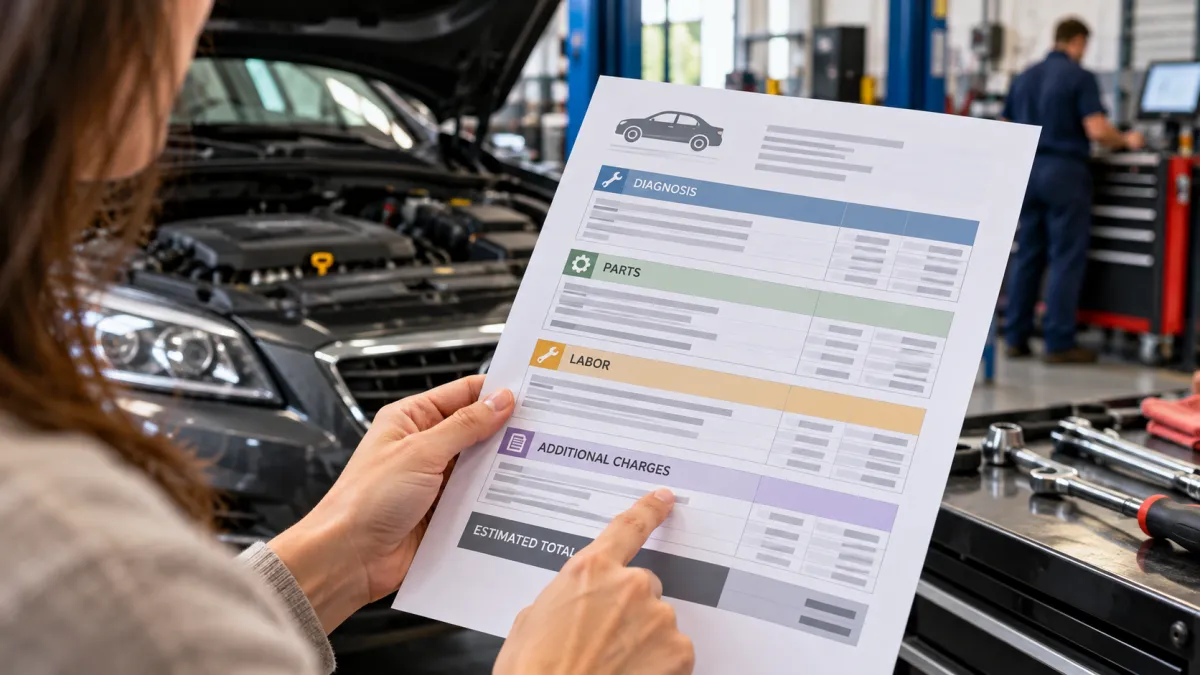
A car repair estimate can be difficult to evaluate when it contains unfamiliar terms, multiple parts, labor charges, diagnostic fees, and several recommended services. A large total does not automatically mean a repair is unnecessary, and a small total does not automatically mean the work is justified.
The key is to separate what problem the shop found, how it diagnosed that problem, what repair it proposes, how urgent the repair is, and what you are actually being asked to pay for.
A good repair estimate should give you enough information to understand the proposed work before you authorize it. The Federal Trade Commission recommends getting a written estimate and notes that an estimate should identify the condition to be repaired, the parts needed, and anticipated labor. Diagnostic work may also be charged separately.
This guide walks through a car repair estimate line by line, explains how to distinguish necessary repairs from recommendations, shows how to compare two estimates fairly, and explains when a second opinion makes sense.
What Is a Car Repair Estimate?
A car repair estimate is a written or electronic description of proposed automotive work and the expected charges associated with that work.
Depending on the shop and the type of repair, an estimate may contain:
-
The vehicle information
-
Your reported problem or complaint
-
Diagnostic work
-
The shop's findings or diagnosis
-
Recommended repairs
-
Parts and part prices
-
Labor hours and labor rates
-
Shop supplies or other fees
-
Taxes
-
An estimated total
-
Authorization information
-
Warranty information
The important point is that an estimate describes proposed work before the repair is completed. It is not necessarily the same thing as the final repair invoice.
For example, a shop might inspect a vehicle because the owner reports a vibration. The technician may perform diagnostic testing and determine that a particular suspension component is worn. The estimate could then list the replacement part, labor, related hardware, and other charges.
That is different from simply writing "suspension repair" and giving one large price.
A useful estimate should allow you to ask: What is wrong, what evidence supports that conclusion, what will be done, and what will it cost?
What Should a Car Repair Estimate Include?
Not every repair estimate will use the same format. A mechanical repair estimate may look very different from an insurance or collision repair estimate.
For routine mechanical repairs and maintenance, look for several basic categories.
Vehicle and customer information
The estimate may identify the vehicle using information such as:
-
Year
-
Make
-
Model
-
Vehicle identification information
-
Mileage
-
Customer information
Check that the estimate belongs to your vehicle. This is particularly important if a shop is handling multiple vehicles.
Your reported problem
Look for a description of why the vehicle came into the shop.
It might refer to a complaint such as:
-
Brake noise
-
Engine warning light
-
Battery problem
-
Steering vibration
-
Overheating
-
Difficulty starting
-
Unusual noise
-
Scheduled maintenance
This matters because your complaint is not necessarily the diagnosis.
If you tell a shop that your car makes a grinding noise, for example, that does not by itself prove which component has failed. The estimate should distinguish your reported symptom from what the technician actually found.
Diagnosis and diagnostic charges
A diagnostic charge may cover the work required to investigate the cause of a problem.
This can include inspection, testing, measurements, scanning, or other diagnostic procedures depending on the problem.
Ask what the diagnostic charge covers. If the shop says additional testing may be necessary, ask whether that could create another charge.
The most important question is not simply, "Did the car produce a trouble code?" It is:
What evidence led the technician from the symptom or test result to the recommended repair?
A diagnostic code can be useful information, but a code does not always mean that the component associated with the code automatically needs to be replaced.
Parts
The estimate should identify the parts being proposed and their associated charges.
Depending on the repair, the estimate may specify whether a part is new, aftermarket, OEM, remanufactured, rebuilt, reconditioned, or used.
Part type can affect price, warranty, availability, and sometimes the appropriate repair choice.
Labor
Labor charges can appear as:
-
Labor hours
-
Hourly labor rate
-
Flat-rate labor
-
A total labor charge
Two shops can quote different labor costs for the same general repair because they may use different labor rates or estimate different amounts of labor.
That is one reason you should compare the details of two estimates instead of comparing only their totals.
Additional charges
An estimate can contain charges beyond parts and labor, depending on the repair and shop.
These might include:
-
Diagnostic charges
-
Shop-related fees
-
Disposal or environmental charges
-
Fluids or other materials
-
Taxes
-
Other repair-related charges
Ask about anything you do not understand.
Estimated total
The bottom of the estimate should make the expected cost clear.
Before authorizing the repair, ask whether the amount represents the complete expected charge for the proposed work or whether additional diagnostic work or related repairs could change the total.
How to Read a Car Repair Estimate Step by Step
A simple way to evaluate an estimate is to use a Read → Verify → Classify → Compare → Authorize process.
Step 1: Identify the problem
Start with the reason you brought the vehicle to the shop.
Compare your original complaint with the estimate.
For example:
Customer reports vibration while braking.
That tells you what prompted the inspection. It does not necessarily tell you what caused the problem.
Step 2: Find the diagnosis
Next, identify what the technician believes is causing the problem.
For example:
Front brake components show excessive wear.
The diagnosis is more important than a generic recommendation such as "brake service."
If the diagnosis is unclear, ask the shop to explain what they found.
Useful questions include:
-
What exactly failed or is worn?
-
What did the technician observe?
-
What testing was performed?
-
Can you show me the problem?
-
Is the diagnosis confirmed or is additional testing needed?
You do not need to become a mechanic to ask for a clear explanation.
Step 3: Identify the proposed repair
Once you understand the diagnosis, look at what the shop wants to do about it.
The estimate might propose replacing a component, repairing a system, adjusting something, or performing maintenance.
Make sure the proposed repair actually addresses the diagnosis.
If the explanation jumps from "the vehicle has a warning light" directly to "replace this component" without explaining the diagnostic reasoning, ask for clarification.
Step 4: Review the parts
Look at each major part separately.
Ask:
-
What part is being replaced?
-
Is it new, OEM, aftermarket, remanufactured, or used?
-
Why is this part appropriate?
-
What warranty applies?
-
Is a related part included in the repair?
Do not automatically assume the most expensive part is the best choice or that the cheapest part is sufficient. The appropriate option depends on the repair, vehicle, part quality, warranty, and circumstances.
Step 5: Review labor
Look for the labor hours and rate when provided.
If two shops quote very different labor charges, determine whether they are proposing exactly the same work.
One estimate might include removal and replacement of a component, while another might include additional related work.
A lower labor total is not necessarily a better deal if important work has been left out.
Step 6: Review additional charges
Look below the major parts and labor lines.
Check for diagnostic charges, fees, fluids, disposal charges, taxes, or other costs.
If you see an unfamiliar charge, ask what it covers.
A few smaller charges can make a noticeable difference in the final amount, especially on larger repairs.
Step 7: Look at the total
Only after reviewing the scope should you focus on the total.
The question should not simply be:
"Is this total expensive?"
Instead ask:
"Does this total make sense for the diagnosis, proposed work, parts, labor, and additional charges?"
That distinction helps you avoid comparing prices without comparing the work being performed.
How to Tell What Maintenance or Repair Is Actually Necessary
One of the hardest parts of a repair estimate is separating necessary work from recommendations.
A shop may identify several items during an inspection. They do not necessarily all have the same level of urgency.
A useful way to classify them is:
| Type of work | What it generally means | What to ask |
|---|---|---|
| Safety-related repair | A problem that can affect safe vehicle operation | Is it unsafe to continue driving? |
| Confirmed repair | A diagnosed problem requiring correction | What evidence confirms the failure? |
| Scheduled maintenance | Work associated with the manufacturer's maintenance schedule | Is this due based on mileage, time, or vehicle conditions? |
| Wear-related service | A component is wearing and may need replacement | How much usable life remains? |
| Preventive recommendation | Work suggested to reduce future problems | What is the benefit of doing it now? |
| Optional service | A service that may provide convenience or another benefit but is not necessary for the immediate problem | What happens if I decline it? |
This does not mean that preventive maintenance is unimportant. It means you should understand why each item is being recommended and when it needs to be performed.
For scheduled work, your vehicle's maintenance requirements are a useful reference. KnowBrook's guide to the car maintenance schedule can help you understand how mileage- and time-based maintenance fits into the bigger picture.
Similarly, maintenance expenses and unexpected repairs are different types of vehicle costs. Our guide to car maintenance costs explains the difference between predictable maintenance expenses and unexpected repair costs.
Ask whether the work is needed now
A useful question is:
"If I do not approve this today, what is the likely consequence?"
The answer can help you understand urgency.
For some repairs, continuing to drive may create a safety problem or cause additional damage. Other work may be something the owner can plan for later.
A responsible discussion should distinguish between:
-
Do now
-
Plan soon
-
Monitor
-
Optional
Do not assume that every line on a multi-item estimate requires immediate approval.
Ask for evidence
When a repair is expensive, ask the shop what supports the recommendation.
Depending on the problem, evidence could include an inspection finding, measurement, test result, visible damage, or another diagnostic finding.
The goal is not to challenge every recommendation. It is to understand the connection between the problem, diagnosis, and repair.
How to Compare Two Car Repair Estimates
If you receive two estimates, do not immediately choose the one with the lowest total.
First determine whether both shops are proposing the same repair.
Use this comparison:
| Compare | What to look for |
|---|---|
| Diagnosis | Are both shops identifying the same problem? |
| Repair scope | Are they proposing the same work? |
| Parts | Are the same components being replaced? |
| Part type | Are the parts OEM, aftermarket, remanufactured, or used? |
| Labor | Are the labor hours and rates comparable? |
| Related services | Does one estimate include additional necessary work? |
| Diagnostic work | Did both shops perform or include the same diagnostic process? |
| Fees and taxes | Are additional charges included or calculated differently? |
| Warranty | What coverage comes with the parts and labor? |
| Total | What is the final expected cost for equivalent work? |
Imagine Shop A quotes $1,200 and Shop B quotes $850.
At first glance, Shop B appears cheaper.
But suppose Shop A includes the complete repair, a particular part warranty, and required related labor, while Shop B has quoted only the primary component and has not included additional work.
The $350 difference may not represent a genuine price difference.
The reverse can also happen. A shop may recommend several additional services that another shop does not believe are necessary at that time.
The correct comparison is therefore scope first, price second.
What Do OEM, Aftermarket, Remanufactured, and Used Parts Mean?
Part terminology can make an estimate difficult to understand.
OEM parts
OEM generally refers to parts associated with the vehicle's original equipment manufacturer.
Ask the shop exactly what part is being proposed and what warranty applies.
Aftermarket parts
Aftermarket parts are produced by manufacturers other than the vehicle's original equipment manufacturer.
Quality and specifications can vary, so the important question is whether the particular part is appropriate for the repair and what warranty it carries.
Remanufactured or rebuilt parts
These parts have been previously used and processed or rebuilt for reuse. The exact process varies by component and supplier.
Ask about the part's warranty and what is included.
Used or salvage parts
A used part comes from another vehicle or source and may be appropriate for some repairs.
Ask about its condition, source, warranty, and suitability for your vehicle.
The FTC's auto-repair guidance discusses different categories of replacement parts, including new, remanufactured, rebuilt, reconditioned, and salvage parts.
The important lesson is that part terminology should not be treated as a simple good-versus-bad ranking. Consider the specific component, vehicle, repair, warranty, and price.
Can a Repair Shop Charge More Than the Estimate?
There is no single nationwide rule that can be applied to every repair shop and every situation.
Repair-estimate and authorization requirements can vary by state. Some states have specific requirements concerning written estimates, customer authorization, and additional work.
The Federal Trade Commission also notes that state law can affect how repair estimates and additional charges are handled.
Before approving a repair, ask:
-
Is this estimate written?
-
What exactly am I authorizing?
-
What happens if additional work is discovered?
-
Will you contact me before performing additional work?
-
What authorization method do you use?
-
Are there state-specific requirements that apply to this repair?
If you have a dispute about an estimate or authorization, check the current rules and consumer resources for your state rather than relying on a general statement found online.
This is particularly important because requirements are not identical across the United States.
When Should You Get a Second Opinion?
A second opinion can be useful when the proposed repair is expensive, the diagnosis is unclear, or you do not understand why the repair is necessary.
Consider getting another opinion when:
-
The estimate is significantly higher than expected.
-
The diagnosis is difficult to explain.
-
Several expensive repairs are recommended at once.
-
You are being asked to approve work you do not understand.
-
The repair is major relative to the vehicle's value or your budget.
-
Two shops appear to disagree about the cause of the problem.
-
You simply want more confidence before authorizing substantial work.
A second opinion does not automatically mean the first shop is wrong.
The second shop may reach the same conclusion. That can actually give you greater confidence in the repair decision.
Remember that another shop may charge its own diagnostic fee, particularly if the second shop needs to perform its own testing.
When requesting a second opinion, provide the relevant information without assuming that the first estimate is correct. Ask the second shop to independently explain the problem and recommended repair.
Questions to Ask Before Approving a Repair
You do not need a long technical conversation with a mechanic. A few focused questions can reveal whether you understand the estimate.
Ask:
-
What problem did you confirm?
-
How did you diagnose it?
-
What evidence supports the diagnosis?
-
What repair are you recommending?
-
Does the repair need to be done now?
-
What happens if I wait?
-
Which parts will you use?
-
Are those parts OEM, aftermarket, remanufactured, or used?
-
What warranty comes with the parts and labor?
-
Does the estimate include all expected charges?
-
Could additional diagnostic work be necessary?
-
Will you contact me before additional work is performed?
-
Which items are required and which are recommendations?
These questions help turn a confusing estimate into a decision you can evaluate.
Repair Estimate vs. Final Repair Invoice
An estimate and an invoice serve different purposes.
A repair estimate describes expected work and anticipated charges before the repair is performed.
A final repair invoice documents what was actually performed and the final charges after the work is completed.
For example, an estimate might propose replacing a component and include an anticipated number of labor hours. The final invoice records the completed work and the actual charges associated with it.
When you receive the final invoice, compare it with the estimate and your authorization.
Look for:
-
Repairs performed
-
Parts installed
-
Labor charges
-
Additional work
-
Diagnostic charges
-
Fees
-
Taxes
-
Final total
If something on the invoice is unfamiliar, ask the shop to explain it.
The comparison is especially important when additional work was discovered during the repair process.
How to Use a Price Benchmark Without Letting It Make the Decision
Online repair-pricing tools can help you understand whether a quoted repair price appears to fall within a reasonable range for a particular vehicle and repair.
Kelley Blue Book, for example, provides vehicle repair pricing information that can be useful as a benchmark.
But a pricing tool has an important limitation: price information does not prove that a repair is necessary.
Suppose an online pricing reference suggests that a particular repair commonly costs a certain amount. That may help you evaluate the quoted price after you understand the repair.
It does not answer:
-
Is the vehicle actually experiencing that failure?
-
Was the diagnosis performed correctly?
-
Does the vehicle need the repair now?
-
Is another component causing the symptom?
-
Does the estimate include the same scope as the benchmark?
Use pricing information as one piece of the decision, not as proof of the diagnosis.
Common Mistakes When Reviewing a Repair Estimate
Looking only at the final price
A $900 estimate is not automatically better than a $1,100 estimate.
Compare the scope first.
Assuming a warning light identifies the failed part
A warning light or diagnostic code can provide useful information, but it does not necessarily establish that a specific component should automatically be replaced.
Ask how the shop confirmed the diagnosis.
Treating every recommendation as urgent
A shop may identify several items during an inspection.
Ask which ones require immediate attention and which can be scheduled later.
Comparing different repairs
Two estimates can have completely different scopes even when the descriptions sound similar.
Make sure you are comparing equivalent work.
Ignoring part type
A quote for an OEM component and a quote for an aftermarket or remanufactured component may not be directly comparable.
Forgetting about warranty coverage
A lower price may come with different warranty terms.
Ask what coverage applies to both parts and labor.
Approving work you do not understand
You do not need to understand every mechanical detail, but you should understand the basic reason for the repair and what you are authorizing.
Assuming state rules are identical everywhere
Repair authorization requirements can vary by state.
If a legal question arises, check the current rules applicable to your state.
A Simple Repair Estimate Decision Framework
When you receive a repair estimate, work through these five stages:
Read: Identify the complaint, diagnosis, repair, parts, labor, fees, and total.
Verify: Ask what evidence supports the diagnosis and whether the proposed repair addresses the confirmed problem.
Classify: Separate safety-critical repairs, confirmed repairs, scheduled maintenance, preventive recommendations, and optional services.
Compare: If you get another estimate, compare the diagnosis, scope, parts, labor, fees, warranty, and total rather than looking only at price.
Authorize: Before approving the work, understand what you are authorizing and how additional work will be handled.
This framework is simple, but it prevents one of the most common mistakes: treating the estimate as nothing more than a number.
Conclusion
Learning how to read a car repair estimate is less about understanding every mechanical term and more about understanding the relationship between the problem, diagnosis, proposed repair, parts, labor, urgency, and total cost.
Start with the complaint, then identify the diagnosis. Ask what evidence supports it. Review the proposed repair and the parts being used. Separate labor and additional charges from the total. Then determine whether each recommendation is something that needs to happen now, can be planned for later, should be monitored, or is optional.
If you receive multiple estimates, compare equivalent work rather than choosing the lowest total automatically. And for expensive or unclear repairs, a second opinion can provide useful confirmation.
Most importantly, get the proposed work and expected charges in writing, understand what you are authorizing, and remember that repair-estimate and authorization requirements can vary by state.
A repair estimate is most useful when it gives you enough information to make an informed decision—not simply a price to approve.
Frequently asked questions
Why are two car repair estimates so different?
Two repair estimates can differ because they may not include the same diagnosis, parts, labor hours or rates, related services, fees, taxes, or warranty terms. Compare the scope and line items before comparing the final totals.
What is a diagnostic fee for a car?
A diagnostic fee covers the work involved in investigating the cause of a vehicle problem. Ask what testing the fee covers and whether additional diagnostic work could result in another charge before approving it.
Should I get a second opinion on a car repair estimate?
A second opinion can be useful for an expensive repair, an unclear diagnosis, or a recommendation that the shop cannot adequately explain. Remember that another shop may charge its own diagnostic fee.
Can a mechanic charge more than the estimate?
Repair-estimate and authorization requirements vary by state. Before approving work, review the estimate and ask how the shop handles additional repairs or charges. For state-specific requirements, check the applicable current state rules.
What should I ask a mechanic before approving a repair estimate?
Ask what problem was confirmed, how the shop diagnosed it, whether the repair is needed now, what could happen if you wait, what type of parts will be used, and whether the shop will contact you before additional work.
How can I tell if a car repair estimate is fair?
First determine whether the diagnosis and proposed repair make sense. Then compare equivalent estimates based on parts, labor, fees, warranty, and total scope. A pricing reference can help benchmark cost, but price alone does not establish that a repair is necessary.
What is the difference between a repair estimate and a repair invoice?
A repair estimate describes the expected work and anticipated charges before the repair is completed. A final invoice records the work actually performed and the final charges.
What do OEM and aftermarket parts mean on a repair estimate?
1. OEM parts are associated with the vehicle's original equipment manufacturer, while aftermarket parts are produced by other manufacturers. Ask which part will be used, why it is appropriate for the repair, and what warranty applies.

Olivia Bennett writes practical automotive content covering car buying, ownership costs, maintenance, vehicle features, reliability, and everyday driving decisions. Her work focuses on helping readers understand automoti...