How to Compare Transportation Costs When Choosing Where to Live
Learn how to compare housing and transportation costs between locations, including fuel, parking, tolls, transit, vehicle costs, commute frequency, and the impact of living closer to work.
In this article
- Why the Cheapest Home Isn't Always the Cheapest Place to Live
- What Transportation Costs Should You Include?
- Fuel or EV Charging
- Parking
- Tolls
- Public Transportation
- Maintenance, Tires, and Repairs
- Vehicle Ownership
- Other Recurring Trips
- How to Compare the Total Cost of Two Locations
- Example: A Cheaper Home Farther From Work vs. a More Expensive Home Nearby
- Should You Pay More for Housing to Reduce Transportation Costs?
- How One Car vs. Two Cars Can Change the Decision
- How Public Transportation Changes the Calculation
- How Hybrid and Remote Work Changes the Comparison
- Don't Ignore Commute Time
- How to Use Housing and Transportation Affordability Tools
- What Does the 45% Housing and Transportation Benchmark Mean?
- Common Mistakes When Comparing Locations
- Comparing Rent Without Transportation
- Looking Only at Gas
- Assuming a Longer Commute Is the Only Difference
- Ignoring the Second Vehicle
- Using Someone Else's Transportation Budget
- Assuming Transit Is Always Cheaper
- Ignoring Remote Work
- Treating Commute Time as a Dollar Figure
- A Simple Housing + Transportation Comparison Worksheet
- Step 1: Calculate the Full Housing Cost
- Step 2: Estimate Your Regular Travel
- Step 3: Estimate Transportation Costs
- Step 4: Determine Vehicle Needs
- Step 5: Adjust for Your Actual Schedule
- Step 6: Add Housing and Transportation
- Step 7: Consider Time and Practicality
- The Bottom Line
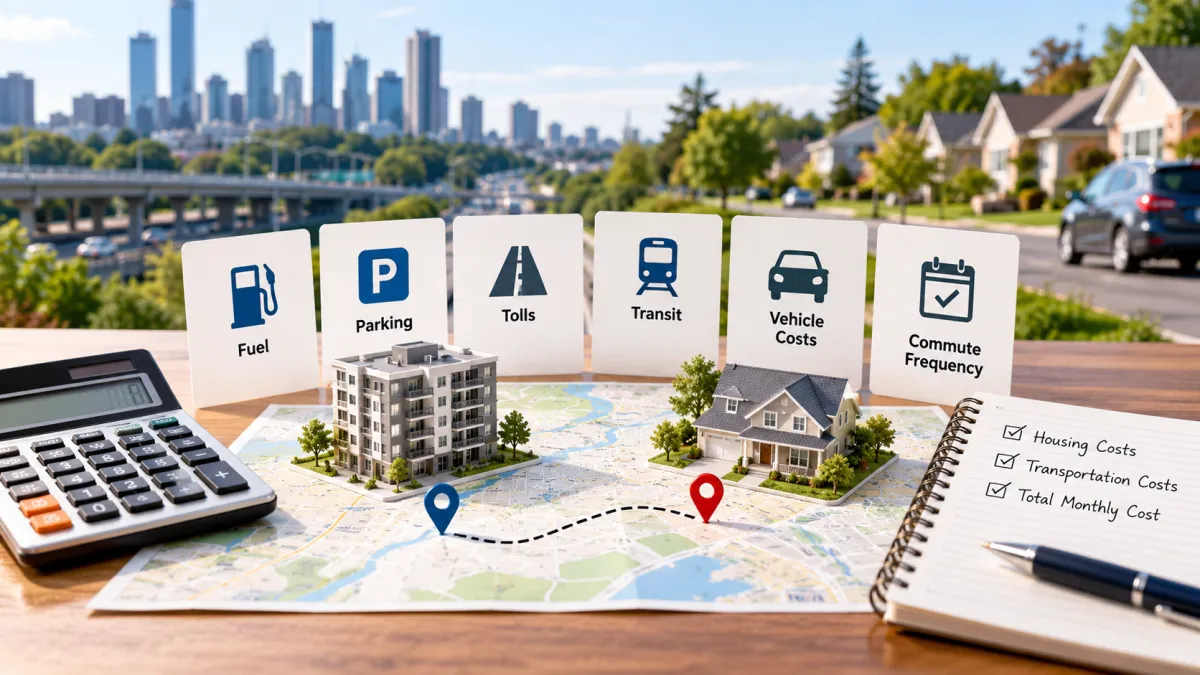
A home with lower rent or a lower purchase price is not always the cheaper place to live. Where you live can change how much you spend on gas, parking, tolls, public transportation, vehicle maintenance, and even whether your household needs one car or two.
That is why comparing housing and transportation costs together can give you a more realistic picture of affordability.
For example, a home farther from work may save $400 per month in housing costs but require another $250 in transportation expenses. A more expensive home closer to work could have a higher monthly housing payment but lower transportation costs. The better choice depends on the numbers for your household, not simply on which home has the lower advertised price.
A useful comparison starts by calculating the full monthly housing cost for each location, estimating the transportation costs created by that location, and then adding the two together. You should also consider how often you travel, whether you need a vehicle, whether a second vehicle is necessary, and how much commute time each option requires.
Why the Cheapest Home Isn't Always the Cheapest Place to Live
Housing is usually one of the largest expenses in a household budget, but the location of that housing can affect many other expenses.
A less expensive home may be farther from your workplace, shopping, schools, family, medical providers, or other places you regularly visit. If that distance means more driving, the savings on housing can be partly or completely offset by higher transportation costs.
The opposite can also happen.
A home in a more expensive neighborhood may reduce the need to drive, make public transportation practical, allow a household to own one vehicle instead of two, or reduce parking and toll expenses.
The basic comparison is:
Total location cost = housing costs + transportation costs
This does not mean housing and transportation should always be treated as one combined expense. They are different categories and can change for different reasons. But combining them for a location comparison can reveal costs that are easy to overlook.
The Center for Neighborhood Technology's Housing + Transportation approach uses this same general concept: the affordability of a location can be affected by both the cost of housing and the cost of getting around.
For your own decision, however, your actual household budget matters more than a generalized location estimate.
What Transportation Costs Should You Include?
Transportation costs are more than the amount you spend filling your gas tank.
When comparing two places to live, consider the costs that are likely to change because of the location.
Fuel or EV Charging
If one location creates a longer or more frequent drive, estimate the additional fuel or charging cost.
For a gasoline vehicle, you can make a basic estimate using:
Monthly fuel cost = monthly miles ÷ vehicle MPG × gas price per gallon
For an electric vehicle, you can estimate charging expenses based on electricity consumption and your typical charging cost.
The important point is to use your expected driving pattern rather than a national average.
If moving farther away adds 500 miles of driving each month, that additional mileage matters even if the home itself is cheaper.
Parking
Parking can be a major location-related expense, particularly in urban areas or neighborhoods where off-street parking is limited.
Consider costs such as:
-
Monthly apartment parking fees
-
Garage fees
-
Workplace parking
-
Daily parking for regular trips
-
Parking required for additional vehicles
-
Special parking arrangements associated with your housing
A location with convenient transit may reduce the need for a car, but if you still own a vehicle, parking can remain part of the budget.
Tolls
A longer commute does not always mean higher toll costs, but the route you choose can make a substantial difference.
Compare the actual routes you expect to use. If one location requires regular toll-road travel while another does not, include the recurring toll expense.
Do not assume that tolls are only a commuting issue. Regular tolls for work, school, medical appointments, or other recurring trips can also affect the comparison.
Public Transportation
If you expect to use buses, trains, subways, commuter rail, or other public transportation, include the fares you will actually pay.
Think about:
-
Regular work trips
-
Transfers between services
-
Occasional transit trips
-
Monthly or other passes
-
Trips that still require rideshare, taxis, or another first- or last-mile option
Public transportation can reduce some vehicle expenses, but it is not automatically cheaper in every situation. The cost depends on your household's actual travel pattern and whether transit can realistically replace driving.
Maintenance, Tires, and Repairs
More driving generally means more vehicle use.
A location that adds significant mileage can contribute to additional maintenance, tire wear, repairs, and other operating expenses over time.
These costs are easy to ignore because you may not receive a separate bill every month. But they are still part of the economic cost of using a vehicle.
You do not need to predict every future repair. A reasonable monthly estimate for vehicle operating costs can be enough for comparing two locations.
Vehicle Ownership
Location can affect whether you need a vehicle at all.
A household living in a car-dependent area may need a car for work, shopping, school, appointments, and everyday errands. Another household in a more connected location may be able to manage with one vehicle instead of two.
That difference can be significant.
When comparing locations, ask:
-
Would we need a car here?
-
Would we need two cars?
-
Could one household member regularly use transit?
-
Could routine errands be completed without driving?
-
Would a second vehicle become necessary because of different work schedules?
The answer can change the entire transportation budget.
Other Recurring Trips
Do not build your comparison around the commute alone.
A location can affect transportation costs for recurring trips such as:
-
Grocery shopping
-
Childcare
-
School
-
Medical appointments
-
Family visits
-
Religious services
-
Regular recreational activities
-
Airport trips
-
Other frequent destinations
A home that looks inexpensive based on the work commute may become less attractive if almost every other regular trip requires a long drive.
How to Compare the Total Cost of Two Locations
The easiest approach is to compare the two locations using the same categories.
Start with housing. Then estimate transportation. Finally, compare the totals.
A simple worksheet can look like this:
| Monthly cost | Location A | Location B |
|---|---|---|
| Rent or mortgage | $ | $ |
| Property taxes/HOA or other housing costs, if applicable | $ | $ |
| Parking | $ | $ |
| Fuel or EV charging | $ | $ |
| Tolls | $ | $ |
| Public transportation | $ | $ |
| Vehicle operating costs | $ | $ |
| Other recurring transportation | $ | $ |
| Estimated housing + transportation total | $ | $ |
The categories will differ depending on whether you rent, own, drive, use transit, or combine multiple transportation methods.
For renters, the advertised rent should not automatically be treated as the full housing cost. Application-related and other recurring housing expenses can matter too. For a broader look at apartment expenses, see compare the total cost of an apartment.
The goal is not to produce a perfectly precise forecast. The goal is to make the comparison more realistic.
Example: A Cheaper Home Farther From Work vs. a More Expensive Home Nearby
Imagine you are comparing two rental homes.
Location A is farther from your workplace and costs less each month.
Location B is closer to work and costs more.
Suppose Location A saves you $400 per month in rent. At first glance, it appears to be the obvious choice.
But the longer distance means:
-
More miles driven
-
More fuel
-
More vehicle wear
-
More frequent parking expenses
-
Higher toll costs on the fastest route
After estimating those additional transportation costs, suppose Location A requires another $275 per month compared with Location B.
The housing savings are still real, but the effective difference is no longer $400.
The comparison becomes:
$400 housing savings − $275 additional transportation = $125 monthly difference
That does not automatically make Location A the wrong choice. You may prefer the larger home, neighborhood, schools, space, or other benefits.
The point is that the decision looks different once transportation is included.
Now consider another possibility: the farther location requires a second vehicle.
That could make the difference much larger.
This is why simply comparing rent or mortgage payments can produce a misleading answer.
Should You Pay More for Housing to Reduce Transportation Costs?
Sometimes, but not automatically.
Paying more for housing can make financial sense when the additional housing cost is reasonably offset by lower transportation expenses.
For example, a higher-cost location might reduce:
-
Daily driving
-
Fuel or charging
-
Parking
-
Tolls
-
Vehicle maintenance
-
Transit expenses
-
The need for a second vehicle
But you should not assume that a higher housing cost will always pay for itself through transportation savings.
Calculate the difference.
A useful comparison is:
Additional housing cost − transportation savings = net monthly difference
If a closer home costs $500 more per month but saves approximately $200 in transportation costs, the closer home still costs about $300 more before considering other factors.
If it saves $600 in transportation costs, the more expensive home could actually have a lower combined monthly cost.
The correct answer depends on your household's numbers.
How One Car vs. Two Cars Can Change the Decision
Vehicle count deserves special attention because it can create a much larger difference than fuel alone.
Consider a household with two adults.
In one location, both adults may need cars because of work schedules, limited transit, and long distances to everyday destinations.
In another location, one adult may be able to walk, bike, take transit, or share the household vehicle for some trips.
The comparison is no longer simply:
Car A uses more gas than Car B.
It may become:
One vehicle vs. two vehicles.
That can affect the household budget through fuel, parking, maintenance, insurance, registration, financing or other ownership expenses, depending on the household's situation.
When comparing locations, therefore, ask whether the location changes the number of vehicles your household needs.
That question can be more important than comparing the cost of a few extra gallons of gasoline.
How Public Transportation Changes the Calculation
Public transportation can change the relationship between housing and transportation costs.
A location with access to useful transit may allow some trips to be completed without driving. That can reduce mileage and potentially reduce some vehicle-related expenses.
But transit access should be evaluated based on how you will actually use it.
Ask:
-
How close is the transit stop?
-
Can it take you where you regularly need to go?
-
How long does the trip take?
-
How often does the service run?
-
Will you need another transportation option to reach your final destination?
-
Will you still need a car?
-
Will the household still need a second car?
A location with transit nearby is not automatically the cheaper choice.
Likewise, a location without convenient transit is not automatically unaffordable.
The relevant question is whether the transportation options at each location work for your household and what they will cost.
How Hybrid and Remote Work Changes the Comparison
Traditional housing comparisons often assume a five-day commute.
That may not match your actual schedule.
If you work remotely most of the week, moving farther from the office may not create the same transportation costs as it would for someone commuting every weekday.
But remote work does not necessarily mean transportation costs disappear.
You may still travel for:
-
Occasional office days
-
Meetings
-
Client visits
-
Childcare
-
Shopping
-
Medical appointments
-
Social activities
-
Family visits
-
Other recurring destinations
Instead of assuming a five-day commute, calculate your actual expected travel pattern.
For example, someone commuting two days a week should not automatically use the same transportation estimate as someone traveling to an office five days a week.
The same principle applies to hybrid households where different members have different schedules.
Don't Ignore Commute Time
Transportation cost is important, but money is not the only transportation-related tradeoff.
A longer commute can also consume more of your time.
Suppose one location saves money on housing but adds significant travel time every week. Another location costs more but substantially reduces the time spent commuting.
That does not mean the more expensive location is automatically better.
Instead, treat commute time as a separate decision factor alongside the financial comparison.
For a more detailed look at fuel, parking, tolls, transit, and other commuting expenses, you can calculate your commute cost.
The goal is to understand both sides of the decision:
What will this location cost me in money?
and
What will this location cost me in time?
How to Use Housing and Transportation Affordability Tools
Several resources can help you understand how location affects housing and transportation costs.
The Center for Neighborhood Technology's Housing + Transportation Index is designed to examine housing and transportation together. It provides location-level estimates that can help illustrate how transportation costs affect the affordability of different neighborhoods.
HUD and the U.S. Department of Transportation have also developed location-affordability resources that combine housing and transportation considerations.
These tools can be useful when researching a new area, particularly when you are comparing neighborhoods that have very different transportation patterns.
However, treat modeled estimates as a starting point rather than a personalized household budget.
Your actual costs can differ because of:
-
Your vehicle
-
Your fuel or charging situation
-
Your commute
-
Your work schedule
-
Your household size
-
Number of vehicles
-
Transit use
-
Parking arrangements
-
Other recurring trips
A location-level estimate cannot know all of those details.
What Does the 45% Housing and Transportation Benchmark Mean?
You may encounter a benchmark suggesting that housing plus transportation should stay below a certain percentage of household income.
The Center for Neighborhood Technology uses 45% as a housing-and-transportation affordability benchmark in its methodology.
It is important to understand what that number does and does not mean.
It is not a federal rule, and it is not a universal personal-finance requirement that every household must follow.
Your household circumstances can be very different from the assumptions used in a location-affordability model.
Someone with a high income, low debt, and minimal transportation expenses may have a very different budget from a household with lower income, multiple vehicles, or significant recurring travel.
Use the benchmark as a reference point for evaluating location affordability, not as an automatic pass-or-fail test for a home.
Common Mistakes When Comparing Locations
A few mistakes can make a location comparison less useful.
Comparing Rent Without Transportation
This is the most obvious mistake.
If one home creates substantially higher transportation expenses, comparing only rent can make the cheaper home appear more affordable than it really is.
Looking Only at Gas
Fuel is visible, but it is only one transportation expense.
Parking, tolls, transit, maintenance, tires, repairs, vehicle ownership, and other recurring trips can also matter.
Assuming a Longer Commute Is the Only Difference
A distant home may affect more than your work commute.
Consider shopping, school, childcare, healthcare, family, and other regular destinations.
Ignoring the Second Vehicle
A household that needs another car because of its location can face a much larger transportation budget.
Always ask whether the location changes the number of vehicles your household needs.
Using Someone Else's Transportation Budget
National averages and location models can provide context, but they do not necessarily represent your expenses.
Use your own expected mileage, travel frequency, vehicles, parking arrangements, and transit use when possible.
Assuming Transit Is Always Cheaper
Transit can reduce transportation costs, but only if it works for the trips you actually need to make.
If you still need a car for most trips, the transportation savings may be smaller than expected.
Ignoring Remote Work
If you work remotely or have a hybrid schedule, calculate your actual travel frequency instead of assuming a traditional five-day commute.
Treating Commute Time as a Dollar Figure
Time matters, but it is not necessary to force it into your financial calculation.
Keep the financial comparison focused on actual monetary costs, then consider commute time separately when making the final decision.
A Simple Housing + Transportation Comparison Worksheet
Before choosing between two locations, collect the same information for each one.
Step 1: Calculate the Full Housing Cost
Start with rent or the expected monthly housing payment.
Then add relevant housing expenses that differ between the locations, such as parking or other recurring charges.
Step 2: Estimate Your Regular Travel
List your major recurring destinations.
Include work, school, shopping, childcare, medical appointments, and other trips that are important to your household.
Step 3: Estimate Transportation Costs
For each location, estimate:
-
Fuel or EV charging
-
Parking
-
Tolls
-
Transit
-
Vehicle operating costs
-
Other recurring transportation expenses
Step 4: Determine Vehicle Needs
Ask whether each location requires:
-
No vehicle
-
One vehicle
-
Two vehicles
-
More vehicle use than your current situation
Do not assume that the same number of vehicles will work equally well in every location.
Step 5: Adjust for Your Actual Schedule
If you work remotely or have a hybrid schedule, use your expected number of trips instead of a standard five-day commute.
Step 6: Add Housing and Transportation
Calculate:
Monthly housing cost + monthly transportation cost = combined monthly location cost
Then compare the two locations.
Step 7: Consider Time and Practicality
Finally, consider commute time, convenience, access to essential services, and how realistic the transportation arrangement is for your household.
A location that is slightly cheaper on paper may not be the better choice if its transportation arrangement is impractical.
The Bottom Line
Choosing where to live is more complicated than comparing two rent or mortgage payments.
A lower-cost home can become more expensive when it requires longer drives, additional fuel, parking, tolls, vehicle maintenance, or a second car. On the other hand, paying more for housing does not automatically make financial sense just because the location is closer to work or public transportation.
The most useful approach is to compare the combined cost of housing and transportation for each location using your own household's expected travel patterns.
Start with the full housing cost. Add fuel or charging, parking, tolls, transit, vehicle operating expenses, and other recurring transportation costs. Then consider whether the location changes the number of vehicles you need and how often you will travel.
Use housing-and-transportation affordability tools as additional research, but do not treat their estimates as a substitute for your own budget.
The best location is not necessarily the one with the cheapest home or the shortest commute. It is the one whose overall costs, transportation needs, and daily travel requirements fit your household's priorities and budget.
Frequently asked questions
Is cheaper rent worth a longer commute?
Compare the housing savings with the additional transportation costs created by a longer commute, including fuel, parking, tolls, transit, vehicle-use costs, and other recurring expenses. The answer depends on the actual numbers for each household and location.
Should I include the cost of owning a car when comparing where to live?
Yes, when the location affects whether you need a vehicle or how much you use one. Consider relevant ownership and use costs such as fuel, maintenance, parking, insurance, and other transportation expenses rather than looking only at gasoline or charging costs.
How do I compare housing and transportation costs if I work from home?
Use your actual travel pattern instead of assuming a traditional five-day commute. Consider the trips you expect to make regularly, including occasional work travel and other recurring trips that differ between the locations being compared.
Is living near public transportation always cheaper?
No. Public transportation can reduce some transportation costs, but a transit-accessible location is not automatically cheaper overall. Compare housing costs, transit fares, parking, vehicle needs, and your actual travel patterns.
What percentage of income should go toward housing and transportation?
There is no universal federal rule requiring a specific combined percentage. The Center for Neighborhood Technology uses a 45% housing-and-transportation affordability benchmark in its H+T methodology. This is a methodology used by CNT, not a federal requirement or universal personal-finance rule.
Can a more expensive home actually cost less overall?
Yes, it can in some situations. A higher housing cost may be partly or fully offset by lower transportation expenses, such as less driving, lower parking costs, fewer tolls, reduced transit costs, or the ability to avoid owning an additional vehicle. The household's actual numbers determine the result.
Is there an official calculator for comparing housing and transportation costs?
1. The Center for Neighborhood Technology's H+T Index is a useful U.S. location-affordability resource that combines housing and transportation considerations. HUD and the U.S. Department of Transportation have also developed location-affordability resources. These tools provide estimates and should supplement, rather than replace, a household's own budget comparison.

Olivia Bennett writes practical automotive content covering car buying, ownership costs, maintenance, vehicle features, reliability, and everyday driving decisions. Her work focuses on helping readers understand automoti...