Where Should I Sell My Car? Private Sale vs. Dealer vs. Online Buyers
Compare the main ways to sell a car in the U.S., including private sales, dealer sales, trade-ins, and online buyers. Learn how to weigh price, speed, effort, convenience, loans, and state tax considerations before choosing how to sell.
In this article
- Where Should You Sell Your Car?
- Your Main Options for Selling a Car
- 1. Sell Your Car Privately
- 2. Sell Directly to a Dealership
- 3. Trade In Your Car
- 4. Sell Through an Online Car-Buying Service
- Private Sale vs. Dealer vs. Online Buyer
- If Getting the Highest Possible Price Matters Most
- If Speed Matters Most
- If You Want the Least Hassle
- If You Want Maximum Control
- If You Are Buying Another Car
- How to Compare Car Offers Correctly
- How to Estimate Whether a Dealer's Offer Is Fair
- What If You Still Owe Money on the Car?
- What About Taxes and State Rules?
- How to Get the Best Result Regardless of Selling Method
- Start With a Realistic Vehicle Value
- Get More Than One Offer
- Separate the Car Sale From the Next Purchase
- Prepare Your Documents
- Be Honest About the Vehicle
- Think About Your Time as Part of the Decision
- Which Selling Method Is Best for You?
- A Practical Selling Strategy
- Conclusion
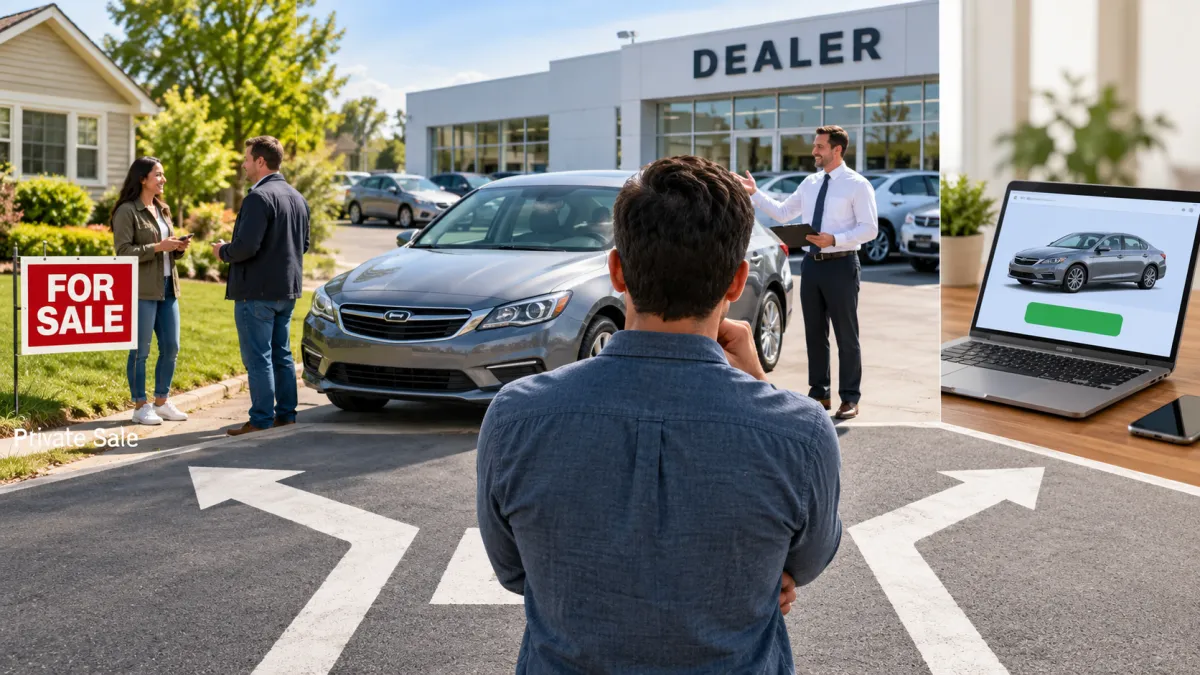
Selling a car is not simply a matter of finding the highest offer. The best place to sell your car depends on what matters most to you: getting the strongest possible price, selling quickly, avoiding negotiations, reducing paperwork, or making the process easier.
For most U.S. sellers, the main choices are a private sale, a direct sale to a dealership, a trade-in, or an online car-buying service. Each option has different advantages and drawbacks.
A private sale may give you more control over the asking price, but it generally requires more work. A dealer may make the process faster and simpler, while a trade-in can be convenient when you are buying another vehicle. Online car-buying services can provide another way to compare an offer without handling the entire private-sale process yourself.
The right choice is therefore less about finding one universally "best" method and more about matching the selling method to your priorities.
Where Should You Sell Your Car?
If your priority is potential selling price, start by considering a private sale and compare it with offers from dealers and online buyers. A private sale may produce a higher selling price, but it usually requires more time, effort, negotiation, and responsibility.
If your priority is speed and convenience, a dealer or online car-buying service may be more attractive.
If you are buying another vehicle, a trade-in may simplify the transaction, although you should still compare the trade-in value with what you could receive by selling the car separately.
If you still owe money on the vehicle, the decision becomes more complicated. You need to know your current loan payoff and compare it with the amount a buyer is willing to pay. The difference determines whether you have positive or negative equity.
A useful way to compare the four options is:
| Selling method | Price potential | Speed | Effort | Control |
|---|---|---|---|---|
| Private sale | Potentially higher | Usually slower | Higher | Highest |
| Direct dealer sale | Varies | Usually faster | Lower | Moderate |
| Trade-in | Varies | Convenient when buying | Low | Moderate |
| Online car buyer | Varies | Often convenient | Low to moderate | Moderate |
These are general characteristics rather than guarantees. Actual offers and selling times depend on the vehicle, condition, mileage, local demand, buyer, and other circumstances.
Your Main Options for Selling a Car
1. Sell Your Car Privately
A private sale means you sell the vehicle directly to another individual rather than to a dealership or professional car buyer.
The biggest advantage is control. You decide how to advertise the vehicle, which buyers to communicate with, when to schedule showings, and whether to accept or reject offers.
A private buyer may also be willing to pay more than a business buyer because the buyer is purchasing the vehicle for personal use rather than as inventory that needs to be resold.
However, that does not mean a private sale automatically produces the highest amount of money.
You may need to:
-
Determine a realistic asking price
-
Prepare the vehicle for sale
-
Create an accurate listing
-
Respond to buyer inquiries
-
Schedule viewings or test drives
-
Negotiate the price
-
Handle paperwork
-
Coordinate payment
-
Complete the title and ownership transfer correctly
-
Follow your state's requirements
There is also more responsibility for dealing with prospective buyers.
If you choose this route, KnowBrook's guide on how to sell a car privately provides a separate step-by-step resource for the private-sale process.
Best for: Sellers who are willing to invest more time and effort in exchange for greater control over the transaction.
2. Sell Directly to a Dealership
You do not necessarily have to trade your car in when selling to a dealership.
A dealership may purchase your vehicle even if you are not buying another car from that dealer. This can make a direct dealer sale useful for someone who wants a relatively straightforward transaction without managing a private listing.
The main advantage is convenience. A dealer is already set up to evaluate vehicles, handle purchase transactions, and process the associated paperwork.
The tradeoff is that the dealer's offer may not be the highest amount you could potentially receive through another selling method.
One advantage of requesting a direct purchase offer is that you can evaluate the vehicle sale separately from your next car purchase. That can make it easier to see what the dealer is actually offering for your current vehicle rather than focusing only on the difference between a trade-in value and the price of another vehicle.
Best for: Sellers who want a relatively quick and straightforward transaction and are willing to trade some control for convenience.
3. Trade In Your Car
A trade-in is different from a direct dealer sale because the value of your current vehicle is applied toward the purchase of another vehicle.
For someone already planning to buy another car, a trade-in can be one of the simplest options. Instead of arranging a separate private sale, you can handle the existing vehicle and replacement vehicle as part of the same dealership transaction.
Convenience is the main attraction.
However, you should avoid judging the deal only by the monthly payment or the apparent difference between the old and new vehicle prices. Look at the actual trade-in value, purchase price, financing terms, fees, and other transaction details separately.
There may also be state-specific tax considerations. Some states provide a sales-tax benefit associated with a qualifying trade-in when purchasing another vehicle, but this is not a universal rule across the United States. Tax treatment varies by state and can depend on the details of the transaction.
That means a trade-in that appears to offer less than a private sale could still have a different after-tax result in a state where a trade-in reduces the taxable amount of the replacement vehicle. The opposite may also be true depending on the specific transaction and applicable rules.
Best for: Sellers who are purchasing another vehicle and value convenience, especially when state tax treatment makes the trade-in financially attractive.
4. Sell Through an Online Car-Buying Service
Online car-buying services provide another option between a traditional dealer transaction and a private sale.
Depending on the provider, you may be able to enter information about your vehicle, receive an offer, provide additional details, and arrange an inspection or transaction without creating a traditional private-sale listing.
The major appeal is convenience.
You may avoid many of the tasks associated with finding individual buyers, such as creating advertisements, responding to numerous messages, arranging multiple appointments, and negotiating with individual shoppers.
But an online offer should not automatically be treated as the best offer.
Offers can depend on vehicle information, condition, inspection results, local demand, eligibility requirements, location, and the provider's terms. The amount or process can also change if information supplied about the vehicle does not match its actual condition.
Best for: Sellers who place a high value on convenience and want another offer to compare with private-sale and dealer options.
Private Sale vs. Dealer vs. Online Buyer
The most useful comparison is not simply "Which one pays the most?"
Instead, consider five factors: price, speed, effort, control, and convenience.
If Getting the Highest Possible Price Matters Most
A private sale deserves serious consideration because you are selling directly to the end buyer rather than to a business that needs to account for resale costs and risk.
But potential is the key word.
A private sale may produce a higher selling price, but there is no guarantee that it will. An unrealistic asking price can leave a vehicle sitting unsold, while a motivated seller may accept less simply to finish the transaction.
A dealer or online buyer may offer less than your private-sale asking price but save you substantial time and effort.
The better comparison is therefore the net result after considering your time and transaction costs, not just the advertised price.
If Speed Matters Most
A dealer or online car-buying service may be more suitable than a private sale.
A private transaction can involve listing the car, waiting for inquiries, communicating with potential buyers, arranging appointments, negotiating, and completing the sale.
A professional buyer may be able to complete the transaction more directly.
However, actual timing varies. Do not assume that every dealer or online service will purchase every vehicle immediately.
If You Want the Least Hassle
Dealer and online options generally have an advantage because they reduce the amount of work required from the seller.
You still need to provide accurate vehicle information and complete the necessary transaction steps, but you may not have to manage an entire private-sale marketing process.
If You Want Maximum Control
A private sale gives you the most control over the asking price, buyer selection, negotiation, and timing.
That control comes with responsibility. You also need to handle the buyer interaction and make sure the transaction follows applicable state requirements.
If You Are Buying Another Car
A trade-in can be convenient because the sale of your current vehicle is incorporated into the purchase transaction.
But convenience should not prevent comparison shopping.
Ask what the dealer will pay for your current vehicle and compare that figure with other legitimate offers. Also consider the replacement vehicle's purchase price and the complete transaction rather than focusing only on the trade-in number.
How to Compare Car Offers Correctly
Getting several offers can make the decision easier, but only if you compare them on the same basis.
Suppose one buyer offers $18,000 while another offers $17,500. The $18,000 offer appears better.
But imagine the first offer requires additional conditions, while the second buyer can complete the transaction immediately with fewer complications. The practical value of the two offers may be closer than the headline numbers suggest.
When comparing offers, look at:
-
Actual purchase price
-
Whether the offer is conditional
-
Inspection requirements
-
Vehicle condition requirements
-
How quickly the transaction can close
-
How much work you must do
-
Pickup or delivery arrangements
-
Paperwork requirements
-
Loan payoff or lien requirements
-
Any applicable fees
-
Potential state tax effects
-
Whether the offer has an expiration period
Do not compare a private-sale asking price directly with a dealer's purchase offer as though they were identical numbers.
An asking price is what a seller hopes to receive. A purchase offer is what a buyer is actually willing to pay under specified conditions.
The most useful comparison is between realistic, actionable offers.
How to Estimate Whether a Dealer's Offer Is Fair
There is no single percentage or formula that proves whether a dealer's offer is fair.
Instead, use several reference points.
Start by researching the vehicle's current market value using established automotive resources such as Kelley Blue Book and Edmunds. Consider the vehicle's:
-
Year
-
Make and model
-
Trim level
-
Mileage
-
Condition
-
Optional equipment
-
Accident or damage history
-
Local demand
-
Maintenance history
-
Overall market conditions
Then compare the dealer's offer with other legitimate offers.
For example, if you receive offers from two dealers and an online car buyer, those offers can provide more useful evidence about the market for your particular vehicle than relying on a single valuation estimate.
Remember that valuation tools are estimates. They do not guarantee that a particular buyer will pay the displayed value.
What If You Still Owe Money on the Car?
An outstanding auto loan does not necessarily prevent you from selling the vehicle, but you need to understand the payoff before agreeing to a transaction.
Start by contacting your lender and obtaining your current payoff amount. Do not rely only on the balance displayed on a recent statement because the amount needed to fully pay off the loan can differ.
Then compare the payoff amount with the vehicle's realistic selling value.
If your vehicle is worth more than the amount needed to pay off the loan, you generally have positive equity.
For example, if your payoff is $14,000 and a buyer offers $18,000, there is a $4,000 difference before considering any other transaction costs or requirements.
If you owe more than the vehicle is worth, you have negative equity.
For example, if the payoff is $20,000 and the vehicle can realistically be sold for $16,000, there is a $4,000 shortfall that must be addressed.
Negative equity becomes particularly important when trading in a vehicle and financing another one. Rolling the unpaid amount into a new auto loan can increase the amount borrowed and may increase the total interest paid over the life of the new loan.
If your vehicle has an outstanding loan or lien, use KnowBrook's guide on selling a car with a loan or lien for more detailed guidance.
The exact payoff and lien-release process can vary by lender and state, so confirm the requirements before completing the sale.
What About Taxes and State Rules?
Selling a car in the United States is not governed by one nationwide set of title, registration, and tax procedures.
Your state's motor vehicle agency determines many of the requirements surrounding title transfers, registration, plates, and related documentation. State tax rules can also affect the financial comparison between selling privately, selling directly to a dealer, and trading in a vehicle.
This is especially important when considering a trade-in.
Some states allow a qualifying trade-in to reduce the taxable amount of a replacement vehicle purchase. Other states handle the transaction differently. You should therefore check your state's current rules rather than assuming that a trade-in automatically provides a tax benefit.
The same principle applies to paperwork.
Before completing the transaction, verify your state's requirements for items such as:
-
Title transfer
-
Lien documentation
-
Odometer disclosure, when applicable
-
Seller and buyer signatures
-
License plates
-
Registration
-
Required notifications
-
Sales or use tax responsibilities
If you have lost your title, the situation may require an additional step before the sale. KnowBrook's guide on replacing a lost car title can help explain the title-replacement issue, but your state motor vehicle agency remains the appropriate source for the specific procedure.
How to Get the Best Result Regardless of Selling Method
You do not have to choose a selling method before learning what your car is worth.
A practical approach is to research the market first and then collect several realistic options.
Start With a Realistic Vehicle Value
Use reputable valuation resources to establish a general range. Be honest about condition and mileage. A vehicle with significant cosmetic or mechanical problems should not be valued as though it were in excellent condition.
Get More Than One Offer
Multiple offers give you a better basis for comparison.
Consider contacting more than one dealership and, where appropriate, an online car-buying service. If a private sale makes sense for your vehicle, research comparable listings to establish a realistic asking price.
The objective is not necessarily to collect the largest possible number of offers. It is to understand what the market is actually willing to pay.
Separate the Car Sale From the Next Purchase
If you are replacing your vehicle, try to evaluate the current car and the next car as separate financial decisions.
A dealer may make the overall transaction appear attractive by combining the trade-in value, vehicle price, financing, and monthly payment.
Looking at each figure independently makes it easier to determine whether you are receiving a competitive offer for your current vehicle.
Prepare Your Documents
Have the relevant vehicle documents available before you begin the transaction.
Depending on your state and circumstances, this may include the title, loan information, maintenance records, registration information, and other required paperwork.
A missing document can delay a sale.
Be Honest About the Vehicle
Accurately describe the vehicle's condition, mileage, history, and known problems.
This is particularly important when working with a dealer or online buyer because an inspection may reveal differences between the information provided and the vehicle's actual condition.
An accurate description also makes a private transaction more straightforward.
Think About Your Time as Part of the Decision
Your time has value.
If a private sale could potentially bring a higher price but requires weeks of communication, appointments, negotiations, and paperwork, the additional money may or may not be worth the effort to you.
There is no universal answer.
For one seller, maximizing the sale price may justify the extra work. For another, completing the sale quickly and moving on may be more valuable.
Which Selling Method Is Best for You?
A simple decision framework can help narrow the choice.
Choose a private sale if: you are comfortable handling buyers, want greater control, and are willing to spend more time trying to achieve a strong selling price.
Consider a direct dealer sale if: you want a relatively simple transaction and are not necessarily buying another vehicle from that dealer.
Consider a trade-in if: you are buying another vehicle and value convenience, while also checking the actual trade-in value and any applicable state tax treatment.
Consider an online car-buying service if: convenience is important and you want another purchase offer without managing a traditional private listing.
Take extra care if: you still owe money on the vehicle, have negative equity, have a lien, have title problems, or are unsure about your state's transfer requirements.
The right choice can also change as your circumstances change. A seller who initially plans to sell privately may decide that a dealer offer is preferable after realizing how much time the private process requires.
A Practical Selling Strategy
You do not have to commit to one method immediately.
A useful strategy is to start by determining a realistic value for your vehicle. Then obtain a few legitimate purchase offers and compare them with the realistic amount you could expect from a private sale.
Next, consider the non-price differences.
Ask yourself:
-
How much more could I realistically receive through a private sale?
-
How much time would the private sale require?
-
How quickly do I need to sell?
-
How comfortable am I negotiating with buyers?
-
Am I buying another vehicle?
-
Do I still have an auto loan?
-
Do I have positive or negative equity?
-
Could my state's tax rules affect a trade-in?
-
Which option involves the least paperwork and risk for my situation?
-
What is the actual amount I will receive after the transaction is completed?
This approach avoids making the decision based on one number alone.
Conclusion
The best place to sell your car depends on the tradeoff you are willing to make between price, speed, effort, control, and convenience.
A private sale can provide more control and may produce a higher selling price, but it usually requires more work. A direct dealer sale can simplify the process without requiring you to buy another vehicle. A trade-in can be convenient when you are replacing your car, while an online car-buying service can provide another relatively convenient way to obtain an offer.
If you are unsure, do not feel pressured to choose immediately. Research your vehicle's value, compare multiple realistic offers, understand your loan payoff if applicable, and check your state's rules before completing the transaction.
The strongest decision is not necessarily the offer with the highest headline number. It is the option that gives you a satisfactory financial result while fitting the amount of time, effort, control, and convenience you want from the sale.
Frequently asked questions
Can I sell my car directly to a dealership without trading it in?
Yes. Selling a car directly to a dealership is different from trading it in. A direct sale lets you compare the dealer's purchase offer separately from any vehicle you may buy. This can make it easier to evaluate the actual value of your current car.
Should I get more than one offer before selling my car?
Getting multiple offers can help you determine whether the first offer is competitive. Compare the actual offers with realistic market values and consider the condition, mileage, vehicle demand, convenience, and effort involved rather than automatically choosing the highest advertised estimate.
How do I know if a dealer's offer is fair?
Compare the dealer's offer with current market-value information, similar vehicles, your car's condition and mileage, and offers from other legitimate buyers. Also consider the time and effort saved by accepting a dealer offer. There is no single percentage that makes a dealer offer fair for every vehicle.
What happens if I still owe money on my car?
First, find out your current loan payoff amount and compare it with the vehicle's value or selling offer. If the car is worth more than the payoff amount, you generally have positive equity. If you owe more than the car is worth, you have negative equity and need to account for the difference when deciding how to sell.
Does trading in a car have tax advantages?
A trade-in can have a sales-tax advantage in some states when you purchase another vehicle, but the rules vary by state. Do not assume a trade-in automatically provides a tax benefit. Compare the actual after-tax financial result with the alternatives available to you.
Is an online car-buying service worth using?
An online car-buying service can be useful if you value convenience and want to reduce the work involved in finding and negotiating with a private buyer. Before accepting an offer, compare its actual terms and value with dealer and private-sale alternatives.
What should I compare besides the offer price?
1. Consider how quickly you need to sell, how much effort the process requires, how much control you want over the transaction, negotiation involved, paperwork, loan or lien requirements, and any applicable state tax considerations. The highest headline offer is not always the best overall result.

Olivia Bennett writes practical automotive content covering car buying, ownership costs, maintenance, vehicle features, reliability, and everyday driving decisions. Her work focuses on helping readers understand automoti...