How to Sell a Car With a Salvage or Rebuilt Title: Disclosure Rules, Pricing, and Paperwork
Selling a car with a salvage or rebuilt title involves more than finding a buyer. This guide explains the differences between title classifications, US disclosure requirements, required paperwork, vehicle-history checks, pricing factors, and places to sell. It also highlights state-specific examples and important restrictions that sellers should understand before completing a transaction.
In this article
- Can You Sell a Car With a Salvage or Rebuilt Title?
- Salvage vs. Rebuilt vs. Junk vs. Nonrepairable Titles
- Salvage title
- Rebuilt or reconstructed title
- Junk or parts-only title
- Nonrepairable title
- What Must You Disclose When Selling a Salvage or Rebuilt Car?
- Federal requirements vs. state laws
- State examples and disclosure requirements
- How to Prepare a Salvage or Rebuilt Vehicle for Sale
- 1. Confirm the exact title status
- 2. Gather repair and parts records
- 3. Check the vehicle's current condition
- 4. Take clear, current photographs
- 5. Prepare an accurate listing
- How to Check a Vehicle's Title History Using NMVTIS
- How to use an NMVTIS report
- How Much Is a Salvage or Rebuilt Title Car Worth?
- Original damage and repair quality
- Mileage, age, make, and model
- Current condition and inspection records
- Local buyer demand
- A practical way to set an asking price
- Where Can You Sell a Salvage or Rebuilt Title Car?
- Private buyers
- Dealerships
- Salvage yards and parts buyers
- Online car buyers and salvage auctions
- What Paperwork Is Needed to Sell a Branded-Title Vehicle?
- Current title or salvage certificate
- Written title-brand disclosure
- Bill of sale
- Odometer disclosure
- Lien release
- Transfer and liability records
- Common Mistakes to Avoid When Selling a Branded-Title Car
- Conclusion
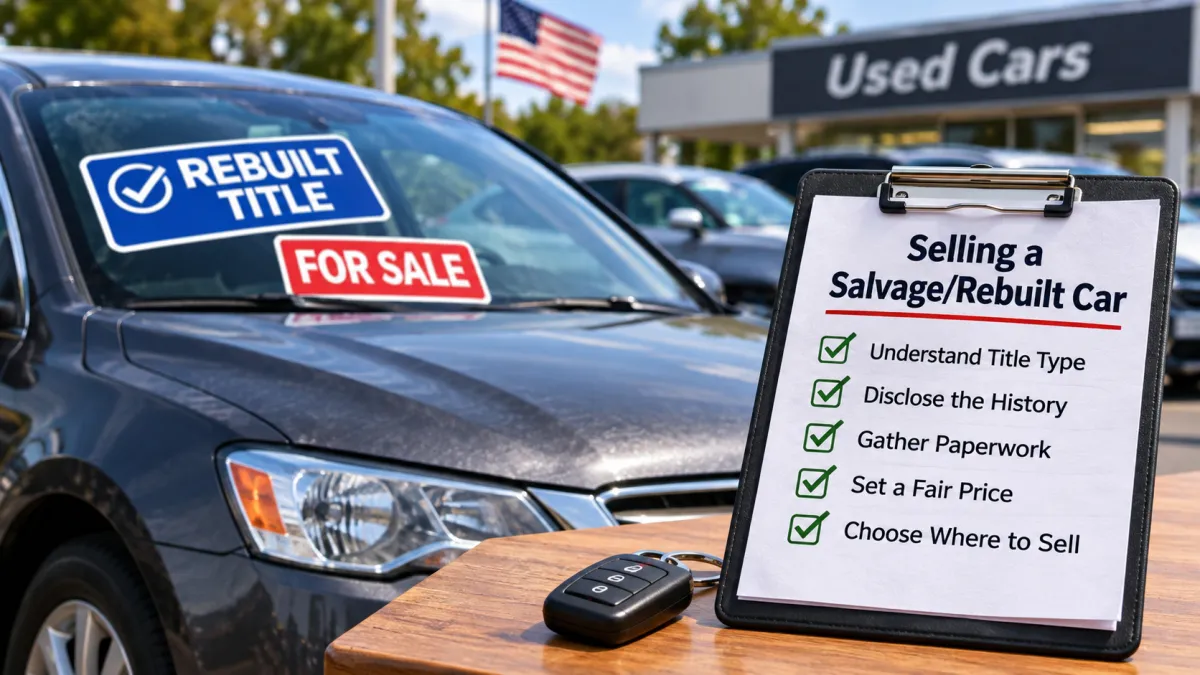
Selling a car with a salvage or rebuilt title is possible in many parts of the United States, but the process is different from selling a vehicle with a clean title. The title brand can affect who is legally allowed to buy the vehicle, whether it can be driven or registered, what you must disclose, and how much a buyer may be willing to pay.
The first step is to identify the vehicle's exact title status. A car with an active salvage title is not necessarily treated the same way as one that has been repaired, inspected, and issued a rebuilt or restored title. Some vehicles are classified as junk or nonrepairable and may not be eligible for ordinary road use or rebuilding.
Before advertising your car, check the title issued by your state, gather available repair records, and confirm the rules that apply to your transaction. You should also disclose the vehicle's history clearly rather than relying on a buyer to discover it through a vehicle-history report.
This guide explains the differences between title classifications, disclosure requirements, paperwork, valuation factors, and the places where you may be able to sell a branded-title vehicle.
Can You Sell a Car With a Salvage or Rebuilt Title?
Yes, you can sell many vehicles with salvage or rebuilt titles, but the options depend on the vehicle's classification and your state's laws.
A vehicle with an active salvage title may be sold to a licensed rebuilder, salvage dealer, parts buyer, or another eligible purchaser, depending on state requirements. Some states also allow an individual owner to sell a salvage vehicle directly under specific conditions.
A rebuilt-title vehicle has generally passed through a repair and inspection or approval process required by the state. It may be eligible for registration and road use, but its title history still identifies it as previously damaged or salvaged.
Before listing the vehicle, establish which of these situations applies:
-
Active salvage title: The vehicle has been branded as salvage and may not be eligible for regular registration or road use until it completes the required restoration process.
-
Rebuilt or restored title: The vehicle has been repaired and has received the title status required by the state for its next stage of use.
-
Junk or parts-only status: The vehicle may be restricted to dismantling, parts, or scrap rather than rebuilding for road use.
-
Nonrepairable status: The state has classified the vehicle as not eligible for restoration or ordinary road registration.
Do not advertise a vehicle as road-ready simply because it starts, moves, or has received some repairs. The title classification and state approval determine its legal status, not just its mechanical condition.
If you are selling a rebuilt vehicle, make the branded history clear in the listing and sale documents. If it still has an active salvage title, check whether the intended buyer is legally permitted to purchase it and what transfer documents are required.
Salvage vs. Rebuilt vs. Junk vs. Nonrepairable Titles
These terms describe different vehicle conditions and legal statuses. They are not interchangeable, and the exact definitions and procedures can vary by state.
| Title classification | What it generally means | Typical selling considerations |
|---|---|---|
| Salvage | The vehicle has been declared salvage because of damage, theft recovery, flood, or another qualifying event | May need repairs and state approval before road use; buyer eligibility can be restricted |
| Rebuilt or reconstructed | A previously salvage vehicle has been repaired and processed under the state's rebuilt-title requirements | May be eligible for registration, but the branded history remains relevant |
| Junk or parts-only | The vehicle is designated for parts, dismantling, or disposal under applicable state rules | May not be eligible for rebuilding or ordinary road use |
| Nonrepairable | The vehicle has been classified as not eligible for restoration for road use | Generally limited to the uses allowed by the state's nonrepairable-vehicle rules |
Salvage title
A salvage title is usually issued after a vehicle meets the state's criteria for a salvage designation. The triggering event might be a collision, flood, fire, theft recovery, or other damage.
A salvage designation does not automatically mean the vehicle is worthless. For example, a vehicle may have substantial damage that makes repairing it uneconomical for an insurer, even though some components remain usable.
However, an active salvage title can prevent the vehicle from being registered or driven normally. The owner may need to complete repairs, inspections, and a title application before the vehicle can return to the road.
Rebuilt or reconstructed title
A rebuilt or reconstructed title generally applies after a salvage vehicle has been repaired and has completed the required state process.
The vehicle may qualify for registration and road use, but the rebuilt designation is important. It tells future buyers that the vehicle previously had a salvage or similar status.
A rebuilt title should not be described as a clean title. Repairs do not erase the vehicle's title history, and a later title issued in another state does not necessarily remove the original brand from vehicle-history records.
Junk or parts-only title
A junk or parts-only classification can impose more serious restrictions than an ordinary salvage designation. Depending on state law, the vehicle may be limited to dismantling, parts, or scrap.
Do not assume that a junk-title vehicle can be repaired and returned to the road. Check the actual title and the issuing state's rules before advertising it as a rebuildable project.
Nonrepairable title
A nonrepairable classification generally indicates that the vehicle cannot be restored for ordinary road use under the state's title system.
A vehicle in this category may still have value for parts or scrap, but the legal restrictions can be significant. Confirm what transfers are permitted before accepting payment or handing over the vehicle.
The important distinction is that salvage does not always mean nonrepairable. A salvage vehicle may have a path to a rebuilt or restored title, while a nonrepairable vehicle may not.
What Must You Disclose When Selling a Salvage or Rebuilt Car?
You should clearly disclose the vehicle's branded-title status before completing the sale. The exact legal requirements depend on the state, the vehicle's history, and whether you are selling as an individual or a dealer.
At a minimum, describe the title accurately. If the title says salvage, rebuilt, reconstructed, flood, or another brand, do not replace that description with a vague phrase such as "previously damaged" if doing so could mislead the buyer.
You should also disclose material damage and known repair information when required by state law. Keep the disclosure in writing so both parties have a record of what was communicated.
Federal requirements vs. state laws
There is no single federal disclosure form that every private seller must use for every salvage- or rebuilt-title vehicle. State laws are particularly important for title branding, damage disclosures, and transfer procedures.
The Federal Trade Commission's Used Car Rule applies to most dealers who sell or offer for sale more than five used vehicles in a 12-month period. Covered dealers generally must display a Buyers Guide on used vehicles they offer for sale. The rule is not a universal Buyers Guide requirement for every private individual selling a personal vehicle. See the FTC Dealer's Guide to the Used Car Rule.
That does not mean private sellers can ignore state disclosure laws or general prohibitions against deceptive statements. A private sale may still require written disclosure of a salvage, rebuilt, flood, or other vehicle status.
For a seller, the practical approach is to:
-
Read the current title and identify every brand shown.
-
Check the motor vehicle agency's disclosure and transfer requirements.
-
Disclose known damage and repairs accurately.
-
Put required disclosures in writing before the transaction is completed.
-
Keep a signed copy of the sale documents and disclosures.
State examples and disclosure requirements
The following examples show why sellers should check the rules in the state where the vehicle is titled and sold. They are not a complete list of US state requirements.
North Carolina
North Carolina requires written disclosure when a used vehicle less than five years old has damage exceeding 25% of its fair market value. The state also requires written disclosure before sale when a vehicle has been salvaged, damaged by flooding, or rebuilt. The North Carolina Department of Justice says these requirements apply to individual sellers as well as dealerships.
Review the state's Disclosing Car Damage guidance before selling a vehicle in North Carolina. <Cite refs={["turn647189search0"]}/>
Virginia
Virginia requires a written disclosure before selling a rebuilt vehicle. The state's Rebuilt Vehicle Disclosure Statement, form VSA 59, identifies the vehicle and its rebuilt status and includes spaces for the seller's and buyer's signatures.
Virginia also restricts certain salvage-pool sales. A salvage pool generally cannot sell a salvage vehicle to an unlicensed person, although the DMV identifies a limited exception for an individual disposing of a salvage vehicle acquired in good faith for personal use and not to avoid salvage laws.
Read the Virginia DMV salvage and nonrepairable vehicle rules and obtain the Rebuilt Vehicle Disclosure Statement (VSA 59) when applicable. <Cite refs={["turn647189search1","turn647189search63"]}/>
Florida
Florida requires anyone offering a rebuilt vehicle for sale or exchange, including a private individual, to disclose in writing before completing the sale that the vehicle was previously titled or registered as rebuilt. The state's dealer handbook also says the disclosure is required in advertisements offering the rebuilt vehicle for sale.
Check the applicable requirements in the Florida Highway Safety and Motor Vehicles dealer handbook. <Cite refs={["turn647189search62"]}/>
Arizona
Arizona requires a seller to disclose before the sale is completed that a vehicle for which a salvage title has been issued is a salvage vehicle. The state also explains that an active salvage vehicle is not eligible for regular registration until it completes the required restoration and inspection process.
See the Arizona Department of Transportation's salvage vehicle guidance for the state's requirements. <Cite refs={["turn647189search4","turn647189search7"]}/>
These examples should not be treated as a substitute for checking your own state's current rules. Requirements can differ based on the title brand, the vehicle's age, the type of damage, and the seller's role.
How to Prepare a Salvage or Rebuilt Vehicle for Sale
A well-organized sale is easier for buyers to evaluate. It also reduces the risk of misunderstandings about the vehicle's condition and history.
1. Confirm the exact title status
Start with the physical or electronic title record. Check the brand, title number, VIN, owner's name, and any restrictions or notes.
If you have an older title, a previous-state title, or paperwork that does not match the vehicle's current status, contact the state motor vehicle agency before advertising it.
Do not assume that a vehicle has a rebuilt title just because repairs were completed. Confirm that the required inspection and title process was actually finished.
2. Gather repair and parts records
Collect any documents that help explain what happened to the vehicle and what was done afterward.
Useful records may include:
-
Collision or damage estimates
-
Insurance total-loss paperwork
-
Repair invoices
-
Parts receipts
-
Inspection reports
-
Alignment or mechanical inspection records
-
Before-and-after photographs
-
Maintenance records
-
Receipts for major replacement components
You may not have every document, particularly if the repairs were completed by a previous owner. Do not create or estimate repair records to fill gaps. Instead, tell buyers which documents are available and which are not.
A buyer may place more confidence in a rebuilt vehicle when the seller can explain the repair process and provide supporting documentation. Records are especially useful when the damage involved structural components, airbags, suspension, or major mechanical systems.
3. Check the vehicle's current condition
A title inspection and a mechanical inspection are not the same thing. A vehicle that passed a state title inspection is not necessarily free of every mechanical or safety problem.
Consider having a qualified mechanic or body shop evaluate the vehicle before listing it. Depending on the previous damage, areas worth checking may include:
-
Frame or unibody structure
-
Suspension and steering
-
Brakes
-
Airbags and seat-belt systems
-
Electrical wiring and sensors
-
Engine and transmission
-
Water intrusion, corrosion, or mold
-
Tire wear and wheel alignment
If the inspection identifies problems, decide whether to repair them or disclose them clearly in the listing. Avoid describing a vehicle as fully roadworthy unless its condition and legal status support that statement.
4. Take clear, current photographs
Photographs should show the vehicle as it exists now. Include exterior views, the interior, the odometer, the engine compartment, the trunk or cargo area, and any visible damage.
If there are signs of previous repairs, do not hide them with selective photography. Buyers considering a branded-title vehicle are likely to want a clear understanding of its present condition.
You can also photograph available repair documents, but cover personal information such as addresses, phone numbers, insurance policy details, and financial account information.
5. Prepare an accurate listing
State the title brand prominently in the description. Explain whether the vehicle currently has an active salvage title or a rebuilt title.
Include relevant details such as:
-
Year, make, model, and trim
-
Current mileage
-
Exact title classification
-
General description of the known damage
-
Repairs completed, if documented
-
Current mechanical condition
-
Inspection status, if applicable
-
Known issues
-
Available service and repair records
Avoid terms such as "clean title," "no damage," or "like new" when they do not accurately describe the vehicle.
How to Check a Vehicle's Title History Using NMVTIS
A title document is important, but it may not tell the entire story of a vehicle's past. The National Motor Vehicle Title Information System (NMVTIS) can help sellers and buyers check title and brand history.
NMVTIS is a federal system designed to help prevent vehicle fraud and protect consumers. It provides information associated with a vehicle's title history, including:
-
Current state of title and last title date
-
Title brand history
-
Latest reported odometer information
-
Certain insurance company or self-insured organization salvage and total-loss determinations
-
Certain reports that a vehicle was transferred to or sold to a salvage yard, junk yard, or auto recycler
You can learn about consumer access through the US Department of Justice's NMVTIS Consumer Information page. <Cite refs={["turn647189search8"]}/>
How to use an NMVTIS report
-
Visit the DOJ's NMVTIS consumer information page.
-
Select an approved consumer access provider.
-
Enter the vehicle identification number as requested.
-
Obtain the report and review its title, brand, and other available information.
-
Compare the report with the current title and your own records.
NMVTIS reports are useful, but they are not complete repair histories. They do not provide every collision detail, repair invoice, maintenance record, or mechanical inspection. Information can also depend on what participating sources have reported.
A missing entry does not prove that a vehicle has never been damaged. The DOJ explains that state branding practices and definitions can vary, which is one reason title history should be considered alongside the actual title and other records. <Cite refs={["turn647189search8","turn647189search10"]}/>
If you discover a mismatch between the title and the report, contact the state motor vehicle agency that issued the title before proceeding with the sale. Do not try to resolve a title-brand discrepancy by simply omitting the information from your advertisement.
How Much Is a Salvage or Rebuilt Title Car Worth?
There is no universal resale discount for a salvage- or rebuilt-title vehicle. Its value depends on the vehicle itself, the severity of the original damage, the quality of the repairs, the current condition, and the buyers available in your market.
A rebuilt-title car may be worth more than a vehicle with an active salvage title because it may have completed the required restoration process and may be eligible for road use. However, it will generally appeal to a different buyer pool than a comparable clean-title vehicle.
Consider these factors when setting a price.
Original damage and repair quality
The type of damage matters. A vehicle that experienced relatively limited damage may attract more interest than one that had major structural damage, extensive flooding, or a fire.
The quality of the repair work also matters. Buyers may want evidence that replacement parts were installed correctly and that safety-related systems were checked.
If you cannot document the repairs, avoid making claims about the quality or completeness of work that you cannot verify.
Mileage, age, make, and model
Mileage and vehicle age still influence value. A popular model with relatively low mileage may attract more interest than an older vehicle with high mileage, even when both have branded titles.
Parts availability can also affect demand. Some buyers look for specific models because they need replacement parts or have the skills and facilities to repair them.
Current condition and inspection records
A rebuilt vehicle that runs well, has no known major mechanical problems, and has supporting inspection records may be easier to sell than one with unresolved issues.
A recent independent inspection can help buyers understand the vehicle's current condition. It does not erase the title brand or guarantee that the vehicle will qualify for insurance or registration in every state.
Local buyer demand
Demand varies by location. A vehicle that attracts interest from local rebuilders, mechanics, or parts buyers may be harder to sell in an area with fewer such buyers.
Compare similar branded-title vehicles in your region, but examine the details carefully. A listing price is not proof of the final selling price, and two vehicles with the same model and mileage can have very different damage histories.
A practical way to set an asking price
Use a few sources of information rather than relying on one online estimate:
-
Find the approximate clean-title value of a comparable vehicle in similar condition.
-
Search for similar salvage- or rebuilt-title vehicles in your local market.
-
Consider the original damage, repair quality, mileage, and current mechanical condition.
-
Obtain an appraisal or written offer from a buyer familiar with branded-title vehicles, if available.
-
Set an asking price that leaves room for negotiation without hiding known problems.
Valuation services may not account fully for the vehicle's repair history or local demand. Kelley Blue Book explains that vehicle values depend on multiple factors and that its values are estimates rather than guaranteed offers. See its vehicle value FAQ.
Do not assume that every salvage or rebuilt vehicle is worth a fixed percentage less than a clean-title equivalent. The right price is the one supported by comparable vehicles, condition, documentation, and actual buyer interest.
Where Can You Sell a Salvage or Rebuilt Title Car?
Your selling options depend on whether the vehicle has an active salvage title, a rebuilt title, or a more restrictive classification.
Private buyers
A private sale may be possible for a rebuilt-title vehicle and, in some states and circumstances, for an active salvage vehicle.
Private buyers may be interested in a lower-priced vehicle, a project car, or a model they already know how to repair. However, they may also be cautious about title history, insurance, financing, and future resale.
Before arranging a private sale, confirm that your state permits the intended transfer to that buyer. Be especially careful if the vehicle is still classified as salvage or nonrepairable.
For general private-sale transaction steps, see KnowBrook's guide to selling a car privately. The branded-title requirements discussed in this article still need to be handled separately.
Dealerships
Some dealerships buy rebuilt-title vehicles, but many prefer clean-title inventory. A dealer may offer less than a private buyer because it must consider resale demand, inspection needs, and the difficulty of finding a suitable customer.
Call ahead and explain the exact title brand. Do not assume a dealership will accept an active salvage vehicle simply because it buys used cars.
Salvage yards and parts buyers
If the vehicle is badly damaged or not suitable for road use, a salvage yard or parts buyer may be a more realistic option.
The buyer may be interested in usable components, the engine, transmission, wheels, electronics, or other parts. The offer will depend on the vehicle's condition, demand for its components, and the buyer's costs.
Check whether the buyer is properly licensed where required and make sure the ownership transfer and vehicle disposition are documented.
Online car buyers and salvage auctions
Some online vehicle buyers and salvage auction services accept branded-title vehicles. Their eligibility rules can differ, and some platforms work only with licensed dealers or other approved buyers.
Before accepting an offer, confirm:
-
Whether the platform accepts your exact title classification
-
Whether you must deliver the vehicle or arrange pickup
-
Whether there are listing, processing, or transportation charges
-
What title and ownership documents are required
-
When and how payment will be made
-
Whether the offer can change after an inspection
To compare selling channels more broadly, use KnowBrook's guide to private buyers, dealerships, and online car buyers.
The best option is not necessarily the one with the highest advertised price. Consider the buyer's eligibility, the final amount you will receive, transfer requirements, and how much time and effort the sale will take.
What Paperwork Is Needed to Sell a Branded-Title Vehicle?
The required documents vary by state and title classification. A seller should confirm the transfer requirements with the state motor vehicle agency before completing the transaction.
Common documents and records include:
| Document or record | Why it may be needed |
|---|---|
| Current title or salvage certificate | Establishes ownership and shows the vehicle's current title status |
| Bill of sale | Records the sale date, price, vehicle details, and parties |
| State-required disclosure form | Documents the salvage, rebuilt, flood, or other required disclosure |
| Repair invoices and parts receipts | Help explain the work completed and components used |
| Inspection or approval records | Show that required inspections were completed, when applicable |
| Odometer disclosure | Records mileage when required by federal or state law |
| Lien release | Shows that a recorded lien has been satisfied, when applicable |
| Release of liability or transfer notice | Helps document that ownership has changed, where the state provides or requires it |
Current title or salvage certificate
The title or certificate should match the vehicle being sold. Check the VIN and ownership information before signing.
If the title is missing, do not assume that a bill of sale alone will be enough to transfer ownership. Follow the state's replacement-title process first. KnowBrook explains the process in its guide to replacing a lost car title.
Written title-brand disclosure
Use the specific form required by your state when one applies. For example, Virginia uses form VSA 59 for rebuilt-vehicle disclosure.
Even where a particular form is not required, a written disclosure can help establish what the buyer was told. Include the vehicle's identifying information and the exact title classification, and keep a signed copy when appropriate.
Bill of sale
A bill of sale should accurately identify the vehicle, buyer, seller, sale date, and purchase price. It should not contradict the title or disclosure documents.
If the vehicle is being sold for parts or with an active salvage status, make that clear in the paperwork. Do not describe it as a fully road-ready vehicle if it is not legally eligible for road use.
Odometer disclosure
Federal and state odometer disclosure requirements depend on the vehicle and transaction. Do not assume that a branded title automatically removes every odometer disclosure obligation.
Check the applicable rules for the vehicle's model year and transfer. Record the mileage accurately and follow the required process if the odometer reading is not the actual mileage or cannot be determined.
Lien release
If a lender or other lienholder is listed on the title, you may need to satisfy the lien and obtain the required release before the buyer can receive transferable ownership.
The process depends on the lender, state, and title system. If the vehicle still has an outstanding loan, review the steps for selling a car with a loan or lien.
Transfer and liability records
After the sale, complete the required title assignment and notify the state motor vehicle agency if it requires a separate transfer notice or release of liability.
Keep copies of the signed title documents, bill of sale, disclosure, payment record, and any transfer confirmation. These records can help if questions arise later about the date of sale or what was disclosed.
Common Mistakes to Avoid When Selling a Branded-Title Car
A branded-title sale can become complicated when the seller overlooks a title restriction or gives the buyer incomplete information. Avoid these common mistakes.
Calling a rebuilt title a clean title. A vehicle's repaired condition does not erase its branded history. Use the title's actual classification in advertisements and paperwork.
Assuming every salvage vehicle can be sold to any buyer. Some states restrict who can purchase an active salvage vehicle, particularly when it is sold through a salvage pool. Check buyer eligibility before accepting an offer.
Failing to disclose known damage. A buyer should not have to discover a known flood history, salvage designation, or rebuilt status after the transaction. Follow state disclosure requirements and document the information provided.
Treating an inspection as a guarantee of vehicle condition. A state title inspection may focus on specific legal or identification requirements. It does not necessarily certify that every mechanical system is in excellent condition.
Relying on an incomplete vehicle-history report. NMVTIS and other vehicle-history services can provide useful information, but no report should be treated as a complete record of every repair or incident.
Advertising repairs that cannot be verified. If you do not have invoices or inspection records, say so. Do not claim that the vehicle has undergone a particular repair unless you have a reasonable basis for the statement.
Signing documents before checking the transfer process. A title with an incorrect signature, missing information, or unresolved lien can delay the transaction. Confirm the required paperwork before handing over the vehicle.
Conclusion
Selling a car with a salvage or rebuilt title starts with confirming the exact title classification. An active salvage title, a rebuilt title, and a nonrepairable designation can carry very different restrictions, so the vehicle's condition alone does not determine how it can be sold.
Check your state's rules, disclose the title brand and known damage in writing when required, and gather the repair, inspection, and ownership records you have. Use NMVTIS as one source for title history, but remember that it does not provide a complete repair record.
When setting your price, consider the vehicle's damage history, repair quality, current condition, documentation, and local demand rather than relying on a fixed discount. Then choose a buyer who is legally eligible to purchase the vehicle and complete the title transfer correctly.
A clear listing, accurate disclosures, and organized paperwork give both parties a better basis for completing the sale.
Frequently asked questions
1. Does a rebuilt title ever become a clean title?
Generally, a rebuilt-title brand remains part of the vehicle's title history even after the vehicle has been repaired and passed the required state inspection. The exact terminology and title-recording procedures vary by state. A seller should not advertise a rebuilt-title vehicle as having a clean title simply because it has been repaired.
2. Can you sell a salvage-title car if the title is not in your name?
You generally need legal authority to sell a vehicle and complete the required ownership transfer. If the title is in another person's name, do not assume that possession of the vehicle is enough. Check your state's DMV requirements for situations involving an authorized representative, inheritance, lienholder, or other ownership arrangement before advertising or selling the vehicle.
3. Can you insure a car with a rebuilt title?
Some insurers may offer coverage for rebuilt-title vehicles, but availability and coverage options vary. Liability, comprehensive, and collision coverage may be subject to different requirements. Contact the insurer before purchasing or selling the vehicle, and ask what inspections, photographs, or documentation it requires.
4. Can a buyer register a salvage-title car in another state?
Possibly, but registration depends on the vehicle's title classification and the destination state's laws. An unrepaired salvage vehicle may not qualify for ordinary road registration, while a properly repaired vehicle may need inspections and additional documentation before receiving a road-eligible title. Buyers should confirm the requirements with the destination state's motor vehicle agency before completing the purchase.
5. What happens if you cannot provide repair receipts for a rebuilt-title car?
Missing repair receipts can make it harder to demonstrate what work was completed and which parts were used. A buyer, insurer, or state agency may request supporting documentation. Check the applicable state's requirements and provide any available inspection reports, photographs, parts records, and repair documentation. Do not claim that repairs were professionally completed if you cannot substantiate that statement.

Olivia Bennett writes practical automotive content covering car buying, ownership costs, maintenance, vehicle features, reliability, and everyday driving decisions. Her work focuses on helping readers understand automoti...