How Much Does Car Maintenance Cost? Average Annual and Monthly Costs
Learn how much car maintenance can cost in the U.S., what routine maintenance and wear items include, why costs vary, and how to build a practical annual and monthly maintenance budget.
In this article
- What Does Car Maintenance Cost?
- What Is Included in Routine Car Maintenance?
- Average Cost of Common Car Maintenance Services
- Oil and filter service
- Tire costs
- Brake costs
- Filters and fluids
- Does Car Maintenance Get More Expensive as a Car Ages?
- How Mileage Affects Maintenance Costs
- Maintenance Costs by Vehicle Type
- Gas-powered vehicles
- Hybrid vehicles
- Plug-in hybrids
- Electric vehicles
- Maintenance vs. Repair Costs
- How Much Should You Save for Unexpected Car Repairs?
- Maintenance fund
- Repair reserve
- How to Build a Car Maintenance Budget
- Step 1: Review the manufacturer's schedule
- Step 2: Estimate scheduled maintenance
- Step 3: Add expected wear items
- Step 4: Add a repair reserve
- Step 5: Convert the annual target to a monthly amount
- Dealer vs. Independent Repair Shop
- How to Tell If a Maintenance Estimate Is Too High
- How Location Affects Car Maintenance Costs
- How to Lower Car Maintenance Costs Without Skipping Necessary Service
- Follow the manufacturer's schedule
- Keep maintenance records
- Address small problems appropriately
- Compare repair estimates
- Take care of tires and brakes
- Budget before the bill arrives
- How to Keep Track of Your Maintenance Costs
- The Best Car Maintenance Budget Is Specific to Your Vehicle
- Conclusion
Car maintenance costs are not the same for every driver. A newer car with low mileage may need relatively little beyond scheduled service, while an older or higher-mileage vehicle may need more frequent attention, tires, brakes, and unexpected repairs. Your vehicle's make, model, mileage, driving habits, location, and maintenance history can all change what you spend.
A broad published benchmark can give you a starting point, but it should not be treated as a universal bill. Some estimates count scheduled maintenance only, while others include repairs, tires, or other vehicle expenses.
A better approach is to build a personal car maintenance budget. Start with the maintenance your vehicle is expected to need, account for normal wear items, and keep a separate reserve for unexpected repairs. Then convert the annual estimate into a monthly amount you can set aside.
What Does Car Maintenance Cost?
For many U.S. drivers, annual maintenance expenses can fall somewhere in the several-hundred-dollar to low-four-figure range, but there is no single national amount that accurately describes every vehicle.
Consumer-facing cost estimates commonly report broad annual ranges, including a roughly $400 to $1,200 benchmark. That figure should be treated as a reference point rather than a guaranteed maintenance bill. Different sources use different definitions, and the actual cost for your vehicle can be higher or lower.
The most important distinction is between routine maintenance, wear items, and unexpected repairs.
| Cost category | Examples | How to budget |
|---|---|---|
| Scheduled maintenance | Oil service when required, inspections, fluid service, filters, manufacturer-recommended services | Plan around the manufacturer's schedule |
| Wear items | Tires, brake pads, some brake components and other parts that wear through normal use | Estimate the replacement cost over the expected service period |
| Unexpected repairs | Failed components, electrical problems, cooling-system issues and other unplanned problems | Maintain a separate repair reserve |
| Broader ownership costs | Insurance, fuel, financing, registration and depreciation | Budget separately from maintenance |
This distinction explains why two websites can publish very different "average maintenance costs" without either necessarily being wrong.
Your owner's manual and the manufacturer's maintenance schedule should be the starting point for determining what your particular vehicle needs.
What Is Included in Routine Car Maintenance?
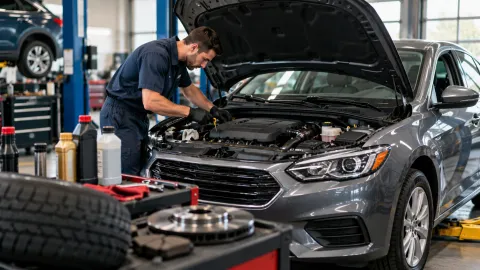
Routine maintenance consists of services intended to keep a vehicle operating properly and to address manufacturer-recommended maintenance requirements.
Depending on the vehicle, this can include oil and filter service, inspections, tire-related service, fluid checks or replacement, filters, brake inspections, and other scheduled work.
Not every vehicle requires the same service at the same mileage. A gasoline-powered vehicle, hybrid, plug-in hybrid, and battery-electric vehicle have different maintenance needs.
Your owner's manual is therefore more useful than a generic internet schedule when determining what your vehicle actually requires.
It is also important to distinguish an inspection from a replacement.
A mechanic may inspect a component and determine that it is still in good condition. That does not necessarily mean you need to pay for a replacement. Likewise, a maintenance visit may reveal that a wear item needs attention even though it was not originally scheduled for replacement.
When reviewing a maintenance recommendation, ask which category it falls into:
-
Is it required by the manufacturer's maintenance schedule?
-
Is it recommended because of severe driving conditions?
-
Is it based on the component's age or mileage?
-
Did an inspection find actual wear or a problem?
-
Is it optional rather than necessary?
Those questions can make a significant difference when estimating your true maintenance costs.
Average Cost of Common Car Maintenance Services
Individual maintenance services can vary substantially in price depending on the vehicle, parts, labor rates, location, and type of service.
Instead of treating one national price as universal, think about maintenance as a collection of expenses that occur at different times.
Oil and filter service
For vehicles that require conventional engine oil, oil and filter service is one of the most familiar routine maintenance expenses. The price can vary depending on the vehicle, oil specification, oil capacity, service provider, and local labor rates.
Some vehicles use longer service intervals or different maintenance requirements. Always follow the manufacturer's specifications rather than assuming every vehicle needs the same oil service interval.
Tire costs
Tires are a major part of long-term vehicle maintenance budgeting even though they are not replaced every month or every year.
A set of tires can represent a significant expense when replacement becomes necessary. The actual replacement interval depends on tire type, driving habits, road conditions, climate, alignment, vehicle characteristics, and tire condition.
For budgeting purposes, it can be useful to estimate the expected replacement cost and spread it across the period you expect the tires to last.
Brake costs
Brake components are another normal wear expense.
Brake pads do not necessarily wear at the same rate on every vehicle. Driving patterns, traffic, terrain, vehicle weight, brake design, and individual driving habits can affect how quickly they need replacement.
A brake inspection does not automatically mean a complete brake replacement is required. Ask the repair shop what component is worn, what measurement or inspection finding supports the recommendation, and whether the work is immediately necessary.
Filters and fluids
Some vehicles require periodic replacement or service of filters and fluids according to the manufacturer's schedule.
The requirements vary by vehicle. Do not automatically assume that a service advertised for one model applies to another.
This is one reason generic maintenance lists can be misleading when used as a substitute for the owner's manual.
Does Car Maintenance Get More Expensive as a Car Ages?
An older vehicle can become more expensive to maintain and repair, but age alone does not determine the cost.
Two vehicles of the same age can have very different expenses because one may have been carefully maintained while the other has accumulated deferred maintenance or experienced more demanding driving.
Mileage matters, too, but it should be considered alongside the vehicle's condition and service history.
Factors that can influence costs as a vehicle ages include:
-
Higher mileage
-
Previous maintenance quality
-
Deferred maintenance
-
Wear on tires and brakes
-
Age-related component deterioration
-
Driving conditions
-
Previous repairs
-
Upcoming scheduled services
-
Vehicle-specific reliability and service requirements
There is no reliable formula such as "add a certain amount for every year the car gets older."
A better way to budget for an older vehicle is to look at what is actually coming due and what condition the vehicle is currently in.
If you are buying a used vehicle, maintenance records can be especially valuable. A vehicle with documented service history gives you a clearer picture of what has already been done and what may be approaching.
How Mileage Affects Maintenance Costs
Mileage is useful for maintenance planning, but it should not be treated as the only factor.
Manufacturers often organize scheduled maintenance around mileage and time. A vehicle can therefore need maintenance even if it has not accumulated many miles.
For example, a low-mileage vehicle that spends years sitting may still have age-related maintenance considerations. Conversely, a high-mileage vehicle that has been consistently maintained may be in better condition than a poorly maintained vehicle with fewer miles.
When estimating your annual budget, consider both:
Mileage: How far you drive each year and what services are approaching based on mileage.
Time: What maintenance or inspections are due because of the vehicle's age or elapsed time.
You should also consider whether your driving qualifies as severe service under the manufacturer's definition. Frequent short trips, heavy traffic, extreme temperatures, towing, dusty conditions, and other demanding uses can affect maintenance requirements depending on the vehicle.
Maintenance Costs by Vehicle Type
The type of vehicle you own can change what maintenance expenses you should expect.
Gas-powered vehicles
Gasoline vehicles have traditional engine-related maintenance requirements that can include oil and filter service, engine-related inspections, fluid service, and other manufacturer-specified maintenance.
Actual costs still vary considerably by vehicle.
Hybrid vehicles
Hybrids combine an internal-combustion engine with an electric powertrain. Some conventional maintenance requirements remain, while certain components may experience different wear patterns.
Regenerative braking can reduce reliance on friction brakes in some hybrid driving conditions, but tires, brakes, fluids, and other maintenance items still need attention according to the vehicle's requirements.
Plug-in hybrids
Plug-in hybrids combine features of gasoline and electric vehicles. Their maintenance needs can therefore include both conventional engine-related service and components associated with their electric systems.
The manufacturer's schedule is particularly important because requirements differ between models.
Electric vehicles
Battery-electric vehicles do not have gasoline engines, so they do not require some conventional engine-related services.
That can reduce certain scheduled maintenance needs, but it does not mean an EV has no maintenance costs. Tires, brakes, suspension components, cabin filters, fluids used by the particular vehicle, and other items can still require attention.
Historical Department of Energy analysis has found lower scheduled maintenance costs for battery-electric vehicles than conventional gasoline vehicles, but those older figures should not be treated as a current 2026 price estimate.
The useful takeaway is structural: EVs can eliminate or reduce some conventional maintenance categories, but owners should still budget for tires, wear items, inspections, and unexpected repairs.
Maintenance vs. Repair Costs
One of the easiest ways to misunderstand car expenses is to combine every service bill into one number.
Maintenance and repairs are related, but they are not the same thing.
Maintenance is planned work intended to keep the vehicle operating properly and follow the manufacturer's recommended service requirements.
Repair is corrective work performed because something has failed, developed a problem, or is no longer functioning as intended.
Wear items sit somewhere between these concepts from a budgeting perspective. Tires and brake components, for example, wear through normal use and eventually need replacement even when there is no unexpected failure.
This distinction matters because a driver could have a year with relatively little scheduled maintenance but still face a large repair bill.
That is why a realistic vehicle budget should not depend entirely on an annual maintenance average.
How Much Should You Save for Unexpected Car Repairs?
There is no single repair-reserve amount that works for every driver.
A newer vehicle under warranty and an older high-mileage vehicle have different financial risks. A driver who relies heavily on a vehicle for work may also need a larger emergency reserve because an unexpected breakdown can create additional costs.
A practical system is to keep two separate categories:
Maintenance fund
Use this for expenses you can reasonably anticipate, such as scheduled service and expected wear items.
Repair reserve
Use this for unexpected mechanical or electrical problems that are outside your planned maintenance.
Keeping these categories separate makes it easier to understand whether you are staying within your normal maintenance budget or dealing with an unusual repair year.
If your car needs a major repair, do not assume that the entire expense represents your normal annual maintenance cost. A single unusual repair can distort a year's total.
How to Build a Car Maintenance Budget
Instead of choosing an arbitrary monthly number, build the budget around your vehicle.
Step 1: Review the manufacturer's schedule
Start with the owner's manual or manufacturer maintenance portal.
Identify the services expected during the next 12 months based on your vehicle's mileage and age.
Step 2: Estimate scheduled maintenance
List the services you expect to need and obtain reasonable local estimates where necessary.
Do not assume every item on a generic maintenance checklist applies to your vehicle.
Step 3: Add expected wear items
Consider whether your vehicle may need tires, brakes, filters, or other wear-related replacements during the year.
If you do not expect an item to be replaced this year, you can still account for it as a future expense by setting aside money gradually.
Step 4: Add a repair reserve
Keep unexpected repairs separate from routine maintenance.
The appropriate amount depends on your vehicle and financial situation rather than a universal national rule.
Step 5: Convert the annual target to a monthly amount
Once you have estimated your annual vehicle-care budget, divide it by 12.
For example, if you decide that your planned maintenance and wear-item budget is $1,200 for the year:
$1,200 ÷ 12 = $100 per month
That does not mean you will spend exactly $100 every month.
You might spend very little one month and several hundred dollars during another month when scheduled service or tires are due. The monthly figure is simply a sinking-fund target that helps smooth out irregular expenses.
Dealer vs. Independent Repair Shop
Where you have maintenance performed can affect what you pay.
Dealerships can be useful for manufacturer-specific knowledge, warranty-related work, recalls, and vehicles that require specialized equipment or procedures.
Independent repair shops may offer competitive labor rates and can be a practical option for routine maintenance and repairs.
The important question is not simply whether one type of shop is always cheaper. Compare the actual service being recommended, the parts being used, labor charges, warranty coverage, and the shop's explanation of why the work is needed.
A low estimate is not automatically the best value if it leaves out necessary work or uses parts that are inappropriate for your vehicle.
Likewise, a higher estimate is not automatically justified simply because it comes from a dealership.
How to Tell If a Maintenance Estimate Is Too High
A maintenance estimate deserves a closer look when you do not understand what you are being charged for or why the work is necessary.
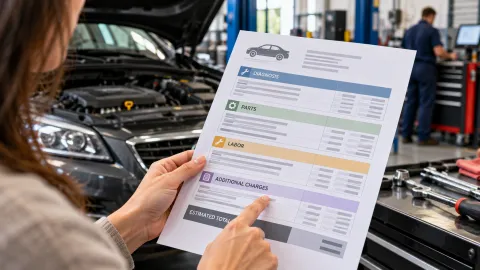
Ask the shop to separate:
-
Labor
-
Parts
-
Shop fees
-
Taxes
-
Recommended maintenance
-
Necessary repairs
-
Inspection findings
-
Optional services
You can also ask whether the work is:
-
Required by the manufacturer's maintenance schedule
-
Recommended because of mileage or vehicle age
-
Needed because of an inspection finding
-
Related to severe driving conditions
-
Preventive or optional
For significant repairs, obtaining a second estimate can help you compare pricing and understand the proposed work.
The goal is not to reject every recommendation. It is to understand what you are paying for and whether the recommendation is supported by your vehicle's condition or maintenance requirements.
How Location Affects Car Maintenance Costs
Car maintenance prices are not identical across the United States.
Local labor rates, operating costs, climate, road conditions, and driving conditions can all affect what a driver pays.
A national estimate is therefore useful as a benchmark, but it should not be treated as a quote for your ZIP code.
For example, two drivers with the same vehicle may receive different labor estimates in different markets. A driver who regularly encounters heavy traffic, extreme weather, rough roads, or other demanding conditions may also have different maintenance needs from someone who drives fewer miles under easier conditions.
When building a personal budget, local estimates are more useful than simply copying a national average.
How to Lower Car Maintenance Costs Without Skipping Necessary Service
Reducing maintenance costs does not mean postponing every service that costs money.
In many cases, the better strategy is to prevent avoidable expenses and make informed decisions.
Follow the manufacturer's schedule
Use the owner's manual as your primary guide instead of automatically paying for every service advertised as necessary.
Keep maintenance records
A record of completed services helps prevent unnecessary duplication and makes it easier to identify what is actually due.
Address small problems appropriately
Ignoring a legitimate problem can allow it to become more expensive. At the same time, not every recommendation requires immediate replacement.
Understanding the difference is important.
Compare repair estimates
For significant work, comparing estimates can reveal differences in labor rates, parts, and recommended services.
Take care of tires and brakes
Proper tire maintenance and timely attention to brake problems can help you avoid unnecessary wear and more expensive complications.
Budget before the bill arrives
A maintenance sinking fund can make a predictable large expense easier to handle.
Saving gradually for tires, brakes, and scheduled services is generally easier than treating every large maintenance bill as an emergency.
How to Keep Track of Your Maintenance Costs
A simple record can make future budgeting much more accurate.
Track:
-
Date of service
-
Vehicle mileage
-
Service performed
-
Parts replaced
-
Amount paid
-
Shop used
-
Recommended future work
-
Next expected service
At the end of the year, review the total.
Separate the expenses into scheduled maintenance, wear items, and unexpected repairs. This gives you a much more useful personal benchmark than a generic national average.
For example, if your records show that you spent $750 on scheduled maintenance and $450 on tires during the year, you can recognize that your vehicle-care expenses totaled $1,200 even though you did not receive a $100 bill every month.
That information can help you set a more realistic budget for the following year.
The Best Car Maintenance Budget Is Specific to Your Vehicle
There is value in knowing the average car maintenance cost, but an average cannot tell you exactly what your car will cost to maintain.
Published estimates vary because they may use different definitions and include different expenses. Some focus on scheduled maintenance, while others combine maintenance with repairs, tires, or broader vehicle ownership costs.
For your own budget, start with your manufacturer's maintenance schedule. Then estimate upcoming routine services, account for wear items such as tires and brakes, and maintain a separate reserve for unexpected repairs.
A useful formula is:
Expected scheduled maintenance + expected wear items + repair reserve = annual vehicle-care budget
Then divide the annual target by 12 to create a monthly sinking-fund amount.
That approach turns an uncertain national average into a practical budget based on your actual vehicle, mileage, maintenance history, and driving situation.
Conclusion
Car maintenance costs are best understood as a range rather than a single number. A broad benchmark can help you start planning, but the amount you actually spend depends on your vehicle, mileage, age, maintenance history, driving conditions, location, and the services or repairs needed during a particular year.
The most useful budgeting approach is to separate scheduled maintenance from normal wear items and unexpected repairs. Use your owner's manual to identify upcoming maintenance, estimate future tire and brake expenses, and keep a separate reserve for repairs that cannot be predicted.
Once you have an annual estimate, divide it by 12 and treat the result as a monthly sinking-fund target—not a prediction of what you will spend every month.
That gives you a more realistic way to prepare for vehicle expenses while avoiding the mistake of treating someone else's average maintenance cost as a fixed price for your own car.
Frequently asked questions
Is $100 a month enough for car maintenance?
$100 a month equals $1,200 a year and can be a useful budgeting example for some drivers, but it is not a universal maintenance amount. Your actual budget can vary based on the vehicle's age, mileage, maintenance history, annual driving, wear items, location, and expected repairs.
Are maintenance and repair costs the same?
No. Routine maintenance is scheduled work intended to keep a vehicle operating properly. Repairs address problems that have developed. Wear items such as tires and brake components can be considered separately because they wear out through normal use.
Does car maintenance cost more as a car gets older?
It can, but there is no universal age-based formula. Older or higher-mileage vehicles may require more attention and repairs, but actual costs depend on the vehicle's condition, maintenance history, mileage, driving conditions, and upcoming manufacturer-recommended service.
Are EVs cheaper to maintain than gas-powered cars?
EVs can have fewer conventional maintenance requirements because they do not need some services associated with gasoline engines. However, actual costs vary by vehicle, service needs, tires, driving conditions, and other factors. Historical DOE data can provide structural context, but should not be treated as a 2026 price estimate.
How much should I save for unexpected car repairs?
There is no single amount that works for every driver. A practical approach is to maintain a separate repair reserve in addition to the money set aside for expected maintenance and wear items. The appropriate reserve depends on the vehicle's age, condition, mileage, repair history, and your ability to absorb an unexpected bill.
Does where I live affect car maintenance costs?
Yes. Labor rates, local operating costs, climate, road conditions, and driving conditions can affect what drivers pay for maintenance and repairs. National averages should therefore be treated as benchmarks rather than exact prices for every location.
Should tires and brakes be included in a car maintenance budget?
They should generally be considered when building a realistic vehicle-care budget because they are normal wear items. However, they do not occur at the same frequency as routine services, so it is useful to estimate their expected cost over time rather than treating them as a fixed monthly expense.
Why do different websites report different average car maintenance costs?
1. Different sources may define maintenance differently. One estimate may focus on scheduled maintenance, while another may include repairs, tires, or other vehicle expenses. Vehicle type, age, mileage, location, and the time period used for the estimate can also produce different results.

Olivia Bennett writes practical automotive content covering car buying, ownership costs, maintenance, vehicle features, reliability, and everyday driving decisions. Her work focuses on helping readers understand automoti...