Car Dealer Fees Explained: Which Fees Are Required, Negotiable, or Optional in 2026
Learn how to identify car dealer fees, separate government charges from dealer-controlled and optional costs, understand 2026 FTC pricing guidance, compare dealer quotes, and review the real out-the-door price before signing.
In this article
- Can a Car Dealer Charge More Than the Advertised Price?
- What the FTC Says About Advertised Car Prices
- What Generally Has to Be Included
- What Can Be Excluded
- Why the Advertised Price Matters
- Why the Dealer's Price May Be Higher Than the Advertisement
- Taxes, Title and Registration
- Mandatory Dealer Fees
- Documentation Fees
- Optional Add-Ons
- Conditional Rebates and Discounts
- Financing-Related Conditions
- The Advertised Vehicle Is No Longer Available
- Mandatory Dealer Fees vs. Government Charges
- What Is an Out-the-Door Price?
- What to Do If the Dealer Wants More Than the Advertised Price
- 1. Save the Advertisement
- 2. Confirm the Exact Vehicle
- 3. Ask for an Itemized Written Price
- 4. Separate Mandatory Charges From Optional Products
- 5. Check Rebate and Financing Conditions
- 6. Compare the Written Numbers With the Advertisement
- 7. Do Not Sign Until You Understand the Numbers
- 8. Preserve Your Records
- How to Check a Car Price Before Visiting the Dealership
- What If the Price Difference Appears Deceptive?
- State Laws Can Add Additional Protections
- A Simple Price-Checking Framework for Car Buyers
- Advertisement
- Exact vehicle
- Conditions
- Written price
- Charge categories
- Add-ons
- Rebates
- Financing
- Final paperwork
- Records
- Common Mistakes Buyers Make
- The Bottom Line
Seeing a car advertised for one price and then being shown a higher number at the dealership can be frustrating. Sometimes the difference comes from legitimate government charges or other conditions that were clearly disclosed. Other times, the higher amount may include dealer-required fees, add-ons, or pricing conditions that were not clear from the advertisement.
The important point is that a final amount higher than the advertised vehicle price is not automatically unlawful. What matters is why the price is higher, what the advertisement represented, and whether the additional charges or conditions were properly disclosed.
For U.S. car buyers, the Federal Trade Commission (FTC) has emphasized that automobile advertising must not be misleading to a reasonable consumer. Its current automobile pricing-transparency guidance explains how advertised prices and dealer-required fees should generally be treated.
This guide explains what an advertised car price means, which charges may legitimately be added, how rebates and financing conditions can affect a deal, and what you can do if the price you were shown at the dealership does not match the advertisement.
Can a Car Dealer Charge More Than the Advertised Price?
A dealer may be able to charge more than the advertised vehicle price when the additional amount represents a legitimate charge that is not required to be included in the advertised price, such as certain government-required charges that the consumer pays directly.
But the situation is different when the dealer advertises a vehicle at a particular price and then requires the buyer to pay additional dealer-controlled fees to purchase that vehicle.
The FTC's automobile pricing-transparency guidance says that an advertised price should generally represent the actual price any consumer can pay for the advertised vehicle, excluding government-required charges that the government requires the consumer to pay directly.
The distinction is important.
Suppose a vehicle is advertised at a certain price. At the dealership, the buyer is told that the advertised amount is only the starting point and that additional mandatory dealer fees must be paid before the vehicle can be purchased. Those dealer-required charges can be relevant to whether the advertised price accurately represents the actual price available to the consumer.
By contrast, taxes, title fees, registration fees, or other government-required amounts may increase the buyer's total amount due even though they are not necessarily part of the advertised vehicle price.
That is why simply comparing the advertisement with the final check or financing amount does not tell the entire story.
The first step is to identify what caused the difference.
What the FTC Says About Advertised Car Prices
The FTC's automobile pricing-transparency FAQs provide guidance for the automobile industry on applying the FTC Act to vehicle advertising and pricing.
The FTC's basic concern is the overall impression an advertisement creates for a reasonable consumer. An advertisement should not present a price that appears to be available to consumers when important conditions or mandatory charges make that price unavailable in practice.
The FTC has also emphasized that automobile pricing transparency is not a completely new concept. The underlying requirement that advertising not be deceptive comes from the FTC Act and has existed for decades.
The September 2026 FTC FAQs are staff guidance, not a standalone federal regulation. They explain the FTC staff's view of how existing law generally applies to automobile pricing situations, while the circumstances of a particular advertisement still matter.
What Generally Has to Be Included
Under the FTC's current guidance, if a dealer requires a consumer to pay a fee in order to purchase the vehicle, that required fee generally needs to be reflected in the advertised price.
This can include dealer-required charges even when the dealer describes them using different names.
For example, a fee could be described as a documentation charge, processing fee, administrative fee, or another dealer-imposed charge. The important question is not simply what the dealer calls it. The important question is whether the dealer requires the consumer to pay it to purchase the vehicle.
The FTC guidance also addresses fees that a government may authorize but does not require the consumer to pay directly, as well as certain amounts a government requires a dealer to pay that the dealer then passes on to consumers.
That distinction is useful because a fee does not necessarily become a government charge simply because the dealer says that it is related to a government requirement.
What Can Be Excluded
Government-required charges that the government requires the consumer to pay directly can generally be excluded from the advertised vehicle price under the FTC's guidance.
These can include certain taxes, title charges, and registration-related amounts, depending on the applicable government requirements.
This is one reason the advertised vehicle price should not automatically be treated as the same thing as the buyer's final out-the-door amount.
A buyer may see a vehicle advertised at one price and still legitimately owe additional government charges when completing the transaction.
The key is transparency about what those charges are and why they apply.
Why the Advertised Price Matters
An advertised price is important because consumers often use it to decide whether to visit a dealership, contact a dealer, or compare one vehicle with another.
If a buyer sees a vehicle advertised at a particular price, travels to the dealership expecting that price, and then learns that mandatory dealer-controlled charges substantially increase the price, the advertisement may create a misleading impression.
The FTC warned 97 auto dealership groups in March 2026 about deceptive automobile pricing practices and emphasized that advertised prices should match the actual prices charged, including mandatory fees that consumers must pay.
That makes it especially important for buyers to look beyond the large price displayed in an advertisement and check the conditions attached to it.
Why the Dealer's Price May Be Higher Than the Advertisement
There are several different reasons a dealer's final price may be higher than the advertised vehicle price. They should not all be treated the same way.
Taxes, Title and Registration
Government charges are one of the most straightforward reasons the final amount can exceed the advertised vehicle price.
Depending on the transaction and state, the buyer may have to pay taxes, title charges, registration fees, or other government-required amounts.
These charges are different from a dealer deciding to add its own mandatory fee.
When reviewing a price, ask the dealer to identify each government charge separately rather than grouping everything into one unexplained number.
Mandatory Dealer Fees
Dealer-required fees deserve closer attention.
If a fee is mandatory and the consumer must pay it to purchase the vehicle, it may need to be included in the advertised price under the FTC's current guidance.
For example, imagine a dealer advertises a specific vehicle at a certain price but later tells the buyer that every customer must pay an additional dealer processing fee.
The buyer should ask:
- Is the fee mandatory?
- Who receives the fee?
- Is it required by the government or imposed by the dealer?
- Was it already included in the advertised price?
- Is it disclosed clearly in the advertisement?
The answers can help distinguish a legitimate additional government charge from a dealer-required charge that may have been omitted from the advertised price.
Documentation Fees
Documentation fees are another area buyers should examine carefully.
A documentation or administrative fee may have different rules depending on the state and transaction. But if a dealer requires the consumer to pay the fee to purchase the vehicle, the FTC's pricing-transparency guidance makes the fee relevant to the advertised price.
Instead of focusing only on the name of the fee, focus on whether the dealer requires it.
A written, itemized price makes this much easier to evaluate.
Optional Add-Ons
Dealerships may offer products and services such as protection packages, service contracts, accessories, or other optional products.
An optional product is different from a mandatory charge.
If the buyer does not want an optional product, the buyer should ask whether it can be removed and whether the advertised vehicle price changes as a result.
Be particularly careful when an optional product is presented as though it is required for every buyer.
Before signing, review the paperwork for products you did not specifically request.
Conditional Rebates and Discounts
An advertised price may depend on a rebate or discount with eligibility requirements.
For example, a discount could be connected to a particular customer qualification, program, or other condition. If the buyer does not qualify, the lower price may not be available.
That does not mean every conditional discount is automatically deceptive. The important issue is whether the condition is clearly disclosed and whether the advertisement gives consumers a reasonable understanding of who can actually receive the advertised price.
When you see a particularly low advertised price, look for conditions attached to the offer.
Financing-Related Conditions
Financing can make a vehicle transaction more complicated because the price of the vehicle and the cost of borrowing are separate issues.
A dealer may advertise a vehicle with a financing-related condition. Buyers should therefore examine whether the advertised vehicle price depends on using dealer-arranged financing or meeting another financing condition.
The Consumer Financial Protection Bureau explains that, with dealer-arranged financing, a financial institution provides the dealer with a buy rate. The interest rate offered to the consumer may be higher, and that difference can compensate the dealer.
This means buyers should not evaluate a vehicle solely by looking at the monthly payment.
Compare the vehicle price, financing terms, interest rate, loan amount, and total borrowing cost separately.
A lower advertised vehicle price does not necessarily mean the overall transaction is cheaper if the financing terms are less favorable.
The Advertised Vehicle Is No Longer Available
Another situation occurs when a buyer arrives at a dealership and is told that the advertised vehicle has already been sold.
A vehicle can legitimately become unavailable. But buyers should pay attention to what happens next.
If the dealer immediately attempts to move the buyer to a different vehicle at a higher price, the buyer should confirm that the original advertised vehicle was actually the vehicle described in the advertisement and ask for clarification about its availability.
Save the original advertisement before visiting whenever possible.
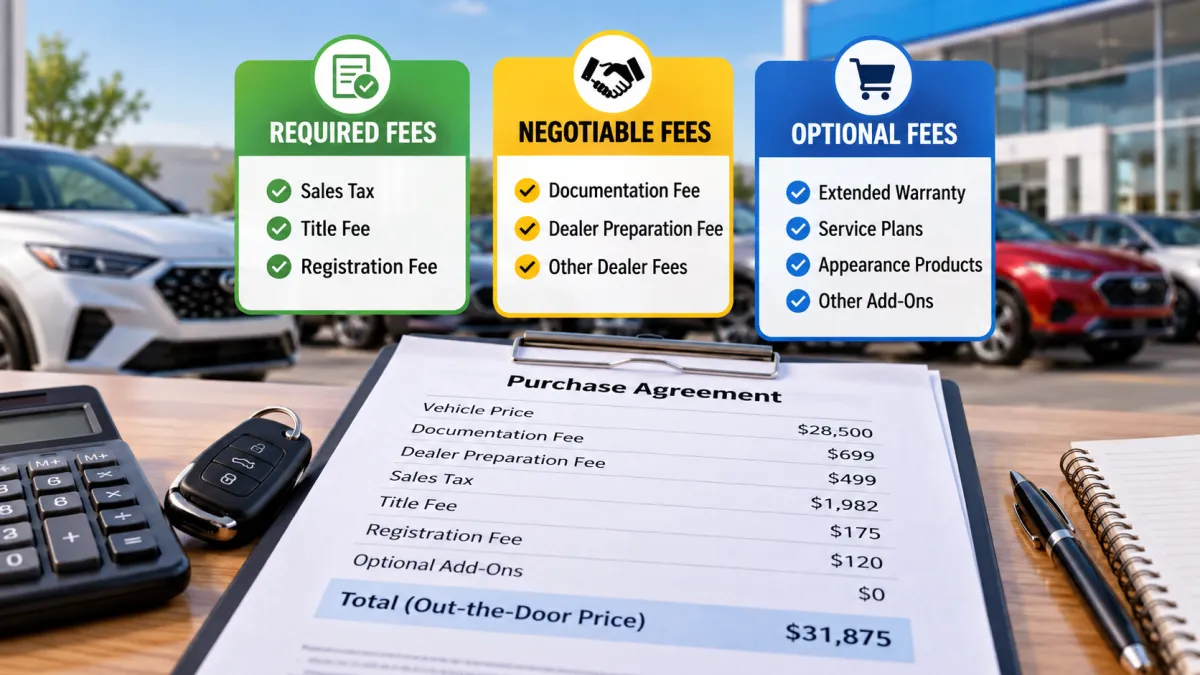
Mandatory Dealer Fees vs. Government Charges
One of the most useful ways to analyze a price discrepancy is to separate charges into categories.
This framework helps prevent a common mistake: treating every additional dollar as either legitimate or illegal without first determining what the charge represents.
The reason for the difference matters.
What Is an Out-the-Door Price?
The out-the-door price is the amount a buyer expects to pay to complete the vehicle purchase after accounting for the relevant components of the transaction.
It is useful because the advertised vehicle price alone may not show the entire financial commitment.
When requesting an out-the-door price, ask the dealer to provide the numbers in writing and identify the components separately.
A useful breakdown should make it possible to distinguish:
- Vehicle price
- Dealer-required fees
- Government charges
- Optional products or services
- Trade-in credits, if applicable
- Down payment or other payment information
- Financing terms, if financing is involved
The exact charges will vary by transaction and location, so the goal is not to force every purchase into the same formula. The goal is to make the numbers understandable before you agree to the transaction.
What to Do If the Dealer Wants More Than the Advertised Price
If the price changes when you arrive at the dealership, slow the transaction down rather than immediately negotiating over the final number.
1. Save the Advertisement
Keep a screenshot, printout, PDF, text message, email, or other record showing the advertised price.
If it is an online advertisement, save the page as soon as possible because online listings can change or disappear.
Make sure the record includes the vehicle description and any visible conditions attached to the offer.
2. Confirm the Exact Vehicle
Make sure the advertisement actually refers to the vehicle you are discussing.
Vehicle identification information can help establish whether the advertisement describes the same vehicle, particularly when a dealer has multiple similar vehicles.
Do not assume that a similar model, trim, color, or vehicle is the same vehicle.
3. Ask for an Itemized Written Price
Do not rely solely on a salesperson's verbal explanation.
Ask for an itemized price showing the vehicle amount and each additional charge.
A written breakdown makes it easier to identify whether the difference comes from taxes, registration, dealer fees, optional products, discounts, or financing.
4. Separate Mandatory Charges From Optional Products
Go through every additional line item.
Ask which charges are mandatory and which products or services are optional.
If an add-on was not something you requested, ask why it appears on the paperwork and whether it can be removed.
You do not have to treat every line on a buyer's order as though it has the same status.
5. Check Rebate and Financing Conditions
If the advertised price depends on a discount, ask exactly what makes a customer eligible.
If financing is involved, ask whether the advertised vehicle price depends on using dealer-arranged financing and separately review the financing terms.
The Consumer Financial Protection Bureau recommends comparing financing options, including financing available directly through banks or credit unions.
Getting financing information before visiting a dealership can also give you a useful comparison point.
6. Compare the Written Numbers With the Advertisement
Place the advertisement and the written price side by side.
Look for the specific reason the numbers differ.
For example, a difference caused by a government charge is not the same as a difference caused by a mandatory dealer fee. Similarly, an optional product that appears on the paperwork should not be confused with a government-required charge.
This simple comparison can turn a confusing price discussion into a specific list of questions.
7. Do Not Sign Until You Understand the Numbers
A dealership transaction can involve several documents, including purchase and financing paperwork.
Read the numbers before signing.
If the final paperwork contains charges or products you do not understand, ask for an explanation and request corrections where appropriate.
There is no advantage to pretending you understand a charge simply because the transaction is taking a long time.
If the price no longer makes sense to you, you can pause and reconsider the purchase.
8. Preserve Your Records
Keep copies of the advertisement, emails, text messages, written quotes, buyer's order, contracts, and other relevant documents.
These records can help you understand what happened later and can be important if you decide to raise a complaint.
The FTC specifically encourages consumers reporting potentially deceptive practices to provide supporting documentation, such as advertisements and contracts.
How to Check a Car Price Before Visiting the Dealership
A few minutes of preparation can make an in-person dealership visit much easier.
Start by saving the advertisement and recording the exact vehicle information.
Then check:
- The advertised vehicle price
- Any conditions attached to the price
- Rebate or discount eligibility
- Whether financing is required
- Whether a trade-in is required
- Whether a particular down payment is required
- Any dealer-required fees disclosed in the advertisement
- Whether optional products are mentioned
- Whether the vehicle is still available
Next, request a written out-the-door price before committing to the visit when the dealer is willing to provide one.
You can also ask the dealer to identify which amounts are government charges and which are dealer charges.
This does not guarantee that every transaction will proceed exactly as expected, but it gives you a much clearer basis for comparison.
What If the Price Difference Appears Deceptive?
Not every pricing dispute is a federal enforcement matter, and a difference between an advertised price and a final amount does not automatically prove that a dealer violated the law.
Start by documenting the facts.
Save the advertisement and compare it with the paperwork. Identify exactly which charge or condition caused the difference.
If you believe the advertisement or pricing practice was deceptive, you can consider reporting the matter to the FTC through ReportFraud.ftc.gov.
State consumer-protection agencies and other state authorities may also have relevant complaint processes.
Because automobile sales rules can vary by state, a consumer should check the requirements that apply where the transaction takes place.
State Laws Can Add Additional Protections
Federal consumer-protection principles provide an important baseline, but state law can provide additional automobile sales protections.
California is a useful current example.
California's Combating Auto Retail Scams Act, known as the CARS Act, takes effect October 1, 2026, and establishes additional requirements for covered automobile sales and leases. Among other provisions, the law addresses advertised pricing and requires a "Total Price" in certain advertisements or initial written communications involving a specific vehicle or financing terms.
It also addresses representations concerning the cost and availability of vehicles.
California is only one state, however. Its requirements should not be treated as a nationwide rule.
If you are dealing with a pricing dispute, check the consumer-protection and motor-vehicle requirements in your own state rather than assuming another state's rules apply to your transaction.
A Simple Price-Checking Framework for Car Buyers
When an advertised price and a dealership's price do not match, use this sequence:
Advertisement → Exact vehicle → Conditions → Written price → Charge categories → Add-ons → Rebates → Financing → Final paperwork → Records
This approach is more useful than simply asking whether the dealer "can" charge more.
Advertisement
What price was actually advertised?
Exact vehicle
Does the advertisement describe the exact vehicle being offered?
Conditions
Was the price subject to financing, rebates, customer eligibility, a trade-in, or another condition?
Written price
Can the dealer provide the actual price in writing?
Charge categories
Which amounts are government-required charges and which are dealer-required charges?
Add-ons
Are optional products or services included?
Rebates
Do you qualify for every discount used to reach the advertised price?
Financing
What are the interest rate, loan terms, and total financing cost?
Final paperwork
Does the contract match what you agreed to?
Records
Do you have copies of the advertisement and the documents showing what you were offered?
This process does not require a buyer to know every automobile regulation. It simply creates a clear record of how the advertised price became the final transaction amount.
Common Mistakes Buyers Make
One of the biggest mistakes is focusing only on the large number displayed in an online listing.
A low advertised price may have conditions that need to be examined.
Another mistake is treating every additional charge as a hidden fee. Some additional amounts may be legitimate government charges that are separate from the advertised vehicle price.
Buyers also sometimes focus on monthly payments instead of the complete transaction. A monthly payment can be affected by the loan amount, interest rate, loan term, down payment, trade-in, and other factors.
Finally, buyers may wait until after signing to look closely at the paperwork.
It is much easier to question a charge before signing than to try to reconstruct the transaction afterward.
The Bottom Line
A car dealer may be able to charge more than the advertised vehicle price, but the reason for the difference matters.
Government-required charges that consumers must pay directly can be treated differently from dealer-required fees. Optional add-ons are different from mandatory charges. Rebates can have eligibility conditions. Financing can change the overall cost of a purchase without being the same thing as the vehicle's advertised price.
The safest approach is to look beyond the headline number.
Save the advertisement, confirm the exact vehicle, ask for an itemized written price, separate government charges from dealer-required fees, question optional products, check rebate conditions, and review financing separately. Do not sign until the numbers and products in the paperwork are clear.
If the advertised price and the dealer's price do not match, focus first on identifying exactly why they are different. That gives you a much stronger basis for deciding whether to continue the purchase, negotiate, walk away, or seek help from the appropriate consumer-protection authority.
Frequently asked questions
Are car dealer fees negotiable?
Some dealer-controlled fees may be negotiable, but not every charge can be negotiated. Government-set taxes, title, and registration charges are generally not negotiable. Whether a dealer fee can be reduced depends on the fee, the dealer, and applicable state rules.
Can a dealer charge a fee that was not included in the advertised price?
Under current FTC staff guidance, a dealer-required fee generally must be included in the advertised price. Certain government-required charges that the consumer must pay directly may be excluded. Buyers should compare the advertised price with the written purchase details and ask about any additional charge.
What is the difference between a dealer fee and a government fee?
A government fee is imposed or required by a government authority, such as applicable taxes, title, or registration charges. A dealer fee is a charge imposed by the dealership, such as a documentation or preparation fee. Their treatment and negotiability can differ.
Can I refuse dealer add-ons?
Optional dealer add-ons are different from required purchase charges. If an add-on is genuinely optional, a buyer can generally decline it. Buyers should ask whether each product or service is required and review how accepting it would change the total price and amount financed.
What is an out-the-door price?
An out-the-door price is the overall amount needed to complete the vehicle purchase after accounting for the vehicle price and applicable taxes, title, registration, dealer fees, and other agreed charges. Asking for the complete written price makes it easier to compare dealers.
Why do car dealer fees vary by state?
Dealer fees can vary because states have different laws, disclosure requirements, fee rules, taxes, and registration systems. A fee or limitation that applies in one state should not automatically be assumed to apply nationwide.
Do dealer fees increase my car loan?
If dealer fees or optional products are included in the amount financed, they can increase the amount borrowed and potentially increase the total cost of the loan. Buyers should compare the cash price and financing terms separately.
What should I do if a dealer adds an unexpected charge?
1. Ask the dealer to identify the charge, explain who requires it, and show where it was disclosed. Compare it with the advertised price and written quote, and ask whether it is required or optional before agreeing to pay it.

Olivia Bennett writes practical automotive content covering car buying, ownership costs, maintenance, vehicle features, reliability, and everyday driving decisions. Her work focuses on helping readers understand automoti...