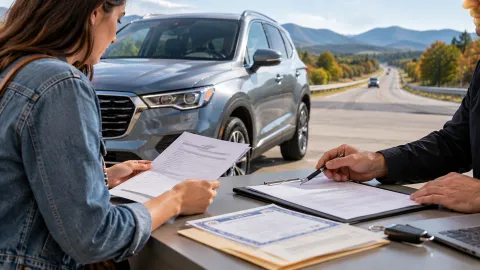
Can You Return a Used Car After Buying It From a Dealer?
Learn when you may be able to return a used car after buying it from a dealer, why the three-day return rule is often misunderstood, and how dealer policies, warranties, financing, and state law can affect your options.
In this article
- There Is Usually No Automatic Right to Return a Used Car
- Check the Dealer's Return Policy First
- The Three-Day Rule Is Commonly Misunderstood
- What If You Simply Changed Your Mind?
- A Serious Mechanical Problem Is a Different Situation
- What the Buyers Guide Tells You
- What "As Is" Means
- What If the Dealer Misrepresented the Vehicle?
- Lemon Laws May Apply in Some Situations — But They Are Not a General Return Rule
- Financing Problems Are a Separate Issue
- What to Do Immediately If You Want to Return the Car
- 1. Stop relying on verbal conversations
- 2. Gather every document
- 3. Identify the reason for the return request
- 4. Review the Buyers Guide
- 5. Contact the dealer promptly
- 6. Preserve the vehicle's condition
- What If the Dealer Refuses?
- Return, Repair, Refund, or Another Remedy?
- Don't Assume "No Return" Means "No Rights"
- When It May Be Worth Getting Legal Help
- The Bottom Line
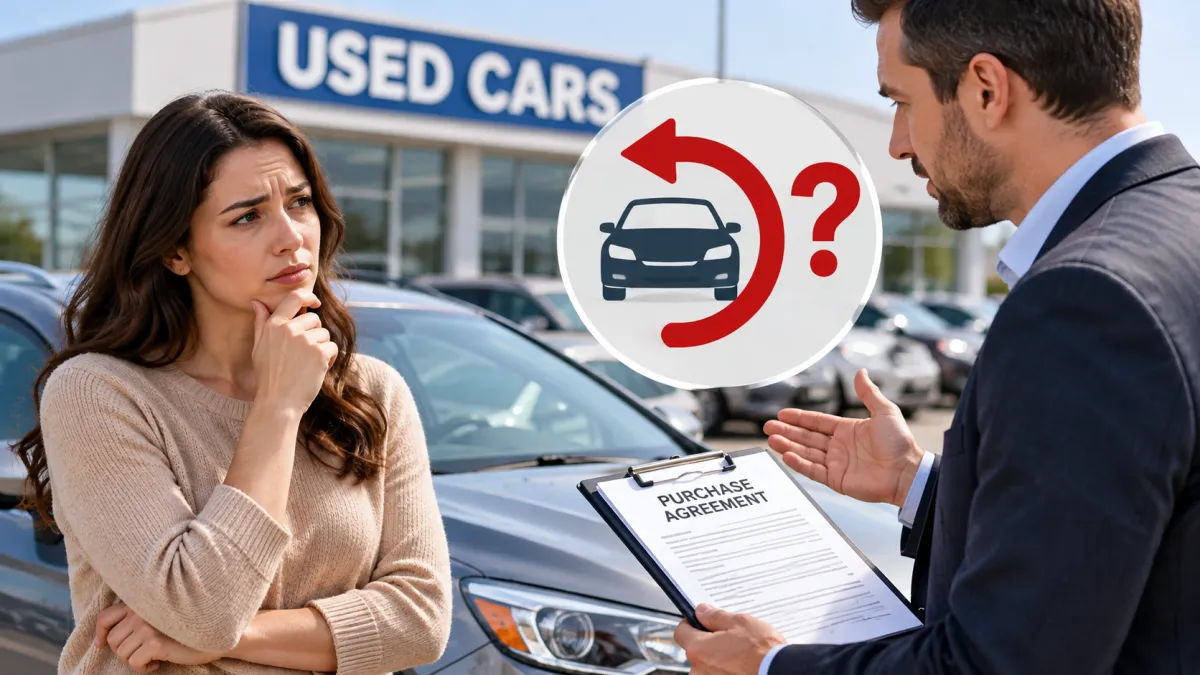
If you recently bought a used car from a dealership and are already wondering whether you can take it back, the answer is not as simple as yes or no.
In the United States, there is no general federal three-day right to cancel a used-car purchase made at a dealership. Whether you can return the vehicle may instead depend on the dealer's written return policy, the law in your state, the terms of your purchase agreement, the vehicle's warranty, and what happened after the sale.
That distinction matters because several different situations can look like a "car return" problem but involve very different rights. A buyer who simply regrets the purchase is in a different position from someone who discovers a serious defect, was given misleading information about the vehicle, or learns that financing was never finalized.
The most useful way to approach the problem is to identify why you want to return the car and which legal or contractual pathway, if any, applies.
There Is Usually No Automatic Right to Return a Used Car
Many consumers have heard that they have three days to change their mind after making a major purchase. That rule does not generally apply to a vehicle purchased from a dealership.
The Federal Trade Commission says federal law does not require dealers to give consumers three days to cancel a vehicle purchase and return the car. Some states have their own cancellation requirements, while in other situations a return period exists only because the dealer voluntarily offers one.
This means that driving a car home and deciding the next day that you do not like it does not, by itself, create a nationwide federal right to undo the transaction.
Your first step should therefore be to determine what documents and rules actually govern your transaction.
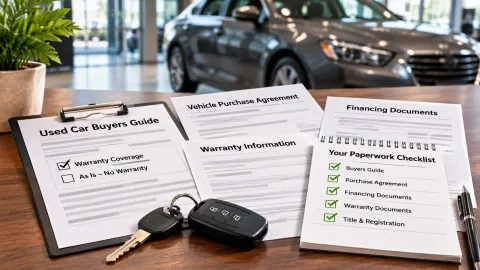
Look for:
-
A written dealership return or exchange policy
-
The signed purchase or sales agreement
-
The Buyers Guide
-
Any written warranty
-
A service contract, if you purchased one
-
Financing documents
-
Written promises made by the dealer
-
Records of communications about the vehicle
-
Documents describing the vehicle's condition or history
The answer may be found in those documents rather than in a general "three-day rule."
Check the Dealer's Return Policy First
Some dealerships voluntarily offer a return period, money-back guarantee, or exchange program. If your dealer offered one, the specific terms matter.
The FTC recommends asking about a dealer's return policy before buying, getting the policy in writing, and reading it carefully. Dealers in some states may also be required to provide a cancellation right under state law.
A dealership return policy may contain conditions such as:
-
A limited number of days or miles
-
Requirements about the vehicle's condition
-
Restrictions on modifications
-
A requirement to return the vehicle to the same dealership
-
Rules concerning trade-ins
-
Limits on refunds
-
Exclusions for certain vehicles or transactions
-
Requirements concerning financing or documentation
Do not assume that a dealer's salesperson's statement is the same thing as a formal return policy.
For example, a salesperson might casually say, "If you don't like it, talk to us." That is not necessarily the same as a written promise that you can return the vehicle for a full refund.
If a dealer has promised a return option, preserve the written evidence. Keep copies of the policy, emails, text messages, advertisements, and signed documents.
The Three-Day Rule Is Commonly Misunderstood
The federal FTC Cooling-Off Rule is one reason people sometimes believe every major purchase can be canceled within three days.
The rule does provide a three-business-day cancellation period for certain sales made at a consumer's home, workplace, dormitory, or certain temporary locations. But it contains important exclusions and does not create a general three-day cancellation right for ordinary dealership car purchases.
In particular, the rule excludes certain transactions involving vehicles and does not turn every car purchase into a three-day trial period.
The key distinction is where and how the transaction occurred.
A normal purchase completed at a dealership's permanent place of business is not automatically covered simply because the buyer changes their mind shortly afterward.
That is why the statement "you always have three days to return a car" is misleading.
If your transaction occurred somewhere other than the dealership, the circumstances may deserve closer examination. But you should not assume that the federal Cooling-Off Rule applies without checking the actual requirements and exclusions.
State law may provide additional protections, which is another reason a state-specific review can matter.
What If You Simply Changed Your Mind?
Buyer’s remorse is one of the most common reasons someone wants to return a recently purchased car.
Maybe you found another vehicle you like better. Maybe the monthly payment feels too high. Maybe you realize the car is larger or smaller than you expected. Or perhaps you simply regret making such a large purchase.
Those circumstances do not automatically create a legal right to cancel the transaction.
If the dealer has no applicable return policy and your state does not provide a cancellation right for your situation, you may not be entitled to return the car merely because you changed your mind.
That does not mean you have no options.
You can still ask the dealership whether it will voluntarily unwind the transaction or offer an exchange. But that is different from claiming that federal law automatically requires the dealer to take the vehicle back.
Before making that request, review the paperwork so you know exactly what you agreed to.
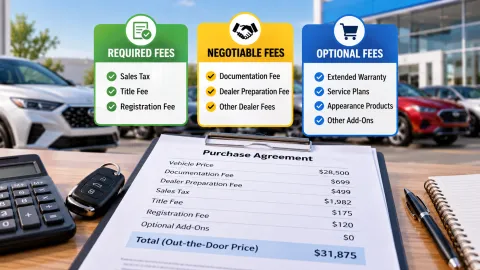
You may also want to understand the financial consequences. Returning or trading the car may affect your down payment, trade-in, loan balance, taxes, registration costs, fees, and other amounts associated with the original transaction.
A voluntary solution from the dealer is therefore something to negotiate carefully rather than something to assume is guaranteed.
A Serious Mechanical Problem Is a Different Situation
A vehicle that develops a serious problem shortly after purchase raises a different set of questions.
The important issue is not simply whether the car broke down. You need to determine what protection, if any, applies to that problem.
Start with the Buyers Guide and warranty documents.
The FTC's Used Car Rule requires covered dealers to provide a Buyers Guide that tells consumers whether the vehicle is being sold "as is" or with a warranty and provides other information about warranty coverage. The Guide is intended to help buyers understand important aspects of the vehicle and the dealer's warranty obligations.
If the vehicle has a warranty, determine:
-
What parts or systems are covered
-
How long coverage lasts
-
Whether there is a mileage limit
-
What repair costs are covered
-
Where repairs must be performed
-
What procedure you must follow to request warranty service
-
Whether the warranty is from the dealer, manufacturer, or another company
A warranty does not necessarily mean you can immediately return the vehicle for a refund.
In many situations, the initial remedy is repair according to the warranty's terms. Whether a buyer can eventually seek a refund or replacement depends on the warranty, applicable law, and the circumstances of the problem.
This is why "the car broke down" and "I have an automatic right to return the car" are not equivalent statements.
What the Buyers Guide Tells You
The Buyers Guide is one of the most important documents to review after a used-car purchase.
The FTC's Used Car Rule requires covered dealers to display a Buyers Guide on used vehicles offered for sale. The Guide identifies whether the vehicle is being sold "As Is—No Dealer Warranty," with implied warranties where applicable, or with a warranty.
It also provides other information intended to help consumers understand the transaction and vehicle condition.
Keep the final Buyers Guide you received at the time of purchase.
Pay particular attention to whether the final version matches what you were told during negotiations.
The FTC explains that negotiated warranty changes should be reflected on the Buyers Guide. If the Guide says the vehicle comes with a warranty while the sales contract contains conflicting language, the FTC says the Buyers Guide can override contrary provisions in the sales contract.
That makes the final version especially important.
Do not rely solely on what a salesperson remembers saying. Written documentation is much easier to evaluate later.
What "As Is" Means
"As is" is another phrase that often causes confusion.
If a used vehicle is sold "as is," the buyer may be assuming significant responsibility for problems that arise after the sale. But "as is" does not mean that every possible consumer protection automatically disappears.
The effect of an "as is" sale depends in part on state law. Some states allow dealers to sell used vehicles without warranties under specified conditions, while other states restrict or prohibit certain "as is" sales or require particular disclosures.
The FTC's Buyers Guide specifically distinguishes between an "As Is—No Dealer Warranty" sale and other warranty arrangements.
If your vehicle was sold as is, review the exact language rather than assuming the phrase settles every possible dispute.
For example, you may still need to examine whether:
-
The dealer made a written promise
-
The dealer provided a separate warranty
-
A manufacturer's warranty remained in effect
-
You purchased a service contract
-
The vehicle's condition was materially misrepresented
-
State law provides protections that cannot simply be waived
-
The dealer failed to provide required disclosures
An as-is designation can make a defect dispute more difficult, but it should not automatically end the analysis.
What If the Dealer Misrepresented the Vehicle?
A different situation arises when the problem is not ordinary buyer's remorse but potentially misleading information about the vehicle or transaction.
Suppose, for example, that a buyer was told something important about the car and later discovers that the written or physical evidence does not match that representation.
The relevant question may then be whether the dealer made a material misrepresentation or violated applicable consumer-protection requirements.
Potentially important evidence can include:
-
The original advertisement
-
Online vehicle listings
-
The vehicle history report
-
Inspection records
-
Repair records
-
The Buyers Guide
-
Purchase documents
-
Emails and text messages
-
Written statements from the dealer
-
Photographs taken before or immediately after purchase
-
Documentation from an independent mechanic
Do not delete the original listing simply because the dealer's website has changed it.
If you believe the dealer misrepresented a material fact, describe the issue precisely. Instead of simply saying "the car is bad," identify what you were told, what the documents show, what you discovered, and when you discovered it.
That creates a much clearer record of the dispute.
Lemon Laws May Apply in Some Situations — But They Are Not a General Return Rule
Lemon laws are another area where consumers sometimes expect a simple answer.
A lemon-law remedy is not a nationwide rule that lets any used-car buyer return a defective vehicle.
Lemon laws are state-specific and have eligibility requirements. They can differ substantially in who is covered, which vehicles qualify, what defects qualify, how many repair attempts may be required, how long the vehicle must be unavailable for use, and what remedies may be available.
For that reason, a serious defect should not automatically be described as a "lemon" simply because the vehicle has a problem.
Instead, determine whether your state has a used-car lemon law and whether your vehicle and circumstances satisfy its requirements.
Depending on the state and circumstances, a qualifying consumer may have remedies that can include repair, replacement, refund, or other relief. But those remedies depend on the applicable law and facts.
The important distinction is this:
A lemon-law claim is a specific legal remedy, not a general buyer's-remorse return policy.
If you believe the vehicle may qualify, use current information from your state's attorney general or another official state source rather than relying on a generic national summary.
Financing Problems Are a Separate Issue
Sometimes the buyer thinks the car purchase is final, only to learn that the financing arrangement has not been completed as expected.
This situation should be treated separately from an ordinary return request.
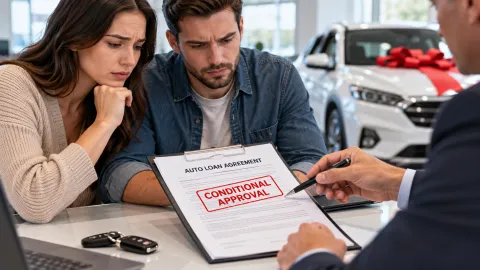
Review the financing agreement and other paperwork to determine whether the financing was finalized, conditional, or subject to additional requirements.
Do not simply stop making payments because you are unhappy with the vehicle or because the dealer has contacted you about financing.
If there is a dispute involving the auto loan, lender, payments, or financing terms, the appropriate remedy may involve the financing agreement rather than a dealership return policy.
USA.gov directs consumers with auto-loan or payment complaints to the Consumer Financial Protection Bureau, while warranty and deceptive-dealer complaints may involve different agencies.
Keep all financing communications with the same care you use for the vehicle purchase documents.
What to Do Immediately If You Want to Return the Car
If you believe you have a reason to return the vehicle, acting quickly can help preserve your options.
1. Stop relying on verbal conversations
Move important communications into writing.
If you speak with the dealer by phone, follow up with an email summarizing what was discussed. Keep copies of emails, texts, and letters.
2. Gather every document
Create one file containing:
-
Purchase agreement
-
Buyers Guide
-
Warranty documents
-
Service contract
-
Financing agreement
-
Trade-in documents
-
Dealer return policy
-
Advertisements
-
Vehicle history information
-
Repair orders
-
Inspection reports
-
Relevant messages and emails
USA.gov also recommends gathering documents such as receipts, warranties, contracts, work orders, and records of communications when preparing a consumer complaint.
3. Identify the reason for the return request
Be specific.
Are you asking because:
-
You changed your mind?
-
The dealer has a return policy?
-
The vehicle has a mechanical defect?
-
The dealer made a representation that appears false?
-
A warranty applies?
-
You believe a state law may provide a remedy?
-
Financing was not finalized?
Different reasons can lead to different remedies.
4. Review the Buyers Guide
Confirm whether the vehicle was sold as is, with a warranty, or under another arrangement.
Compare the final Buyers Guide with your purchase agreement and anything the dealer promised in writing.
5. Contact the dealer promptly
Explain what you are requesting and why.
If you believe you have a contractual or legal basis for cancellation, identify the relevant document or issue rather than simply demanding that the dealership "take the car back."
If the issue involves a defect, ask about the warranty or repair process if that is the applicable route.
6. Preserve the vehicle's condition
If you are pursuing a return, exchange, warranty claim, or other remedy, avoid making unnecessary modifications to the vehicle.
Keep records of mileage, repairs, towing, and other expenses related to the dispute.
What If the Dealer Refuses?
A dealer's refusal does not necessarily mean the matter is over, but it also does not automatically mean the dealer is violating the law.
First determine why the dealer refused.
If you are relying on a voluntary return policy, compare the dealer's decision with the policy's actual terms.
If you are relying on a warranty, determine whether the dealer is refusing a covered repair or whether the problem falls outside the warranty.
If you believe the dealer violated a consumer-protection law, gather the evidence supporting that claim.
If you cannot resolve the issue directly, the appropriate government agency depends on the nature of the complaint. USA.gov currently directs consumers with deceptive dealer issues toward their state consumer protection agency or the FTC; auto-loan complaints may be directed to the CFPB; warranty complaints may involve a state attorney general; and vehicle safety complaints may involve the National Highway Traffic Safety Administration.
A complaint is more useful when it contains organized documentation rather than only a general statement that the dealership treated you unfairly.
Return, Repair, Refund, or Another Remedy?
One of the biggest mistakes consumers make is treating every car problem as a return problem.
The remedy depends on the underlying issue.
| Situation | What to examine first |
|---|---|
| You simply changed your mind | Dealer return policy and applicable state cancellation rules |
| Dealer voluntarily offers a return period | Written return-policy terms |
| Vehicle has a mechanical problem | Buyers Guide, warranty, service contract, and state law |
| Vehicle was sold "as is" | Buyers Guide and state rules governing as-is sales |
| Dealer made a potentially misleading representation | Advertisements, written statements, purchase documents, and consumer-protection law |
| Vehicle may qualify under a lemon law | Current law in your state and eligibility requirements |
| Financing was not finalized or has changed | Financing agreement and communications with the dealer and lender |
| Dealer refuses to resolve a potential legal violation | Organized documentation and appropriate consumer-protection resources |
This framework is useful because the best outcome may not always be a return.
For example, a warranty may provide a repair rather than an immediate refund. A dealer may agree to an exchange under its own policy. A financing dispute may require dealing with the lender. A qualifying legal claim may involve remedies established by state law.
The correct next step depends on the facts.
Don't Assume "No Return" Means "No Rights"
A dealership may tell a buyer that all sales are final or that the vehicle was sold as is.
Those statements may be important, but they should be evaluated against the actual documents and applicable law.
The FTC specifically notes that state law affects how "as is" sales work. In some states, dealers may be permitted to make such sales, while other states impose restrictions or require different disclosures.
Likewise, a dealer's statement that there is "no warranty" should be compared with the final Buyers Guide and other written documents.
If the documents conflict, do not automatically assume the dealer's verbal explanation resolves the issue.
The details matter.
When It May Be Worth Getting Legal Help
A relatively simple buyer's-remorse situation may not require an attorney.
A dispute becomes more complicated when substantial money is involved or when you believe the dealer may have violated a contract or consumer-protection law.
Consider getting qualified legal advice if:
-
The dealer refuses to honor a written promise
-
You believe important facts about the vehicle were misrepresented
-
The vehicle has a serious recurring defect
-
You believe a state lemon law may apply
-
The dealer disputes the meaning of the purchase documents
-
Financing and the vehicle transaction have become entangled
-
You are facing a significant financial loss
-
You are unsure which state law applies
State consumer-protection offices and attorneys general can also be useful starting points for understanding where to direct a complaint. USA.gov maintains information for locating state consumer-protection offices.
This does not mean every disagreement requires a lawsuit. Often, having the documents organized and clearly explaining the problem is the first practical step.
The Bottom Line
You usually cannot rely on a universal three-day federal right to return a used car purchased from a dealership. Federal law does not generally require dealers to provide that kind of cancellation period, although some states and some dealerships may provide return rights.
If you want to return a recently purchased used car, start by identifying why you want to return it.
If it is buyer's remorse, check the dealer's written return policy and state law. If the vehicle has a serious problem, examine the Buyers Guide, warranty, service contract, and applicable state protections. If you believe the dealer misrepresented the vehicle, preserve the evidence and consider consumer-protection remedies. If financing is the problem, review the financing documents separately.
Most importantly, do not assume that phrases such as "three-day rule," "as is," or "lemon" automatically determine the outcome. Each refers to a different legal or contractual concept, and the actual remedy depends on the transaction, the documents, and the law that applies to your situation.
When a dispute develops, act promptly, keep everything in writing, preserve your documents, and use current state and federal consumer resources to determine what options are actually available.
Frequently asked questions
Can you return a used car if you simply changed your mind?
In most cases, simply changing your mind does not automatically give you a right to return a used car. Check the dealer's written return policy, purchase contract, and applicable state law to determine whether a return or cancellation right exists.
Does the three-day cooling-off rule apply when you buy a car from a dealership?
Generally, you should not assume that the federal three-day Cooling-Off Rule gives you three days to return a car purchased from a dealership. The FTC Cooling-Off Rule applies to certain transactions made in specific locations and has exclusions and requirements that make it different from a general dealership vehicle-return rule.
Can you return a used car if it has a serious problem after you buy it?
A serious problem does not automatically create a right to return the vehicle. Your options can depend on the purchase contract, Buyers Guide, warranty, the nature of the defect, and the consumer-protection laws in your state.
Can you return a used car that was sold "as is"?
An "as is" sale can limit certain warranty protections, but it does not mean every possible consumer protection disappears. The effect depends partly on applicable state law and the circumstances of the sale.
Can you return a car if the dealer's financing falls through?
A financing problem is different from ordinary buyer's remorse. If the original financing was conditional or was not finalized, review the financing documents and dealer communications carefully to determine what happened and what rights or obligations may apply.
What should you do if a dealer refuses to take the car back?
Review your purchase agreement, Buyers Guide, warranty and return-policy documents, and keep records of your communications and any vehicle problems. If you believe the dealer violated a contractual or legal obligation, contact the appropriate state consumer-protection agency or seek qualified legal advice.
Does every state have the same used-car return rules?
1. No. State laws and consumer protections can differ, so a rule that applies in one state may not apply in another. Check your state's current consumer-protection or attorney general resources for state-specific requirements.

Olivia Bennett writes practical automotive content covering car buying, ownership costs, maintenance, vehicle features, reliability, and everyday driving decisions. Her work focuses on helping readers understand automoti...