What Happens If You Fail a Professional Certification Exam? Retakes, Waiting Periods, and Fees
Failing a professional certification exam does not always mean starting over. Learn how retakes work, how long you may need to wait, what another attempt can cost, and how retake rules differ for AWS, Microsoft, Google Cloud, PMP, and ISACA certifications.
In this article
- What Happens Immediately After You Fail a Certification Exam?
- Certification Exam Retake Policies: AWS, Microsoft, Google Cloud, PMP, and ISACA
- AWS Certification retake policy
- Microsoft certification exam retake policy
- Google Cloud certification retake policy
- PMP certification exam retake policy
- ISACA certification exam retake policy
- How Much Does It Cost to Retake a Professional Certification Exam?
- Other expenses to consider
- Build a retake budget before registering
- What Happens If You Exhaust All Certification Exam Attempts?
- What Happens When Your Certification Exam Eligibility Expires?
- PMP eligibility
- ISACA eligibility
- Why eligibility matters
- How to Understand Your Failed Certification Exam Score Report
- Look for performance by topic or domain
- Identify patterns in your performance
- Turn the report into a study plan
- What to Do Before Scheduling Your Next Certification Exam
- Step 1: Confirm the exact retake rules
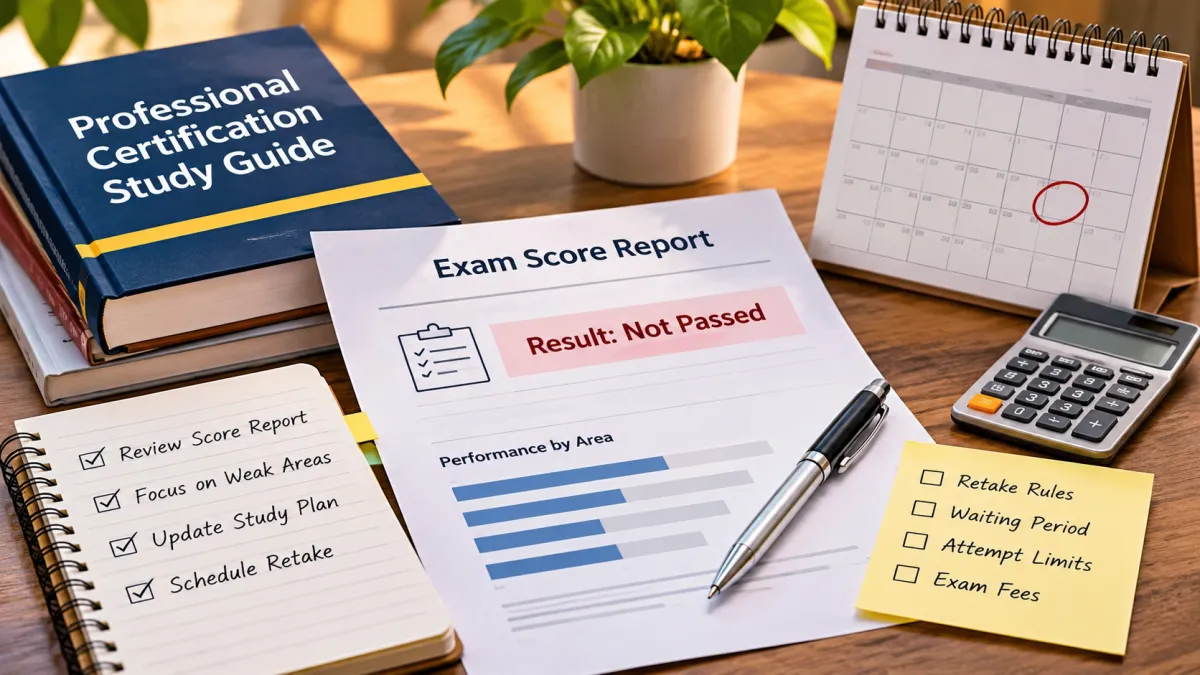
- Step 2: Review your examination result
- Step 3: Identify why you did not pass
- Step 4: Change your preparation approach
- Step 5: Calculate the cost and choose a realistic date
- Step 6: Review your readiness before paying
- When Should You Request a Rescore Instead of Retaking the Exam?
- Common Mistakes to Avoid After Failing a Certification Exam
- Registering again before checking the waiting period
- Assuming every certification has unlimited attempts
- Buying another course without reviewing the score report
- Treating a missed exam as a failed exam
- Ignoring the eligibility deadline
- Repeating the same study method without reviewing mistakes
- Conclusion
Failing a professional certification exam can be disappointing, especially after spending weeks or months preparing. However, an unsuccessful result does not automatically end your opportunity to earn the credential. Many certification providers allow retakes, although the waiting periods, attempt limits, fees, and eligibility rules vary.
What happens next depends on the organization that administers your exam. An AWS certification candidate, for example, can generally retake a failed exam after 14 calendar days, while Google Cloud and Microsoft use different rules depending on the certification or exam category. PMP and ISACA examinations have their own attempt limits and eligibility requirements.
The first step is to review your result and the provider's official retake policy. You should then identify the topics that need more attention, calculate the potential cost of another attempt, and schedule your next exam only when you understand the applicable rules.
This guide explains what happens after an unsuccessful certification attempt, compares retake policies from five major providers, and outlines practical steps to take before registering again.
What Happens Immediately After You Fail a Certification Exam?
When you do not pass a professional certification exam, the provider records the result according to its examination procedures. You may receive a score report, a preliminary result, or information about the areas in which your performance needs improvement.
The exact reporting process depends on the certification organization. Some providers display a preliminary result immediately, while others make the official result available later.
An unsuccessful result generally means you have not earned that certification through the examination. It does not necessarily mean you are permanently disqualified or must repeat every preparation activity from the beginning.
Your next steps should be:
-
Check your official result. Confirm that the provider has recorded the examination as unsuccessful and review any available score report.
-
Read the retake policy. Find the waiting period, attempt limit, registration requirements, and fee for another attempt.
-
Check your eligibility. Some certifications have a limited period in which you must complete the examination.
-
Review your weak areas. Use the available performance information to decide what needs more preparation.
-
Plan the next attempt. Choose a realistic study period and confirm that another examination date is available.
Do not immediately purchase another exam without checking these details. You may need to wait before registering, and some providers count attempts across a defined period.
Certification Exam Retake Policies: AWS, Microsoft, Google Cloud, PMP, and ISACA
There is no universal professional certification exam retake policy. Each provider establishes its own rules, and even one organization may use different policies for different examination categories.
The following comparison covers five widely used certification programs. These are provider-specific examples, not rules that apply to every professional credential.
| Provider | Waiting period after failure | Attempt limit |
|---|---|---|
| AWS Certification | 14 calendar days | No limit on failed attempts |
| Microsoft role-based, specialty, and fundamentals exams | 24 hours after the first failure; 14 days between subsequent attempts | 5 attempts within 12 months |
| Google Cloud foundational exams | At least 14 days between failed attempts | 10 attempts within one year |
| Google Cloud associate and professional exams | 14 days after first failure, 60 days after second, and 365 days after third | 4 attempts within two years |
| PMP | No universal short interval between ordinary attempts stated in the 2026 outline | Up to 3 attempts during the one-year eligibility period |
| Covered ISACA certifications | 30 days before the second attempt, then 90 days between subsequent attempts | 4 attempts in a rolling 12-month period |
The table summarizes the main policies, but it does not replace the provider's complete examination terms. Registration fees, eligibility conditions, exam versions, and special examination categories may have additional requirements.
AWS Certification retake policy
AWS allows candidates who fail a certification examination to try again after waiting 14 calendar days.
There is no limit on the number of failed attempts under the standard AWS retake policy. However, candidates must pay the full registration fee for every attempt.
A few important details:
-
You must wait 14 calendar days after an unsuccessful attempt.
-
There is no fixed maximum number of failed attempts.
-
Each new attempt requires the full registration fee.
-
After passing an exam, you generally cannot retake the same exam for two years.
-
An updated exam with a new exam guide and exam series code may qualify for a new attempt.
AWS also distinguishes a failed examination from a missed appointment. If you do not attend your scheduled exam, you generally forfeit the fee, but the missed appointment is not recorded as a failed examination. AWS states that you cannot register again until 24 hours after the missed appointment time.
For the exact rules, use the AWS Certification FAQ and its After Testing policy.
Microsoft certification exam retake policy
Microsoft's retake rules depend on the type of examination. The standard policy for role-based, specialty, and fundamentals exams is different from the policies for other Microsoft assessments.
For role-based, specialty, and fundamentals examinations:
-
After the first unsuccessful attempt, you must wait 24 hours before retaking the exam.
-
A 14-day waiting period applies between subsequent attempts.
-
You may take the same exam no more than five times within a 12-month period, counted from the first attempt.
-
After five unsuccessful attempts, you become eligible to retake that exam again 12 months after your first attempt.
These rules should not automatically be applied to Microsoft Office Specialist (MOS), Microsoft Certified Educator (MCE), beta exams, renewal assessments, or Applied Skills labs. Those categories have separate policies.
For example, Microsoft Applied Skills assessments use lab-based evaluation and have their own rules for interrupted or cancelled assessments. Candidates should check the relevant policy rather than assuming that the standard role-based exam rules apply.
Before registering again, review the official Microsoft exam and Applied Skills assessment lab retake policies.
Google Cloud certification retake policy
Google Cloud separates its retake rules by certification level. Foundational examinations have a different attempt limit from associate and professional examinations.
For foundational certifications:
-
Candidates can make up to 10 attempts within a one-year period.
-
A minimum waiting period of 14 days applies between failed attempts.
For associate and professional certifications:
-
The maximum is four attempts within a two-year period.
-
After the first failure, you must wait 14 days before attempting the exam again.
-
After the second failure, the waiting period before the third attempt is 60 days.
-
After the third failure, you must wait 365 days before the fourth attempt.
Google Cloud also requires payment each time you register for an examination.
Changing the examination language or delivery method does not create a separate attempt allowance. Attempts count toward the applicable limit regardless of language or whether the examination is taken online or at a testing center.
Review the Google Cloud exam terms and conditions before scheduling another attempt.
PMP certification exam retake policy
The Project Management Professional (PMP) examination is administered by the Project Management Institute (PMI). Its retake policy includes an eligibility period and a limit on the number of attempts.
Under the July 2026 PMP Examination Content Outline:
-
Candidates may take the exam up to three times within their one-year eligibility period.
-
After three unsuccessful attempts, candidates must wait one year from the date of their last examination before reapplying.
-
If the one-year eligibility period expires before the candidate uses all three attempts, the candidate must reapply. In that situation, the additional one-year waiting period does not apply.
This distinction matters. A candidate who has used all three attempts is in a different position from someone whose eligibility period simply expired before all permitted attempts were used.
The outline does not establish one universal short waiting interval between ordinary PMP attempts. Candidates should therefore avoid assuming that the AWS or Microsoft waiting periods apply to PMP.
The examination outline is also not a substitute for checking PMI's current registration and fee requirements. Do not assume that a particular retake fee applies without confirming it with PMI.
Consult the PMI PMP Examination Content Outline and the official PMP certification page.
ISACA certification exam retake policy
The ISACA 2026 Certification Exam Candidate Guide covers examinations for credentials including CISA, CRISC, CISM, CGEIT, and CDPSE.
For the covered examinations, the retake policy allows four attempts within a rolling 12-month period. Candidates who do not pass their first attempt may take the examination up to three more times within that period.
The waiting periods are:
| Attempt | Required waiting period |
|---|---|
| First retake | 30 days after the first attempt |
| Second retake | 90 days after the second attempt |
| Third retake | 90 days after the third attempt |
Candidates must pay the full registration fee for each attempt.
ISACA also has an eligibility period that is important to understand. The 2026 Candidate Guide provides a six-month examination eligibility period after registration. Candidates who do not take the examination within that period may forfeit their eligibility and registration fee. The guide provides an option to purchase one six-month extension for US$75, subject to its conditions.
ISACA also offers a separate rescore procedure for unsuccessful candidates. A written request must be submitted through ISACA support within 30 days after the examination results are released. The rescore fee is US$75, and the rescore is performed by PSI.
The rescore option is not the same as registering for another attempt. It is a separate process for requesting a review of the scoring.
The ISACA 2026 Certification Exam Candidate Guide contains the complete retake, eligibility, and rescore requirements.
How Much Does It Cost to Retake a Professional Certification Exam?
The cost of failing a certification examination can extend beyond the original registration fee. If the provider requires a full payment for every attempt, another examination means paying the registration fee again.
However, the exact amount depends on the credential, exam level, membership status, region, and current pricing.
For example:
-
AWS requires the full registration fee for each failed retake.
-
Google Cloud requires payment for each new examination registration.
-
The covered ISACA examinations require full registration payment for each attempt.
-
Microsoft fees depend on the exam and applicable retake arrangements.
-
PMP candidates should check PMI's current fee and registration terms rather than relying on an assumed universal retake amount.
A failed attempt does not automatically mean the provider will refund the original examination fee.
Other expenses to consider
The examination fee is only one part of the potential cost. A second attempt may also involve:
-
Additional study materials or practice tests.
-
A new training course, if your preparation has significant gaps.
-
Travel expenses for an in-person testing appointment.
-
Time away from work.
-
A rescheduling or cancellation fee, where applicable.
-
An eligibility extension or new application, if required by the provider.
You do not necessarily need to purchase another course after failing. Start by identifying what went wrong. If your understanding of most exam objectives is strong, targeted practice may be more useful than buying an entirely new preparation package.
Build a retake budget before registering
Before paying for another attempt, calculate the likely expenses.
| Expense | What to check |
|---|---|
| Examination fee | Current price for your specific exam |
| Preparation materials | Whether you need new resources |
| Practice tests | Whether additional practice is necessary |
| Travel | Transportation and accommodation, if relevant |
| Scheduling changes | Cancellation or rescheduling conditions |
| Eligibility | Whether an extension or new application is required |
A simple budget helps you avoid unexpected expenses and choose a realistic date for your next attempt.
What Happens If You Exhaust All Certification Exam Attempts?
Reaching the maximum number of attempts does not always mean you can never earn the certification. It usually means you must follow the provider's rules before becoming eligible to try again.
The next step depends on the certification program.
For example:
-
A candidate who reaches the five-attempt limit for a Microsoft role-based, specialty, or fundamentals exam must wait until the applicable 12-month period has passed before another attempt.
-
A Google Cloud associate or professional candidate who has used the permitted attempts must follow the applicable waiting period and two-year attempt limit.
-
A PMP candidate who fails all three permitted attempts must wait one year from the date of the last examination before reapplying.
-
An ISACA candidate must follow the rolling 12-month attempt limit and the specified waiting periods.
Do not try to bypass an attempt limit by creating another account, changing your name, or registering through another route. Providers may treat attempts across languages or delivery methods as part of the same limit, and attempts to circumvent examination rules can affect eligibility or certification status.
If you have reached the limit, contact the certification provider and ask for the earliest date on which you can register again. Keep a record of your previous examination dates so you can calculate the applicable period accurately.
What Happens When Your Certification Exam Eligibility Expires?
An examination attempt limit and an eligibility period are two different things.
An attempt limit controls how many times you can take an examination during a specified period. Eligibility determines how long you have to complete the examination or use the registration you already purchased.
This distinction can affect your next steps.
PMP eligibility
PMP candidates have a one-year eligibility period. If it expires before the candidate passes the exam, the candidate must reapply. Under the July 2026 outline, this situation does not automatically create the additional one-year waiting period that applies after three unsuccessful attempts.
ISACA eligibility
The ISACA 2026 Candidate Guide provides a six-month period after registration to take the examination. Candidates may purchase one six-month extension for US$75, subject to the guide's conditions.
The guide also explains that registration fees and eligibility can be forfeited if the candidate does not take the examination within the eligibility period.
Why eligibility matters
Suppose you have failed an examination once but have not yet scheduled your next attempt. You may be allowed to retake it, but that does not necessarily mean your original registration remains valid indefinitely.
Before waiting several months to study again, check:
-
When your current eligibility period ends.
-
Whether another attempt requires a new registration.
-
Whether an extension is available.
-
Whether the provider charges an extension or reapplication fee.
-
Whether the attempt limit changes when the eligibility period expires.
Do not assume that a new eligibility period automatically resets every attempt limit. The provider's written policy determines how these periods interact.
How to Understand Your Failed Certification Exam Score Report
A score report can help you decide what to study before another attempt. It may show an overall score, a pass/fail result, performance by subject area, or other information depending on the provider.
Read the report carefully instead of focusing only on the unsuccessful result.
Look for performance by topic or domain
Some certification organizations provide a breakdown of performance across examination areas.
For example, Microsoft score reports can provide performance information by skill area. AWS provides scaled scores and uses different passing standards by certification level. ISACA reports scaled scores and provides domain-level results for informational purposes.
The amount of detail differs. ISACA's 2026 guide states that candidates do not receive question-level results. Its domain-level percentages are informational and do not determine the overall examination score independently.
Identify patterns in your performance
Use the report to look for areas that deserve additional attention.
For example, if your performance indicates difficulty with one particular domain, review its official objectives and identify the underlying concepts you need to strengthen.
Avoid treating a domain-level percentage as a precise prediction of how many questions you answered correctly. Providers may use scaled scoring, different exam forms, and other scoring procedures.
Turn the report into a study plan
After reviewing your result, create a short action plan:
-
List the exam domains or skills where your performance needs improvement.
-
Compare those areas with the official examination objectives.
-
Identify whether the problem involved knowledge, application, time management, or misunderstanding questions.
-
Select study resources that address the specific gaps.
-
Complete practice questions or practical exercises relevant to those areas.
-
Review your mistakes before scheduling another attempt.
The aim is to make the next preparation period more targeted than the previous one.
What to Do Before Scheduling Your Next Certification Exam
A second attempt should be based on a better understanding of the examination, not simply a desire to register as quickly as possible.
Use the following process to prepare.
Step 1: Confirm the exact retake rules
Visit the official certification provider's website and check the policy for your specific exam.
Do not rely on a general article, an old discussion forum post, or another candidate's experience. Policies can change, and different exam categories may have different conditions.
Confirm the waiting period, number of attempts, fee, eligibility period, and scheduling rules.
Step 2: Review your examination result
Read the score report and identify the areas that need improvement.
If the provider gives performance information by domain, use it to prioritize your preparation. If it does not provide detailed feedback, compare the examination objectives with your own preparation notes and practice-test mistakes.
Step 3: Identify why you did not pass
There may be several reasons for an unsuccessful result:
-
You did not understand important concepts.
-
You knew the theory but struggled with scenario-based questions.
-
You had limited hands-on experience.
-
You misread questions or overlooked important details.
-
You spent too much time on difficult questions.
-
Your preparation materials did not cover important exam objectives adequately.
Be specific. A plan that says "study harder" is less useful than one that identifies the exact skills or concepts that need work.
Step 4: Change your preparation approach
If your previous method did not work, repeating it without changes may produce the same problems.
Consider:
-
Replacing passive video watching with active recall.
-
Practicing questions organized by exam objective.
-
Reviewing explanations for incorrect answers.
-
Adding hands-on exercises when the exam assesses practical skills.
-
Using a mistake log to track recurring problems.
-
Following the official exam guide more closely.
You may not need to replace every study resource. Make changes based on the gaps you actually identified.
Step 5: Calculate the cost and choose a realistic date
Check the current examination fee and any additional expenses. Make sure you understand the provider's registration and cancellation policies.
Choose a date that gives you enough time to address your weak areas. Avoid scheduling another attempt simply because the waiting period has ended.
Step 6: Review your readiness before paying
Before registering, ask yourself:
-
Can I explain the main exam objectives without relying on notes?
-
Have I improved in the areas where I previously struggled?
-
Can I apply the concepts to realistic scenarios?
-
Have I reviewed my practice-test mistakes?
-
Do I understand the examination format and time limits?
-
Have I confirmed the latest retake and eligibility rules?
This checklist is a preparation aid, not an official passing standard. It helps you make a more informed decision about when to try again.
When Should You Request a Rescore Instead of Retaking the Exam?
A rescore and a retake serve different purposes.
A retake means registering for another examination attempt. A rescore means asking the provider to review the scoring of an examination that you have already completed.
Not every certification provider offers a rescore option, and the process may have a deadline and fee.
ISACA provides a specific example. Candidates who do not pass a covered examination may request a rescore in writing through ISACA support within 30 days after the results are released. The fee is US$75, and PSI performs the rescore.
A rescore is not a guarantee that the result will change. It is a formal review process, not an additional opportunity to answer the examination questions.
If you believe a technical or administrative problem affected your examination, report it through the provider's official process as soon as possible. Keep relevant details such as the examination date, appointment information, testing location, and a description of what happened.
For ISACA examinations, the 2026 Candidate Guide also asks candidates to submit comments about examination administration issues within 48 hours of completing the test. This is separate from the later rescore request.
Common Mistakes to Avoid After Failing a Certification Exam
The decisions you make after an unsuccessful result can affect the cost and quality of your next attempt.
Registering again before checking the waiting period
Each provider has its own rules. Registering too early may be impossible or may create unnecessary scheduling problems.
Confirm the earliest permitted date before making another payment.
Assuming every certification has unlimited attempts
AWS has no standard limit on failed attempts, but Microsoft, Google Cloud, PMP, and ISACA have defined attempt limits for the examination categories discussed here.
Never assume that the policy for one provider applies to another.
Buying another course without reviewing the score report
A new course may help, but it may also duplicate material you already understand.
Identify the actual knowledge gaps first. Then decide whether you need a new course, practice questions, practical exercises, or focused revision.
Treating a missed exam as a failed exam
A missed appointment and an unsuccessful examination may have different consequences.
For example, AWS states that missing an appointment forfeits the fee but does not result in a failed-exam status. Other providers have their own no-show and rescheduling rules.
Check the applicable policy instead of assuming that every missed appointment counts as an attempt.
Ignoring the eligibility deadline
Waiting too long to prepare may cause your examination eligibility to expire. This can lead to additional costs or a requirement to reapply.
Check the expiry date before deciding how long to wait.
Repeating the same study method without reviewing mistakes
If your previous preparation did not address your weak areas, repeating the same routine may not be the best use of your time.
Use the score report, official objectives, and mistake log to make the next study plan more focused.
Conclusion
Failing a professional certification exam does not automatically end your opportunity to earn the credential. In many cases, you can retake the examination, but the waiting period, attempt limit, registration fee, and eligibility requirements depend on the provider and exam category.
Before scheduling another attempt, check the official policy for your exact certification. Review your score report, identify the areas that need improvement, and calculate the cost of another registration. If you believe an examination was scored incorrectly or an administrative problem affected your result, check whether the provider offers a formal rescore or incident-review process.
Most importantly, use the unsuccessful attempt to make your next preparation plan more specific. Understand what needs to change, give yourself enough time to address those gaps, and register again only when you understand the rules and are ready for another attempt.
Frequently asked questions
1. Do you have to pay the full exam fee again if you fail a certification exam?
It depends on the certification provider. Some providers require candidates to pay the full registration fee for every retake. AWS, Google Cloud, and the covered ISACA certification exams require payment for another attempt. Microsoft retake fees depend on the exam and applicable policy. Check the provider's current retake rules before scheduling because fees and eligibility conditions can differ.
2. Can a technical problem affect whether a certification exam attempt counts?
Yes. A technical problem, interrupted exam, or testing-center issue may be handled differently from an ordinary failed attempt. Report the problem to the proctor or exam provider immediately and follow its incident-reporting process. Do not assume that an interrupted exam will automatically be cancelled or that your fee will be refunded. The provider determines how the incident affects your attempt.
3. Can you retake a certification exam in a different language?
This depends on the certification provider. For Google Cloud certification exams, attempts in different languages and delivery methods still count toward the applicable attempt limit. Changing the language does not create a new set of attempts. Always check the rules for your particular certification before registering in another language.
4. Can you get a refund after failing a certification exam?
Failing an exam does not normally create an automatic right to a refund. Exam registration and retake fees are governed by the provider's cancellation, refund, and retake policies. A technical incident or administrative problem may be reviewed separately, but a refund or replacement attempt is not guaranteed. Contact the provider or testing organization if you believe an issue affected your exam.
5. Can an employer reimburse you for a certification exam retake?
Possibly. Some employers have professional development or certification reimbursement programs that may cover examination fees, including retakes. Coverage depends on the employer's policy, your role, approval requirements, and available training budget. Ask your manager or HR department whether another attempt is eligible before paying for it.

James Collins writes practical content about work, business, careers, workplace trends, productivity, and professional development. His articles focus on helping readers understand everyday workplace decisions, business...