Do Employers Verify Certifications? How Credential Checks Work
Learn when US employers may verify certifications, how credential checks work, what information can be checked, and what to do if a certification cannot be verified.
In this article
- Do Employers Actually Verify Certifications?
- What Does Certification Verification Actually Mean?
- How Do Employers Verify Professional Certifications?
- 1. Certification Registries
- 2. Credential or Certificate Lookup
- 3. Digital Verification Links
- 4. Documents Provided by the Candidate
- 5. Direct Contact With the Issuing Organization
- What Information Can an Employer Use to Verify a Credential?
- Can Employers Verify Whether a Certification Is Active or Expired?
- What If an Employer Cannot Verify Your Certification?
- Check the Name
- Check the Credential Number
- Check the Issuing Organization
- Check the Current Status
- Keep Supporting Documentation
- Certification Verification Is Not the Same as a Background Check
- Certification vs. Certificate vs. License
- Professional Certification
- License
- Educational Certificate
- How to Make Your Certification Easy to Verify
- 1. Confirm the Exact Credential Name
- 2. Check Your Current Status
- 3. Save Your Credential Information
- 4. Check the Issuer's Verification Process
- 5. Make Your Name Consistent
- 6. Keep Supporting Documents Available
- Does Every Certification Have a Public Verification System?
- Does a Verified Certification Prove You Can Do the Job?
- Common Certification Verification Mistakes Job Seekers Make
- Listing an Expired Credential as Current
- Using an Informal Credential Name
- Entering the Wrong Credential Number
- Assuming Every Certificate Is a Professional Certification
- Assuming No Public Search Result Means No Credential Exists
- Altering or Misrepresenting Documentation
- A Simple Credential Check Before You Apply
- Conclusion
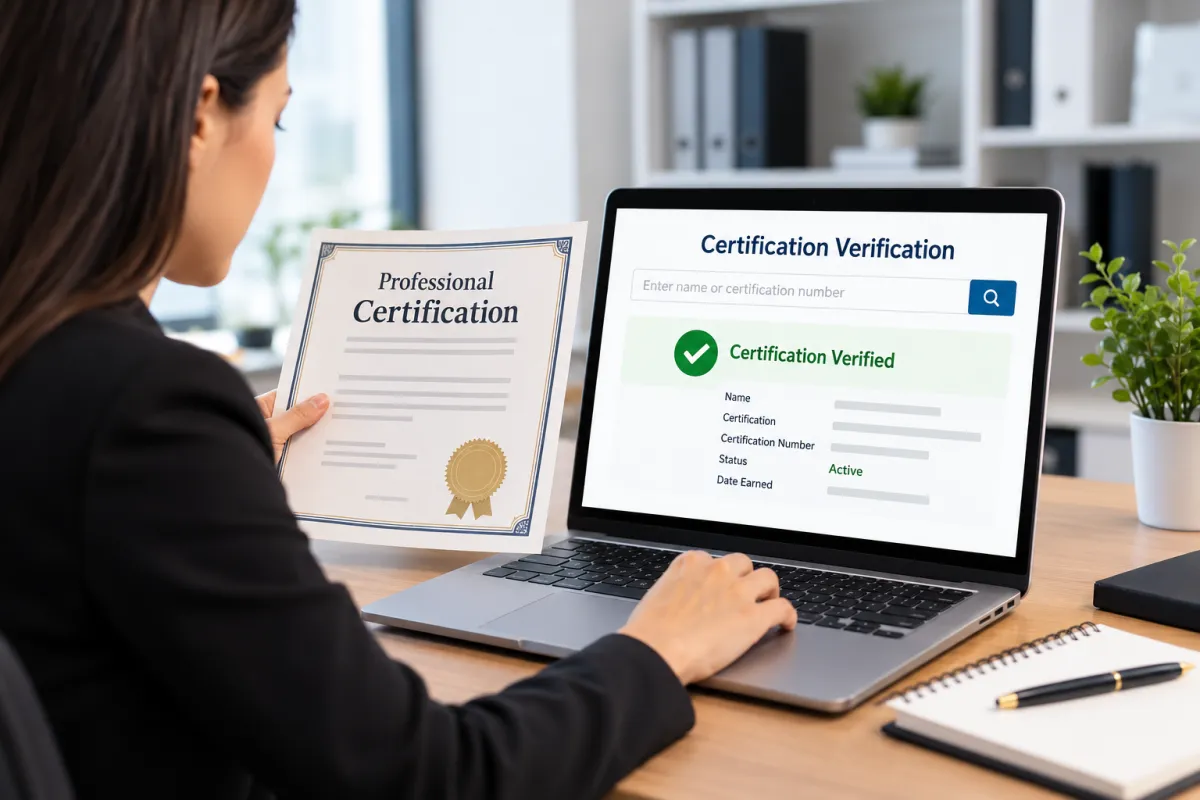
Yes, employers may verify certifications, but there is no single verification process that every employer uses. What gets checked, when it gets checked, and how the verification happens can depend on the job, the credential, the employer, and the organization that issued the credential.
For a job seeker, the important question is not simply whether an employer will check a certification. It is how the employer could confirm that the credential is genuine, current, and belongs to you.
An employer may use an issuer's certification registry, a credential lookup system, a verification link, documents you provide, or a credential-check service. Some employers may also contact the issuing organization directly.
This guide explains how certification verification works in the US, what information employers may check, what happens when a credential cannot be verified, and how you can check your own certification before putting it on a resume or application.
Do Employers Actually Verify Certifications?
They can, but certification verification is not universal.
An employer may have little reason to perform a separate verification when a certification is optional and unrelated to the job. On the other hand, verification can be more important when a credential is listed as a job requirement, when the position involves a regulated occupation, or when the employer needs to confirm that a candidate actually holds a particular credential.
The type of credential matters too.
A professional certification is generally issued by a nongovernmental certification organization and demonstrates that an individual has demonstrated specified knowledge, skills, or abilities. A license is issued by a government licensing agency and conveys legal authority to work in an occupation. The two should not be treated as interchangeable. Bureau of Labor Statistics
For example, an employer hiring for a position that requires a particular professional certification may want to confirm:
- The name of the certification
- The organization that issued it
- The credential holder's identity
- The credential or certificate number
- Whether the credential is currently active
- Whether the information supplied by the applicant matches the issuer's records
Indeed's current US documentation provides a concrete example. For some jobs, its credential-check process can check the type of license or certificate, the issuing state or organization, the license or certificate number, and the current status when applicable. Indeed
That does not mean every employer uses Indeed or the same process. It simply demonstrates one way credential verification can work.
What Does Certification Verification Actually Mean?
Certification verification is the process of confirming that a claimed credential is legitimate and belongs to the person claiming it.
Think of it as checking the connection between three things:
The person → the credential → the issuing organization
For example, suppose a job seeker lists a professional certification on a resume.
The employer may want to determine:
- Does the certification actually exist?
- Was it issued by the organization the applicant named?
- Does the credential belong to this applicant?
- Is the credential number or other identifying information correct?
- Is the certification still active, if the credential has an active-status requirement?
The exact information available depends on the issuer.
ASQ, for example, maintains a Certification Verification Registry. ASQ says the registry is designed to make it easier for potential employers and others to verify an individual's certification. For active certifications, the registry can display the certificate number, certification holder's first and last name, credential, date earned, and certification status, along with certain geographic information. ASQ
This illustrates an important point: verification is often based on information maintained by the organization that issued the credential.
There is no requirement that every certification organization use the same database, provide the same information, or offer a public search tool.
How Do Employers Verify Professional Certifications?
There are several possible methods.
1. Certification Registries
Some professional organizations maintain online registries where an employer can search for credential holders.
ASQ is one example. Its registry allows searches using information such as certification, country, state, and last name. ASQ describes the registry as an up-to-date record of people who have earned ASQ certification and, where applicable, maintained it through recertification. ASQ
A registry can make verification relatively straightforward because the employer does not have to rely solely on a document supplied by the applicant.
However, a registry is issuer-specific. The existence of an ASQ registry does not mean that every professional certification has a similar public database.
Some organizations may use private verification systems, require credential numbers, provide verification links, or use another process entirely.
2. Credential or Certificate Lookup
An organization may provide a dedicated verification page where someone can enter identifying information about a credential.
Depending on the organization, this could involve information such as:
- Credential number
- Name
- Certification type
- Issuing organization
- State or jurisdiction
- Other identifying information
The purpose is to match the information supplied by the job seeker with the issuer's records.
The exact process varies, so candidates should use the verification instructions provided by their own certification organization rather than assuming that another organization's process will work the same way.
3. Digital Verification Links
Some credentials can be represented digitally or accompanied by a verification link.
Instead of giving an employer only a PDF or printed certificate, a candidate may be able to provide a link that leads to a credential record maintained by the issuing organization or credential platform.
The advantage is that the employer can check the credential against the underlying record rather than relying entirely on a document uploaded by the applicant.
But again, this depends on the issuer. Not every certification has a public verification link.
4. Documents Provided by the Candidate
Verification does not always involve an online database.
An employer may ask a candidate to provide documentation showing the credential. Depending on the credential, that could include a certificate, license, credential card, official letter, or a screenshot or printout of an online certification record.
Indeed's credential-check documentation provides an example of this approach. Applicants using its process can upload a file such as a photo or scan of a physical license, a screenshot or printout of an online certification page, or an official document from a licensing organization. Indeed
A document can be useful evidence, but it is not necessarily the same thing as an independent verification.
An employer may still want to confirm the information with the issuing organization.
5. Direct Contact With the Issuing Organization
An employer may also contact the organization that issued a credential when the organization's policies allow it.
This can be useful when:
- There is no public registry
- The credential record is difficult to locate
- Additional confirmation is needed
- The employer has questions about the credential
- The candidate's documentation does not provide enough information
The issuer's privacy and verification policies determine what information can be disclosed.
Therefore, you should not assume that a certification organization will provide an employer with every detail about your credential.
What Information Can an Employer Use to Verify a Credential?
The information required depends on the verification system.
A useful general checklist is:
Not every verification system uses all of these fields.
For example, Indeed says applicants using its credential-check process need to provide their first and last name as they appear on the credential, the license number, the state or group that issued it, and an email address. Indeed
ASQ's registry, meanwhile, displays information including the certificate number, holder's name, credential, date earned, and certification status for active certifications. ASQ
The practical lesson is simple: keep the information associated with your credential accurate and accessible.
Can Employers Verify Whether a Certification Is Active or Expired?
Sometimes.
Whether an employer can see the current status depends on the certification organization's verification system.
This is important because having earned a certification in the past does not necessarily mean that you can currently claim an active credential.
BLS notes that professional certifications and licenses can be time-limited credentials that require periodic renewal. Bureau of Labor Statistics
ASQ provides a clear example of why active status matters. Its registry includes individuals with active certifications, while its documentation explains that an inactive certification is not included in the registry and should not be claimed as an active certification. ASQ
That means job seekers should avoid assuming that an old certificate is still valid simply because they earned it legitimately.
Before listing a credential, check its current status with the issuing organization.
What If an Employer Cannot Verify Your Certification?
A verification problem does not automatically mean that someone has lied about a credential.
There can be several reasons why a verification system fails to find a match.
For example:
- Your name may not match the issuer's record exactly.
- The credential number may have been entered incorrectly.
- The issuing organization's record may contain additional information.
- The credential may not currently have active status.
- The verification system may temporarily experience a technical problem.
- The organization may not provide a public verification system.
- The credential may require a different verification method.
Indeed's troubleshooting documentation specifically notes that a credential check can fail to find a matching active record because of issues such as a temporary system interruption, a typo, or the status shown by the source. It also notes that an application can require further review when a matching active record cannot be found. Indeed
If your own credential cannot be verified, do not immediately assume that the credential itself is the problem.
Instead, work through the information systematically.
Check the Name
Compare the name you entered with the name associated with your credential.
A difference in spelling, initials, surname, or other identifying information can interfere with an automated match.
Check the Credential Number
If your certification or license has a number, make sure every character is correct.
A single incorrect digit can prevent a lookup from finding the right record.
Check the Issuing Organization
Make sure you selected or provided the correct organization.
A professional may have several credentials from different organizations, and similar credential names can create confusion.
Check the Current Status
If the credential is supposed to be active, confirm its status through the issuer.
An expired or inactive credential may not appear in a system that only displays active records.
Keep Supporting Documentation
Keep a copy of your certificate, license, renewal documentation, or other official records.
If an automated check fails, documentation may give the employer another way to evaluate the credential.
Indeed's process illustrates this fallback: when its third-party credential check cannot find a matching active record or encounters an error, the applicant may need to upload a file of the license or certificate instead. Indeed
Certification Verification Is Not the Same as a Background Check
These terms are sometimes used together, but they are not automatically the same thing.
A credential verification focuses on whether a person has a particular certification or license and, where applicable, whether that credential is active.
A background check can involve much broader information used in an employment decision.
The distinction matters because different processes can involve different information, organizations, and legal requirements.
Indeed explicitly states that its credential check is not a background check or screening service. Its credential-check process is designed to verify a professional license or certificate associated with a job requirement. Indeed
Formal employment background reports can involve additional legal requirements. The Federal Trade Commission explains that when employers obtain background information through a company in the business of compiling such information, the Fair Credit Reporting Act can impose requirements including written notice and the applicant's written permission before obtaining the report. Federal Trade Commission
That does not mean that every certification lookup is subject to the FCRA.
A simple employer lookup of a credential registry should not automatically be described as an FCRA-regulated background report. The legal treatment depends on what information is being obtained, how it is obtained, and the circumstances of the employment decision.
For a job seeker, the practical distinction is:
Credential verification asks, “Do you have this credential?”
A broader background check can ask many other questions about your background.
Certification vs. Certificate vs. License
These terms are often used interchangeably in everyday conversation, but they can refer to different things.
Professional Certification
According to the BLS framework, a professional certification is issued by a nongovernmental certification body and is based on demonstrating designated knowledge, skills, and abilities. It does not itself give someone legal authority to work in an occupation. Bureau of Labor Statistics
Examples can include professional credentials in areas such as information technology or project management.
License
A license is issued by a governmental licensing agency and conveys legal authority to work in an occupation. The requirements can include education, examinations, work experience, certifications, or other criteria. Bureau of Labor Statistics
Licensing requirements can also vary by state and occupation.
Educational Certificate
An educational certificate can be awarded by an educational institution after completion of a program of study.
BLS distinguishes educational certificates from the professional certifications and licenses measured in its labor statistics. It notes that educational certificates can include credentials from colleges, universities, community colleges, trade schools, or online educational programs. Bureau of Labor Statistics
This distinction matters when reading a job posting.
If an employer asks for a professional certification, an educational course-completion certificate may not satisfy the requirement simply because both documents contain the word “certificate.”
How to Make Your Certification Easy to Verify
You can make the verification process easier before you ever submit an application.
1. Confirm the Exact Credential Name
Use the official name of the credential rather than shortening it into a phrase that could be confused with another certification.
2. Check Your Current Status
Go directly to the certification organization's account or verification system and confirm that your credential is active when applicable.
Do this especially if you earned the credential several years ago or if it requires periodic renewal.
3. Save Your Credential Information
Keep a secure record of:
- Credential name
- Issuing organization
- Credential number
- Date earned
- Renewal or expiration information, when applicable
- Official verification page or instructions
- Supporting documents
You do not necessarily need to put all of this information on your resume.
The purpose is to make sure you can provide accurate information if an employer asks for it.
4. Check the Issuer's Verification Process
Do not assume that an employer will use the same method you used to obtain the certification.
Look for the issuing organization's official instructions for credential verification.
If the organization provides a public registry, learn how your record appears.
If it uses a private account-based verification process, know where to access your information.
5. Make Your Name Consistent
If your professional credentials use a different version of your name than the one on your job application, understand how the issuer handles that difference.
This is particularly important for automated credential checks.
6. Keep Supporting Documents Available
A digital copy of your official credential documentation can be useful when an employer asks for proof or when an automated lookup does not work.
The document should be clear and genuine. Never alter a credential to make it appear current or different from the issuer's actual record.
Does Every Certification Have a Public Verification System?
No.
This is one of the most important points for job seekers to understand.
Some professional organizations provide public registries. ASQ is one example. Its registry allows potential employers and recruiters to verify active ASQ credentials. ASQ
Other organizations may provide a different type of verification.
A credential might be verified through:
- A private member account
- A credential number
- A verification link
- A document supplied by the candidate
- Direct communication with the issuer
- A third-party credential-check service
- A combination of these methods
The absence of a public search result does not automatically prove that the credential is fake.
The correct verification method is the one provided by the credential's issuing organization.
Does a Verified Certification Prove You Can Do the Job?
No.
Verification establishes something narrower: that the claimed credential can be confirmed according to the issuer's records or the applicable verification process.
It does not guarantee job performance.
A certification may demonstrate that someone met the requirements established by a professional certification organization. A license may establish legal authority to practice an occupation. Neither one, by itself, tells an employer everything about a candidate's communication skills, judgment, experience, reliability, or ability to perform a particular company's work.
That is why certification verification is only one part of a hiring decision.
An employer can still evaluate:
- Work experience
- Technical skills
- Interviews
- References
- Job-specific knowledge
- Work samples
- Education
- Other qualifications
The exact hiring process varies by employer and position.
Common Certification Verification Mistakes Job Seekers Make
A few avoidable mistakes can make a legitimate credential harder to verify.
Listing an Expired Credential as Current
If a certification has an active-status requirement, check its status before listing it as current.
Using an Informal Credential Name
Use the credential's official name so that the employer can understand exactly what you earned.
Entering the Wrong Credential Number
Double-check numbers before submitting an application.
Assuming Every Certificate Is a Professional Certification
A course-completion certificate and a professional certification can have different purposes and verification systems. BLS specifically distinguishes educational certificates from professional certifications and licenses. Bureau of Labor Statistics
Assuming No Public Search Result Means No Credential Exists
Some legitimate credentials do not have public registries. Find out how the issuing organization actually handles verification.
Altering or Misrepresenting Documentation
Never modify a certificate, credential number, expiration information, or verification record.
If something is incorrect, resolve the discrepancy through the issuing organization.
A Simple Credential Check Before You Apply
Before listing a certification for a job, run through this quick checklist:
Credential: Do I have the exact credential the employer is asking for?
Issuer: Do I know the official organization that issued it?
Status: Is it currently active if the credential requires active status?
Name: Does the name associated with my credential match the information I normally provide?
Number: Do I have the correct credential or certificate number?
Verification: Does the issuer provide a registry, lookup, verification link, or another verification method?
Documentation: Do I have an authentic copy of the credential or supporting documentation?
Job requirement: Does the job require this specific credential, or is it simply a qualification I am choosing to highlight?
This check takes little time and can prevent avoidable problems later in the hiring process.
Conclusion
Employers can verify certifications, but there is no universal process that every company follows. Verification may involve an issuer's registry, an online lookup, a credential number, a digital verification link, documents supplied by the candidate, direct contact with the credentialing organization, or a third-party credential-check process.
The most important thing for job seekers is to understand the credential they are claiming and how its issuing organization verifies it. A professional certification, government-issued license, and educational certificate can have different meanings and different verification methods. Bureau of Labor Statistics
Before applying, confirm the credential's exact name, current status, identifying information, and verification method. Keep authentic supporting documentation available in case an employer asks for proof.
And if a verification attempt fails, do not automatically assume that your credential is invalid. Check for simple issues such as name or credential-number mismatches, status problems, or technical errors and follow the issuer's official verification process. Indeed's current credential-check guidance shows that legitimate verification attempts can sometimes require further review or supporting documentation. Indeed
The goal is not to make every certification look independently verified before you apply. It is to make sure that when an employer does check a credential, the information you provided is accurate, current, and easy to confirm.
Frequently asked questions
Can employers verify a certification without asking me?
Yes. Depending on the credential and employer's process, an employer may verify a certification through an issuer's public registry, credential lookup, verification link, or another credential-check system. Not every certification has a public verification system.
Do employers verify certifications before making a job offer?
They may, but there is no universal timing or process. Verification can depend on the employer, position, credential, and hiring process. Some employers may check credentials during hiring or onboarding, while others may not perform a separate certification check.
Can an employer see if my certification has expired?
If the certification issuer provides status information through a registry or verification system, an employer may be able to determine whether the credential is currently active. What an employer can see depends on the certification organization and its verification system.
What happens if my certification cannot be verified?
A failed verification does not automatically mean that a credential is fraudulent. Problems can result from a name mismatch, incorrect credential information, an unavailable record, technical issues, or differences between the information provided and the issuer's records. Check your credential details with the issuing organization and correct any discrepancies.
Do employers verify online course certificates?
They may, but an online course certificate is not necessarily the same as a professional certification. Verification depends on the course provider, the type of certificate, and what the employer requires. A certificate from an educational or training provider may have a different verification process from a professional certification issued by a certification organization.
Can an employer contact the certification organization directly?
Yes, an employer may contact a certification organization when the organization provides a way to verify credentials or when additional confirmation is needed. The exact process depends on the issuer's verification policies.

James Collins writes practical content about work, business, careers, workplace trends, productivity, and professional development. His articles focus on helping readers understand everyday workplace decisions, business...