How to Prepare for a Professional Certification Exam While Working Full-Time
Preparing for a professional certification while working full-time can be challenging. This guide explains how to build a realistic study schedule, prioritize exam objectives, use practice tests, manage busy workweeks, and assess your exam readiness without neglecting work or personal responsibilities.
In this article
- 1. Understand the Certification Exam Before You Start Studying
- Turn the exam objectives into a study checklist
- 2. Audit Your Available Time Before Building a Study Schedule
- Separate available time from usable study time
- Choose a sustainable weekly target
- 3. Build a Weekly Certification Study Schedule
- Give each session a specific goal
- Use a flexible schedule instead of a rigid one
- 4. Prioritize Exam Objectives Instead of Studying Everything Equally
- Identify your weak areas early
- Avoid spending too long on one difficult topic
- 5. Choose the Right Certification Exam Preparation Resources
- Start with the official exam guide
- Select one primary learning resource
- Add supplementary resources only for specific gaps
- 6. Use Study Techniques That Work After a Full Workday
- Practice active recall
- Use spaced review
- Practice explaining concepts simply
- Combine learning with practice
- 7. Use Practice Questions and Mock Exams Strategically
- Begin with topic-based questions
- Maintain a mistake log
- Take full practice exams when appropriate
- Do not rely on memorizing question banks
- 8. Include Hands-On Practice When the Certification Requires It
- Match practice to the exam objective
- Keep hands-on sessions focused
- 9. Adjust Your Study Plan When Work Gets Busy
- Use a recovery method
- Create a minimum study routine for difficult weeks
- Avoid sacrificing sleep to catch up
- 10. Balance Certification Preparation With Your Job and Personal Life
- Communicate when appropriate
- Protect some personal time
- Connect learning to your current work when possible
- 11. Decide When You Are Ready to Schedule the Exam
- Certification exam readiness checklist
- Consider your exam date carefully
- 12. Common Mistakes to Avoid While Studying for a Certification
- Creating an unrealistic study schedule
- Watching courses without testing your understanding
- Using too many preparation resources
- Ignoring the official exam objectives
- Avoiding difficult topics
- Taking practice tests without reviewing mistakes
- Treating a missed session as a failed plan
- Rushing to schedule an exam
- Conclusion
Preparing for a professional certification exam while working full-time requires a study plan that fits around your job, personal responsibilities, and energy levels. The most effective approach is not necessarily to study for several hours every night. It is to use your available time consistently, focus on the exam objectives, practice applying what you learn, and adjust your schedule when work becomes demanding.
A certification can help demonstrate specialized knowledge, support career development, or strengthen your qualifications for a new role. However, preparing for an exam while maintaining a full-time job can be difficult. Long workdays, family commitments, unexpected deadlines, and fatigue can make it challenging to follow a study routine.
A realistic plan should account for these constraints from the beginning. Start by understanding what the exam covers, determine how much time you can actually study, and divide the material into manageable tasks. Use shorter weekday sessions for focused learning and longer sessions when your schedule allows.
This guide explains how to create a practical certification exam study plan, choose appropriate preparation resources, prioritize difficult topics, use practice tests effectively, and assess your readiness without neglecting your work or personal life.
1. Understand the Certification Exam Before You Start Studying
Before creating a schedule or purchasing a course, understand exactly what the certification exam requires. Studying without a clear picture of the exam can lead to wasted time on topics that are not relevant or receiving too little attention on important subject areas.
Begin with the official certification provider’s exam information.
Review these details:
-
Exam objectives: The knowledge areas and skills covered.
-
Exam format: Whether questions are multiple-choice, scenario-based, practical, or another format.
-
Exam duration: How much time is available to complete the exam.
-
Prerequisites: Whether you need experience, education, or another certification.
-
Exam policies: Rules concerning registration, identification, retakes, and testing.
-
Practical requirements: Whether the exam expects hands-on skills or applied knowledge.
For example, someone preparing for an AWS certification should review the official AWS Certification Exam Guides. A person pursuing a Project Management Professional (PMP) certification should use the official PMI certification information. Microsoft certification candidates should review the applicable exam details and policies.
Official information is important because exam objectives and policies can change. A preparation course or book may not reflect the current exam version.
Turn the exam objectives into a study checklist
Once you have reviewed the exam outline, convert each objective into a checklist.
Instead of writing a broad task such as “Study cloud computing,” break it into specific items. For a hypothetical cloud certification, the checklist might include:
-
Explain the basic cloud service models.
-
Identify appropriate storage options for different use cases.
-
Understand identity and access management concepts.
-
Recognize common security responsibilities.
-
Apply networking concepts to simple scenarios.
-
Interpret monitoring and troubleshooting situations.
The actual topics should come from your certification’s official exam objectives.
This checklist becomes the foundation of your study plan. It allows you to track what you have covered and identify areas that still need attention.
2. Audit Your Available Time Before Building a Study Schedule
A study schedule should reflect your real life, not an ideal week in which you have unlimited energy and no unexpected responsibilities.
Start with a time audit. For one typical week, identify when you work, commute, handle household tasks, exercise, spend time with family, and sleep. Then look for realistic study windows.
Consider the following:
-
Your usual work start and finish times.
-
Whether you commute and how long it takes.
-
Your most productive time of day.
-
Recurring personal responsibilities.
-
Days when work is usually more demanding.
-
Time you need for rest and recovery.
Do not assume that every free hour is suitable for studying. A person who finishes a demanding workday may have 45 minutes available but may not be able to concentrate effectively for all 45 minutes.
Separate available time from usable study time
There is a difference between having time and being able to use it productively.
For example, you may have an hour between finishing work and preparing dinner. That hour might be interrupted by errands, messages, or household responsibilities. It may be better to plan a shorter, focused session than to schedule an unrealistic block.
Try identifying three types of study windows:
| Study window | Typical use |
|---|---|
| Short sessions | Flashcards, reviewing notes, a small set of practice questions |
| Medium sessions | Learning one topic, reviewing a lesson, solving scenario questions |
| Longer sessions | Practice tests, hands-on exercises, reviewing weak areas |
The exact duration depends on your schedule. The important point is to match the activity to the time available.
Choose a sustainable weekly target
There is no universal number of study hours that guarantees success. The time required depends on the certification’s difficulty, your existing knowledge, your experience, and the amount of material you need to learn.
Instead of selecting an ambitious target immediately, start with a schedule you can consistently maintain.
If you find that your initial plan is manageable, you can gradually add study time. If it regularly interferes with sleep, work performance, or personal responsibilities, reduce it or rearrange the sessions.
A sustainable plan is more useful than an intense schedule that lasts only a few days.
3. Build a Weekly Certification Study Schedule
After completing your time audit, create a weekly schedule with specific study activities. Avoid writing “study certification” in every available time slot. Assign a clear purpose to each session.
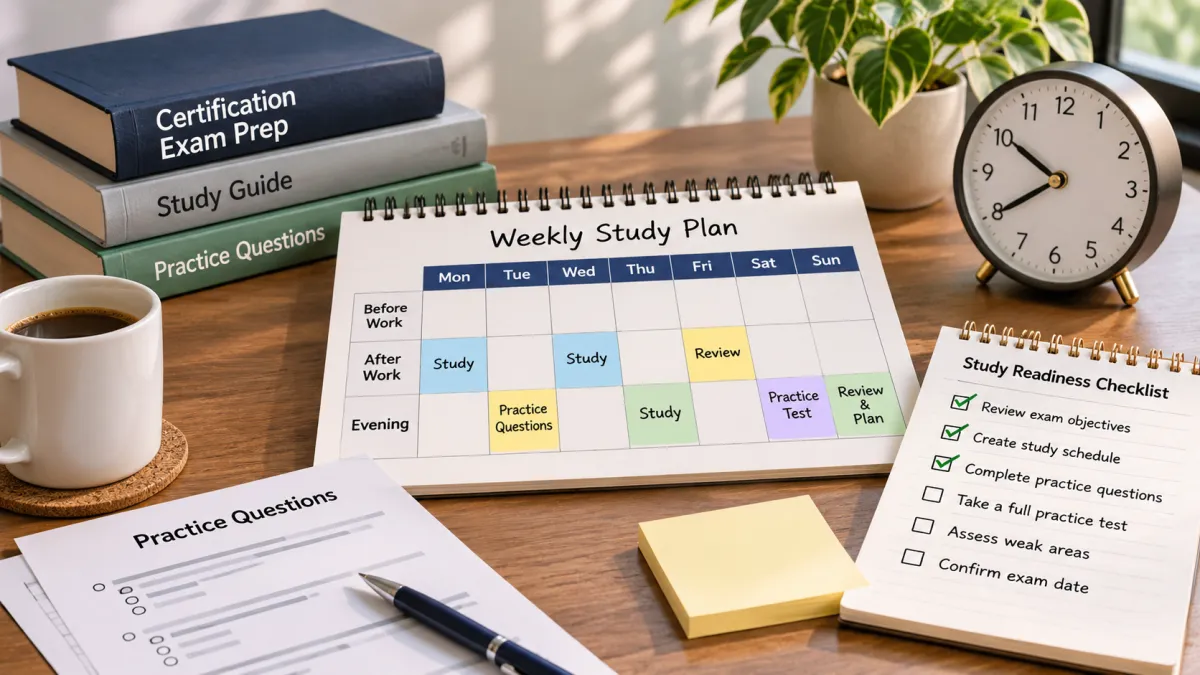
A sample schedule for a full-time professional might look like this:
| Day | Study activity | Example session |
|---|---|---|
| Monday | Learn a new exam objective | Focused lesson or reading |
| Tuesday | Reinforce Monday’s topic | Notes and practice questions |
| Wednesday | Study another objective | Focused lesson or hands-on practice |
| Thursday | Review difficult concepts | Weak-area practice |
| Friday | Light review | Flashcards or missed questions |
| Saturday | Longer study session | Practice test or practical exercises |
| Sunday | Review and plan | Analyze mistakes and schedule next week |
This is an example, not a required schedule. You can move sessions around to fit your workdays, commute, and personal obligations.
The schedule also does not require studying every day. Some professionals may prefer a few longer sessions, while others may learn better with frequent shorter sessions.
Give each session a specific goal
A study session is easier to begin when you know what you need to accomplish.
Weak goal:
“Study for the certification.”
More useful goals:
-
Review one exam objective and summarize its key concepts.
-
Complete a set of practice questions on a specific topic.
-
Revisit the questions missed during the previous session.
-
Perform a hands-on exercise related to an exam skill.
-
Review the reasoning behind incorrect answers.
A specific goal helps you measure progress even when you have limited time.
Use a flexible schedule instead of a rigid one
Full-time work can be unpredictable. A meeting may run late, an urgent project may appear, or you may need to handle a personal commitment.
Create a primary schedule and a backup option.
For instance, if you planned a longer study session on Wednesday but cannot complete it, move the essential task to another available window. Do not automatically push every missed session into the following day. Doing so can create a backlog that becomes difficult to manage.
The goal is to keep the plan moving, not to maintain a perfect calendar.
4. Prioritize Exam Objectives Instead of Studying Everything Equally
Not every topic deserves the same amount of preparation time. Some objectives may be more heavily represented on the exam, while others may be less familiar or more challenging for you.
Use a simple prioritization framework based on three factors:
-
Exam importance: How much emphasis does the official exam outline place on the objective?
-
Current understanding: How confidently can you explain or apply the concept?
-
Practical difficulty: Does the topic require more practice, calculations, troubleshooting, or hands-on work?
You can use the following matrix to decide where to focus.
| Exam importance | Your understanding | Study priority |
|---|---|---|
| High | Weak | Highest priority |
| High | Strong | Review and test |
| Lower | Weak | Targeted study |
| Lower | Strong | Light review |
This framework helps prevent a common mistake: spending too much time on topics you already understand because they feel comfortable.
Identify your weak areas early
During your first few study sessions, take a small set of diagnostic questions or review the exam objectives and rate your familiarity with each one.
You might label topics as:
-
Strong: I can explain this and answer related questions.
-
Developing: I understand the basics but make mistakes.
-
Weak: I need to learn this topic from the beginning.
These labels are only an initial assessment. Update them as you progress.
If a topic repeatedly causes mistakes, investigate why. You may be missing a foundational concept, confusing similar terms, or struggling to apply the information to a scenario.
Do not simply reread the same chapter without identifying the problem.
Avoid spending too long on one difficult topic
A difficult objective can consume several evenings if you do not set boundaries.
Try breaking it into smaller pieces. Learn one concept, test your understanding, and then move forward when you have a reasonable grasp of it. Schedule additional review later.
This approach helps you make progress across the exam syllabus instead of becoming stuck on one area.
5. Choose the Right Certification Exam Preparation Resources
Preparation materials should support the official exam objectives and fit your learning style. Buying several courses, books, and question banks at the same time can create confusion and unnecessary expense.
A practical resource setup usually begins with a primary resource and adds supplementary material only when you identify a specific gap.
Start with the official exam guide
The official exam guide or exam objectives should remain your reference point throughout preparation.
It helps you determine:
-
What you need to learn.
-
Which skills the exam expects.
-
Whether your course covers the required material.
-
Which topics need additional preparation.
For AWS certifications, use the relevant AWS Certification Exam Guides.
For Microsoft certifications, review the official Microsoft Certification Exam Policies alongside the specific certification and exam information.
For professional credentials such as PMP, refer to the official PMI certification information.
These resources provide provider-specific information. Exam formats, policies, and preparation expectations are not identical across certification programs.
Select one primary learning resource
Your primary resource could be:
-
An instructor-led or self-paced course.
-
An official training program.
-
A certification preparation book.
-
A structured learning path.
-
A course with demonstrations and practice exercises.
Choose one that clearly maps to the exam objectives and is suitable for your current level.
A resource is not necessarily better because it is longer or more popular. Look for clear explanations, relevant examples, and coverage of the actual exam scope.
Add supplementary resources only for specific gaps
You may need additional material when:
-
A concept in your primary course is unclear.
-
You need more practice with scenario-based questions.
-
A skill requires hands-on experience.
-
The course does not adequately cover an official objective.
-
You need to verify a current policy or exam detail.
For example, if you understand the theory of a technical topic but cannot perform the task, a practical exercise may be more useful than another introductory video.
Avoid switching resources every time a topic becomes difficult. First determine whether the resource is inadequate or whether you need more focused practice.
6. Use Study Techniques That Work After a Full Workday
After work, your attention may be limited. Passive study methods can feel easy, but they do not always reveal whether you can recall or apply what you learned.
Use methods that require active engagement.
Practice active recall
Active recall means trying to retrieve information from memory rather than immediately looking at the answer.
After studying a topic:
-
Close the course or book.
-
Explain the concept in your own words.
-
Write down the main steps or principles.
-
Identify what you could not remember.
-
Check the source and correct the gaps.
You can also turn key concepts into flashcards. Keep cards focused on one question or idea rather than placing an entire chapter on a single card.
Active recall can be particularly useful for short study sessions because it gives you a clear task.
Use spaced review
Instead of studying a concept once and leaving it untouched, revisit it over time.
For example, you could review a topic:
-
Shortly after learning it.
-
During a later weekday session.
-
At the end of the week.
-
Again during a practice test review.
This is a flexible illustration rather than a fixed timetable. Adjust the intervals based on how well you remember the material.
Topics that you repeatedly forget may need more frequent review.
Practice explaining concepts simply
Try explaining a concept as if you were helping a colleague who is unfamiliar with it.
If your explanation depends on memorized wording or you cannot describe why something works, you may need to strengthen your understanding.
For technical certifications, explain not only what a tool or concept does but also when it would be appropriate to use it.
Combine learning with practice
A useful session might follow this pattern:
-
Learn a concept.
-
Apply it through an exercise or scenario.
-
Answer related questions.
-
Review mistakes.
-
Record what needs another look.
The balance between learning and practice depends on the exam. A knowledge-based certification may require more concept review, while a hands-on technical exam may demand substantial practical work.
7. Use Practice Questions and Mock Exams Strategically
Practice questions help you evaluate your understanding, recognize exam-style scenarios, and identify gaps. However, completing a large number of questions without reviewing your mistakes can provide limited value.
The goal is not simply to achieve a high score in a question bank. It is to understand the concepts behind the answers.
Begin with topic-based questions
When you have completed an objective, try questions related to that topic.
This lets you identify problems while the material is still fresh. If you consistently miss questions about one concept, return to the relevant lesson or official resource.
Do not treat a correct answer as proof of understanding if you guessed.
Maintain a mistake log
A mistake log is one of the most useful tools in a certification study plan.
Record the following information:
| Item | What to record |
|---|---|
| Topic | The exam objective involved |
| Mistake | What you answered incorrectly or misunderstood |
| Reason | Knowledge gap, misreading, confusion, or weak application |
| Correct concept | The explanation you need to remember |
| Follow-up | What you will review or practice next |
For example, a hypothetical candidate may repeatedly confuse two similar technical services. The mistake log can show that the issue is not general lack of knowledge but difficulty distinguishing when each service is appropriate.
Review the log regularly. It should guide your next study sessions.
Take full practice exams when appropriate
A full-length practice exam can help you assess how well you manage the exam format, question types, and time limits.
Use a practice exam after you have covered a meaningful portion of the syllabus. Taking a full test too early may be less useful if you have not yet learned most of the material.
During a practice test:
-
Follow the applicable time limit.
-
Avoid looking up answers while testing.
-
Use the question format that resembles the real exam.
-
Record your result without treating it as a guarantee.
Afterward, review both incorrect and uncertain answers. A correct answer based on a guess deserves attention too.
Do not rely on memorizing question banks
Memorizing answer patterns can leave you unprepared for questions that describe the same concept in a different way.
Focus on understanding:
-
Why the correct answer is appropriate.
-
Why the other options are less suitable.
-
Which detail in the question changes the decision.
-
What principle or skill the question tests.
Use legitimate preparation materials that respect the certification provider’s exam policies. Avoid unauthorized dumps or materials claiming to reproduce actual exam questions.
8. Include Hands-On Practice When the Certification Requires It
Some professional certifications assess applied skills rather than knowledge alone. In these cases, reading and watching videos may not be sufficient preparation.
Hands-on practice may include:
-
Working in a software environment.
-
Configuring or troubleshooting a system.
-
Completing a project-management exercise.
-
Performing calculations.
-
Using a tool or process required by the exam.
-
Solving realistic scenarios.
The exact activity depends on the credential.
Match practice to the exam objective
Review the official objectives and identify which skills require application. Then create a small exercise for each one.
For a hypothetical technical certification, instead of only watching a lesson about a service, you might perform a basic configuration, observe the result, and troubleshoot a simple problem.
For a nontechnical certification, practical preparation may involve analyzing a case scenario, applying a framework, or working through a decision.
Keep hands-on sessions focused
You do not need to build a large project every time you study. A small, objective-specific exercise can be more manageable after work.
Write down:
-
What you attempted.
-
What worked.
-
What failed.
-
What you learned.
-
Which exam objective it supports.
This makes practical study easier to revisit and helps you avoid repeating exercises without a clear purpose.
9. Adjust Your Study Plan When Work Gets Busy
A certification study plan should be flexible enough to survive a demanding workweek. Unexpected deadlines, overtime, travel, or personal responsibilities can interrupt your routine.
Falling behind does not mean your entire plan has failed. The important step is to adjust it without creating an unrealistic backlog.
Use a recovery method
When you miss a study session:
Step 1: Identify what was missed. Determine whether the session covered a new exam objective, practice questions, or review.
Step 2: Separate essential tasks from optional tasks. Prioritize exam objectives that are important and that you have not yet understood.
Step 3: Move the task to a realistic time slot. Avoid automatically scheduling it for the next evening if that session already has a purpose.
Step 4: Reduce lower-priority activities temporarily. If necessary, postpone light review of topics you already understand.
Step 5: Reassess the weekly plan. If you repeatedly miss sessions, the schedule may be too demanding.
This recovery method keeps your plan adaptable and reduces the pressure to compensate for every missed hour.
Create a minimum study routine for difficult weeks
During a busy week, you may not be able to follow your normal schedule. A smaller routine can help you maintain continuity.
Your minimum routine might include:
-
Reviewing a few previously missed questions.
-
Revisiting one important concept.
-
Completing a short flashcard session.
-
Updating your study checklist.
-
Planning the next available focused session.
These activities are not substitutes for learning the full exam material. They are ways to maintain momentum until you can return to your regular plan.
Avoid sacrificing sleep to catch up
Late-night studying may seem like an easy solution when you fall behind. However, regularly reducing sleep can make concentration and learning more difficult.
If your schedule consistently requires studying late into the night, reconsider the exam timeline or the amount of study you have planned.
Your preparation should support your ability to learn, not undermine your work performance or health.
10. Balance Certification Preparation With Your Job and Personal Life
Preparing for a certification is a commitment, but it should not require abandoning every other responsibility.
A balanced plan recognizes that your job, relationships, household tasks, and rest all matter.
Communicate when appropriate
If your certification is related to your current role, consider discussing your learning goals with your manager.
Depending on your workplace, you may be able to ask about:
-
Professional development time.
-
Training budgets.
-
Reimbursement programs.
-
Access to relevant learning materials.
-
Opportunities to apply new skills at work.
Employer support is not guaranteed, and workplace policies differ. Review your company’s requirements before assuming that training or exam fees will be covered.
Protect some personal time
Avoid filling every evening and weekend with study sessions.
Choose study blocks that fit your commitments, and leave room for activities that help you recharge. This is particularly important if your job already involves long hours or intensive mental work.
A plan that allows occasional rest is often easier to maintain than one that expects constant productivity.
Connect learning to your current work when possible
If your job includes tasks related to the certification, you may be able to reinforce what you learn through appropriate work activities.
For example, a professional studying a project-management credential may recognize concepts in their existing project tasks. A technical professional may have opportunities to apply relevant concepts in approved work environments.
Do not assume that work experience covers every exam objective. Use it as a learning aid, then check your understanding against the official syllabus.
11. Decide When You Are Ready to Schedule the Exam
Scheduling your exam can help establish a target, but choosing a date should be based on a realistic assessment of your preparation.
There is no single readiness score or universal number of practice exams that guarantees a pass. Certification providers differ, and practice test scores may not perfectly predict the actual exam result.
Use a readiness checklist instead.
Certification exam readiness checklist
Before scheduling or confirming your exam, consider whether you can:
This checklist is a planning tool, not an official certification requirement.
If several important objectives remain unfamiliar, you may need additional study. If your understanding is consistent and your remaining gaps are limited, you may be closer to readiness.
Consider your exam date carefully
An exam date can provide structure, but it should not create unnecessary pressure.
When deciding on a date, consider:
-
Your remaining study objectives.
-
Your work schedule during the preparation period.
-
Any personal commitments.
-
The exam provider’s scheduling and rescheduling policies.
-
Whether you have enough time for review and practice.
If you already scheduled an exam and your preparation is behind, review the provider’s policies before making a decision. Rescheduling rules, fees, and deadlines may vary by certification.
Do not assume that every provider offers the same options.
12. Common Mistakes to Avoid While Studying for a Certification
Working full-time makes efficient preparation especially important. Avoid these common mistakes.
Creating an unrealistic study schedule
Planning to study for several hours every night may look productive on paper, but it can be difficult to maintain after a demanding workday.
Start with realistic study windows and adjust based on your progress.
Watching courses without testing your understanding
Completing video lessons is not the same as being able to recall or apply the material.
Add practice questions, active recall, and practical exercises where relevant.
Using too many preparation resources
Switching between multiple courses and books can make it difficult to determine what you have learned.
Choose a primary resource and supplement it only when a clear learning gap exists.
Ignoring the official exam objectives
A preparation resource may cover useful information that is outside the exam’s scope.
Keep the official exam guide as your checklist and make sure your study activities align with it.
Avoiding difficult topics
It is tempting to spend time on familiar subjects because they feel comfortable.
Use your mistake log and topic-priority framework to direct attention toward weaker areas.
Taking practice tests without reviewing mistakes
A score alone does not explain why you are struggling.
Review the reasoning behind every incorrect or uncertain answer and use that information to plan your next session.
Treating a missed session as a failed plan
One missed study block does not invalidate your progress.
Use your recovery method to move important tasks into realistic time slots and continue.
Rushing to schedule an exam
A deadline can help you stay organized, but it should not replace preparation.
Use the readiness checklist and consider the provider’s policies before choosing or changing an exam date.
Conclusion
Preparing for a professional certification exam while working full-time is easier to manage when you build your study plan around your actual schedule rather than an ideal one. Start by reviewing the official exam objectives, auditing your available time, and choosing a primary preparation resource.
Use focused weekday sessions for learning and review, and reserve longer sessions for practice tests or hands-on work when your schedule allows. Prioritize weak and important exam objectives, maintain a mistake log, and use active recall and spaced review to strengthen your understanding.
When work becomes busy, adjust your plan instead of trying to make up every missed session at once. Before taking the exam, evaluate your readiness based on your understanding of the objectives, your ability to apply concepts, and your progress with practice questions.
A certification study plan does not need to be perfect to be useful. It needs to be realistic, adaptable, and focused on the skills the exam actually assesses.
Frequently asked questions
1. How many hours a week should I study for a certification exam while working full-time?
There is no universal number of study hours that works for every certification. The time you need depends on the exam's difficulty, the topics covered, your existing knowledge, and your preparation deadline. Start by reviewing the official exam objectives and calculating how much study time you can realistically protect each week. Use the certification provider's preparation guidance as a starting point rather than treating a fixed number of hours as a guarantee.
2. Is it better to study for a certification exam before work or after work?
The better time depends on your energy levels, work schedule, and personal responsibilities. Morning study may work well if you are more focused before work, while evening study may be more practical for people with flexible mornings. Choose a consistent study window that does not interfere with adequate sleep or essential responsibilities.
3. How long does it take to prepare for a professional certification exam while working full-time?
Preparation time varies by certification, exam scope, previous experience, and available study hours. Some candidates may need a shorter preparation period, while others may require a longer one. Review the official exam guide, assess your current knowledge, and build a timeline around your learning needs instead of relying on a universal estimate.
4. Can I pass a professional certification exam by studying only on weekends?
Weekend-only preparation may be workable for some candidates, depending on the certification and their existing knowledge. However, longer weekend sessions can be difficult to sustain and may leave less opportunity for regular review. If possible, combine weekend study with brief weekday review sessions. No schedule can guarantee a passing result.
5. Should I schedule my certification exam before I finish studying?
Setting a target exam date can help organize your preparation, but scheduling too early may create unnecessary pressure. Review the exam objectives, estimate your preparation needs, and assess your readiness before committing. Check the certification provider's current scheduling, cancellation, and rescheduling policies because they vary by provider.
6. What should I do if I fall behind on my certification study schedule?
Review the topics you have not completed and identify which ones are most important or where your knowledge is weakest. Adjust your remaining study sessions instead of trying to recover every missed hour at once. If necessary, revise your target exam date after checking the provider's scheduling policies. Focus on consistent progress and realistic preparation.

James Collins writes practical content about work, business, careers, workplace trends, productivity, and professional development. His articles focus on helping readers understand everyday workplace decisions, business...