How to Calculate Quarterly Estimated Taxes for Side Hustles and Freelancers
Learn how to calculate quarterly estimated taxes for freelance work, gig income, and side hustles. Understand federal tax requirements, self-employment tax, IRS safe harbor rules, payment deadlines, and how paycheck withholding can affect what you owe.
In this article
- What Are Quarterly Estimated Taxes?
- Who Needs to Pay Estimated Taxes?
- Example: When a freelancer may need estimated payments
- When a W-2 employee also has side income
- How to Calculate Quarterly Estimated Taxes Step by Step
- Step 1: Estimate your total income for the year
- Step 2: Subtract eligible business expenses
- Step 3: Estimate self-employment tax
- Step 4: Estimate your federal income tax
- Step 5: Account for withholding, credits, and payments already made
- Step 6: Determine the required annual payment
- Step 7: Calculate the payments you still need to make
- A Worked Example: Estimating Taxes on Side-Hustle Income
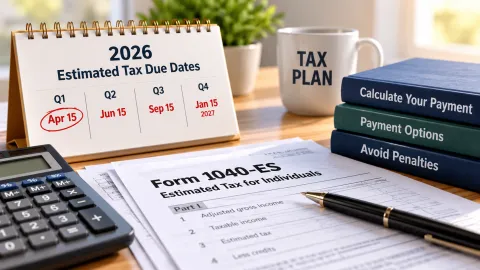
- 2026 Quarterly Estimated Tax Deadlines
- How to Make an Estimated Tax Payment
- Use an official IRS payment option
- Keep confirmation and payment records
- Update your estimate as circumstances change
- What If Your Income Changes During the Year?
- When income increases unexpectedly
- When income is concentrated late in the year
- When you start freelancing partway through the year
- Common Mistakes to Avoid When Calculating Estimated Taxes
- Calculating tax on revenue instead of business profit
- Forgetting self-employment tax
- Ignoring withholding from a regular job
- Assuming every installment must be identical
- Waiting until the tax return is due
- Using outdated worksheets or deadlines
- Do You Need to Pay State Estimated Taxes Too?
- Official IRS Resources for Calculating Estimated Taxes
- Conclusion
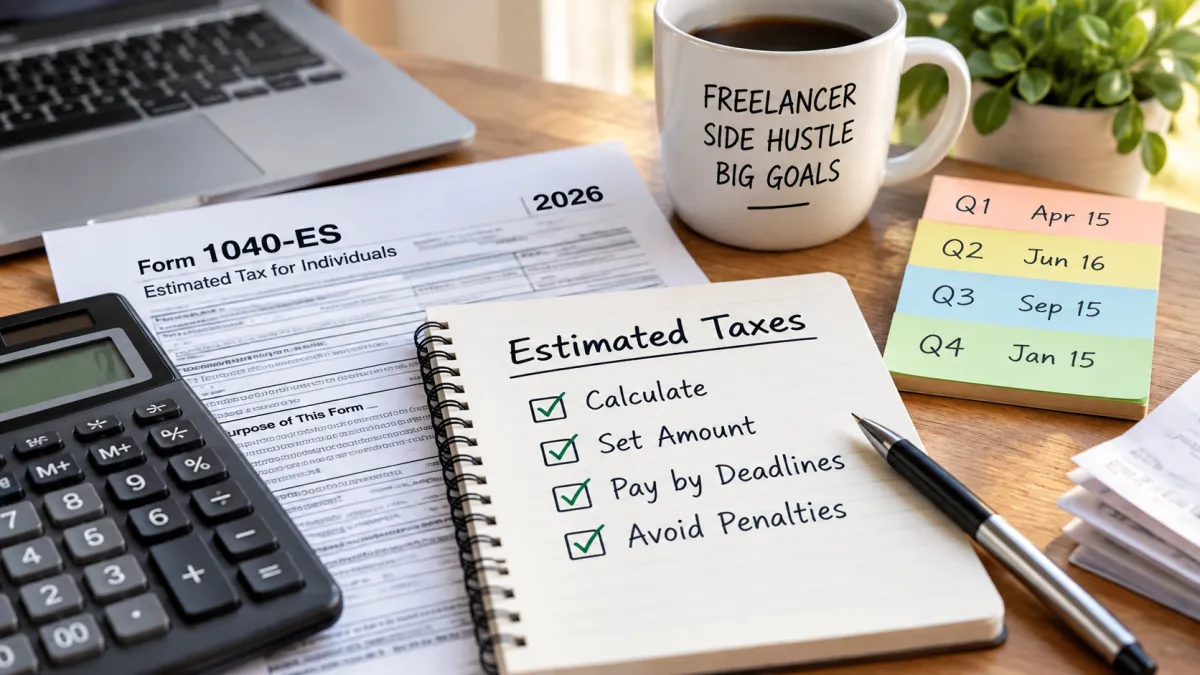
If you earn money from freelancing, gig work, consulting, or a side hustle, you may need to pay federal income taxes throughout the year instead of waiting until you file your tax return. These payments are called quarterly estimated taxes, and calculating them correctly can help you avoid an unexpected tax bill and potential underpayment penalties.
The basic process is to estimate your annual income, subtract eligible business expenses, calculate your expected federal income and self-employment taxes, account for paycheck withholding and other tax payments, and determine how much you need to pay by each deadline. The amount depends on your overall financial situation, not just how much you earn from your side hustle.
For the 2026 tax year, the IRS provides Form 1040-ES to help individuals calculate estimated payments. You do not necessarily have to pay one-quarter of your projected tax in every installment: prior-year tax, withholding, and the timing of your income can all affect the calculation.
What Are Quarterly Estimated Taxes?
Quarterly estimated taxes are payments made directly to the IRS during the year to cover taxes you expect to owe. They are commonly relevant to people whose income is not fully covered by tax withholding from an employer.
You may encounter estimated taxes if you earn money through:
-
Freelance writing, design, programming, consulting, or other independent services
-
Rideshare driving, food delivery, or other gig-platform work
-
An online store or another small business
-
Contract work reported on Form 1099
-
Content creation, commissions, or other self-employed activities
-
A side business alongside a regular W-2 job
Estimated taxes can cover both federal income tax and, when applicable, self-employment tax. Self-employment tax generally helps fund Social Security and Medicare.
Receiving a Form 1099 does not, by itself, determine whether you must make quarterly payments. Your expected overall tax liability, withholding, credits, and other circumstances matter. Likewise, not receiving a Form 1099 does not automatically make income tax-free.
Employees generally have federal income tax withheld from their paychecks. Independent workers usually have to manage payments themselves unless other withholding or payments cover the required amount.
Who Needs to Pay Estimated Taxes?
For most individuals, the IRS estimated-tax rules involve two main tests. You generally need to make estimated payments if you expect to owe at least $1,000 in federal tax after subtracting withholding and refundable credits, and you expect those withholding and credits to be less than the smaller of:
-
90% of the tax you expect to owe for the current year, or
-
100% of the tax shown on your prior-year return.
The prior-year safe-harbor percentage generally increases to 110% for certain taxpayers whose prior-year adjusted gross income exceeded $150,000, or $75,000 for married people filing separately. Special rules and exceptions can apply.
The $1,000 test is based on expected tax after withholding and refundable credits, before estimated payments are applied. It is not simply a test of how much side-hustle income you earn.
Example: When a freelancer may need estimated payments
Suppose a freelancer expects to owe $5,000 in federal tax for the year after accounting for withholding and refundable credits. If the freelancer has little or no withholding and does not qualify for an exception, estimated payments may be required.
By contrast, someone who earns side income but has enough additional withholding from a regular job may not need separate quarterly payments. The correct answer depends on the full tax calculation.
When a W-2 employee also has side income
Having a regular job does not automatically exempt you from estimated-tax requirements. Your employer's withholding may cover some of the tax generated by your freelance earnings, but it may not cover all of it.
Before setting up separate payments, estimate your total tax from all income sources. This can help you avoid paying too little—or unnecessarily sending more than your calculation requires.
The IRS Tax Withholding Estimator can help employees review their withholding. If an adjustment is appropriate, you may be able to submit an updated Form W-4 to your employer instead of making separate estimated payments, provided your withholding satisfies the applicable requirements.
How to Calculate Quarterly Estimated Taxes Step by Step
The most reliable starting point is the IRS's official 2026 Form 1040-ES. Its worksheet helps you estimate your annual tax and determine the amount you may need to pay during the year.
Use the following process to prepare your estimate.
Step 1: Estimate your total income for the year
Start with all income you expect to receive during 2026, not just your side-hustle earnings.
Depending on your situation, this may include:
-
W-2 wages from employment
-
Net earnings from freelance or gig work
-
Income from other businesses
-
Taxable interest and investment income
-
Other taxable income
Use realistic projections rather than assuming that every month will be as profitable as your best month. If your income is seasonal or unpredictable, update your estimate as you receive new information.
Keep in mind that the tax treatment of different income sources can vary. For example, business revenue is not necessarily the same as taxable business profit.
Step 2: Subtract eligible business expenses
For a sole proprietor or many independent contractors, business profit generally starts with business income minus deductible business expenses.
Potential expenses may include qualifying portions of:
-
Business software and online services
-
Supplies used for business
-
Business insurance
-
Professional fees
-
Eligible business travel
-
Business-related vehicle expenses, calculated under the applicable rules
-
The business-use portion of certain phone, internet, or home-office costs
An expense is not deductible merely because you paid it while working. It must meet the applicable tax requirements, and personal expenses generally cannot be treated as business deductions just because you also run a business.
Keep receipts, invoices, mileage records where relevant, and other documentation supporting your figures.
Example: Suppose a freelance designer expects $60,000 in business revenue and $10,000 in eligible business expenses for the year. The projected business profit is $50,000.
That $50,000 is a starting point for the tax estimate—not the final amount of federal tax owed. Other income, deductions, adjustments, credits, and taxes still matter.
Step 3: Estimate self-employment tax
People who work for themselves may owe self-employment tax in addition to regular federal income tax. This tax generally covers Social Security and Medicare contributions on qualifying net earnings from self-employment.
For many sole proprietors, self-employment tax is calculated using net earnings from self-employment, with adjustments specified in the IRS worksheets. It is not simply a tax on every dollar of business revenue.
The calculation can become more complicated if you also receive W-2 wages because Social Security tax limits and other rules can affect the result. Your filing status, business structure, and other income can also matter.
Do not assume that setting aside money for income tax alone is enough. For many freelancers, self-employment tax is a significant part of the total amount they need to plan for.
Use Form 1040-ES and its instructions to estimate the applicable tax rather than relying on a flat percentage of revenue.
Step 4: Estimate your federal income tax
Next, estimate your federal income tax for the year. This calculation generally considers your projected income, applicable deductions, filing status, and tax credits.
Your taxable income may differ substantially from your business profit. For example, business deductions reduce the profit used in the relevant calculations, while other deductions and adjustments may affect taxable income or self-employment tax differently.
If you also have a W-2 job, include those wages in the overall estimate. The tax on your freelance income cannot always be calculated accurately in isolation because your total income determines how the relevant tax rules apply.
The IRS Form 1040-ES worksheet provides a structured way to estimate your tax. If you have investments, multiple businesses, significant deductions, or other complex circumstances, you may need additional tax guidance.
Step 5: Account for withholding, credits, and payments already made
Once you have estimated your total tax, account for amounts expected to cover it.
These may include:
-
Federal income tax withholding from W-2 paychecks
-
Applicable refundable credits
-
Estimated tax payments already made or planned, as directed by the worksheet
This step is particularly important for people with both employment and self-employment income. Additional paycheck withholding may reduce the need for separate estimated payments.
Do not subtract the same amount twice. Follow the worksheet's sequence and distinguish between the annual tax estimate, the required annual payment, withholding, and the remaining payments due.
Step 6: Determine the required annual payment
Your required annual payment is not always equal to your total projected tax. The estimated-tax safe-harbor rules may allow you to base the required amount on a specified percentage of current-year tax or prior-year tax, depending on the circumstances.
For many taxpayers, the general comparison involves 90% of current-year tax and 100% of prior-year tax, with a higher prior-year percentage applying to certain higher-income taxpayers. Other rules and exceptions may affect the calculation.
This distinction matters because a person may have a projected tax bill of one amount but a different required annual payment under the safe-harbor rules.
Use the applicable Form 1040-ES worksheet to determine your required annual payment and how much of it is covered by withholding. Do not automatically divide your total projected tax by four and assume that the result is correct.
Step 7: Calculate the payments you still need to make
After determining your required annual payment and accounting for withholding and other relevant amounts, follow Form 1040-ES to calculate your estimated installments.
If your income and payment circumstances are relatively consistent, the worksheet may lead to equal installments. However, not everyone should simply pay the same amount four times.
If your income changes during the year, you start a side hustle later, or your withholding changes, revisit the calculation. The annualized income installment method may be relevant when income is uneven, but it has specific rules and requires the appropriate worksheet.
A Worked Example: Estimating Taxes on Side-Hustle Income
Consider a hypothetical US taxpayer who has a regular job and earns additional income from freelance work. The figures below illustrate the planning process; they are not a completed IRS tax calculation or a recommendation for a specific payment amount.
Suppose the taxpayer projects the following for 2026:
| Item | Illustrative amount |
|---|---|
| Freelance business revenue | $30,000 |
| Eligible freelance business expenses | $5,000 |
| Projected freelance business profit | $25,000 |
| Federal tax withheld from W-2 wages | $6,000 |
The taxpayer should not conclude that the amount owed on freelance work is a fixed percentage of the $30,000 in revenue. Instead, the calculation proceeds in stages.
-
Calculate business profit. Subtract eligible business expenses from business revenue. In this example, projected profit is $25,000.
-
Estimate self-employment tax. Apply the relevant rules to the taxpayer's net earnings from self-employment, taking other employment and applicable limits into account.
-
Estimate total federal income tax. Combine the relevant income sources and apply the taxpayer's filing status, deductions, adjustments, and credits.
-
Review the withholding already expected. The $6,000 in W-2 withholding may cover part of the overall tax liability, but it does not automatically cover the additional tax associated with freelance work.
-
Determine the required annual payment. Compare the applicable current-year and prior-year safe-harbor calculations under the IRS rules.
-
Calculate any remaining estimated installments. Use Form 1040-ES to determine what remains after accounting for the applicable withholding and payments.
The actual result could vary considerably depending on the taxpayer's wages, filing status, deductions, credits, prior-year tax, and other circumstances. This example intentionally stops short of inventing a final tax bill from incomplete information.
The main lesson is that business profit is only one input in the estimated-tax calculation. A reliable estimate accounts for the taxpayer's complete tax situation.
2026 Quarterly Estimated Tax Deadlines
For most individual taxpayers using the regular calendar-year schedule, federal estimated-tax payments for the 2026 tax year are generally due on the following dates.
| Payment period | Income covered | Due date |
|---|---|---|
| First payment | January 1–March 31, 2026 | April 15, 2026 |
| Second payment | April 1–May 31, 2026 | June 15, 2026 |
| Third payment | June 1–August 31, 2026 | September 15, 2026 |
| Fourth payment | September 1–December 31, 2026 | January 15, 2027 |
These periods are not four equal three-month quarters. The second period covers two months, while the fourth covers four months.
If a due date falls on a weekend or legal holiday, the deadline generally moves to the next business day. Check the IRS's current instructions for any applicable adjustment.
There is also a specific exception for the fourth installment for 2026: if you file your 2026 federal income tax return and pay the entire remaining balance by February 1, 2027, you generally do not need to make a separate January 15 estimated payment. This exception does not automatically eliminate potential underpayment penalties for earlier periods.
For the rules that apply to your circumstances, consult IRS Publication 505 and the instructions accompanying Form 1040-ES.
How to Make an Estimated Tax Payment
After calculating your payment, use an official IRS payment method and make sure you select the correct tax year and payment type.
Use an official IRS payment option
The IRS provides several ways to pay federal taxes. Available options may include electronic payments through IRS payment services, electronic funds withdrawal when filing a return, and other approved methods.
Start with the official IRS Payments page to review current options and instructions.
When making an estimated payment, check that you have selected the correct tax year and the estimated-tax payment category. Choosing an incorrect payment type or tax year can complicate your records and may require follow-up.
Keep confirmation and payment records
Save your payment confirmations and maintain a record of:
-
The payment date
-
The amount paid
-
The tax year and payment type
-
The confirmation number or receipt
-
The income and expense estimates used to calculate the payment
These records help you compare your estimates with your actual results when preparing your tax return.
Update your estimate as circumstances change
Your first estimate is based on what you expect to earn, not what you will necessarily earn. If your freelance revenue rises, a major contract ends, or your business expenses change, review your projection again.
You may need to adjust later payments. Do not assume that a payment amount calculated early in the year remains appropriate for the entire year.
What If Your Income Changes During the Year?
Freelance and side-hustle income can be uneven. A contractor might earn most of the year's income during a few months, while an online seller may experience seasonal sales or a creator may receive irregular payments.
In these situations, an estimate based on an early-year income projection may become inaccurate.
When income increases unexpectedly
Suppose you receive a large contract payment in the middle of the year. Recalculate your projected annual business profit and overall federal tax instead of waiting until tax season.
If your expected tax has increased, you may need to adjust your remaining payments. Whether you face an underpayment penalty depends in part on how much was paid and when the income was earned and payments were made.
When income is concentrated late in the year
The IRS annualized income installment method may help certain taxpayers whose income arrives unevenly. Rather than treating income as though it were earned evenly throughout the year, this method uses income earned during particular periods to calculate required installments.
It is not an automatic exemption from estimated payments, and it requires the relevant IRS calculations and documentation. Review Publication 505 and the applicable worksheets before using it.
When you start freelancing partway through the year
If you start a side hustle after January, do not automatically assume you owe four equal installments. Estimate your overall tax based on your expected income for the year, consider withholding and prior-year safe-harbor rules, and determine which installments apply.
The timing of your income can affect the calculation. If you begin earning money late in the year, the annualized income method may be relevant, depending on your circumstances.
Common Mistakes to Avoid When Calculating Estimated Taxes
Small planning errors can lead to an unexpected balance due or an underpayment penalty. These are some of the most important mistakes to watch for.
Calculating tax on revenue instead of business profit
Business revenue is the money coming into your business before expenses. Your profit is generally calculated after subtracting eligible business expenses.
Using revenue as though it were profit can overstate the business earnings used in parts of your tax calculation. However, claiming personal expenses as business deductions can create a different problem. Keep clear records and apply the relevant deduction rules.
Forgetting self-employment tax
Freelancers often focus on federal income tax and overlook self-employment tax. For many self-employed individuals, both are important parts of the overall estimate.
Use the IRS worksheet to account for the applicable taxes rather than assuming your regular income-tax calculation covers everything.
Ignoring withholding from a regular job
If you receive W-2 wages, your employer's federal withholding may cover some of your overall tax liability. Ignoring that withholding can cause you to overestimate the amount that must be paid separately.
The opposite mistake is assuming that paycheck withholding automatically covers every dollar of tax generated by your side hustle. Review your total projected tax and withholding together.
Assuming every installment must be identical
Equal installments may be appropriate in some situations, but they are not universal. Safe-harbor calculations, withholding, changes in income, and the timing of earnings can affect the amount and timing of required payments.
Use the IRS worksheet rather than dividing a rough annual estimate by four without checking the applicable rules.
Waiting until the tax return is due
Estimated payments are designed to cover tax during the year. Paying everything when you file may leave you exposed to an underpayment penalty, even if you pay the full balance by the return's filing deadline.
If you discover that you have missed a payment, review your situation promptly. Paying as soon as possible may reduce the period of underpayment, although it does not necessarily remove a penalty.
Using outdated worksheets or deadlines
Tax rules and official forms can change. Use the form and instructions for the relevant tax year, particularly when calculating payments that span two calendar years.
For 2026 income, start with the 2026 Form 1040-ES rather than assuming that an older worksheet contains all the applicable information.
Do You Need to Pay State Estimated Taxes Too?
Federal estimated-tax payments and state estimated-tax payments are separate obligations. Whether you need to make state payments depends on the state whose tax rules apply to you, your income, and other circumstances.
Some states impose individual income taxes and have their own estimated-payment requirements, forms, thresholds, and deadlines. Others do not impose a broad individual income tax, although other state or local obligations may still apply.
If you live in one state and perform work or operate a business in another, your situation may require additional review. Do not assume that making a federal payment satisfies a state obligation.
To check your requirements:
-
Identify the state or states whose income-tax rules may apply to you.
-
Visit the official state tax agency website.
-
Review its estimated-tax rules for individuals and self-employed taxpayers.
-
Check the applicable payment deadlines and approved payment methods.
-
Keep state payment records separate from federal payment records.
State rules should be checked independently rather than inferred from federal Form 1040-ES.
Official IRS Resources for Calculating Estimated Taxes
These resources provide a reliable starting point for calculating and paying estimated taxes.
-
Form 1040-ES for 2026: The main worksheet and instructions for estimating federal income tax payments for the 2026 tax year.
-
IRS Publication 505: Detailed guidance on withholding, estimated taxes, safe-harbor rules, and underpayment penalties.
-
IRS Estimated Tax FAQs: Answers to common questions about who may need to pay and how estimated-tax rules work.
-
IRS Payments: Official information about available federal tax payment methods.
-
IRS Tax Withholding Estimator: A useful tool for employees who want to review whether their paycheck withholding is appropriate for their overall income.
-
IRS Gig Economy Tax Center: Guidance on tax responsibilities associated with gig work and independent earnings.
These resources are especially useful when income changes during the year, you have both W-2 and self-employment income, or you are unsure which safe-harbor calculation applies.
Conclusion
Calculating quarterly estimated taxes starts with projecting your total income and eligible business expenses, but it does not end with multiplying your side-hustle profit by a fixed percentage. You also need to consider self-employment tax, federal income tax, withholding, credits, prior-year tax, and the timing of your earnings.
For 2026, use the official Form 1040-ES worksheet to estimate your tax and determine the required payment amounts. Keep track of the April 15, June 15, and September 15, 2026 deadlines, along with the January 15, 2027 installment deadline and its applicable filing exception.
If your income changes, revisit your estimate instead of relying on an outdated projection. And if you have a regular job, check whether adjusting your paycheck withholding could cover some or all of the additional tax. A calculation based on your full financial situation is more reliable than a one-size-fits-all percentage.
Frequently asked questions
1. Can I increase my paycheck withholding instead of paying quarterly estimated taxes?
Yes. If you also have a W-2 job, you may be able to increase federal income tax withholding from your paycheck to cover some or all of the additional tax on your side income. Use the IRS Tax Withholding Estimator to review your situation and update Form W-4 with your employer if appropriate. Whether this is sufficient depends on your total tax liability and withholding.
2. What happens if I miss a quarterly estimated-tax payment?
You may owe an underpayment penalty, even if you receive a refund or pay the remaining tax when you file your return. The result depends on how much you paid, when you paid it, and whether an exception applies. Pay any overdue amount as soon as possible and review IRS Publication 505 for the applicable rules.
3. What if my freelance income is irregular throughout the year?
If your income changes significantly from month to month or you start earning freelance income later in the year, your estimated payments may not need to be equal. The IRS annualized income installment method may help calculate payments based on when income was actually earned. Review Form 1040-ES and IRS Publication 505 before relying on this method.
4. Do I need to pay state estimated taxes separately?
Possibly. State income tax rules, payment thresholds, and due dates vary by state. Check your state tax agency's official guidance to determine whether you need separate estimated payments in addition to federal payments.
5. Do I still owe tax when I file my return if I paid estimated taxes?
Possibly. Estimated payments are applied toward your annual tax liability, but they may not cover the full amount owed. When you prepare your return, compare your total tax liability with your withholding, estimated payments, and applicable credits. You may owe a balance or receive a refund.
6. How much of my side-hustle income should I set aside for taxes?
There is no single percentage that works for everyone. The amount depends on your net business profit, filing status, other income, deductions, credits, and applicable federal and state taxes. Estimate your annual tax using IRS Form 1040-ES rather than relying on a universal percentage.

Daniel Brooks writes practical content about personal finance, budgeting, saving, credit, banking, taxes, and everyday money decisions. His work focuses on explaining financial topics in straightforward language and help...