2026 Car Loan Interest Deduction: Who Qualifies and How It Works
Learn who can claim the 2026 federal car loan interest deduction, which vehicles and loans qualify, how the $10,000 limit and income phaseout work, and how to verify and claim the deduction.
In this article
- What Is the 2026 Car Loan Interest Deduction?
- Who Can Qualify for the Deduction?
- Your Vehicle Generally Must Be New
- What about a used car purchased from a dealer?
- The Vehicle Must Be Finally Assembled in the United States
- What Types of Vehicles Can Qualify?
- Your Loan Must Meet Specific Requirements
- Personal Use Is an Important Requirement
- How Much Can You Deduct in 2026?
- How the Income Phaseout Works
- Example of the phaseout
- The $10,000 Deduction Is Not a $10,000 Refund
- What If You Take the Standard Deduction?
- What Happens If You Refinance the Car Loan?
- What About Leasing a Vehicle?
- How to Verify Your Vehicle Before Claiming the Deduction
- 1. Confirm that the vehicle was purchased new
- 2. Check the loan date
- 3. Confirm the lien requirement
- 4. Verify final assembly
- 5. Determine your qualifying interest
- 6. Check your MAGI
- 7. Keep your VIN available
- What Is Form 1098-VLI?
- How to Claim the Deduction on Your 2026 Return
- Common Mistakes to Avoid
- Assuming every car loan qualifies
- Treating the $10,000 limit as a refund
- Assuming an American brand means U.S. assembly
- Assuming a used vehicle qualifies
- Forgetting the income phaseout
- Thinking the limit is $10,000 per vehicle
- Ignoring the VIN requirement
- Assuming Form 1098-VLI guarantees eligibility
- A Simple Eligibility Test
- How the Deduction Fits Into the Overall Cost of Owning a Car
- Conclusion
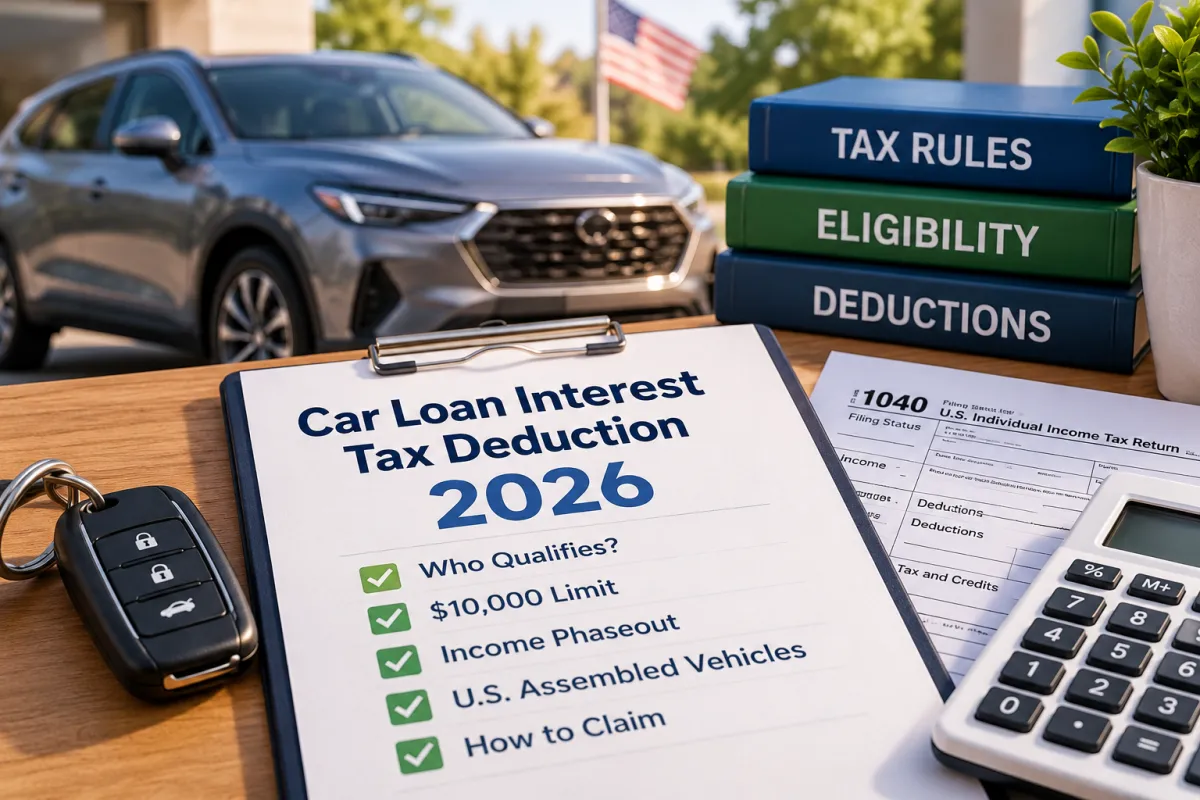
If you financed a qualifying new vehicle, you may be able to deduct some or all of the interest you paid on the car loan on your 2026 federal tax return. The deduction can be worth up to $10,000 of qualified passenger vehicle loan interest, but it is subject to vehicle, loan, personal-use, and income requirements. It is also available to taxpayers who take the standard deduction, so you do not have to itemize to benefit.
The rule applies to qualifying tax years beginning after December 31, 2024, and before January 1, 2029. For 2026, that means interest that meets the requirements can potentially qualify for the deduction.
The important point is that having a car loan is not enough. Your vehicle and financing arrangement have to satisfy specific federal requirements. The easiest way to evaluate your situation is to check the vehicle, loan, personal-use, U.S. assembly, interest, and income rules separately.
What Is the 2026 Car Loan Interest Deduction?
The 2026 car loan interest deduction is a federal income-tax deduction for certain interest paid on qualifying passenger vehicle loans.
Under the current federal rules, you may be able to deduct up to $10,000 of qualified passenger vehicle loan interest per federal tax return. The $10,000 limit applies to the return as a whole, regardless of filing status. If you have more than one qualifying vehicle, you generally combine the qualifying interest before applying the $10,000 limit rather than receiving a separate $10,000 limit for each vehicle.
This is a deduction, not a tax credit.
That distinction matters. A $10,000 deduction does not mean the IRS sends you a $10,000 refund. Instead, an eligible deduction can reduce the income subject to federal income tax. Your actual tax savings depend on your overall tax situation.
For example, suppose you have $5,000 of qualifying car loan interest and are eligible to deduct the entire amount. The deduction could reduce your taxable income by $5,000. Your actual federal tax savings would depend on factors such as your marginal tax rate and other items on your return.
The deduction is available whether you itemize deductions or claim the standard deduction, which makes it different from many traditional personal-interest deductions.
Who Can Qualify for the Deduction?
There are several requirements, and they work together.
A simplified eligibility checklist is:
| Requirement | What generally must be true |
|---|---|
| Tax year | The deduction applies for tax years 2025 through 2028 |
| Loan date | The qualifying indebtedness must generally be incurred after December 31, 2024 |
| Vehicle | It must meet the federal definition of an applicable passenger vehicle |
| Original use | The vehicle's original use must start with the taxpayer |
| Assembly | Final assembly must occur in the United States |
| Loan security | The loan must be secured by a first lien on the vehicle |
| Use | The vehicle must be purchased for qualifying personal use |
| Interest | The deduction is for qualifying loan interest paid or accrued during the tax year |
| Income | The deduction phases out above specified MAGI thresholds |
| Filing | The VIN must be reported as required by the applicable federal filing rules |
Meeting one requirement does not make the entire loan eligible. For example, a new vehicle may still fail the test if its final assembly occurred outside the United States. Similarly, a U.S.-assembled vehicle may not qualify if the loan does not meet the required financing rules.
Your Vehicle Generally Must Be New
One of the biggest differences between this deduction and a general car-loan-interest deduction is the original-use requirement.
The vehicle's original use must start with you, meaning the vehicle generally needs to be treated as new when you purchase it with the qualifying loan.
This means you should not assume that a low-mileage used vehicle qualifies simply because it looks almost new.
What about a used car purchased from a dealer?
Generally, no.
If someone previously took delivery of the vehicle and it is being sold to you as a used vehicle, the original-use requirement generally prevents the loan interest from qualifying for this particular deduction.
That makes the distinction between new and used one of the first things to check before expecting a deduction.
The Vehicle Must Be Finally Assembled in the United States
The vehicle's final assembly must occur in the United States. This requirement is separate from where the manufacturer is headquartered or where the vehicle brand originated.
In other words, simply buying an American-brand vehicle does not automatically establish eligibility.
The relevant question is where the vehicle was finally assembled.
You can research vehicle information using the vehicle identification number, or VIN, and available government resources. The vehicle's labeling and purchase documentation can also provide useful manufacturing information.
The important distinction is:
Brand origin is not the same thing as final assembly location.
If you are considering a vehicle specifically because you expect to claim the deduction, verify the vehicle's final assembly rather than relying on the brand name.
What Types of Vehicles Can Qualify?
The rules do not apply to every type of vehicle.
Qualifying vehicle categories can include:
-
Cars
-
Minivans
-
Vans
-
SUVs
-
Pickup trucks
-
Motorcycles
The vehicle must also satisfy the other federal requirements. Among the requirements are rules concerning how the vehicle is manufactured, its use on public streets and highways, and its gross vehicle weight rating.
For this deduction, the applicable passenger vehicle generally must have a gross vehicle weight rating of less than 14,000 pounds.
This is why it is better to think of the deduction as a qualification test rather than a benefit automatically attached to every new car loan.
Your Loan Must Meet Specific Requirements
The vehicle is only one part of the test. The financing arrangement matters too.
The qualifying indebtedness generally must have been incurred after December 31, 2024, for the purchase of the vehicle. The loan must also be secured by a first lien on the qualifying vehicle.
A first lien generally means the lender has a valid security interest in the vehicle with priority over other security interests, subject to the applicable rules.
The interest must also relate to qualifying indebtedness.
For example, financing unrelated property along with the vehicle does not automatically turn interest on that unrelated amount into qualified passenger vehicle loan interest.
Personal Use Is an Important Requirement
The deduction is intended for qualifying passenger vehicle loan interest associated with a vehicle purchased for personal use.
At the time the indebtedness is incurred, the applicable rules generally require the taxpayer to expect the vehicle to be used for personal purposes by the taxpayer, the taxpayer's spouse, or certain related individuals for more than 50% of the time the taxpayer expects to own the vehicle.
This is particularly important for vehicles that have both personal and business uses.
The rules do not necessarily mean that a vehicle becomes ineligible simply because it is occasionally used for business. However, business use can make the tax treatment more complicated.
For a vehicle used substantially for business, the treatment of interest and other vehicle expenses may involve separate tax rules. Keep records that support how the vehicle is actually used.
How Much Can You Deduct in 2026?
The maximum amount of qualified passenger vehicle loan interest that can be taken into account is $10,000 per federal tax return for the tax year.
That means the basic calculation starts with the amount of qualifying interest you actually paid or accrued during the year.
For example:
-
Qualifying interest paid: $3,500
-
Maximum statutory limit: $10,000
-
Potential deduction before income phaseout: $3,500
Because $3,500 is below the $10,000 limit, the dollar cap would not reduce the deduction in this simplified example.
If you paid $12,000 in qualifying interest, the $10,000 annual limit would generally prevent you from taking more than $10,000 as qualified passenger vehicle loan interest before considering the separate income phaseout.
The $10,000 limit is not $10,000 per vehicle. If you have multiple qualifying vehicles, the qualifying interest is subject to the per-return limit.
How the Income Phaseout Works
Even if your vehicle and loan qualify, your income can reduce or eliminate the deduction.
The phaseout begins when modified adjusted gross income, or MAGI, exceeds:
-
$100,000 for most taxpayers
-
$200,000 for married taxpayers filing jointly
The deduction is reduced by $200 for each $1,000, or portion of $1,000, by which MAGI exceeds the applicable threshold.
The phaseout can reduce the deduction to zero.
Example of the phaseout
Suppose a taxpayer filing as single has:
-
$7,000 of qualifying vehicle-loan interest
-
$124,200 of MAGI
The taxpayer is $24,200 above the $100,000 threshold.
Because the rule counts each $1,000 or portion thereof, $24,200 is treated as 25 increments for purposes of the reduction.
The reduction would therefore be:
25 × $200 = $5,000
The potential $7,000 deduction would be reduced to $2,000.
This is why simply looking at the $10,000 headline limit can give an incomplete picture. Your actual deduction depends on both the amount of qualifying interest and your MAGI.
The $10,000 Deduction Is Not a $10,000 Refund
This is one of the easiest parts of the rule to misunderstand.
A deduction reduces taxable income. A tax credit directly reduces the amount of tax owed.
Suppose, purely as an illustration, that you qualify for a $5,000 deduction and that the deduction produces a federal tax benefit at a 22% marginal rate. The approximate tax reduction from that deduction would be $1,100, not $5,000.
Your actual result can be different because federal tax calculations involve filing status, taxable income, other deductions, credits, and other factors.
So when evaluating the benefit of the car loan interest deduction, focus on the taxable-income reduction, not the deduction amount as though it were a refund.
What If You Take the Standard Deduction?
You can still potentially claim the car loan interest deduction.
The qualified passenger vehicle loan interest deduction is available to eligible taxpayers whether they itemize deductions or take the standard deduction.
This makes the rule especially relevant to taxpayers who normally use the standard deduction.
You should still distinguish this deduction from other forms of personal interest. The fact that car loan interest is generally personal interest does not mean every vehicle loan automatically qualifies. The special federal rule applies only to interest meeting the qualified passenger vehicle loan requirements.
What Happens If You Refinance the Car Loan?
Refinancing does not automatically destroy eligibility, but the refinancing rules matter.
A qualifying car loan that is later refinanced may remain eligible under the applicable rules. However, the amount of the new loan that can qualify is generally limited by the outstanding balance of the refinanced qualifying loan at the time of refinancing.
This matters if you refinance and also borrow additional money.
For example, imagine a qualifying vehicle loan has an outstanding balance when you refinance. If the new loan is larger because you add unrelated debt or additional amounts, the entire new balance should not automatically be treated as qualifying for this deduction.
The refinancing rules are therefore another reason to retain the original loan records, payoff information, and refinancing documents.
What About Leasing a Vehicle?
A lease is different from purchasing a vehicle with a qualifying secured loan.
The federal rule applies to qualified passenger vehicle loan interest on qualifying indebtedness incurred for the purchase of an applicable passenger vehicle.
Lease financing does not qualify for this particular deduction.
So you should not assume that payments made under a vehicle lease create deductible car-loan interest under this provision.
If you are comparing a lease with a purchase, treat the tax consequences as one factor among many rather than assuming that the new deduction applies to both arrangements.
How to Verify Your Vehicle Before Claiming the Deduction
If you think your vehicle qualifies, verify the requirements rather than relying only on the dealership's description or the vehicle's brand.
A practical verification process is:
1. Confirm that the vehicle was purchased new
Check your purchase and loan documents. The vehicle needs to satisfy the original-use requirement.
2. Check the loan date
Confirm that the qualifying indebtedness was incurred after December 31, 2024.
3. Confirm the lien requirement
Review the financing documents to make sure the qualifying loan is secured by the required first lien.
4. Verify final assembly
Look at the vehicle's labeling and purchase documentation for final-assembly information.
You can also use the vehicle's VIN to research vehicle information through National Highway Traffic Safety Administration resources.
5. Determine your qualifying interest
Review your lender records and determine how much interest you actually paid or accrued during 2026.
6. Check your MAGI
Compare your MAGI with the applicable $100,000 or $200,000 phaseout threshold.
7. Keep your VIN available
The federal filing rules require the VIN of the qualifying vehicle to be reported when claiming the deduction.
What Is Form 1098-VLI?
For qualifying vehicle loans, your lender may provide Form 1098-VLI, Vehicle Loan Interest Statement.
The IRS created Form 1098-VLI for lenders that receive at least $600 of interest on a specified passenger vehicle loan during the calendar year in the course of their trade or business.
The form can help you identify the interest information associated with the loan, but receiving a Form 1098-VLI does not automatically mean that the entire amount shown is deductible.
The reported amount may still be subject to limitations based on the vehicle, loan, taxpayer's income, and other applicable requirements.
Think of Form 1098-VLI as supporting tax information from the lender—not as an automatic eligibility approval.
You should still check:
-
Whether the vehicle is eligible
-
Whether it was new when purchased
-
Whether final assembly occurred in the United States
-
Whether the loan satisfies the requirements
-
Whether the personal-use test is met
-
Whether your income reduces the deduction
-
Whether other limitations apply
How to Claim the Deduction on Your 2026 Return
The deduction is part of the federal additional-deduction process rather than an ordinary vehicle expense deduction.
The IRS filing materials for the deduction include a specific section for qualified passenger vehicle loan interest and require information such as the vehicle identification number.
Because tax forms and instructions can be updated during the filing season, use the final 2026 IRS forms and instructions available when you file rather than relying on an early draft or an outdated software screen.
A practical filing checklist is:
-
Gather your vehicle purchase documents.
-
Gather the original loan agreement.
-
Confirm the loan date and lien information.
-
Determine the amount of interest paid or accrued during 2026.
-
Obtain your Form 1098-VLI if your lender provides one.
-
Verify the vehicle's VIN.
-
Verify that the vehicle meets the U.S. final-assembly requirement.
-
Determine your MAGI for the tax year.
-
Apply the $10,000 annual limit.
-
Apply the applicable income phaseout.
-
Enter the deduction using the final IRS filing forms and instructions for 2026.
If your situation involves a complicated refinancing, substantial business use, multiple qualifying loans, or another unusual circumstance, professional tax advice may be appropriate.
Common Mistakes to Avoid
The deduction is relatively new, so several mistakes are easy to make.
Assuming every car loan qualifies
A normal auto loan does not automatically qualify. The vehicle, loan, personal-use, assembly, income, and other requirements all matter.
Treating the $10,000 limit as a refund
The $10,000 figure is a maximum deduction, not a $10,000 tax credit.
Assuming an American brand means U.S. assembly
The relevant requirement is final assembly in the United States, not simply the nationality of the automaker.
Assuming a used vehicle qualifies
The original-use requirement generally excludes used vehicles.
Forgetting the income phaseout
A taxpayer can have a qualifying vehicle and loan but still receive a reduced deduction because of MAGI.
Thinking the limit is $10,000 per vehicle
The federal limit is $10,000 per tax return. Multiple qualifying loans are subject to the same per-return limitation.
Ignoring the VIN requirement
The VIN is part of the federal reporting process for claiming the deduction. Keep it with your tax records.
Assuming Form 1098-VLI guarantees eligibility
The lender's statement provides important information, but it does not replace your responsibility to determine whether the vehicle and loan qualify.
A Simple Eligibility Test
If you want a quick way to evaluate a 2026 car loan, work through these questions in order:
Vehicle: Was it purchased new, with its original use starting with you?
Assembly: Was its final assembly completed in the United States?
Type: Does it meet the applicable passenger-vehicle requirements, including the less-than-14,000-pound gross vehicle weight rating?
Loan: Was the qualifying debt incurred after December 31, 2024, for the vehicle purchase and secured by a first lien?
Use: At the time you took out the loan, did you expect the vehicle to be used for personal purposes more than 50% of the time you expected to own it?
Interest: How much qualifying interest did you actually pay or accrue during 2026?
Income: Is your MAGI above $100,000, or above $200,000 if you are married filing jointly?
Limit: Is your qualifying interest below the $10,000 per-return maximum?
Documentation: Do you have your VIN, loan records, interest information, and supporting vehicle documents?
If the answer to all applicable questions is yes, you may have a qualifying deduction. If one answer is no, investigate that requirement before including the interest on your return.
How the Deduction Fits Into the Overall Cost of Owning a Car
The tax deduction can reduce the after-tax cost of financing a qualifying vehicle, but it should not be the only factor in a vehicle-buying decision.
Interest is only one part of the cost of ownership. Insurance, fuel, maintenance, registration, depreciation, financing terms, and the purchase price can have a much larger effect on the total cost of owning a vehicle.
For example, if you are comparing two vehicles and one has slightly lower financing costs but significantly higher insurance costs, the tax deduction alone may not make it the cheaper choice.
Before buying or financing a vehicle, it can also help to evaluate your expected car insurance costs and coverage alongside the financing decision.
The best use of the car loan interest deduction is therefore to treat it as one component of your overall financial calculation—not as a reason by itself to borrow more money or choose a more expensive vehicle.
Conclusion
The 2026 car loan interest deduction can allow eligible taxpayers to deduct up to $10,000 of qualified passenger vehicle loan interest, and the benefit is available to both itemizers and taxpayers who take the standard deduction. But eligibility depends on much more than having a new car loan.
For a vehicle to qualify, the purchase and financing generally must meet requirements involving the loan date, first lien, personal use, original use, vehicle type, U.S. final assembly, and other federal rules. Your deduction can also be reduced by the MAGI phaseout beginning above $100,000 for most taxpayers or $200,000 for married couples filing jointly.
Before claiming the deduction, verify the vehicle and loan documents, determine your actual qualifying interest for 2026, keep your VIN available, and use the final IRS forms and instructions applicable when you file.
Most importantly, remember that the $10,000 figure represents a maximum deduction, not a guaranteed refund. The value of the deduction depends on how much qualifying interest you paid, whether your income reduces the benefit, and how the deduction interacts with your overall federal tax situation.
Frequently asked questions
Does a used car qualify for the 2026 car loan interest deduction?
No. For this deduction, the vehicle's original use must start with the taxpayer. That means a used vehicle generally does not qualify for the 2026 qualified passenger vehicle loan interest deduction.
Can I deduct car loan interest if I lease my vehicle?
No. The deduction applies to qualifying loan interest on a purchased passenger vehicle. Lease financing does not qualify for this deduction.
How do I know if my car was finally assembled in the United States?
The vehicle must meet the U.S. final-assembly requirement. You can use the vehicle's VIN to research its manufacturing information, including build-plant details, through NHTSA's VIN resources.
Can I claim the deduction if I take the standard deduction?
Yes. This particular car loan interest deduction is available to eligible taxpayers whether they itemize deductions or take the standard deduction.
What happens if my income is over $100,000?
The deduction begins to phase out when modified adjusted gross income exceeds $100,000, or $200,000 for married taxpayers filing jointly. The deduction is reduced by $200 for each $1,000, or portion of $1,000, above the applicable threshold.
Can I deduct interest on a refinanced car loan?
A qualifying car loan that is later refinanced may remain eligible under the applicable rules. The refinanced amount must meet the requirements and limitations that apply to qualifying passenger vehicle loan interest.
How much tax will I actually save from the deduction?
The deduction reduces taxable income; it is not a $10,000 tax credit or automatic $10,000 refund. Your actual tax savings depend on your individual tax situation and the amount of qualifying interest you can deduct.
Do I need to report my vehicle's VIN to claim the deduction?
Yes. The applicable federal filing materials require the VIN of the qualifying vehicle to be reported when claiming the deduction. Use the applicable 2026 IRS form and instructions when filing.

Olivia Bennett writes practical automotive content covering car buying, ownership costs, maintenance, vehicle features, reliability, and everyday driving decisions. Her work focuses on helping readers understand automoti...