What Is Disposable Income? How to Calculate It and Compare It With Discretionary Income
Learn what disposable income means, how to calculate it, how it differs from take-home pay and discretionary income, and how to use it when planning a U.S. household budget.
In this article
- What Is Disposable Income?
- Disposable income is not simply "money in your bank account"
- How Is Disposable Income Calculated?
- Formal economic calculation
- Personal budgeting calculation
- Disposable Income vs. Gross Income
- Disposable Income vs. Take-Home Pay
- Disposable Income vs. Discretionary Income
- A simple comparison
- A Disposable Income Example
- What Can Affect Your Disposable Income?
- Changes in earnings
- Changes in taxes
- Voluntary payroll deductions
- Changes in household income
- Why Disposable Income Matters for Personal Finance
- Building a budget
- Setting savings goals
- Managing debt
- Evaluating lifestyle changes
- Common Mistakes When Understanding Disposable Income
- Mistake 1: Using gross income as spending money
- Mistake 2: Assuming disposable income means "fun money"
- Mistake 3: Treating take-home pay as a universal definition
- Mistake 4: Ignoring voluntary deductions
- Mistake 5: Mixing economic and legal definitions
- Disposable Earnings Is a Different Legal Concept
- How to Use Disposable Income in Your Financial Planning
- The Bottom Line
Disposable income is the money you have left after taxes and other deductions that apply to the particular definition being used. In everyday personal-finance conversations, it is often used to describe income available to a person or household after taxes. In economic statistics, the U.S. Bureau of Economic Analysis (BEA) uses a more specific definition: disposable personal income is personal income minus personal current taxes.
The term can become confusing because disposable income, take-home pay, net pay, disposable earnings, and discretionary income are not always the same thing.
For a household trying to understand its budget, the distinction matters. The amount deposited into your bank account may differ from the amount considered disposable under a particular calculation, while discretionary income generally refers to what remains after necessary expenses have been covered.
A useful way to think about the terminology is:
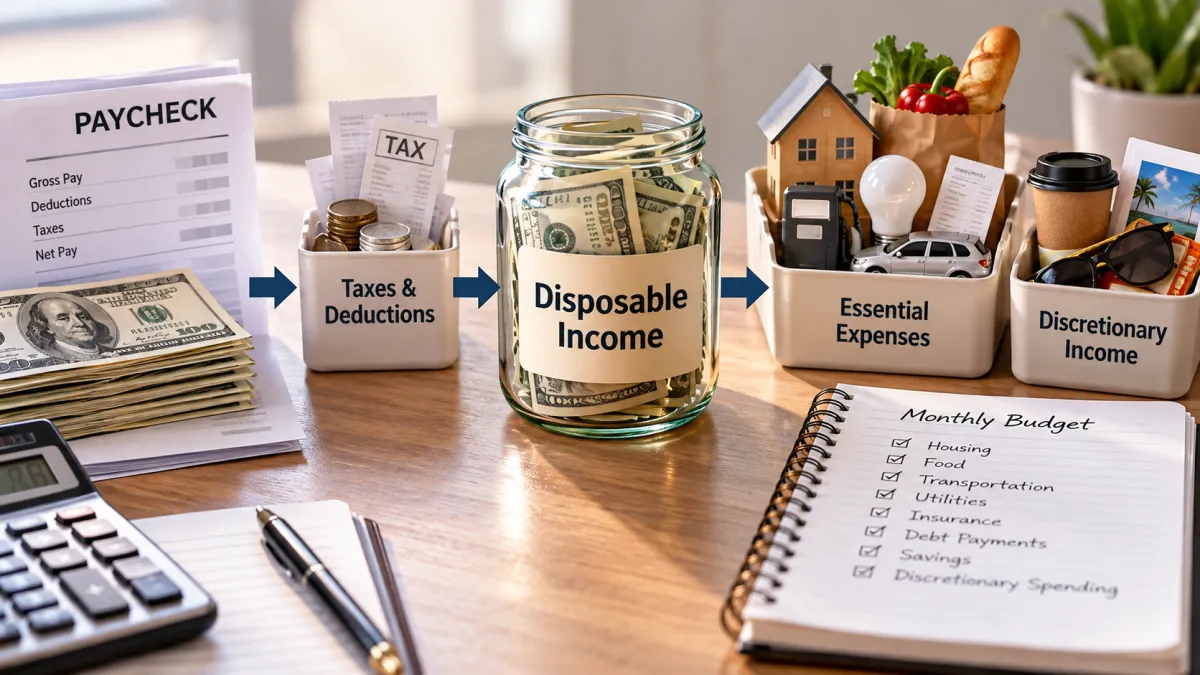
Income → taxes and applicable deductions → disposable-income concept → essential expenses → discretionary income
Understanding where each term fits can make it easier to build a realistic budget, decide how much to save, and understand what your paycheck is actually telling you.
What Is Disposable Income?
Disposable income generally refers to income available after taxes have been taken into account.
For an individual or household, the basic idea is simple: start with income and subtract the taxes that apply. The result represents money available for spending or saving before considering whether particular purchases are necessary or optional.
The term is also used in a formal economic context. The BEA defines disposable personal income (DPI) as personal income minus personal current taxes. At the national level, this measure helps economists understand how much income U.S. residents have available to spend or save.
That economic definition is different from a personal budgeting calculation.
For example, suppose someone earns wages from a job. Their gross pay is the amount earned before payroll taxes and other deductions. After applicable taxes and deductions, the amount available to the person is lower.
But the amount shown as take-home pay on a paycheck is not automatically interchangeable with every definition of disposable income.
That distinction becomes particularly important when voluntary deductions are involved.
Disposable income is not simply "money in your bank account"
Your bank account balance is a snapshot of available cash. Disposable income is an income concept.
For example, you could have $2,000 deposited into your checking account after a paycheck, but that does not mean you have $2,000 of completely unrestricted money. You may still need to pay rent, groceries, utilities, insurance, transportation costs, debt payments, and other expenses.
This is where the distinction between disposable and discretionary income becomes important.
How Is Disposable Income Calculated?
There are two useful calculation contexts to understand.
Formal economic calculation
The BEA's formal calculation is:
Disposable Personal Income = Personal Income − Personal Current Taxes
This is a macroeconomic measure used to analyze income and spending across the U.S. economy.
It is not designed to calculate exactly how much one individual can spend each month.
Personal budgeting calculation
For personal budgeting, a simpler approach is to start with your income and subtract applicable taxes and required deductions to estimate the income available after taxes.
A simplified framework is:
Income − applicable taxes and required deductions = after-tax income
From there, you can look separately at your essential expenses to determine how much money remains for discretionary spending.
The exact calculation can vary depending on why you are calculating the number. A household budget, a government economic statistic, a wage-garnishment calculation, and another legal or financial calculation may use different definitions.
That is why it is better to ask "Disposable income for what purpose?" rather than assuming there is one universal formula for every situation.
Disposable Income vs. Gross Income
Gross income is income before taxes and other deductions.
For an employee, gross wages may include salary, hourly wages, bonuses, commissions, and other compensation that is included in wages.
Disposable income comes later in the income process.
A simplified example:
| Income concept | What it generally represents |
|---|---|
| Gross income | Income before taxes and deductions |
| After-tax income | Income remaining after applicable taxes |
| Disposable income | Income available after taxes under the relevant definition |
| Essential expenses | Necessary costs such as housing, food, utilities, and transportation |
| Discretionary income | Money remaining after necessary expenses |
These terms are related, but they answer different questions.
If you look only at gross income, you can overestimate how much money is actually available to use. If you look only at the amount deposited into your bank account, you may overlook differences between ordinary take-home pay and a calculation being used for a specific legal or economic purpose.
Disposable Income vs. Take-Home Pay
Disposable income and take-home pay are closely related in everyday conversations, but they should not automatically be treated as identical.
Take-home pay is the amount you actually receive from your paycheck after the deductions applied by your employer.
Those deductions can include federal income tax withholding, Social Security and Medicare taxes, and potentially state or local taxes. A paycheck can also contain voluntary deductions such as retirement contributions or certain benefit premiums.
Because payroll deductions vary, the amount deposited into your account can differ from a simplified disposable-income calculation.
Consider a hypothetical employee whose gross monthly wages are $5,000.
After applicable taxes and payroll deductions, the employee may receive less than $5,000. The amount actually deposited into the employee's account is the take-home amount.
But if the employee also contributes money to a retirement plan or pays for benefits through payroll, you need to know what definition you are using before deciding whether those voluntary deductions should be treated as reducing disposable income.
The safest approach is to identify the purpose of the calculation first.
If you are building a household budget, your paycheck and bank deposit are highly useful because they show the cash you actually have available to manage. If you are trying to understand an official economic or legal definition, use the rules associated with that definition instead.
For readers trying to understand their paycheck and direct deposit, KnowBrook also covers understanding your paycheck and direct deposit.
Disposable Income vs. Discretionary Income
The most important distinction is that disposable income generally comes before discretionary income.
Disposable income focuses primarily on income after taxes under the applicable definition.
Discretionary income goes a step further by considering necessary living expenses.
A simplified framework looks like this:
Income → taxes → disposable income → essential expenses → discretionary income
Suppose a household has $6,000 of disposable income for a month.
The household still has to pay for necessities such as:
-
Housing
-
Food
-
Utilities
-
Transportation
-
Insurance
-
Required debt payments
-
Other necessary household expenses
If those essential expenses total $4,500, the household has $1,500 remaining after those expenses.
That $1,500 can be thought of as discretionary money in a household-budgeting context. It could potentially be used for entertainment, dining out, additional savings, travel, optional purchases, or accelerated debt payments.
The exact classification of an expense can vary by household. For example, one person's transportation expense may be essential because they need a vehicle to get to work, while another person may have more flexibility.
A simple comparison
| Term | Main question it answers |
|---|---|
| Gross income | How much income is earned before taxes and deductions? |
| Take-home pay | How much does the employee actually receive from the paycheck? |
| Disposable income | How much income remains after taxes under the relevant definition? |
| Discretionary income | How much remains after necessary expenses? |
This distinction prevents a common budgeting mistake: assuming that every dollar left after taxes is available for optional spending.
It is not.
A Disposable Income Example
Consider a hypothetical U.S. household with monthly employment income of $7,000 before taxes.
After applicable taxes and payroll deductions, suppose the household has $5,400 available after taxes for purposes of its household budget.
That $5,400 is the household's practical after-tax income for the example.
Now consider its monthly essential expenses:
-
Housing: $2,000
-
Groceries: $700
-
Utilities: $300
-
Transportation: $500
-
Insurance: $400
-
Other necessary expenses: $500
Total essential expenses are $4,400.
The household therefore has:
$5,400 − $4,400 = $1,000
That $1,000 is money remaining after the listed essential expenses. In a household budgeting context, it can represent discretionary income.
The household could decide to use that money for additional savings, extra debt payments, entertainment, travel, dining out, or other optional expenses.
The important point is that the $5,400 and $1,000 represent different stages of the calculation.
The first number is after-tax income for the example. The second is what remains after the household's selected essential expenses.
This is why saying "I have $1,000 of disposable income" could mean something different from saying "I have $1,000 of discretionary income."
What Can Affect Your Disposable Income?
Your disposable income can change when your income, taxes, or applicable deductions change.
Changes in earnings
If your salary increases, your disposable income may increase as well. The same can happen if you work more hours, receive a bonus, earn additional commissions, or add another source of income.
The reverse is also true. Reduced hours, a lower salary, or the loss of another income source can reduce the amount available.
Changes in taxes
Federal, state, and local taxes can affect the amount of income left after taxes.
Federal income tax withholding can change when your earnings or withholding information changes. Social Security and Medicare taxes also affect employee paychecks.
The amount withheld from a paycheck is not necessarily the same thing as your final tax liability for the year, so paycheck withholding should not be confused with your final income-tax calculation.
Voluntary payroll deductions
Some employees have deductions that are not simply taxes.
Examples can include:
-
Retirement-plan contributions
-
Health insurance premiums
-
Other employer-sponsored benefits
These deductions can affect the amount that reaches your bank account.
However, whether a particular voluntary deduction should reduce "disposable income" depends on the context in which the term is being used.
That is one reason a budgeting calculation should not automatically be presented as an official legal or economic calculation.
Changes in household income
A household with multiple earners can see disposable income change when one person's earnings change.
This is especially important for households with variable income. If your income changes from month to month, using one fixed income number may produce a budget that looks realistic on paper but does not match your actual cash flow.
KnowBrook's guide to budgeting with changing income can help when your monthly income is not consistent.
Why Disposable Income Matters for Personal Finance
Disposable income is useful because it gives you a better starting point for financial decisions than gross income alone.
Someone earning $80,000 per year does not have $80,000 available to spend. Taxes and other deductions reduce the amount that actually reaches the household.
Looking at after-tax income gives you a more realistic starting point.
From there, you can determine how much of that income is committed to necessary expenses.
This can help with several financial decisions.
Building a budget
A practical household budget should be based on the money you realistically have available rather than on gross earnings alone.
Starting with after-tax income can make your spending plan more realistic.
Setting savings goals
Once you know what remains after essential costs, you can decide how much to direct toward savings.
The appropriate amount depends on your circumstances, including income stability, existing savings, debt, and upcoming expenses.
Managing debt
Disposable and discretionary income can also help you understand how much flexibility you have for debt payments.
If a household has money remaining after essential expenses, it may choose to use some of that money for additional payments rather than treating the entire amount as spending money.
Evaluating lifestyle changes
Knowing how much money remains after taxes and essential expenses can make larger financial decisions easier to evaluate.
For example, before taking on a new recurring payment, you can compare the payment with the amount of income already available after your existing obligations.
Common Mistakes When Understanding Disposable Income
The terminology can create several common mistakes.
Mistake 1: Using gross income as spending money
Gross income is useful for understanding earnings, but it does not tell you how much money you can actually use for household spending.
Taxes and other deductions need to be considered.
Mistake 2: Assuming disposable income means "fun money"
Disposable income is not necessarily the same as money available for entertainment or optional purchases.
Essential expenses still need to be paid.
That is why discretionary income is a separate concept.
Mistake 3: Treating take-home pay as a universal definition
Take-home pay is the amount that reaches you after payroll deductions. It is extremely useful for personal budgeting, but it should not automatically be substituted for every formal definition of disposable income.
Mistake 4: Ignoring voluntary deductions
Retirement contributions and benefit premiums can reduce the amount deposited into your account.
Whether those deductions should also reduce disposable income depends on the specific calculation being used.
Mistake 5: Mixing economic and legal definitions
The term "disposable" can have specialized meanings outside ordinary household budgeting.
For example, federal wage-garnishment rules use the concept of disposable earnings, which is a legal calculation based on legally required deductions. Voluntary deductions are treated differently under that framework.
That legal concept should not be confused with the BEA's economic measure of disposable personal income or with the everyday household-budgeting use of disposable income.
Disposable Earnings Is a Different Legal Concept
If you encounter the phrase "disposable earnings" in connection with wage garnishment, do not assume it means the same thing as disposable income in a personal-finance article.
The U.S. Department of Labor uses a specific definition when discussing federal wage-garnishment protections. In that context, disposable earnings are generally earnings remaining after legally required deductions.
The rules governing that calculation can differ from ordinary budgeting calculations because the purpose is different.
This distinction matters if you are reading information about wage garnishment, because a legal calculation should follow the applicable federal and state rules rather than a household budgeting formula.
Similarly, other legal or government programs may define income differently for their own purposes.
If the calculation affects a legal obligation, benefit eligibility, or another official determination, use the definition provided by the relevant government agency or program rather than assuming that a general personal-finance definition applies.
How to Use Disposable Income in Your Financial Planning
Once you understand the terminology, the concept becomes more useful for everyday planning.
Start with the income that is relevant to your situation. Then identify taxes and deductions that apply to the calculation you are making.
For a household budget, use the income you realistically have available after taxes and normal payroll deductions. From there, separate essential expenses from optional spending.
A simple framework is:
1. Identify income
List your regular sources of income and distinguish gross income from the amount you actually receive.
2. Account for taxes
Identify the federal, state, and local taxes that affect your income, where applicable.
3. Determine your practical after-tax income
Use your actual paycheck information to understand how much money is available to manage.
4. List essential expenses
Separate necessities such as housing, food, utilities, transportation, and insurance from optional spending.
5. Calculate what remains
The amount left after essential expenses gives you a clearer picture of your discretionary flexibility.
6. Decide how to allocate that flexibility
You can divide the remaining money among savings, debt reduction, planned purchases, and optional spending according to your financial priorities.
This approach is more useful than treating disposable income as a single number that automatically tells you how much you should spend.
The Bottom Line
Disposable income is best understood as an after-tax income concept, but its exact meaning depends on the context.
In formal U.S. economic statistics, disposable personal income is personal income minus personal current taxes. In everyday budgeting, people often use the term to describe income available after taxes and applicable deductions. Take-home pay is the amount actually received from a paycheck, while discretionary income generally refers to what remains after necessary living expenses.
The simplest way to keep the terms straight is to think of them as different stages:
Gross income → taxes and applicable deductions → disposable-income concept → essential expenses → discretionary income
Once you separate those stages, it becomes much easier to understand your paycheck, build a realistic household budget, and make financial decisions based on the money you actually have available rather than on gross income alone.
Frequently asked questions
Is disposable income the same as take-home pay?
Disposable income and take-home pay are closely related in everyday budgeting, but they are not universally identical. Take-home pay is the amount actually received after payroll withholding and deductions, while the meaning and calculation of disposable income can vary by context.
Are 401(k) contributions included when calculating disposable income?
It depends on the definition being used. A voluntary 401(k) contribution can reduce the amount deposited into your bank account, but it should not automatically be treated as a required deduction in every disposable-income calculation. Legal calculations can use their own rules.
Does disposable income include Social Security and Medicare taxes?
For paycheck-based calculations, Social Security and Medicare taxes are payroll taxes that reduce the amount of earnings available after withholding. The exact treatment depends on the type of disposable-income calculation being performed.
Can disposable income change from one paycheck to another?
Yes. Disposable income can change when earnings, tax withholding, or applicable deductions change. Variable work hours, bonuses, commissions, and other changes in pay can also affect the amount available.
Is disposable income the same as money I can spend on anything I want?
No. Disposable income should not automatically be treated as “fun money.” It may still need to cover housing, food, transportation, insurance, debt payments, savings, and other financial priorities. Discretionary income generally refers to what remains after necessary expenses.
How can I increase my disposable income?
You can potentially increase disposable income by increasing earnings, reducing recurring expenses, and reviewing voluntary deductions or legitimate tax-planning choices. Changes to tax withholding can affect your paycheck without necessarily changing your overall tax liability.
Does disposable income mean the same thing in wage-garnishment or child-support calculations?
1. Not necessarily. Legal and government programs can use specific definitions and deduction rules. Federal wage-garnishment rules, for example, use the term “disposable earnings” and apply specific statutory rules, so a household budgeting formula should not automatically be used for a legal calculation.

Daniel Brooks writes practical content about personal finance, budgeting, saving, credit, banking, taxes, and everyday money decisions. His work focuses on explaining financial topics in straightforward language and help...