What Movers Won’t Move: Items to Keep Off the Moving Truck
Learn which household items movers commonly won’t accept, why restrictions apply, what you should carry yourself, and what to do with items that require special handling or disposal.
 By Ethan Parker
In this article
- What Movers Won’t Move
- The Five Categories to Use Before You Pack
- Hazardous and Dangerous Household Materials
- Gasoline and other fuels
- Paint and paint thinner
- Propane cylinders
- Fireworks and flammable products
- A useful garage rule
- Perishable Food
- Plants and Soil
- Pets and Animals
- Valuables and Irreplaceable Items
- Medication and Essential Personal Items
- Firearms and Ammunition
- Oversized and Specialty Items
- Prohibited vs. Restricted vs. Carry-It-Yourself
- Prohibited by applicable rules
- Restricted or subject to requirements
- Not accepted by your mover
- Better carried personally
- What to Do With Items Movers Won’t Take
- Household hazardous waste
- Usable food
- Plants
- Valuables
- Specialty items
- Ask Your Moving Company Before Moving Day
- The Pre-Move “Do Not Load” Sweep
- Garage
- Kitchen
- Refrigerator and freezer
- Bathroom
- Home office
- Bedrooms and closets
- Yard and outdoor storage
- A Simple Sorting System
- Local vs. Interstate Moves
- What to Keep With You on Moving Day
- Common Mistakes to Avoid
- Assuming every mover follows the same list
- Treating every refusal as a legal prohibition
- Waiting until loading begins
- Packing everything from the garage
- Assuming plants are always allowed
- Putting valuables into ordinary boxes
- Using a generic internet list for firearms
- A Practical Decision Table
- What to Do the Day Before the Movers Arrive
- Conclusion
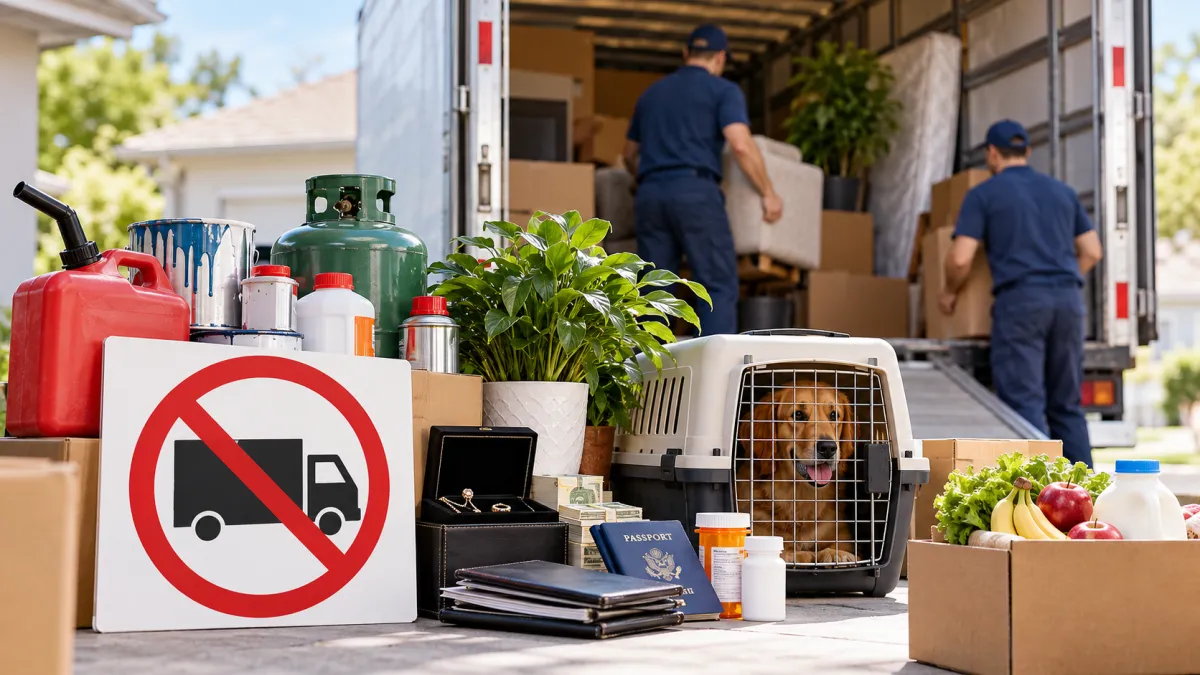
Hiring professional movers does not mean every item in your home can go into the moving truck. Some household products create transportation or safety concerns, some are excluded by a mover’s own policy, and others are better kept with you because they are valuable, fragile, personal, or difficult to replace.
The important distinction is that “movers won’t move it” does not always mean “it is illegal to move it.” Federal transportation requirements, state or local rules, the moving company’s policies, and practical considerations can all affect whether an item belongs on the truck.
A good approach is to sort questionable belongings into five groups: hazardous or restricted items, mover-policy-dependent items, belongings you should carry yourself, items requiring special handling, and items affected by destination-specific rules.
This guide explains how to make those decisions before moving day and what to do with items your moving company will not accept.
What Movers Won’t Move
There is no single universal list that every moving company follows in exactly the same way. A mover may have its own non-allowable-items policy in addition to federal, state, or local requirements.
That means the safest rule is simple: get your moving company’s current list before packing.
Common categories that deserve attention include:
-
Gasoline and other fuels
-
Paints and paint thinners
-
Lighter fluid
-
Fireworks
-
Propane cylinders
-
Certain automotive chemicals
-
Oxygen bottles and other potentially hazardous materials
-
Perishable food
-
Plants and soil
-
Pets and animals
-
Cash, jewelry, and other valuables
-
Important personal documents
-
Medication
-
Firearms and ammunition
-
Oversized or specialty items that require advance arrangements
The reason for exclusion is different from one category to another. A hazardous product can create a transportation or safety issue. A plant can involve agricultural restrictions. A valuable item may be better kept in your personal possession. A specialty item may simply require equipment or preparation that a standard moving crew does not provide.
The Five Categories to Use Before You Pack
Instead of treating every questionable item as simply “prohibited,” use this framework.
| Category | What it means | What you should do |
|---|---|---|
| Hazardous or restricted | Transportation or handling requirements may apply | Check the mover and applicable rules before packing |
| Mover-policy dependent | The moving company may choose not to accept it | Get the company's current non-allowable list |
| Better carried personally | Valuable, important, or sensitive belongings | Keep them with you whenever practical |
| Special handling | The item may require special equipment or arrangements | Ask the mover before moving day |
| State/destination dependent | Rules can vary based on where you are moving | Check the destination requirements |
This distinction prevents a common moving mistake: assuming that every item on a mover's “do not load” list is banned by federal law.
Hazardous and Dangerous Household Materials
Hazardous household products deserve the most attention because they can create safety and transportation problems inside a moving truck.
The Federal Motor Carrier Safety Administration (FMCSA) specifically warns consumers about hazardous materials that should not simply be placed into household-goods boxes or luggage without informing the mover. Examples include nail polish remover, paints, paint thinners, lighter fluid, gasoline, fireworks, oxygen bottles, propane cylinders, automotive chemicals, and radiopharmaceuticals.
Gasoline and other fuels
Do not assume that a gasoline can sitting in your garage can simply be packed into a moving box.
Fuel is highly flammable, and transportation requirements make it inappropriate to treat gasoline like an ordinary household item. The same caution applies to other fuels and fuel-containing products.
Before moving day, ask the mover how it wants fuel-related items handled and determine the appropriate disposal or alternative transportation option.
Paint and paint thinner
Paint cans, paint thinners, solvents, and similar products are common garage items that can easily be overlooked during packing.
A can that has been sitting on a garage shelf for years may not seem like a transportation concern, but the contents can still matter. Do not automatically place paint or solvents into a box headed for the truck.
Instead, check your local hazardous-waste or household hazardous-waste program for disposal options.
Propane cylinders
Propane cylinders are another item that should not be treated like ordinary household goods.
This can include cylinders used for grills and other household equipment. Ask the moving company about its policy before moving day and arrange an appropriate alternative if the company will not accept the cylinder.
Fireworks and flammable products
Fireworks and other flammable products require particular caution. They should not be casually packed into household boxes simply because they are small.
If you have questionable chemicals or flammable products in a garage, workshop, basement, or storage area, make a separate pile during your pre-move inspection and verify how each item should be handled.
A useful garage rule
The garage is one of the easiest places to miss non-allowable items because many products are stored there for months or years without being used.
Before the movers arrive, inspect:
-
Garage shelves
-
Cabinets
-
Tool storage
-
Outdoor storage sheds
-
Workbenches
-
Lawn-equipment areas
-
Automotive storage
-
Grilling supplies
-
Paint and renovation supplies
Do not wait until the movers are standing at the door to discover that several questionable products are still packed.
Perishable Food
Food can be another category where the answer depends on the mover's policy and the circumstances of the move.
Perishable foods can create problems because of temperature, spoilage, leakage, and the length of the journey. A long-distance move can make this particularly important.
Examples include:
-
Fresh meat
-
Fresh seafood
-
Refrigerated dairy products
-
Frozen food
-
Open refrigerated containers
-
Other foods that require continuous temperature control
Even if a mover accepts some food, that does not mean every type of food should automatically go into the truck.
Ask your moving company what food it accepts and whether its rules differ for local and interstate moves.
For items the mover will not take, practical alternatives may include using the food before moving, giving usable food to friends or family, donating appropriate unopened items, or transporting suitable food yourself.
Plants and Soil
Plants require a different kind of consideration.
The issue is not simply whether a moving company has room for a potted plant. Plants and soil can potentially carry pests or diseases, and restrictions can vary depending on the destination and the type of plant.
USDA APHIS advises people to think carefully before moving plants or soil and recommends checking applicable plant-health requirements.
For plants you plan to move, consider:
-
Check whether your moving company accepts the plant.
-
Identify the destination state's plant-health requirements.
-
Inspect the plant for pests or disease.
-
Clean the plant and container appropriately before the move.
-
Check whether soil or other plant material creates additional restrictions.
-
Consider rehoming plants that are difficult or impractical to move.
Do not assume that a plant can cross every state border simply because it is a common houseplant.
For state-specific questions, USDA APHIS plant-health resources and the appropriate state plant-health authorities can provide more useful guidance than a generic moving checklist.
Pets and Animals
Pets should not be treated like household boxes or furniture.
A professional household-goods moving truck is designed to transport belongings, not to serve as a normal pet-transport method. Your moving company's policy may also specifically exclude animals.
If you are moving with a dog, cat, bird, or another animal, make separate transportation arrangements that are appropriate for the animal and your destination.
This is particularly important for long-distance moves because the animal may spend many hours in transit.
The key point is to separate moving your household belongings from transporting your pets. Do not assume that because a mover is transporting everything else in your home, the same truck is an appropriate place for your pet.
Valuables and Irreplaceable Items
Some belongings may not be prohibited from a moving truck but are still better kept with you.
Think about items that would be difficult, expensive, or emotionally impossible to replace.
These can include:
-
Cash
-
Jewelry
-
Important identification
-
Financial records
-
Birth certificates
-
Passports
-
Legal documents
-
Small family heirlooms
-
Essential medication
-
Personal electronics containing sensitive information
-
Irreplaceable photographs
-
Small sentimental items
The question is not only, “Will the mover take it?”
A better question is:
“Would I want this item out of my direct control during the move?”
For many important belongings, the answer should be no.
Keep essential documents and other critical personal items accessible rather than burying them inside a moving box that may remain sealed until you reach your destination.
Medication and Essential Personal Items
Medication deserves special treatment because access can matter during the move.
If you take prescription or other essential medication, keep it with you rather than assuming it belongs in the moving truck.
The same principle applies to other immediate necessities such as:
-
Identification
-
Wallet and payment cards
-
Important documents
-
Phone and chargers
-
Basic toiletries
-
Essential medical supplies
-
A small change of clothes
-
Items needed for children or other family members
Create a personal “first-day” bag or container that stays with you.
This is not necessarily because a mover is prohibited from transporting every one of these items. It is because you may need them before the rest of your household belongings are unpacked.
Firearms and Ammunition
Firearms require more careful treatment than a simple “movers cannot move guns” statement suggests.
Firearm transportation is not universally prohibited during a change of residence. Federal requirements can allow lawful firearm transportation or shipment in certain circumstances, but the details matter.
If you plan to move a firearm, tell the moving company in advance and ask for its current requirements.
You also need to consider:
-
The type of firearm
-
Whether ammunition is involved
-
Federal requirements
-
State law
-
Local law
-
Destination requirements
-
The mover's own policy
-
Whether additional approvals are required for a particular firearm
Certain NFA firearms can have additional federal requirements.
Because firearm laws can vary by jurisdiction, do not rely on a generic internet checklist for a specific move. Verify the requirements that apply to your firearm and both locations before moving day.
The important lesson is that “not accepted by my mover” and “illegal to transport” are not automatically the same thing.
Oversized and Specialty Items
Some items are not necessarily prohibited or hazardous but may require advance arrangements.
Examples can include unusually large, heavy, fragile, or specialized belongings.
Before moving day, tell the company about anything that may require:
-
Special equipment
-
Additional workers
-
Disassembly
-
Specialized packing
-
Crating
-
Extra protection
-
A different transportation arrangement
Examples might include certain large exercise equipment, unusually heavy safes, specialty workshop equipment, or delicate items that require specialized handling.
The important point is to disclose these items early.
A moving company that knows about a difficult item before arrival has more opportunity to determine whether it can safely transport it and what preparation is necessary.
Prohibited vs. Restricted vs. Carry-It-Yourself
One of the biggest sources of confusion is treating three different situations as if they were the same.
Prohibited by applicable rules
Some transportation activities are subject to federal, state, or local restrictions.
If a particular item or activity is prohibited under the rules that apply to your move, you need an alternative arrangement.
Restricted or subject to requirements
Other items may be transportable under certain conditions but require notification, special handling, approval, or compliance with specific requirements.
Firearms are an example where a blanket “never move it” statement can be misleading.
Not accepted by your mover
A moving company can also have its own non-allowable-items policy.
An item can therefore be legal for an individual to possess or transport while still being something your particular household-goods mover will not put on its truck.
Better carried personally
Finally, some items are best kept with you even if the mover is willing to transport them.
This commonly applies to valuables, important documents, medication, and other belongings that you may need immediate access to or do not want separated from you.
Understanding these distinctions makes the moving process much easier.
What to Do With Items Movers Won’t Take
Finding a non-allowable item does not mean you are stuck with it.
The right solution depends on the item.
Household hazardous waste
For paint, solvents, fuels, chemicals, and other household hazardous products, check your state or local household hazardous-waste program.
The EPA provides household hazardous-waste information and points consumers toward appropriate disposal resources.
Do not pour questionable chemicals down a drain or put them into ordinary household trash simply because the moving company will not accept them.
Follow the disposal instructions provided by your local program.
Usable food
For food your mover will not accept, consider using it before the move or giving it to friends, family, neighbors, or an appropriate food-donation organization when the food is suitable for donation.
Plants
If a plant is impractical or not permitted to move to the destination, consider giving it to a friend, family member, neighbor, or another appropriate recipient.
For plants you do intend to take, check the destination requirements before the moving date.
Valuables
Move valuables and essential personal belongings yourself whenever practical.
Keep them in a secure, easily accessible bag or container rather than putting them into the moving truck simply because there is room.
Specialty items
For specialty items, ask the mover whether it offers a special handling option or whether you need a separate specialist.
The important thing is to make the decision before moving day, not while the truck is being loaded.
Ask Your Moving Company Before Moving Day
A short conversation with the mover can prevent a major problem later.
Ask for the company's current non-allowable-items list and specifically ask about anything questionable in your home.
Useful questions include:
-
What items will your company not transport?
-
Do you have a written non-allowable-items list?
-
Are there different rules for local and interstate moves?
-
Will you transport food?
-
Will you transport plants?
-
What is your policy for firearms and ammunition?
-
Are there items that require special handling?
-
Are there high-value items you recommend keeping with me?
-
What should I do with hazardous household products?
-
Are there items that require advance notice?
-
Are there size or weight restrictions for specialty belongings?
Do not rely only on what a friend says their mover allowed.
Policies can differ between companies, and the rules that applied to someone else's move may not apply to yours.
The Pre-Move “Do Not Load” Sweep
Do a final sweep of your home shortly before the movers arrive.
Instead of walking randomly from room to room, check the areas where easily forgotten items are most likely to be stored.
Garage
Look for:
-
Gasoline
-
Paint
-
Paint thinner
-
Automotive chemicals
-
Propane cylinders
-
Lighter fluid
-
Fireworks
-
Cleaning chemicals
-
Workshop products
Kitchen
Check:
-
Perishable food
-
Refrigerated products
-
Frozen food
-
Open containers
-
Items your mover specifically excludes
Refrigerator and freezer
Do not assume these items will automatically be accepted. Confirm the policy before moving day and make a plan for anything the mover will not transport.
Bathroom
Check:
-
Aerosol products
-
Solvents
-
Chemicals
-
Medications
-
Personal items you need immediately
Keep essential medication with you.
Home office
Set aside:
-
Passports
-
Birth certificates
-
Financial records
-
Legal documents
-
Identification
-
Sensitive personal records
These should not disappear into an unidentified moving box.
Bedrooms and closets
Look for:
-
Jewelry
-
Cash
-
Small valuables
-
Sentimental items
-
Medication
-
Items you need immediately after arrival
Yard and outdoor storage
Check:
-
Fuel
-
Propane
-
Chemicals
-
Lawn-care products
-
Plants
-
Soil
-
Gardening products
A final sweep can prevent a last-minute refusal at the truck.
A Simple Sorting System
If you have a lot of belongings to review, use four physical areas before packing is complete:
LOAD: Items confirmed for the moving truck.
CARRY: Important or valuable belongings that will stay with you.
VERIFY: Items that require confirmation from the mover or another authority.
DISPOSE/REHOME: Items that cannot or should not be transported and need another solution.
This system is useful because it prevents questionable items from disappearing into ordinary moving boxes.
The VERIFY category is especially important. Instead of guessing whether an item is allowed, temporarily set it aside until you have an answer.
Local vs. Interstate Moves
The rules that apply to your move can depend on whether you are crossing state lines.
For interstate household-goods transportation, federal requirements administered by the FMCSA can apply. Local or intrastate moves may also be subject to state or local requirements.
This matters for categories such as:
-
Hazardous materials
-
Plants and soil
-
Firearms
-
Specialty transportation
-
Disposal of household hazardous waste
You do not need to research every possible regulation yourself.
Instead, identify the categories that apply to your belongings and ask the appropriate authority or your moving company for the requirements that apply to your particular move.
For plants, USDA APHIS and state plant-health authorities can be especially useful. For household hazardous waste, state and local disposal programs are important. For firearms, federal, state, and local requirements should all be considered.
What to Keep With You on Moving Day
Even after you have dealt with non-allowable items, create a personal moving-day kit.
Keep it with you rather than loading it onto the truck.
Consider including:
-
Identification
-
Wallet
-
Keys
-
Phone
-
Chargers
-
Medication
-
Important documents
-
Financial cards
-
Basic toiletries
-
Essential electronics
-
A change of clothes
-
Items needed immediately by children or other family members
-
Small valuables
The goal is not to keep your entire household with you.
The goal is to make sure the items you cannot afford to lose, cannot easily replace, or may need immediately are never separated from you.
Common Mistakes to Avoid
Assuming every mover follows the same list
A list found on one moving company's website is not automatically the policy of another company.
Always verify with your actual mover.
Treating every refusal as a legal prohibition
A mover may refuse an item because of company policy, liability concerns, equipment limitations, or special handling requirements.
That does not automatically mean federal law prohibits the item.
Waiting until loading begins
Discovering hazardous products or specialty items when the movers are already at your home creates unnecessary pressure.
Review questionable items ahead of time.
Packing everything from the garage
Garages often contain the products most likely to require separate handling.
Do a dedicated garage inspection.
Assuming plants are always allowed
Plants and soil can involve destination-specific plant-health requirements. Check before transporting them across state lines.
Putting valuables into ordinary boxes
If you would be devastated by losing an item, consider whether it should travel under your direct control instead.
Using a generic internet list for firearms
Firearm transportation depends on the specific circumstances and applicable laws. Verify the requirements for your move rather than relying on a blanket statement.
A Practical Decision Table
When you are unsure about an item, use this quick decision process:
| If the item is... | First question to ask | Best next step |
|---|---|---|
| Flammable or chemical | Is it subject to hazardous-material requirements? | Ask the mover and check appropriate disposal guidance |
| Perishable | Does the mover accept this type of food? | Confirm the policy and make an alternative plan |
| A plant or contains soil | Are there destination restrictions? | Check the mover and USDA APHIS/state requirements |
| A pet or animal | Is this appropriate for household-goods transport? | Arrange separate animal transportation |
| Valuable or irreplaceable | Do I want it in the truck? | Keep it with you when practical |
| Medication | Will I need it during the move? | Keep it with you |
| A firearm | What federal, state, local and mover requirements apply? | Notify the mover and verify requirements |
| Oversized or specialty | Does it require special equipment? | Tell the mover in advance |
| Something you cannot identify as allowed | Does the mover accept it? | Put it in the VERIFY group until confirmed |
The table is not a substitute for the moving company's current policy or applicable regulations. Its purpose is to help you decide which items deserve additional attention before moving day.
What to Do the Day Before the Movers Arrive
The day before loading, walk through the house one more time.
Check that:
-
Your mover's non-allowable-items list has been reviewed.
-
Hazardous products have been separated.
-
Food has been handled according to the mover's policy.
-
Plants have been checked for destination requirements.
-
Valuables are packed separately for personal transport.
-
Medication is with you.
-
Important documents are with you.
-
Firearms have been addressed with the mover and applicable authorities.
-
Specialty items have been disclosed.
-
Items awaiting confirmation are clearly separated from ordinary boxes.
This final check is much easier when you have already created your LOAD, CARRY, VERIFY, and DISPOSE/REHOME groups.
Conclusion
The easiest way to avoid moving-day problems is to stop thinking of the question as simply, “What won't movers move?”
Instead, ask why an item may not belong on the moving truck.
Some belongings involve hazardous-material requirements. Some are excluded by the moving company's own policy. Others are better kept with you because they are valuable, important, or needed immediately. Plants, firearms, and certain specialty items may require additional verification based on the circumstances and destination.
Before the movers arrive, get your company's current non-allowable-items list and separate questionable belongings from ordinary household boxes. Use local or federal resources when the issue involves hazardous waste, plant-health restrictions, or firearm requirements.
A few minutes spent sorting and verifying these items can prevent a last-minute refusal, an unsafe load, or the unpleasant discovery that something important was packed onto the truck when it should have stayed with you.
Frequently asked questions
Can movers move plants?
Mover acceptance of plants can vary by company, and plant-health rules may also apply depending on the destination and type of plant. Check your mover’s current policy and USDA APHIS guidance before moving plants or soil.
Can movers move perishable food?
Perishable food may be subject to the mover’s policies and liability limitations. Ask the moving company what food it accepts before moving day, and plan another method for anything the mover will not transport.
What should I do with household hazardous materials that movers won’t take?
Do not simply put hazardous household products into boxes for the moving truck. Check your local or state household hazardous-waste program for appropriate disposal or other approved options.
Should I put jewelry, cash, important documents, and medication on the moving truck?
Important personal items such as cash, jewelry, essential documents and medication are generally better kept with you during the move. Also check your mover’s rules and liability terms for high-value or important items.
Can movers transport firearms?
Firearm transportation is not universally prohibited, but requirements can depend on the firearm, mover, destination and applicable federal, state and local laws. If using a moving company, notify the mover and verify the requirements before moving day.
Do moving companies have different lists of items they won’t move?
Yes. Moving companies can have their own non-allowable-item policies in addition to applicable transportation laws and regulations. Get your specific mover’s current list before packing and before the movers arrive.
Are the rules different for local and interstate moves?
1. They can be. Interstate household-goods moves are subject to federal requirements, while local or intrastate moves can also be subject to state or local requirements. Your mover should confirm which rules and policies apply to your move.
Ethan Parker writes practical guides about home, everyday living, household decisions, consumer products, organization, and practical lifestyle topics. His work focuses on helping readers compare options, understand comm...