Moving to Another State With Pets: Requirements and Checklist
Learn how to move a dog or cat to another U.S. state, including how to check destination-state requirements, prepare veterinary records, plan transportation, keep your pet safe on moving day, and prepare for arrival.
 By Ethan Parker
In this article
- Moving to Another State With a Pet: What to Do First
- Check Your Destination State's Pet Entry Requirements
- 1. Identify your destination state
- 2. Find the state's animal-health authority
- 3. Check the requirements for your specific pet
- 4. Check the timing
- 5. Save the official information
- 6. Recheck before departure
- Do You Need a Health Certificate or CVI?
- Vaccinations, Rabies Records, and Other Veterinary Requirements
- Check for Temporary or Special State Rules
- Hawaii is a special case
- How to Prepare Your Pet Before Moving Day
- Driving vs. Flying With Your Pet
- Driving with your pet
- Flying with your pet
- What to Do on Moving Day
- What to Pack in a Pet Moving Kit
- Keep Important Documents With You
- What to Do After You Arrive
- A Simple Interstate Pet-Moving Checklist
- Several weeks before the move
- Before moving day
- On moving day
- After arrival
- The Most Important Step Is Verification
- Conclusion
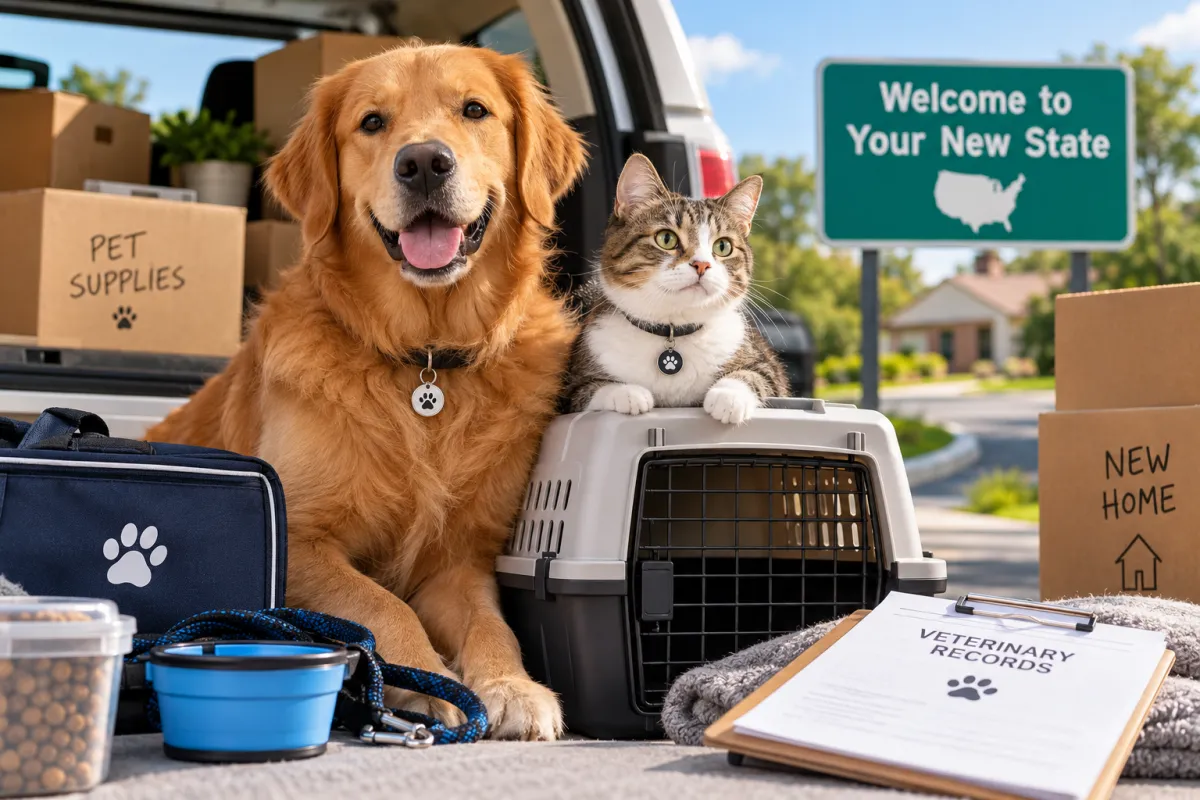
Moving with a dog or cat to another U.S. state takes more than putting a carrier in the car and heading out. The destination state may have specific animal-entry requirements, and those rules can include documentation, vaccinations, testing, treatments, or a veterinary inspection.
The important point is that there is not one universal set of requirements for every interstate pet move. The state or territory you are entering determines its own requirements. That means your first step should be checking the current rules for your destination, followed by a conversation with your veterinarian.
Once the legal and veterinary requirements are clear, the rest of the move becomes a planning exercise: choose how your pet will travel, organize records and supplies, keep your pet away from moving activity, and make the first few hours in the new home as calm as possible.
Moving to Another State With a Pet: What to Do First
Start by separating the move into two parts:
-
Requirements you must meet
-
Steps that make the trip safer and easier for your pet
For requirements, check the destination state's current animal-entry rules. The U.S. Department of Agriculture's Animal and Plant Health Inspection Service (USDA APHIS) explains that states and territories establish their own requirements for animals entering from another U.S. state or territory.
Depending on the destination, requirements can involve things such as:
-
A health certificate or Certificate of Veterinary Inspection (CVI)
-
Current vaccination records
-
Rabies documentation
-
Diagnostic testing
-
Treatments
-
Other animal-health documentation
Not every state requires all of these, and the requirements can vary depending on the animal, where it is coming from, and the circumstances of the move.
Once you know the destination requirements, contact your veterinarian. This gives you time to determine which records, vaccinations, tests, treatments, or certificates apply to your pet.
Do not leave this step until moving week. Some veterinary requirements may take time to complete, and a veterinarian may need to review your pet's records before determining what is necessary.
Check Your Destination State's Pet Entry Requirements
The destination state's requirements should be your starting point because interstate pet rules are not identical across the country.
USDA APHIS provides information about interstate pet movement and state and territory animal-entry requirements, but the receiving state is ultimately the important authority for determining what applies to an animal entering that state.
A practical verification process looks like this:
1. Identify your destination state
Write down the state where your pet will be living after the move. If you are relocating to a territory rather than a state, check that territory's requirements as well.
2. Find the state's animal-health authority
Look for the official agriculture department, animal-health agency, or other state authority responsible for animal entry requirements.
A state agriculture department is often a useful starting point, but the responsible agency can vary.
3. Check the requirements for your specific pet
Look specifically for requirements covering dogs or cats, rather than assuming rules for livestock, exotic animals, or other species apply to your pet.
4. Check the timing
Look for any required time windows related to veterinary examinations, certificates, testing, vaccinations, or treatments.
5. Save the official information
Keep a copy or record of the requirements you reviewed. This gives you something to reference when speaking with your veterinarian and preparing your travel documents.
6. Recheck before departure
Animal-health requirements can change. Temporary disease-control measures may be introduced or modified after you originally planned the move.
For that reason, checking the rules once when you begin planning is not necessarily enough. Reconfirm the requirements close to your departure date.
Do You Need a Health Certificate or CVI?
A health certificate or Certificate of Veterinary Inspection may be required for some interstate pet moves, but it is not a universal requirement for every move between U.S. states.
The destination state's rules determine whether one is required and what information or examination may be necessary.
If a certificate is required, your veterinarian can help determine how to obtain it and what must be documented.
Do not assume that a certificate is required simply because you are crossing a state line. At the same time, do not assume you can travel without one because a friend or family member moved their pet to another state without needing one.
The safest approach is to verify the rule for your particular destination and then follow your veterinarian's instructions.
This distinction matters because interstate pet requirements can be very different from international pet travel requirements. Rules that apply when taking an animal to another country should not automatically be applied to a domestic move.
Vaccinations, Rabies Records, and Other Veterinary Requirements
Your pet's veterinary records should be part of your moving paperwork.
Before the move, ask your veterinarian to review your pet's records and determine whether anything needs to be updated for the destination.
Depending on the destination's requirements, relevant records may include:
-
Rabies vaccination documentation
-
Other vaccination records
-
Veterinary examination information
-
Health certificates or CVIs
-
Diagnostic test results
-
Treatment records
-
Medication information
Do not assume that every state uses the same vaccination requirements.
Rabies documentation is particularly important to keep organized, but the specific requirements still depend on the destination.
It is also useful to keep your pet's identification information current. CDC guidance recommends microchipping pets and keeping contact information updated.
This becomes especially important during a move because familiar surroundings are disappearing and doors may be opened frequently. A pet that escapes during loading, at a rest stop, or after arriving at the new home may be harder to recover if its identification information is outdated.
Ask your veterinarian about any other preparation that may be appropriate for your particular pet, especially if your dog or cat has a medical condition, takes medication, becomes highly anxious during travel, or has never taken a long trip before.
Check for Temporary or Special State Rules
State requirements are not always static.
Animal-health events can lead to temporary restrictions or additional requirements for animals entering a state from particular areas.
That is why a search performed several months before your move should not necessarily be your final check.
For example, Washington introduced an emergency rule in June 2026 concerning New World screwworm and certain dogs, cats, and ferrets entering the state from areas designated by USDA APHIS as active New World screwworm zones. The emergency rule was scheduled to expire October 15, 2026 unless changed.
This is useful as an example of how a state requirement can change because of an animal-health situation. It should not be treated as a permanent requirement for all interstate pet moves.
If your move takes place during an active animal-health event, check both the destination state's current requirements and any applicable USDA information.
Hawaii is a special case
Hawaii has requirements that are substantially different from a typical move between mainland states.
Hawaii maintains special rabies-control and animal-quarantine requirements for dogs and cats entering the state. Its requirements include specific preparation for programs that can allow eligible animals to avoid a longer quarantine.
If Hawaii is your destination, begin checking the state's official animal-quarantine requirements well before your trip. Do not assume that requirements for moving between mainland states will apply to Hawaii.
Because Hawaii's procedures, forms, fees, and timelines can change, verify the current official requirements before making travel arrangements.
How to Prepare Your Pet Before Moving Day
A successful interstate move is not just about paperwork. Your pet also needs time to adjust to changes in routine.
Start preparing before moving day.
If your pet normally spends most of its time loose in the house, introduce the carrier or travel crate well before the trip. Let your pet become familiar with it rather than making the carrier a completely new experience on departure day.
For dogs, make sure the travel setup is secure and comfortable. If your dog is not accustomed to long car trips, gradually increasing travel time can help you identify problems before the actual move.
For cats, a secure carrier is particularly important. Even a normally calm cat can become frightened when exposed to unfamiliar sounds, open doors, new people, and a changing environment.
Keep normal routines as consistent as possible in the days before departure:
-
Maintain regular feeding times.
-
Keep familiar bedding available.
-
Avoid unnecessary changes to food.
-
Make sure medications are available.
-
Keep identification information current.
-
Get your pet accustomed to its carrier or travel setup.
-
Prepare important veterinary records in advance.
If your pet becomes extremely anxious during travel, discuss the situation with your veterinarian before the moving day rather than experimenting with medication on your own.
Driving vs. Flying With Your Pet
The best transportation method depends on your pet, the distance, the destination, and your available options.
Driving with your pet
Driving can give you greater control over the travel environment.
You can plan stops, manage feeding and water breaks, and keep your pet with you throughout much of the journey.
Before leaving, make sure your pet is safely restrained. A carrier, crate, or other appropriate restraint should be secured so it does not move around unexpectedly.
Plan your route around your pet's needs rather than treating the trip like an ordinary drive.
Bring:
-
Water
-
Food
-
Leash and collar
-
Carrier or crate
-
Medication
-
Waste bags
-
Cleaning supplies
-
Familiar bedding
-
Veterinary records
-
Identification information
Never leave a pet unattended in a parked vehicle.
Flying with your pet
Flying can make sense for some longer-distance moves, but it introduces another set of considerations.
Airlines have their own pet policies, and those policies can differ. Check the airline's current rules before booking your trip rather than assuming that a pet can travel under the same conditions on every airline.
Verify requirements for:
-
Carrier dimensions
-
Cabin or cargo eligibility
-
Reservations
-
Documentation
-
Fees
-
Temperature-related restrictions
-
Check-in procedures
State requirements and airline requirements are separate things. Meeting a state's animal-entry requirements does not automatically mean your pet meets an airline's requirements.
If you are considering air travel, confirm both sets of requirements before finalizing the trip.
What to Do on Moving Day
Moving day can be one of the most stressful parts of the relocation for a pet.
Doors may remain open while furniture is carried outside. Strangers may enter the house repeatedly. Loud noises and unfamiliar activity can make an otherwise calm animal anxious.
The safest approach is to keep your pet separated from the moving activity.
A quiet, secure room can work if it can remain closed and clearly separated from the movers. Another option may be having the pet stay temporarily with a trusted person or in another safe location.
The goal is to prevent two common moving-day problems:
Escape: An open exterior door gives a frightened dog or cat an opportunity to run outside.
Injury or stress: Moving furniture, boxes, and equipment creates an environment where an animal can become frightened or accidentally get in the way.
Keep your pet's carrier, leash, medication, food, water, and documents somewhere accessible rather than buried in a moving box.
Before leaving, confirm that your pet is actually with you and that its travel supplies are accounted for.
What to Pack in a Pet Moving Kit
Your pet's supplies should travel with you rather than inside a moving truck whenever possible.
A practical pet moving kit can include:
| Item | Why it matters |
|---|---|
| Carrier or crate | Provides secure transportation |
| Leash and collar | Helps prevent escapes during stops |
| Food | Keeps meals consistent during travel |
| Water | Helps maintain normal hydration |
| Food and water containers | Makes feeding easier on the road |
| Medication | Prevents important medication from being packed away |
| Veterinary records | Keeps important documentation accessible |
| Rabies/vaccination records | Useful when documentation is required |
| Familiar blanket or bedding | Provides a familiar item during travel |
| Waste bags and cleaning supplies | Helps handle accidents or messes |
| Identification information | Helps with recovery if your pet gets lost |
| Basic pet-care supplies | Useful during unexpected delays |
The exact supplies will depend on your pet and travel method.
For a long drive, think beyond the scheduled journey. Delays, traffic, weather, vehicle problems, and unexpected stops can extend travel time.
Keep Important Documents With You
Do not put your pet's important records in a box that will be loaded onto the moving truck.
Keep them in a folder or travel organizer that stays with you.
Depending on what your destination requires, this may include:
-
Health certificate or CVI
-
Vaccination records
-
Rabies documentation
-
Test or treatment records
-
Veterinary contact information
-
Medication information
-
Identification details
-
Destination-state requirement information
A simple organization system can prevent a stressful search when you are already traveling.
It is also useful to keep digital copies of important records when appropriate, while retaining any original documents that the destination authority or veterinarian requires.
What to Do After You Arrive
Arriving at the new home does not mean your pet immediately feels comfortable.
The house smells different. The layout is unfamiliar. Boxes may be everywhere, and doors may continue opening and closing while unloading takes place.
Give your pet a controlled space while the house is being organized.
For example, you can establish a quiet room with:
-
Water
-
Food
-
Bedding
-
A litter box for cats
-
Familiar toys
-
Medication
-
The carrier or crate
Keep exterior doors closed and monitor your pet carefully while people are moving in and out.
Once the main moving activity is finished, allow your pet to explore gradually rather than expecting it to immediately settle into the entire house.
For cats especially, a smaller starting area can provide a more manageable transition.
For dogs, return to familiar routines such as regular meals, walks, and rest as quickly as practical.
If your pet takes medication or has ongoing veterinary care, make sure you know how to continue that care after the move. Finding a local veterinarian can be part of your relocation preparation, particularly if your pet has an ongoing medical need.
A Simple Interstate Pet-Moving Checklist
Use this checklist as a final review before departure.
Several weeks before the move
-
Confirm your destination state.
-
Find the state's official animal-health or agriculture authority.
-
Check the current entry requirements for your dog or cat.
-
Contact your veterinarian.
-
Review vaccination and rabies records.
-
Ask whether a health certificate or CVI is required.
-
Determine whether testing or treatment is required.
-
Update your pet's microchip and contact information.
-
Decide whether you will drive or fly.
-
Check airline requirements if you are flying.
-
Begin getting your pet comfortable with its carrier or travel setup.
Before moving day
-
Recheck the destination state's requirements.
-
Look for temporary animal-health restrictions.
-
Gather veterinary records.
-
Organize any required documentation.
-
Prepare food and water.
-
Pack medication.
-
Prepare the carrier or crate.
-
Pack a leash and collar.
-
Gather familiar bedding and other comfort items.
-
Keep your pet's supplies separate from household moving boxes.
On moving day
-
Keep your pet away from movers and open doors.
-
Use a secure room or another safe location.
-
Keep documents and supplies with you.
-
Check that your pet is safely secured before departure.
-
Make sure your pet cannot escape during stops.
After arrival
-
Keep your pet in a controlled area while unloading.
-
Secure exterior doors.
-
Provide familiar food, water, bedding, and other supplies.
-
Reestablish normal routines.
-
Let your pet explore gradually.
-
Continue any required medication or veterinary care.
-
Keep important records accessible.
The Most Important Step Is Verification
The biggest mistake in an interstate pet move is assuming that someone else's experience tells you what your pet needs.
A friend may have moved their dog to another state without a health certificate. That does not establish the requirements for your destination.
A website may describe rules that applied several years ago. That does not establish today's requirements.
A moving company may give you general advice. That does not replace the destination state's official animal-entry rules.
The more reliable process is straightforward:
Check the destination state's current requirements → contact your veterinarian → prepare the required documentation → verify temporary restrictions → plan safe transportation → keep your pet and records with you.
This approach also helps you distinguish between what is legally required and what is simply recommended for a safer, less stressful move.
Conclusion
Moving to another state with a dog or cat is easier to manage when you treat the relocation as both a regulatory check and a practical travel plan.
Start with the destination state's current requirements instead of assuming every state follows the same rules. Then work with your veterinarian to determine whether your pet needs updated vaccinations, documentation, testing, treatment, or a health certificate or CVI.
After the requirements are settled, focus on transportation and moving-day safety. Keep your pet secured away from loading activity, carry important records and supplies with you, and prepare a controlled space for your pet when you arrive.
Most importantly, recheck state requirements close to departure. Animal-health rules can change, and temporary restrictions can affect an otherwise routine interstate move.
A little verification and preparation before moving day can help turn a complicated pet relocation into a much more manageable part of the move.
Frequently asked questions
Do I need a health certificate to move my pet to another state?
Not always. Requirements are set by the destination state or territory, and some destinations may require a health certificate or Certificate of Veterinary Inspection (CVI). Check the current requirements for your destination and ask your veterinarian what documentation applies to your pet.
Do I need to check pet requirements for every state I drive through?
Start with the destination state's requirements and verify any applicable requirements for states along your route, particularly if temporary animal-health restrictions are in effect. Requirements can vary by state and can change over time.
How far in advance should I prepare my pet for an interstate move?
Start as soon as you know your travel plans. Contact your veterinarian early so you have time to determine whether vaccinations, records, testing, treatments, or other documentation are required by your destination.
Do pets need proof of rabies vaccination when moving between states?
Rabies documentation requirements vary by destination. Keep your pet's current vaccination records available and check the receiving state's rules before traveling.
Is it better to drive or fly with a pet when moving to another state?
It depends on the pet, distance, travel conditions, and available transportation options. Driving can provide more control over stops and your pet's environment, while flying may make sense for some longer moves. If flying, check the airline's current pet policies separately before booking.
What should I do with my pet while movers are loading the house?
Keep your pet secured away from the moving activity, ideally in a quiet, controlled area where doors cannot be accidentally left open. This helps reduce stress and lowers the risk of escape or injury.
Can temporary animal-disease rules change interstate pet requirements?
Yes. Temporary animal-health restrictions can affect animals entering particular states or coming from specific areas. Check for current restrictions close to your departure date rather than relying only on information gathered when you first planned the move.
Are Hawaii's pet-entry requirements different from other states?
Yes. Hawaii has special requirements for dogs and cats because of its rabies-control program. Travelers should check Hawaii's current official animal-quarantine requirements well before departure.
Ethan Parker writes practical guides about home, everyday living, household decisions, consumer products, organization, and practical lifestyle topics. His work focuses on helping readers compare options, understand comm...