Moving Broker vs. Moving Company: How to Tell Who You’re Hiring
Learn the difference between a moving broker and a moving company, who will actually transport your belongings, and how to verify the broker, carrier, estimates, documents, and warning signs before booking an interstate move.
 By Ethan Parker
In this article
- Moving Broker vs. Moving Company: What's the Difference?
- What happens when you use a broker?
- Why the Distinction Matters Before You Book
- How to Tell Whether You're Talking to a Broker
- Questions to ask before booking
- How to Verify the Broker and the Actual Mover
- Check the broker
- Check the carrier or mover
- Registration is not the same as a quality guarantee
- Don't Assume the Broker's Estimate Is the Final Mover's Estimate
- A rate quote is not the same as a written estimate
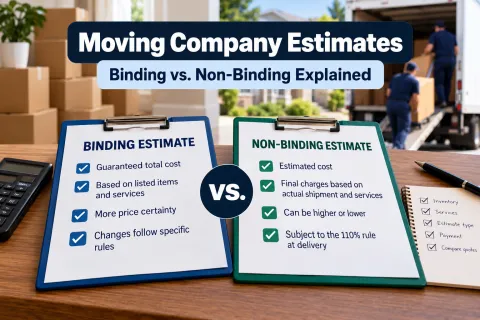
- Understand Binding and Non-Binding Estimates
- What the 110% rule means
- Pay Attention to the Physical Survey Requirement
- Review the Documents Before Moving Day
- Watch for Red Flags
- Broker or Direct Moving Company: Which Should You Choose?
- A broker may make sense if:
- A direct mover may appeal to you if:
- A Practical Pre-Booking Verification Checklist
- 1. Identify the business
- 2. Identify the actual carrier
- 3. Verify both companies
- 4. Get the actual mover's written estimate
- 5. Understand the estimate type
- 6. Ask about the physical survey
- 7. Review the documents
- 8. Check for red flags
- 9. Compare more than price
- One Simple Rule to Remember
- Conclusion

If you are comparing moving quotes, one important question can get lost in the process: Are you talking to the company that will actually move your belongings, or to a broker arranging the move for you?
A moving company, or mover, transports household goods using its own trucks and moving staff. A moving broker acts as an intermediary and arranges transportation with a mover. For interstate household-goods moves, both movers and brokers must be registered with the Federal Motor Carrier Safety Administration (FMCSA), and an interstate broker must use FMCSA-registered movers. FMCSA
That distinction does not automatically make one option good and the other bad. The important issue is transparency: who are you paying, who will pick up your belongings, what company will transport them, and what does the actual mover's paperwork say?
This guide explains how to tell the difference, what to verify before booking, how estimates work, and which warning signs deserve your attention.
Moving Broker vs. Moving Company: What's the Difference?
The simplest distinction is who actually performs the transportation.
FMCSA describes a mover as a company that owns trucks and employs moving staff and assumes responsibility for transporting the goods. A broker, by contrast, acts as a middleman and is not authorized to transport household goods itself. FMCSA
That difference matters because the name you see first may not be the name on the truck that arrives at your home.
What happens when you use a broker?
A broker arranges transportation by connecting you with a mover capable of transporting your shipment. The broker does not operate the truck or handle the shipment itself, although it can arrange the truck and labor needed for the move. FMCSA
For example, you might request a moving quote online and speak with Company A. Company A may be a broker. After you book, Company A could arrange for Company B—the actual mover—to pick up, transport, and deliver your belongings.
That means there are potentially two companies you need to understand, not just one.
Why the Distinction Matters Before You Book
The biggest problem is not simply choosing a broker. It is booking without knowing who will actually perform the move.
If you believe you are hiring a specific moving company but later discover that another company will handle the shipment, you may have questions about:
- Who is transporting your belongings
- Which company's estimate applies
- Which company will provide the moving documents
- Who will arrive for pickup
- What company information you should verify
- Which company's truck and crew will handle the shipment
- What happens if the planned carrier changes
FMCSA specifically advises consumers to determine whether the company they are dealing with is a mover or a broker. For interstate moves, brokers must provide consumers with information about the movers they use and may only use movers registered with FMCSA. FMCSA
The goal is therefore not to avoid every broker. The goal is to know exactly what role the company plays before you commit money or sign documents.
How to Tell Whether You're Talking to a Broker
Start by asking a direct question:
"Are you the moving company that will physically transport my shipment, or are you a moving broker?"
Do not rely only on the company's name, website design, advertisements, or the person who gives you the quote.
If the company is a broker, ask for the identity of the mover that is expected to transport your shipment.
For interstate household-goods moves, FMCSA says brokers must:
- Be registered with FMCSA
- Provide the required Your Rights and Responsibilities When You Move booklet and Ready to Move brochure
- Provide a list of the moving companies they use
- Use only FMCSA-registered movers
- Have written agreements with the movers they use
- Base binding or non-binding estimates on the tariff of the mover that will transport the shipment
- Identify themselves as brokers and provide required business and identifying information FMCSA
These requirements give you several practical questions to ask.
Questions to ask before booking
Ask:
- Are you a mover or a broker?
- If you are a broker, which company will transport my shipment?
- What is the actual mover's legal/company name?
- What identifying information does the mover have?
- Can I review information about the actual mover before booking?
- Who will provide my final written estimate?
- Which company will provide the moving documents?
- Who will arrive to pick up my belongings?
If the answers are vague, keep asking until you understand the arrangement.
How to Verify the Broker and the Actual Mover
Finding a company in an FMCSA database is useful, but it should not be treated as a guarantee that the company will provide good service.
For an interstate move, use FMCSA's resources to check the companies involved. FMCSA provides a search tool that can be used to check mover or broker registration and complaint history. Its consumer guidance also recommends checking whether the mover is authorized and insured and reviewing available complaint information. FMCSA
Check the broker
If you are dealing with a broker, verify that the broker is registered with FMCSA and identify the role it is operating in.
Then ask for the actual mover.
Check the carrier or mover
Do not stop after verifying the broker.
If the broker tells you that another company will transport your shipment, verify that company too. Look at its FMCSA information, applicable operating-authority status, insurance information, and available complaint history.
This two-company check is one of the most useful steps when comparing brokered moves.
Registration is not the same as a quality guarantee
A company appearing in a federal database does not tell you everything about what your moving experience will be.
Use registration and regulatory information as part of a larger evaluation that includes:
- Written estimates
- Company identity
- Complaint history
- Required consumer information
- Insurance information
- Contract and moving documents
- Communication
- The terms of the actual move
FMCSA recommends doing this kind of homework rather than choosing a mover based solely on price. FMCSA
Don't Assume the Broker's Estimate Is the Final Mover's Estimate
This is one of the most important details to understand when using a broker.
A broker can provide an estimate on behalf of a motor carrier using the applicable tariff of the mover that will transport the shipment. But the actual mover may not be required to accept the broker's estimate. FMCSA specifically advises consumers to obtain a written estimate from the mover if there is any question about whether the mover will accept the broker's estimate. FMCSA
That creates a simple rule:
If a broker gives you a quote, find out what the actual mover's written estimate says before loading.
Do not assume that an online quote, phone quote, or broker estimate is automatically the final amount the carrier must honor.
A rate quote is not the same as a written estimate
FMCSA distinguishes a rate quote from a written estimate.
For an interstate shipment, the mover must prepare a written estimate covering applicable charges, and the estimate must be signed and dated with a copy provided to the consumer. A rate quote by itself is not the same thing as an estimate. FMCSA
When reviewing paperwork, look for the actual written estimate rather than relying on a salesperson's verbal statement about what the move should cost.
Understand Binding and Non-Binding Estimates
The type of estimate matters.
A binding estimate is a written agreement made in advance with the mover that establishes the agreed charges, subject to the rules governing changes and additional services.
A non-binding estimate is not a guaranteed final price. It is an estimate of the charges based on the information available for the move.
The distinction is important because consumers sometimes treat any quoted number as a guaranteed price. It is not necessarily one.
What the 110% rule means
For a non-binding estimate, federal rules generally limit what the mover can require you to pay at delivery for the services and quantities covered by the estimate. FMCSA states that, once the shipment is loaded, the mover generally may not collect more than 110% of the estimate at destination for those covered services and quantities. There are separate rules for additional services requested after the contract and certain impracticable-operation charges. FMCSA
So the 110% rule should not be interpreted as meaning that every possible charge is always capped at exactly 110%.
Before booking, understand:
- Whether your estimate is binding or non-binding
- What services and quantities the estimate covers
- How additional services are handled
- What payment forms the mover accepts
- What paperwork controls the move
Pay Attention to the Physical Survey Requirement
A physical survey can be important because the mover needs an accurate understanding of what is being transported.
For an applicable interstate household-goods move, if the origin is within 50 miles of the mover's or its agent's place of business, the mover's estimate generally must be based on a physical survey of the goods. A consumer can waive that requirement, but the waiver must be a written agreement signed before the shipment is loaded. FMCSA
For a brokered move, the relevant mover is the company that will actually transport the shipment. FMCSA's broker guidance requires that mover to perform the applicable physical survey, subject to the permitted waiver. FMCSA
This is another reason not to stop at the broker's quote. You want to understand what the actual transporting mover has evaluated and documented.
Review the Documents Before Moving Day
Paperwork is not just administrative detail. It can tell you who you are dealing with and what you agreed to.
Before an interstate move, movers and brokers are required to provide consumers with FMCSA's Your Rights and Responsibilities When You Move booklet. FMCSA also requires the Ready to Move brochure to be provided in the circumstances specified by its rules. FMCSA
You should also carefully review the documents associated with your shipment, including the estimate and other applicable moving paperwork.
Check that:
- The company names are clear
- The estimate is written and dated
- You understand whether it is binding or non-binding
- The services included are clear
- The payment terms are clear
- The actual mover is identified
- You have copies of documents you sign
- You are not being asked to sign blank paperwork
If a salesperson tells you something important that does not appear in the paperwork, ask for clarification before signing.
Watch for Red Flags
FMCSA identifies several warning signs that consumers should take seriously.
One red flag is an estimate provided without an appropriate inspection of the household goods. Other warning signs include a company that does not provide a written estimate, demands cash or a large deposit, asks you to sign blank documents, or lacks clear information about its local address, registration, or insurance. FMCSA
Other warning signs include:
- The company says it will determine the price after loading
- Required consumer information is not provided
- A company claims that all of your belongings are covered by its insurance
- The company cannot clearly identify itself
- The company has no credible office or warehouse information
- A rental truck arrives instead of the expected company-owned or marked fleet truck
- The mover claims that you have substantially more belongings than were estimated
These signs do not mean every unusual situation is automatically fraud. They do mean you should stop and investigate rather than proceeding because you are already close to moving day.
FMCSA's advice is straightforward: if you encounter a red flag while searching for a mover or broker, keep looking for a reputable company. FMCSA
Broker or Direct Moving Company: Which Should You Choose?
There is no universal rule that says every consumer should use a direct mover or that every broker should be avoided.
The better question is:
Which arrangement gives you the level of transparency and control you want?
A broker may be useful if you want an intermediary to arrange transportation and help connect you with a mover. A direct relationship with a moving company may be preferable if you want to deal directly with the business that will physically transport your belongings.
The important factors are the same either way.
A broker may make sense if:
- You understand that the broker is an intermediary
- The broker clearly identifies the mover
- You can verify the actual mover before booking
- The estimate and documentation are clear
- You understand who will handle the physical move
- The arrangement meets your needs
A direct mover may appeal to you if:
- You prefer dealing directly with the company transporting your belongings
- You want fewer parties involved in arranging the move
- You can verify the mover and its information
- You are comfortable with the mover's estimate and terms
- The company meets your other selection criteria
Neither choice eliminates the need to do your homework.
A Practical Pre-Booking Verification Checklist
Before paying a deposit or committing to an interstate move, work through this sequence.
1. Identify the business
Ask whether you are speaking with a mover or a broker.
Do not assume.
2. Identify the actual carrier
If it is a broker, get the name and identifying information of the mover expected to transport your shipment.
3. Verify both companies
Check the broker and the actual mover through FMCSA's available resources. Review registration information, applicable authority/status, insurance information, and complaint history where available. FMCSA
4. Get the actual mover's written estimate
Do not assume the broker's estimate is automatically accepted by the mover. Obtain and review the transporting mover's written estimate. FMCSA
5. Understand the estimate type
Determine whether the estimate is binding or non-binding and understand what services and quantities it covers.
6. Ask about the physical survey
If the move falls under the applicable physical-survey requirement, understand whether the mover has completed the survey or whether you are being asked to sign a written waiver. FMCSA
7. Review the documents
Read the estimate and other moving documents before signing. Keep copies for your records.
8. Check for red flags
Do not ignore unusual deposit demands, blank paperwork, missing written estimates, unexplained company identities, or other warning signs identified by FMCSA. FMCSA
9. Compare more than price
A lower quote is not automatically the better deal. Compare the companies, documentation, services, estimate terms, and available regulatory information rather than choosing solely on the initial price. FMCSA
One Simple Rule to Remember
When comparing moving brokers and moving companies, the most important question is not simply "Which one is cheaper?"
It is:
"Who is actually responsible for moving my belongings, and have I verified that company before I book?"
If you are working with a broker, identify the actual mover. If you are dealing directly with a mover, verify that company. In either case, review the written estimate and understand whether it is binding or non-binding.
For interstate household-goods moves, FMCSA provides consumer resources for checking movers and brokers, reviewing complaint information, understanding your rights, and preparing for the move. FMCSA
Also remember that the federal rules discussed here are primarily for interstate household-goods moves. Moves that stay within one state can be subject to different state or local requirements, so check the appropriate state or local authorities when the move is not interstate. FMCSA
Conclusion
A moving broker and a moving company perform different roles. A broker arranges transportation; the actual mover or carrier physically transports the shipment. For consumers, the key is knowing which company is which before money changes hands.
Before booking, identify the business you are dealing with, identify the company that will actually move your belongings, verify the relevant information for both, obtain the transporting mover's written estimate, understand the estimate terms, review your documents, and watch for red flags.
That process gives you a much clearer picture of who you are hiring—and lets you compare moving options based on verified information rather than simply choosing the first quote that looks attractive.
Frequently asked questions
Are moving brokers legitimate?
A moving broker can be a legitimate business that arranges transportation rather than physically moving household goods. For an interstate move, verify the broker's FMCSA registration and identify the actual carrier that will transport your shipment. The broker/carrier distinction itself is not a red flag; transparency and proper verification are important.
How can I tell if a moving company is a broker?
Ask the company directly whether it is a broker or the mover that will physically transport your shipment. A broker should disclose its broker status and provide information about the moving companies it uses. You can also check the company's information through FMCSA's mover and broker resources.
Who will actually move my belongings if I hire a broker?
The carrier or moving company arranged by the broker will physically transport your belongings. The broker arranges the transportation but does not operate the truck or transport the household goods itself.
Can a moving broker give me an estimate?
Yes. A broker can provide an estimate on behalf of a motor carrier based on the carrier's applicable tariff. However, the actual mover may not be required to accept the broker's estimate, so consumers should obtain and review the transporting mover's written estimate before the move.
Who is responsible if my belongings are damaged during a brokered move?
The broker does not physically transport the shipment. The responsibilities related to transporting the shipment therefore need to be understood in relation to the actual mover or carrier handling the move and the applicable moving documents and protections. Consumers should identify the carrier before booking and review the carrier's paperwork and valuation information.
What should I ask a moving broker before I pay a deposit?
Ask whether the company is a broker, which carrier will transport your shipment, and for the carrier's identifying information. Also ask for the required moving information and documents, understand the estimate and its terms, and verify the broker and carrier through appropriate FMCSA resources before committing.
How do I check a moving company with FMCSA?
Use FMCSA's mover and broker search resources to look up the company by its name or identifying number. Review its registration information and applicable operating-authority status, along with available complaint and other relevant information. Finding a company in the database alone should not be treated as a guarantee of service quality.
Is a moving broker cheaper than hiring a moving company directly?
1. Not necessarily. Pricing depends on the move, services, carrier, estimate, and other circumstances. A broker should not be judged solely by whether its initial quote is lower. Compare the actual services, written estimates, carrier information, and terms before choosing.
Ethan Parker writes practical guides about home, everyday living, household decisions, consumer products, organization, and practical lifestyle topics. His work focuses on helping readers compare options, understand comm...