Should You Rent or Buy a Home? A Break-Even Guide Based on How Long You Plan to Stay
Learn how to compare renting and buying based on your expected stay, total housing costs, break-even timing, transaction costs, equity, opportunity cost, and local housing conditions.
 By Ethan Parker
In this article
- What Does Rent-vs-Buy Break-Even Mean?
- How Long Does Buying Typically Take to Break Even?
- Why Your Expected Stay Is One of the Most Important Factors
- If You May Move Within a Few Years
- If You Expect to Stay Around Five Years
- If You Expect to Stay for 10 Years or More
- The Costs You Need to Include
- Renting Costs
- Buying Costs
- Why a Mortgage Payment Is Not the Same as Rent
- How Down Payment Size Changes the Comparison
- Mortgage Rates Can Change the Break-Even Point
- Why the Break-Even Point Changes by City
- Monthly Cost and Long-Term Cost Can Tell Different Stories
- What Happens If You Sell Before the Break-Even Point?
- A Practical Way to Compare 3-, 5-, and 10-Year Scenarios
- Scenario 1: Three Years
- Scenario 2: Five Years
- Scenario 3: Ten Years
- When Renting May Make More Sense
- When Buying May Make More Sense
- How to Use a Rent-vs-Buy Calculator Without Being Misled
- The Best Rent-vs-Buy Decision Framework
- Conclusion
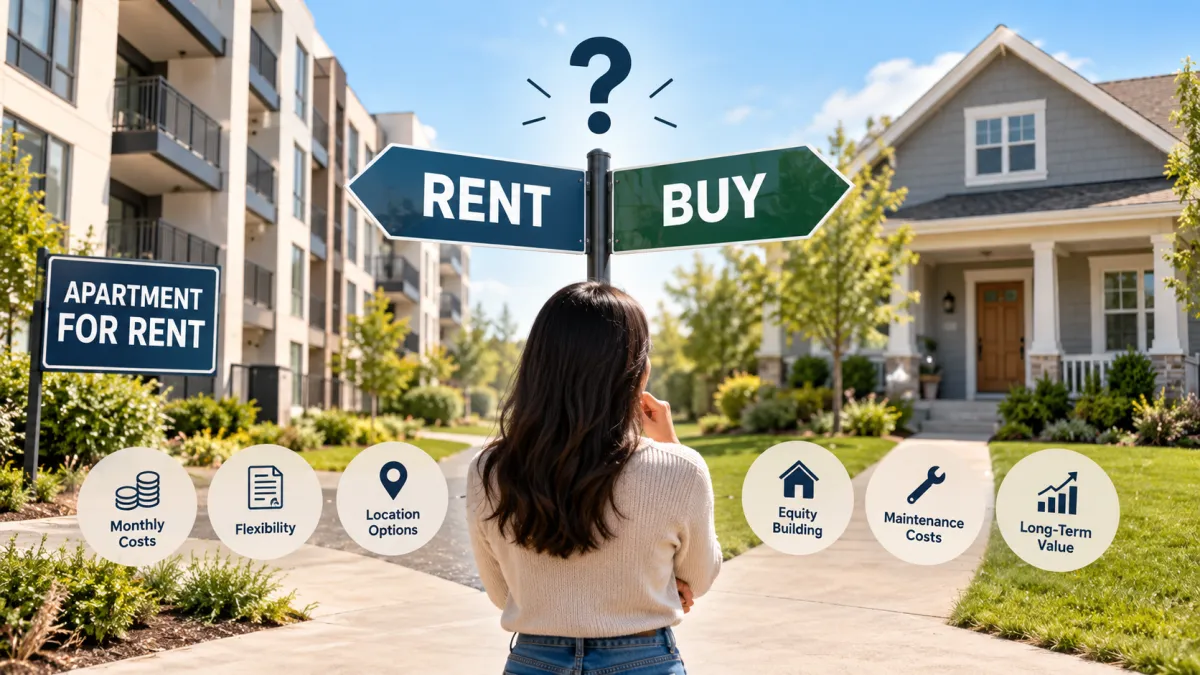
Renting or buying a home is not simply a question of whether you can afford the monthly payment. The more useful question is how long you expect to stay, what the full cost of each option will be, and when buying could potentially break even with renting.
Buying can build home equity and may become financially attractive over a longer stay. But purchasing also comes with closing costs, mortgage interest, property taxes, insurance, maintenance, and eventual selling costs. Renting may provide more flexibility and lower upfront costs, while allowing you to avoid many expenses associated with ownership.
There is no single number of years that makes buying the better choice for everyone. Zillow's June 2026 analysis modeled a national break-even point of about six years, but the result varies significantly by market and by the assumptions used in the calculation.
A practical rent-vs-buy decision therefore starts with your expected time in the home, then compares the total costs and financial trade-offs over that period.
What Does Rent-vs-Buy Break-Even Mean?
The rent-vs-buy break-even point is the point at which the financial outcome of buying a home becomes more favorable than renting under a particular set of assumptions.
It is not simply the point where your monthly mortgage payment becomes lower than your rent.
For example, suppose renting costs $2,000 per month while owning appears to cost $2,200 per month. It would be easy to conclude that renting is cheaper.
But ownership can also result in principal payments that increase your home equity. The property may appreciate, although appreciation is never guaranteed. At the same time, the buyer may have paid closing costs, property taxes, insurance, maintenance, and other ownership expenses.
The renter has a different financial position. Renting generally requires less money upfront and provides greater flexibility, but the renter does not build home equity through mortgage principal payments. Money that would otherwise have been used for a down payment can also have an opportunity cost because it could potentially remain invested or available for other purposes.
A meaningful break-even calculation attempts to account for these differences rather than comparing rent with the mortgage payment alone.
How Long Does Buying Typically Take to Break Even?
There is no universal break-even period.
Zillow's June 2026 national analysis estimated that buying became financially preferable to renting after roughly six years under its modeled assumptions. The analysis also found substantial differences between metropolitan areas. Some markets reached a modeled break-even point in roughly four years, while some expensive markets remained renter-favorable across the modeled 30-year period.
That makes the six-year figure useful as a benchmark, but not as a rule.
Your break-even point could be shorter or longer depending on factors such as:
-
Home prices
-
Local rents
-
Mortgage rates
-
Down payment
-
Property taxes
-
Homeowners insurance
-
Maintenance costs
-
HOA fees
-
Buyer closing costs
-
Selling costs
-
Home-price appreciation
-
Rent growth
-
How long you remain in the property
-
What you could have earned on money used for the purchase
The key takeaway is that time matters because buying and selling a home involve transaction costs that are difficult to spread over a very short ownership period.
If you purchase a home and sell it after only a year or two, those costs can represent a significant portion of the financial result. Staying longer gives you more time for principal payments and potential appreciation to offset those costs.
Why Your Expected Stay Is One of the Most Important Factors
Before comparing numbers, estimate how long you realistically expect to live in the home.
Think about three possible scenarios:
| Expected stay | What to pay particular attention to |
|---|---|
| 3 years | Upfront costs, selling costs, flexibility, and the risk of selling before break-even |
| 5 years | Transaction costs, equity growth, local rent-versus-price relationship, and break-even timing |
| 10 years | Long-term ownership costs, equity accumulation, maintenance, taxes, insurance, and opportunity cost |
These are not universal financial rules. They are useful time horizons for testing the decision.
If You May Move Within a Few Years
A short expected stay can make renting more attractive because buying involves costs at both ends of the transaction.
A buyer may pay closing costs when purchasing and then face additional selling costs when leaving. There can also be maintenance expenses during the ownership period.
If the home has not appreciated enough and you have not built enough equity to offset those costs, selling early can produce a weaker financial outcome than renting for the same period.
That does not mean buying for a short period is always wrong. It means the calculation needs to account for the possibility that you will sell before reaching your modeled break-even point.
If You Expect to Stay Around Five Years
Five years is a useful scenario to model because it sits near the national break-even benchmark identified in Zillow's 2026 analysis, but it should not be treated as a universal threshold.
For a five-year scenario, compare:
-
Total rent paid over five years.
-
Upfront rental costs.
-
Down payment and buyer closing costs.
-
Mortgage interest and principal payments.
-
Property taxes.
-
Homeowners insurance.
-
Maintenance.
-
HOA costs, if applicable.
-
Expected selling costs.
-
The remaining home equity when you sell.
-
The opportunity cost of money used for the purchase.
The result can be very different from a simple rent-versus-mortgage comparison.
If You Expect to Stay for 10 Years or More
A longer ownership period gives the purchase more time to accumulate equity and potentially benefit from home-price appreciation.
But longer does not automatically mean better.
A home can have high property taxes, insurance costs, maintenance requirements, or other expenses. A buyer can also tie up a large amount of capital in the property.
If the local market has high home prices relative to rents, renting may remain financially competitive even over a long period.
The goal is not to reach a predetermined answer. The goal is to test the financial outcome under a realistic time horizon.
The Costs You Need to Include
A rent-vs-buy comparison becomes misleading when it includes only rent and the mortgage payment.
A more complete comparison should consider the following.
Renting Costs
For the rental side, consider:
-
Monthly rent
-
Rent increases over time
-
Renter's insurance
-
Utilities that you are responsible for
-
Parking or other recurring housing charges
-
Pet-related costs, where applicable
-
Security deposits and other upfront costs
-
Other recurring fees
The advertised rent is therefore only one part of the rental calculation. KnowBrook's guide on how to compare apartment costs beyond the advertised rent explains why renters should look at the total cost rather than the headline monthly price. compare the total cost of renting
Buying Costs
For the purchase side, consider:
-
Down payment
-
Mortgage principal
-
Mortgage interest
-
Property taxes
-
Homeowners insurance
-
Private mortgage insurance when applicable
-
Maintenance and repairs
-
HOA fees when applicable
-
Buyer closing costs
-
Selling costs when you eventually leave
-
The opportunity cost of money invested in the home
Zillow's 2026 methodology includes mortgage payments, property taxes, insurance, maintenance, buyer closing costs, seller closing costs, and the equity created through principal payments and appreciation in its modeled comparison.
That broader approach illustrates why the monthly mortgage payment should not be treated as the equivalent of monthly rent.
Why a Mortgage Payment Is Not the Same as Rent
Part of a mortgage payment generally goes toward principal, which can increase your ownership stake in the property.
Rent does not create home equity for the renter.
But that does not mean every dollar paid toward a mortgage is financially equivalent to saving money.
Mortgage interest is a cost. Property taxes are a cost. Insurance is a cost. Maintenance is a cost. Buying and selling costs are costs.
The principal portion of the mortgage can contribute to equity, while the property itself may gain or lose value.
This distinction is important because a buyer can have a higher monthly housing expense but still potentially achieve a better long-term financial result. Conversely, a renter can pay less each month and still come out ahead if the ownership costs and opportunity costs are high enough.
The comparison needs to look at the overall financial position rather than one monthly payment.
How Down Payment Size Changes the Comparison
The amount you put down can materially change the rent-vs-buy calculation.
A larger down payment generally means:
-
A smaller mortgage balance
-
Less interest paid over time
-
Potentially lower borrowing costs
-
More home equity from the beginning
But there is another side to the decision.
A down payment represents money that is no longer available for other purposes. That creates an opportunity cost.
For example, someone considering a $100,000 down payment should not look only at the mortgage savings created by putting that money into the house. They should also consider what that capital could otherwise have done.
Zillow's methodology accounts for the opportunity cost of the renter's money by modeling investment of funds that would otherwise be used for the down payment and certain purchase costs.
This is one reason why a larger down payment does not automatically make buying the superior financial decision.
Mortgage Rates Can Change the Break-Even Point
Mortgage rates affect the cost of borrowing and therefore influence the economics of buying.
When financing is more expensive, the ownership side of the comparison can become less attractive. When financing is cheaper, buying may become more competitive.
But the mortgage rate is only one input.
Two buyers with the same interest rate can have very different outcomes because they may live in different housing markets, pay different property taxes, face different insurance costs, buy at different prices, or stay for different lengths of time.
That is why a national rent-vs-buy benchmark should be treated as a reference point rather than a personal answer.
Why the Break-Even Point Changes by City
Housing markets are local.
A city with relatively affordable homes and high rents can produce a very different rent-vs-buy calculation from a city where home prices are extremely high relative to rents.
Zillow's 2026 analysis illustrates this difference. It found that some markets could reach a modeled break-even point in roughly 3.5 to 4.2 years, while markets such as San Francisco and San Jose could remain renter-favorable across the modeled 30-year period.
This is why statements such as "buying is better after five years" are too broad.
The relevant question is closer to:
At today's housing costs and under reasonable assumptions, how does buying compare with renting in the market where I expect to live, and how long do I expect to stay?
A national benchmark can help frame the question. Local numbers determine the actual comparison.
Monthly Cost and Long-Term Cost Can Tell Different Stories
A current monthly comparison can point in one direction while a long-term break-even analysis points in another.
For example, Realtor.com's July 2026 rental analysis found that renting a starter home was cheaper than buying in all 50 of the largest U.S. metros in its monthly comparison, with average monthly savings of $858 for renters.
That type of comparison is useful for understanding current monthly affordability.
But it is not the same thing as a full long-term rent-vs-buy analysis.
A long-term model can account for equity, transaction costs, appreciation assumptions, opportunity cost, and the financial effects of owning over multiple years.
This distinction matters because the cheapest monthly option is not necessarily the option with the lowest total financial cost over your entire time horizon.
What Happens If You Sell Before the Break-Even Point?
Selling before the modeled break-even point can weaken the financial case for buying.
Imagine that you purchase a home and plan to stay for several years. You pay the purchase-related costs, make mortgage payments, pay taxes and insurance, maintain the property, and eventually decide to move.
If you sell before enough equity accumulation and potential appreciation have offset the costs of purchasing and selling, the total financial result may be worse than renting over that same period.
This is one reason expected stay length deserves serious attention before buying.
It also explains why flexibility can have financial value.
If your career, family situation, or location may change soon, renting can reduce the risk of having to sell a property before your financial model reaches its break-even point.
A Practical Way to Compare 3-, 5-, and 10-Year Scenarios
Instead of asking only "Should I rent or buy?", run several scenarios.
Scenario 1: Three Years
Ask:
-
What are my total rental costs?
-
What would my purchase and selling costs be?
-
How much equity would I likely have?
-
What happens if the home value does not increase?
-
Would I be comfortable selling after only three years?
This scenario emphasizes flexibility and transaction costs.
Scenario 2: Five Years
Compare the same factors over five years.
Pay particular attention to whether the modeled break-even point occurs before or after year five.
Do not assume that being close to a national six-year benchmark means the decision is automatically favorable. Your local market and personal assumptions may produce a different result.
Scenario 3: Ten Years
Then extend the calculation to ten years.
Look at:
-
Cumulative housing costs
-
Mortgage principal paid
-
Mortgage interest
-
Taxes and insurance
-
Maintenance
-
HOA costs
-
Estimated selling costs
-
Home equity
-
Opportunity cost
-
Changes in rent over the same period
This longer horizon can show how the financial picture changes as transaction costs become less significant relative to the amount of time you own the home.
When Renting May Make More Sense
Renting can be the more sensible financial choice when:
-
You expect to move relatively soon.
-
Comparable rental housing costs substantially less than ownership.
-
Home prices are high relative to local rents.
-
Buying would require using most of your available cash.
-
You want flexibility because your job or household situation may change.
-
Ownership costs are unusually high.
-
The purchase would put too much pressure on your overall budget.
-
Your rent-vs-buy analysis shows that you are unlikely to reach the break-even point during your expected stay.
Renting is not necessarily a financially inferior choice. It can be a deliberate decision to pay for flexibility while avoiding the costs and risks of ownership.
When Buying May Make More Sense
Buying may become more attractive when:
-
You expect to stay in the home for a long period.
-
The purchase price is reasonable relative to local rents.
-
You can comfortably handle ownership costs beyond the mortgage.
-
You have enough cash for the purchase without leaving yourself financially stretched.
-
The expected ownership period gives you time to absorb transaction costs.
-
The local rent-vs-buy calculation favors ownership under reasonable assumptions.
-
Building home equity is an important part of your long-term financial plan.
The important word is may.
A longer stay can improve the economics of buying, but it does not eliminate the need to examine the numbers.
How to Use a Rent-vs-Buy Calculator Without Being Misled
A rent-vs-buy calculator can be useful because it allows you to change assumptions and see how the result changes.
Rather than entering one set of optimistic assumptions and accepting the result, test multiple scenarios.
For example, compare:
-
A shorter stay and a longer stay
-
Different down payments
-
Different home prices
-
Different rent levels
-
Conservative and more optimistic home-price assumptions
-
Different maintenance costs
-
Different selling-cost assumptions
Pay attention to which assumptions have the largest effect on the outcome.
A calculator is a planning tool, not a guarantee. Zillow's methodology itself relies on assumptions about factors including home-price appreciation, rent growth, financing, maintenance, transaction costs, and investment returns.
Future housing prices, rents, mortgage rates, and expenses can all differ from a model.
The Best Rent-vs-Buy Decision Framework
A practical decision can be reduced to five questions:
1. How long will I realistically stay?
Start with your expected time horizon rather than with the desire to own.
2. What is the full cost of renting?
Include rent and other recurring and upfront rental costs.
3. What is the full cost of owning?
Go beyond the mortgage payment and include taxes, insurance, maintenance, transaction costs, and other applicable expenses.
4. When does buying break even under reasonable assumptions?
Compare your expected stay with the modeled break-even point.
5. What happens if my assumptions are wrong?
Test less favorable outcomes rather than assuming that home prices will rise or rents will increase exactly as expected.
This framework keeps the decision focused on your actual situation instead of relying on a generic rule.
Conclusion
The rent-vs-buy decision is ultimately a time-horizon and total-cost decision, not simply a comparison between monthly rent and a mortgage payment.
A national Zillow analysis published in June 2026 estimated a modeled break-even point of about six years, but that figure varies substantially by housing market and by the assumptions used.
If you expect to move soon, buying can expose you to transaction costs before you have had enough time to build equity or benefit from potential appreciation. If you expect to stay for many years, buying may have a stronger financial case, but high home prices, taxes, insurance, maintenance, and opportunity costs can still make renting competitive.
The most useful approach is to compare three-, five-, and ten-year scenarios, use realistic local housing costs, account for the full cost of each option, and test what happens when your assumptions change.
There is no universal year when buying becomes better than renting. The right break-even point is the one that reflects where you live, what you can afford, how long you expect to stay, and the full financial trade-offs of both choices.
Frequently asked questions
Is buying a home worth it if you plan to move in 5 years?
Buying may or may not make financial sense if you expect to move in five years. Compare the expected costs of buying and selling with the cost of renting over the same period, including mortgage interest, property taxes, insurance, maintenance, closing costs, and the opportunity cost of your down payment.
Can buying still be a bad financial choice if you plan to stay for 10 years?
Yes. A longer stay can improve the financial case for buying, but it does not guarantee that buying will be better. Local home prices, rent levels, mortgage costs, property taxes, insurance, maintenance, transaction costs, and assumptions about future appreciation can all affect the result.
Does a larger down payment always make buying better than renting?
No. A larger down payment can reduce borrowing costs and may improve the long-term economics of buying, but the money used for the down payment also has an opportunity cost. The right comparison considers what that money could have earned if it remained invested or available for other uses.
Is renting always cheaper than buying in the short term?
Not necessarily. Monthly rent can be lower than the monthly cost of owning in many markets, but short-term comparisons should also account for upfront costs, maintenance, insurance, taxes, and other ownership expenses. The result depends on the specific home and rental alternative being compared.
Should I use a rent-vs-buy calculator before deciding?
A rent-vs-buy calculator can help compare different time horizons and assumptions, but it should be treated as a planning tool rather than a prediction. The result depends heavily on inputs such as home price, rent, mortgage terms, down payment, taxes, insurance, maintenance, transaction costs, and assumptions about future changes.
What happens if I sell the home before reaching the break-even point?
Selling before the break-even point can leave you financially worse off than renting over the same period because buying and selling involve transaction costs and the home may not have built enough equity or appreciated enough to offset those costs.
Ethan Parker writes practical guides about home, everyday living, household decisions, consumer products, organization, and practical lifestyle topics. His work focuses on helping readers compare options, understand comm...