Moving to Another State: First 30 Days Checklist for New Residents
Moving to another state involves more than transporting your belongings. This checklist explains what to do during your first 30 days, including updating your address, changing your driver's license, registering your vehicle, updating voter registration, reviewing health insurance, and notifying important government agencies. It also compares selected requirements in California, Texas, and New York.
 By Ethan Parker
In this article
- Your First 30 Days After Moving: A Practical Timeline
- First 48 Hours: Confirm Your Address and Secure Important Records
- Days 3–7: Check Your DMV and Insurance Deadlines
- Days 8–14: Update Financial and Government Records
- Days 15–30: Confirm Remaining Changes
- Change Your Driver's License in Your New State
- Documents You May Need
- Selected State Deadlines
- Register Your Vehicle After Moving
- Documents Commonly Needed for Vehicle Registration
- California, Texas, and New York Registration Deadlines
- Understand Inspection and Emissions Rules
- Update Your Address With Government Agencies
- USPS: Forward Eligible Mail
- IRS: Notify the Tax Agency
- Social Security and Other Federal Records
- Voter Registration
- Review Your Health Insurance After an Interstate Move
- If You Have HealthCare.gov Marketplace Coverage
- If You Have Employer-Sponsored Insurance
- If You Have Medicare or Other Coverage
- Update Car Insurance and Other Financial Accounts
- Contact Your Car Insurance Company
- Update Banks and Credit Card Accounts
- Review Other Insurance Policies
- Update Your Employer, Schools, Healthcare Providers, and Services
- Employer and Payroll Records
- Schools and Educational Records
- Healthcare Providers and Pharmacies
- Utilities and Household Services
- Documents to Keep Together During Your Move
- Common Mistakes to Avoid After Moving to Another State
- 1. Assuming USPS Forwarding Updates Every Account
- 2. Waiting Until Day 30 to Check DMV Requirements
- 3. Treating a Driver's License and Vehicle Registration as One Task
- 4. Assuming Your Old Insurance Automatically Meets New-State Requirements
- 5. Overlooking Health Insurance Changes
- 6. Forgetting Voter Registration
- 7. Failing to Keep Confirmation Records
- Conclusion
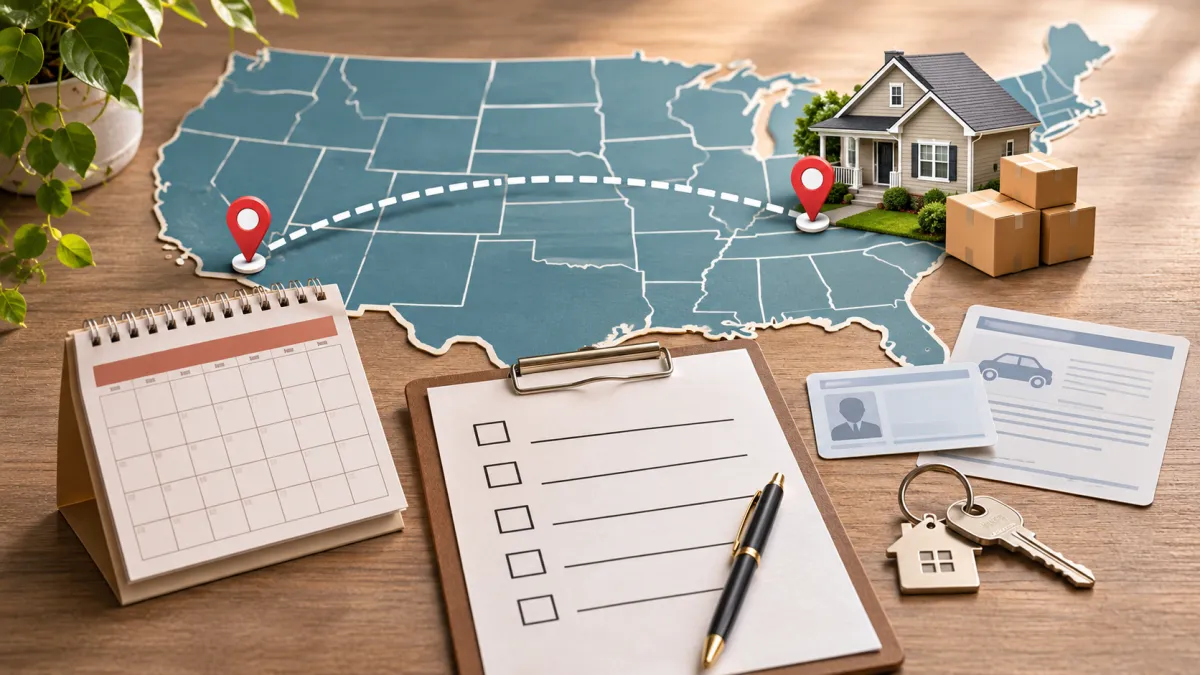
Moving to another state involves more than getting your belongings into a new home. Once you arrive, you may need to update your driver's license, register your vehicle, change your address with government agencies, review your insurance, and register to vote in your new state.
Some of these tasks have legal deadlines. Others are important because they help prevent missed bills, delayed mail, insurance problems, and interruptions to essential services.
This first-30-days checklist organizes the work into manageable stages. It also compares selected requirements in California, Texas, and New York so you can see why checking your destination state's rules matters.
One important distinction: The 30-day timeline below is an organizational plan, not a universal legal deadline. Your new state may require certain updates much sooner or allow more time. Always follow the deadline that applies to your specific situation.
Your First 30 Days After Moving: A Practical Timeline
You do not need to complete every administrative task on the day you arrive. However, it helps to handle urgent address, vehicle, insurance, and government matters early.
Use this schedule as a starting point, then adjust it to meet your state's requirements.
| Time period | Main priorities |
|---|---|
| First 48 hours | Confirm your new address, secure important documents, check mail forwarding, and contact essential service providers |
| Days 3–7 | Review driver's license and vehicle-registration deadlines, contact your insurer, and check health coverage |
| Days 8–14 | Complete urgent DMV tasks, update financial accounts, and begin voter registration |
| Days 15–30 | Finish remaining address changes, organize records, and confirm that important updates have been processed |
Some tasks may need to happen sooner. For example, California's vehicle-registration deadline is generally 20 days after becoming a resident or bringing a vehicle into the state. Waiting until the end of your first month would be too late.
First 48 Hours: Confirm Your Address and Secure Important Records
Start by making sure you have a reliable record of your new residential address.
You will use it when updating your driver's license, vehicle registration, insurance, bank accounts, tax records, and other services.
Keep a copy of documents that show your new address if available. Depending on the agency, useful records may include:
-
A signed lease or rental agreement
-
A mortgage statement or property document
-
A recent utility bill
-
A bank or financial statement showing your new address
-
Other residency documents accepted by your state agency
Requirements differ. A document accepted by one agency may not be accepted by another, so check the relevant agency's document list before making an appointment.
If you arranged USPS mail forwarding, confirm that the request was submitted correctly. Keep in mind that forwarding is a way to receive eligible mail at your new address; it does not automatically update every account or government record.
Also make a list of organizations that send you important mail. This may include your bank, employer, insurance company, healthcare provider, school, and government agencies.
Days 3–7: Check Your DMV and Insurance Deadlines
Your driver's license and vehicle registration deserve early attention because state deadlines can be short.
Visit your new state's DMV website and identify the requirements for:
-
Exchanging or applying for a driver's license
-
Registering an out-of-state vehicle
-
Providing proof of identity and residency
-
Showing vehicle ownership documents
-
Obtaining any required inspections or emissions tests
-
Paying applicable registration and licensing fees
Do not assume that your old driver's license or vehicle registration can remain unchanged indefinitely.
Contact your car insurance company as well. Tell the insurer that you have moved and ask whether your existing policy can be updated or whether you need coverage issued under your new state's requirements.
If you have Marketplace health insurance, review the rules for moving to another state promptly. Interstate moves can affect which plans are available to you.
Days 8–14: Update Financial and Government Records
Once the most urgent DMV and insurance questions are addressed, work through your financial and government accounts.
Update your address with your bank, credit card companies, loan providers, investment accounts, and other financial institutions.
You should also review voter registration requirements in your new state. If you moved across state lines, you generally need to register in the destination state rather than assuming your previous registration transferred.
If you have not already done so, review how to notify the IRS of your new mailing address. Do not rely only on USPS forwarding.
Days 15–30: Confirm Remaining Changes
Use the final part of your first month to check whether important updates have actually been processed.
A submitted form does not always mean that an account has already been updated. Review confirmation emails, account profiles, mailed notices, and any instructions from the relevant agency.
Finish remaining updates for:
-
Employer and payroll records
-
Schools and educational institutions
-
Healthcare providers and pharmacies
-
Utility and service accounts
-
Subscription services
-
Professional licenses, if applicable
-
Other organizations that need your current address
If an agency has not processed an application, contact it to confirm whether additional documents or steps are required.
Change Your Driver's License in Your New State
A driver's license issued by your previous state does not automatically become a license issued by your new state.
When you establish residency, your destination state may require you to exchange your old license or apply for a new one within a specified period.
The deadline and application process vary by state. Some states also have different requirements depending on whether you are an adult, a new driver, or someone with a particular license status.
Before visiting the DMV, check its official website for the current application procedure.
Documents You May Need
Depending on your state and circumstances, the DMV may ask for:
-
Your current out-of-state driver's license
-
Proof of identity and date of birth
-
Proof of Social Security number, when required
-
One or more documents showing residency
-
Completed application forms
-
Applicable fees
-
Vision or other required testing
Some states may require additional documents or testing. Do not assume that an out-of-state license can always be exchanged without an examination.
Selected State Deadlines
The following examples show how different state requirements can be.
| State | Driver's license requirement |
|---|---|
| California | California's DMV handbook states a 10-day period for residents who intend to drive. Check current DMV instructions for how the requirement applies to your situation. |
| Texas | New residents generally have 90 days after establishing residency to obtain a Texas driver's license. |
| New York | New residents generally must exchange their out-of-state license within 30 days of becoming permanent residents. |
These are state-specific examples, not nationwide rules. Other states may use different deadlines and residency definitions.
For official instructions, see the California DMV's New to California guidance, Texas.gov's Moving to Texas information, and New York's out-of-state license exchange guidance.
Register Your Vehicle After Moving
Your vehicle registration is separate from your driver's license.
If you bring a vehicle from another state, you may need to register it in your new state, obtain new plates, submit proof of ownership, and meet local inspection or emissions requirements.
Do not assume that changing your driver's license automatically updates your vehicle registration.
Documents Commonly Needed for Vehicle Registration
The exact list depends on your state, vehicle, and ownership situation. You may be asked for:
-
The vehicle's title or ownership documentation
-
Current out-of-state registration
-
Proof of identity
-
Proof of residency
-
Proof of insurance meeting state requirements
-
Vehicle identification number information
-
Required inspection or emissions documentation
-
Registration application and payment
If your vehicle is financed or leased, the lender or leasing company may hold the title. Ask your DMV how to complete registration when you do not have the physical title.
California, Texas, and New York Registration Deadlines
| State | General new-resident vehicle-registration deadline |
|---|---|
| California | Generally within 20 days of becoming a resident or bringing the vehicle into California |
| Texas | Generally within 30 days of establishing residency |
| New York | Generally within 30 days of establishing residency |
Check the relevant DMV or motor vehicle agency before relying on these deadlines. Your circumstances and vehicle type may affect the process.
Official resources include the California DMV vehicle-registration requirements, Texas Department of Motor Vehicles new-resident guidance, and New York DMV vehicle-ownership guidance.
Understand Inspection and Emissions Rules
Vehicle inspection rules are not identical across the country.
Texas, for example, ended its noncommercial vehicle safety inspection program on January 1, 2025. However, emissions testing continues to apply in designated counties. Commercial vehicle requirements are different.
This distinction matters because an old checklist may still tell you to obtain a general Texas safety inspection even though the program has changed.
Before scheduling an inspection, check the current rules for your vehicle and county through the Texas Department of Public Safety and the Texas DMV.
Update Your Address With Government Agencies
A move can affect several government records. Updating one address does not necessarily update all the others.
Start with the agencies that send you important documents, payments, notices, or benefits.
USPS: Forward Eligible Mail
The United States Postal Service offers a Change of Address service that can forward eligible mail from your old address to your new one.
This is useful during the transition because some organizations may continue sending mail to your previous home.
However, forwarding is not a substitute for updating your address directly with the organizations that matter.
For example, a bank may need your new address for account records, security checks, and replacement cards. An insurer may need it to determine where a vehicle is primarily kept.
Use the official USPS Change of Address service and review its instructions and limitations.
IRS: Notify the Tax Agency
If you move, make sure the IRS has a reliable mailing address for correspondence.
The IRS may receive address information through the USPS National Change of Address database. However, you should not assume that a USPS forwarding request will update every IRS record or ensure that all government mail reaches you.
The IRS provides several ways to report an address change, including:
-
Filing Form 8822
-
Using your new address on a tax return
-
Sending a signed written statement with the required information
-
Providing information through another method accepted by the IRS
Choose the method that fits your circumstances and follow the current instructions.
See the official IRS address-change guidance for details.
Social Security and Other Federal Records
If you receive Social Security benefits or need services from the Social Security Administration, check whether your address needs to be updated.
The appropriate method may depend on the type of benefits or services you receive.
You may also need to update records with other federal agencies if you receive benefits, have an active application, or regularly receive official correspondence.
Do not assume that changing your address with USPS or the IRS updates every federal record.
Voter Registration
Moving to a different state generally means registering to vote in your new state.
Your previous state's registration does not automatically transfer to the destination state. Registration deadlines, identification requirements, and available registration methods vary.
Check your new state's election office to find out:
-
Whether online registration is available
-
What identification or residency information is required
-
The registration deadline for upcoming elections
-
Whether you can register through a state motor vehicle agency
The federal Vote.gov registration resource can direct you to your state's official registration process.
Review Your Health Insurance After an Interstate Move
Health insurance is one of the most important things to review after moving because coverage options and service areas can depend on where you live.
The correct steps depend on the type of insurance you have.
If You Have HealthCare.gov Marketplace Coverage
If you have a health insurance plan through the federal Health Insurance Marketplace and move to another state, you cannot keep your existing state Marketplace plan.
You will need to start a new Marketplace application using your new address and select a plan available in your destination state.
A move may qualify you for a Special Enrollment Period, depending on your circumstances and eligibility. Do not assume that simply moving automatically guarantees a particular enrollment outcome.
Report the move promptly, review the applicable enrollment rules, and compare available plans before selecting coverage.
Use HealthCare.gov's guidance for reporting a move and its information about coverage outside Open Enrollment.
If You Have Employer-Sponsored Insurance
Employer-sponsored coverage follows different rules from Marketplace coverage.
If you receive insurance through work, contact your employer's benefits department or plan administrator.
Ask whether:
-
Your existing plan covers care in the new state
-
Your provider network changes after the move
-
You need to select a different plan
-
Your address must be updated with the insurer
-
The move affects your enrollment options
Do not cancel existing coverage until you understand when any replacement coverage would begin.
If You Have Medicare or Other Coverage
People with Medicare, Medicaid, or other government-supported coverage should check the rules that apply to their particular program.
For example, moving may affect the availability of certain Medicare Advantage or prescription drug plans, while Medicaid eligibility and administration are state-specific.
Contact the appropriate program or plan before assuming that coverage will continue unchanged.
Update Car Insurance and Other Financial Accounts
A new state can affect your insurance and financial arrangements even when your income and vehicle remain the same.
Contact Your Car Insurance Company
Tell your insurer when your vehicle is relocated to another state.
The company may need to update:
-
Your residential address
-
The address where the vehicle is primarily kept
-
Your policy's state of issue
-
Coverage limits or other policy details
-
Applicable state-specific insurance requirements
Your existing insurer may be able to update your policy, or you may need a different policy for the new state.
Ask when any changes take effect and make sure you have appropriate coverage before ending an existing policy.
Update Banks and Credit Card Accounts
Notify your banks and credit card companies of your new address.
This can help ensure that statements, replacement cards, account notices, and security-related correspondence reach you.
Check both mailing and residential address fields if the institution maintains them separately.
You may also need to update your address with:
-
Mortgage or loan providers
-
Auto lenders
-
Investment and brokerage accounts
-
Retirement account administrators
-
Credit unions
-
Student loan servicers
Use each institution's official website or customer-service process. Do not assume that a single address update covers every account you hold with a company.
Review Other Insurance Policies
Your new location may affect more than car insurance.
Contact your insurers to review relevant policies, including:
-
Renters insurance
-
Homeowners insurance
-
Life insurance
-
Disability insurance
-
Other property or personal insurance
For renters and homeowners, make sure the policy reflects the correct property and occupancy details. Coverage terms, availability, and pricing may vary by location.
Update Your Employer, Schools, Healthcare Providers, and Services
Once the major legal and financial updates are underway, work through the everyday records connected to your household.
Employer and Payroll Records
Give your employer your new residential address.
Ask whether you need to update your information in the payroll or employee benefits system.
An interstate move can also affect state tax withholding and other payroll administration. If you work remotely, confirm that your employer has recorded the correct work location and address.
Do not assume that changing your address in one employee portal automatically updates every payroll or benefits record.
Schools and Educational Records
If you or a family member is changing schools or colleges, contact the relevant institution.
Depending on the situation, you may need to update:
-
Student contact information
-
Emergency contacts
-
Residency documentation
-
Enrollment records
-
Financial aid records
-
Transcripts or transfer documents
-
Transportation or school-service arrangements
Public school enrollment requirements are determined by the relevant school district and state. Check the destination district's instructions rather than relying on your previous state's procedures.
Healthcare Providers and Pharmacies
Update your address with doctors, dentists, specialists, pharmacies, and other healthcare providers.
If you are changing providers, arrange for relevant medical records to be transferred through the provider's approved process.
If you take prescription medication, check how the move affects refills and pharmacy access. Some prescriptions and insurance arrangements may have specific restrictions.
Utilities and Household Services
Make sure essential services are set up at your new home and that old accounts are closed or transferred where appropriate.
These may include:
-
Electricity
-
Natural gas
-
Water and sewer
-
Internet
-
Trash collection
-
Home security
-
Rent or homeowners association services
Keep final bills and confirmation records from your previous address. This can help resolve disputes about final charges or deposits.
Also update delivery addresses for subscriptions and online shopping accounts so orders are not sent to your previous home.
Documents to Keep Together During Your Move
Having important paperwork organized can make DMV appointments, insurance updates, and government applications easier.
Create a physical folder or secure digital folder for your relocation documents.
Consider keeping the following items available:
| Document | Why you may need it |
|---|---|
| Current driver's license | Identity and license exchange |
| Passport or other accepted identity document | Identity verification, if required |
| Social Security information | Applications that require verification |
| Lease, mortgage, or residency document | Proof of your new address |
| Recent utility or financial statement | Additional residency evidence, if accepted |
| Vehicle title or ownership documents | Vehicle registration |
| Current vehicle registration | Previous registration information |
| Proof of insurance | Vehicle registration and coverage verification |
| Insurance policy information | Updating coverage after the move |
| Important medical records | Continuing healthcare |
| School or college records | Enrollment or transfer |
| Government correspondence | Tracking benefits, taxes, or applications |
Not every agency accepts the same documents. Check the official requirements before an appointment, and avoid carrying original documents when a copy is sufficient.
Store sensitive information securely. A folder containing identity documents, financial records, and Social Security information should not be left in an unattended vehicle or shared through unsecured channels.
Common Mistakes to Avoid After Moving to Another State
A move can involve dozens of small updates, and some are easy to overlook. These mistakes can create avoidable delays or administrative problems.
1. Assuming USPS Forwarding Updates Every Account
Mail forwarding helps you receive eligible mail, but it does not replace direct address changes with banks, insurers, government agencies, and service providers.
Make a list of organizations that need your new address and update them individually.
2. Waiting Until Day 30 to Check DMV Requirements
The first 30 days are a planning framework, not a universal grace period.
Some states have deadlines shorter than 30 days. California's general vehicle-registration deadline, for example, is 20 days.
Check your state's rules as soon as you establish residency or bring your vehicle into the state.
3. Treating a Driver's License and Vehicle Registration as One Task
These are separate administrative requirements.
You may complete your license application but still need to submit a different vehicle-registration application.
Track each process separately and keep its confirmation records.
4. Assuming Your Old Insurance Automatically Meets New-State Requirements
Your old policy may need changes after an interstate move.
Contact your insurer and confirm that your coverage is appropriate for your new address and state. Do not rely on assumptions about whether the existing policy will remain suitable.
5. Overlooking Health Insurance Changes
Marketplace coverage, employer-sponsored insurance, Medicare, and Medicaid do not all follow the same relocation rules.
Identify your coverage type and contact the appropriate insurer or program before assuming your benefits remain unchanged.
6. Forgetting Voter Registration
Your old state's voter registration generally does not transfer automatically to a new state.
Check the new state's registration process and deadlines well before an election.
7. Failing to Keep Confirmation Records
Save confirmation numbers, application receipts, emails, and copies of submitted forms.
If an update is delayed or an agency requests additional information, these records can help you explain what you have already completed.
Conclusion
Moving to another state creates a new set of administrative responsibilities, but you do not have to handle everything at once.
Start by confirming your address, checking your destination state's driver's license and vehicle-registration deadlines, and reviewing your insurance. Then update government records, voter registration, financial accounts, healthcare providers, schools, and household services.
The most important step is to distinguish between tasks that have legal deadlines and those that can be completed over the following weeks. California, Texas, and New York have different licensing and vehicle-registration requirements, and other states have their own rules.
Use the first 30 days as a practical checklist, keep your documents organized, and verify requirements through official state and federal websites. That approach can help you settle into your new home while reducing the chance of missing an important update.
Frequently asked questions
1. Will USPS forwarding automatically update my address with the IRS?
USPS forwarding does not guarantee that every government agency will receive your new address. The IRS may receive address information through the USPS National Change of Address database, but you should not rely on mail forwarding alone. You can notify the IRS directly using Form 8822, a signed written statement, or your new address on a tax return. Check the IRS's official address-change guidance for the appropriate method.
2. Do I need to register to vote again after moving to another state?
Yes. If you move to a different state, you generally need to register to vote in your new state. Your previous state's registration does not automatically transfer. Registration deadlines, online options, and documentation requirements vary by state, so check your new state's election office or Vote.gov before an upcoming election.
3. Can I keep my current HealthCare.gov Marketplace plan after moving to another state?
No. If you have a HealthCare.gov Marketplace plan and move to another state, you cannot keep your existing state Marketplace plan. You need to start a new Marketplace application using your new address and select a plan available in your destination state. Report the move promptly and review your enrollment options. Employer-sponsored insurance and other coverage types may follow different rules.
4. Do I need to change my car insurance when moving to another state?
You should contact your insurance company when you move to another state. Your new address can affect your policy, premium, coverage requirements, and available insurers. Ask your insurer whether your current policy can be updated or whether you need a new policy that meets your destination state's requirements. Make sure you understand when the new coverage begins before canceling your existing policy.
5. What happens if I miss my new state's driver's license or vehicle-registration deadline?
The consequences depend on the state and the circumstances. You may face late fees, penalties, registration problems, or other compliance issues. Requirements and enforcement procedures differ between states. Contact your destination state's DMV as soon as possible, explain your situation, and ask what documents, fees, or steps are needed to become compliant.
Ethan Parker writes practical guides about home, everyday living, household decisions, consumer products, organization, and practical lifestyle topics. His work focuses on helping readers compare options, understand comm...