How Long Do Late Payments Stay on Your Credit Report?
Learn how long late payments remain on your credit report, when creditors typically report missed payments, and how the seven-year reporting period works. This guide explains 30-, 60-, and 90-day delinquencies, the effect on your credit score, how to dispute inaccurate information, and practical steps to rebuild your payment history.
In this article
- How Long Do Late Payments Stay on Your Credit Report?
- When Does a Payment Become Late on Your Credit Report?
- Payment Due Date vs. Late Fee
- When Creditors Typically Report Late Payments
- Why 30 Days Past Due Matters
- What Do 30-, 60-, and 90-Day Late Payments Mean?
- Why a 90-Day Late Payment Can Be More Serious
- When Does the Seven-Year Reporting Period Start?
- How Consecutive Missed Payments Affect the Timeline
- What If the Account Becomes Current and Later Becomes Delinquent Again?
- Does the Seven-Year Rule Always Mean Seven Years Plus 180 Days?
- Does Paying a Late Payment Remove It From Your Credit Report?
- What Happens When an Account Is Paid Off?
- What Happens if the Debt Goes to Collections?
- How Much Can a Late Payment Affect Your Credit Score?
- Why Recent Late Payments Can Matter More
- How Long Does It Take to Recover From a Late Payment?
- Steps That Can Help Rebuild Your Credit
- Can You Get a Late Payment Removed From Your Credit Report?
- Disputing an Inaccurate Late Payment
- Requesting a Goodwill Adjustment
- What to Do if the Creditor Rejects Your Request
- What to Do After Missing a Payment
- How to Prevent Future Late Payments
- Conclusion
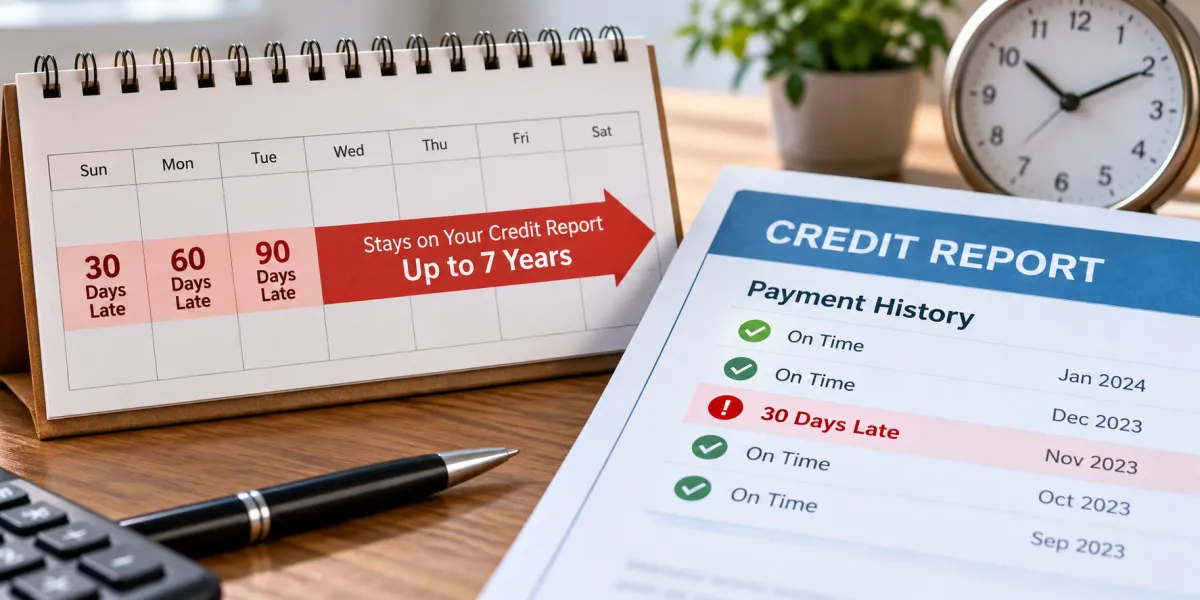
A late payment can affect your credit long after you have paid the overdue amount. In the United States, most negative payment-history information can generally remain on a credit report for up to seven years. The exact reporting timeline depends on the type of account and when the delinquency began.
That does not mean a late payment affects your credit score equally for all seven years. Recent late payments can be more damaging than older ones, and their influence may lessen as you build a consistent record of on-time payments.
To understand what happens after a missed payment, it helps to separate three things: when a payment becomes late under your account terms, when a creditor reports the delinquency to the credit bureaus, and how long the negative information can remain on your credit report.
This guide explains those timelines, what the different delinquency stages mean, how paying an overdue account affects your report, and what to do if a late-payment entry is inaccurate.
How Long Do Late Payments Stay on Your Credit Report?
Most accurate late-payment information can generally remain on your credit report for up to seven years. The reporting period is connected to the delinquency that led to the negative information, not simply the date you paid the debt or the date you checked your credit report.
For example, suppose a credit-card payment first became delinquent in March 2026 and the account was never brought current. The late-payment history may generally remain reportable for up to seven years under the applicable reporting rules. Paying the balance later does not automatically erase the accurate history.
The seven-year period is a general rule for most negative credit-account payment information, but some reporting situations have more specific legal calculations. Certain accounts placed for collection, charged to profit and loss, or subject to similar action are covered by a special rule under the Fair Credit Reporting Act (FCRA), which includes an additional 180-day calculation.
It is important not to apply that additional 180 days to every ordinary late-payment entry.
Here is a practical overview:
| Situation | What may happen on your credit report |
|---|---|
| Payment is a few days late | You may face account consequences, but the payment is not necessarily reported as a 30-day delinquency |
| Payment reaches 30 days past due | The creditor may report a 30-day late payment |
| Payment reaches 60 or 90 days past due | More serious delinquency statuses may be reported |
| Account is brought current | The account status may update, but accurate late-payment history can remain |
| Account is paid or closed | Payment history does not automatically disappear |
| Account is sent to collections or charged off | Additional negative reporting may occur, subject to applicable reporting limits |
The key distinction is that paying an overdue balance changes the account's current status, but it does not necessarily remove its past payment history.
When Does a Payment Become Late on Your Credit Report?
A payment can be late under your credit-card or loan agreement before it becomes a 30-day late-payment entry on your credit report.
This distinction matters because people sometimes assume that they have 30 extra days after a due date to make a payment without consequences. That is not a safe assumption.
Payment Due Date vs. Late Fee
Your account's payment due date is the date by which the creditor expects to receive your payment under the account terms.
If you miss that date, the creditor may treat the payment as late and may apply a late fee or other account consequences, depending on the agreement and applicable law.
However, a payment that is only a few days late is not necessarily reported to the credit bureaus as a 30-day delinquency.
For example, imagine your credit-card payment is due on June 10:
-
You pay on June 12: The payment is late under the account's terms, but it has not reached 30 days past due.
-
You still have not paid by July 10: The payment may have reached the 30-day-past-due stage.
-
You continue missing payments: The account may progress to more serious delinquency stages.
The dates in this example are illustrative. Your actual payment status depends on the due date, how the creditor calculates delinquency, and when the payment is received and credited.
When Creditors Typically Report Late Payments
Creditors commonly report a late payment to the major credit bureaus once the account reaches 30 days past due.
The three nationwide credit reporting companies are Equifax, Experian, and TransUnion. A creditor may furnish account information to one or more of them, and reporting practices or update timing can differ.
As a result, you may not see identical account information appear at exactly the same time across all three reports.
A creditor's decision to charge a late fee and its decision to report a 30-day delinquency are separate matters. Do not assume that avoiding a credit-report entry means there will be no account consequences.
Why 30 Days Past Due Matters
Thirty days past due is an important reporting milestone because it is commonly used to identify a delinquent payment in credit reporting.
A payment that reaches this stage can become part of your negative payment history. The later the payment becomes, the more serious the delinquency status may appear.
If you realize that you have missed a payment, contact the creditor as soon as possible. Ask whether the payment has been reported, what amount is needed to bring the account current, and whether any available payment arrangement could prevent the account from becoming more seriously delinquent.
Do not wait until the next billing cycle simply because you believe the credit bureaus will not receive information immediately.
What Do 30-, 60-, and 90-Day Late Payments Mean?
Credit reports may show different levels of delinquency, such as 30, 60, or 90 days late. These labels indicate how far behind the account has become.
The longer a payment remains unpaid, the more serious the reported delinquency can become.
| Delinquency status | General meaning | Why it matters |
|---|---|---|
| 30 days late | Payment has reached approximately 30 days past due | May create the first reported late-payment entry |
| 60 days late | Payment has reached approximately 60 days past due | Shows a more serious continuing delinquency |
| 90 days late | Payment has reached approximately 90 days past due | Indicates a substantial period without the required payment |
| 120 days late or more | Payment remains unpaid for a longer period | The account may face further collection or account-status consequences |
These stages are not a promise that every creditor will follow exactly the same reporting schedule. The account type, payment history, creditor practices, and applicable rules can affect how information is furnished.
Why a 90-Day Late Payment Can Be More Serious
A 90-day delinquency generally indicates a more serious payment problem than a single 30-day late payment.
Credit-scoring models may consider several characteristics of negative payment history, including:
-
Recency: How recently the late payment occurred.
-
Severity: How far behind the account became.
-
Frequency: Whether the consumer has one late payment or a pattern of missed payments.
This is why two consumers with a late-payment entry may not experience the same credit-score impact.
For example, one person may have a single 30-day late payment from several years ago, while another may have several recent delinquencies, including a 90-day late payment. Their credit profiles are different, even though both have late payments.
A more serious delinquency can be a stronger negative signal to lenders and scoring models. Avoid assuming that all late-payment entries have an identical effect.
When Does the Seven-Year Reporting Period Start?
The reporting timeline is generally tied to the original delinquency date, sometimes called the date of first delinquency.
This is an important concept when an account has several missed payments, becomes seriously delinquent, or is eventually transferred to a collection agency.
The original delinquency date is generally the date the account first became delinquent in the continuous series of missed payments that led to the later negative status.
How Consecutive Missed Payments Affect the Timeline
Imagine a borrower misses a payment in January and then continues missing payments in February, March, and April.
If the account remains continuously delinquent, those missed payments generally belong to the same delinquency sequence. The reporting timeline is not supposed to restart with every additional missed payment.
The original delinquency date remains important when determining how long the related negative information can be reported.
This protects consumers from having the reporting period improperly extended simply because the account remained unpaid for several months.
What If the Account Becomes Current and Later Becomes Delinquent Again?
A different situation occurs when a borrower catches up on the account and brings it current, then misses another payment months later.
For example:
-
A borrower misses payments in January and February.
-
The borrower pays enough to bring the account current in March.
-
The borrower makes payments on time for several months.
-
The borrower misses another payment in November.
The November delinquency may represent a separate delinquency episode rather than a continuation of the January sequence.
The distinction matters because the reporting timeline for a new delinquency should not automatically be treated as part of an earlier, resolved episode.
If a credit report shows dates that appear inconsistent with the account's actual history, review the payment records and ask the creditor or credit bureau to investigate.
Does the Seven-Year Rule Always Mean Seven Years Plus 180 Days?
No. This is an important legal distinction.
The FCRA contains a special provision for certain accounts that are placed for collection, charged to profit and loss, or subjected to similar action. For those specified accounts, the reporting period is calculated using a seven-year period that begins after the expiration of the 180-day period described in the law.
This is not a blanket rule for every late-payment entry.
An ordinary late-payment mark should not automatically be described as remaining on a credit report for seven years plus 180 days. The applicable calculation depends on the account and the circumstances covered by the FCRA.
If a collection or charge-off account has an unusual reporting date, checking the original delinquency date and the account's history is more useful than relying on a simple calendar estimate.
Does Paying a Late Payment Remove It From Your Credit Report?
No. Paying an overdue balance does not automatically remove an accurate late-payment entry from your credit report.
Payment changes what you owe and may change the account's current status. It does not necessarily change what happened before the payment was made.
For example, suppose you missed two credit-card payments and later paid the amount needed to bring the account current. Your credit report may show that the account is current now, while still displaying the earlier late-payment history.
These are two separate pieces of information:
-
Current account status: Whether you are up to date on the account now.
-
Payment history: Whether you made payments late in the past.
A paid or closed account can still have a payment history that remains visible for the applicable reporting period.
What Happens When an Account Is Paid Off?
If you pay the full balance, the creditor should update the account information to reflect the payment and the appropriate account status.
However, the earlier accurate late-payment entries do not have to disappear just because the balance is now zero.
This is also true when an account is closed. Closing a credit card or loan does not automatically erase its payment history.
If you are rebuilding your credit, bringing overdue accounts current can still be an important step. It prevents an existing delinquency from continuing to worsen, even if the earlier negative information remains on your report.
What Happens if the Debt Goes to Collections?
If an unpaid account is sent to a collection agency, the collection account may appear on your credit report in addition to information about the original account.
The original creditor's account and the collection account are separate reporting entries, but they relate to the same underlying debt.
The information must be accurate. In particular, transferring or selling a debt should not improperly restart the credit-reporting period.
Review the dates and account details carefully if both entries appear. If you believe the original delinquency date, balance, account status, or other information is incorrect, you can dispute the inaccurate information.
How Much Can a Late Payment Affect Your Credit Score?
A late payment can have a meaningful negative effect on a credit score, but there is no single point reduction that applies to everyone.
The impact depends on the rest of your credit profile and the details of the delinquency.
Credit-scoring models may consider:
-
How recently the late payment occurred.
-
Whether it was 30, 60, or 90 days late.
-
Whether there are multiple late payments.
-
Whether the person has an otherwise consistent payment history.
-
Other information in the credit report.
For example, someone with a long record of on-time payments and one isolated late payment may have a different result from someone who already has several recent missed payments.
A more serious or repeated delinquency can indicate greater repayment risk than a single older late payment.
Why Recent Late Payments Can Matter More
Recent payment behavior can be especially important because it gives lenders information about how you are managing credit now.
An older late payment may continue to appear on your credit report, but its influence on a score can lessen over time as it becomes less recent and new positive payment history builds.
That does not mean the entry is automatically ignored after a certain number of months. Different scoring models can evaluate information differently, and lenders may use different scoring models.
If you want to understand the broader role of payment history, see KnowBrook's guide to how payment history affects your credit score.
How Long Does It Take to Recover From a Late Payment?
There is no guaranteed recovery schedule after a late payment.
Some consumers may see their scores improve as they bring accounts current and establish a consistent record of on-time payments. Others may take longer, particularly if they have multiple late payments, high balances, collections, or other negative information.
It is useful to separate two timelines:
| Timeline | What it describes |
|---|---|
| Credit-score recovery | How your score may change as your overall credit history improves |
| Credit-report retention | How long the late-payment information can remain visible under reporting rules |
A late payment may remain on a report for up to seven years even while its effect on a credit score becomes less significant.
Steps That Can Help Rebuild Your Credit
1. Bring overdue accounts current where possible.
Contact the creditor to find out the amount required to bring the account current. Ask about available payment arrangements if you cannot pay the full amount immediately.
2. Make every future payment on time.
A consistent payment record helps establish better payment behavior. Consider automatic payments for at least the minimum amount due, provided you keep enough money in the linked account.
3. Set reminders before due dates.
Calendar reminders or alerts from your bank or creditor can help you avoid forgetting a payment.
4. Review your credit reports.
Check whether the account status, payment history, and dates are accurate. You can obtain reports through AnnualCreditReport.com.
5. Avoid taking on unnecessary new debt.
Opening new accounts simply to try to offset one late payment may not solve the underlying issue. Focus first on managing existing obligations and making payments consistently.
6. Monitor progress rather than expecting an immediate score increase.
A credit score can change as report information is updated. Look for improvements in your overall credit habits and report accuracy instead of relying on a specific point target or recovery deadline.
Can You Get a Late Payment Removed From Your Credit Report?
Sometimes, but the available options depend on whether the information is inaccurate or accurate.
An incorrect late-payment entry may be disputed. An accurate entry may remain for the applicable reporting period, although you can ask the creditor to consider a voluntary goodwill adjustment.
These are different processes, and it is important not to confuse them.
Disputing an Inaccurate Late Payment
You have the right to dispute information on your credit report that you believe is incorrect or incomplete.
Examples of possible errors include:
-
A payment marked late even though it was made on time.
-
An incorrect number of days past due.
-
A payment shown as missed when it was properly received.
-
An incorrect account status.
-
An inaccurate original delinquency date.
-
An account that does not belong to you.
-
Information that appears more than once or is otherwise reported inaccurately.
Start by reviewing your credit reports from the nationwide credit reporting companies. Compare the reported information with your statements, payment confirmations, bank records, and correspondence with the creditor.
You can generally submit a dispute to the credit reporting company showing the error and to the company that furnished the information.
A clear dispute should identify:
-
The account and the specific entry you believe is wrong.
-
What information should be corrected.
-
Why the information is inaccurate.
-
Supporting documents, such as payment confirmations or account statements.
Keep copies of your dispute and supporting records. If you submit documents online or by mail, retain confirmation of what you sent.
The credit reporting company generally has 30 days to investigate. Certain circumstances allow up to 45 days. After the investigation, it should provide the results and update the report if the information is found to be inaccurate or cannot be verified as required.
An investigation does not guarantee deletion. If the creditor verifies that the late payment was reported correctly, the accurate entry may remain.
For a more detailed process, use KnowBrook's guide on how to dispute an error on your credit report.
Requesting a Goodwill Adjustment
If a late payment is accurate, you can ask the creditor whether it is willing to remove the entry as a goodwill adjustment.
A goodwill request is a voluntary request, not a legal right to have accurate information deleted.
It may be reasonable to explain:
-
Why the payment was missed.
-
Whether the circumstances were unusual or temporary.
-
Whether the account has since been brought current.
-
Whether you have maintained on-time payments afterward.
Keep the request polite and factual. Avoid claiming that the creditor must remove an accurate entry.
The creditor may agree, decline, or choose not to respond. There is no guarantee that a goodwill request will succeed.
What to Do if the Creditor Rejects Your Request
If the information is accurate and the creditor declines a goodwill adjustment, you generally cannot force its removal simply because you have paid the balance or disagree with the reporting.
Continue making payments on time and monitor the account's reporting period.
If you still believe the information is inaccurate, you can pursue the formal dispute process and provide relevant evidence. A goodwill request and an accuracy dispute should remain separate: one asks for a voluntary exception, while the other challenges the correctness of the reported information.
What to Do After Missing a Payment
If you have just missed a credit-card or loan payment, acting quickly can help prevent the situation from becoming more serious.
You do not need to wait until the payment appears on your credit report before taking action.
Use this practical checklist:
1. Check the account immediately.
Sign in to your creditor's website or contact customer service. Confirm the missed payment, the amount due, any late fee, and the date by which the account must be paid to become current.
2. Pay what you can or discuss an arrangement.
If you can make the required payment, do so as soon as possible. If you cannot pay the full amount, explain your situation to the creditor and ask whether a payment arrangement or other assistance is available.
Do not assume that a partial payment automatically brings the account current. Confirm how the creditor will apply it.
3. Ask about the account's reporting status.
Ask whether the account has already been reported as delinquent and what status the creditor currently reports. The creditor may not be able to guarantee exactly when information will appear on every credit report.
4. Keep proof of payment.
Save payment confirmations, bank records, emails, and any communication with the creditor. These records can help if a payment is later shown incorrectly as missed or late.
5. Review your credit reports.
Once the creditor has had an opportunity to update the account, check your reports for accuracy. Look at the payment status, delinquency dates, and account balance.
6. Contact the creditor if the information is wrong.
If a payment was made on time but reported as late, gather your records and ask the creditor to review the account. You can also dispute the incorrect information with the credit reporting company.
Taking these steps does not guarantee that a late payment will be kept off your report. It does help you address the account, understand its status, and identify reporting errors.
How to Prevent Future Late Payments
Preventing another missed payment is important because repeated delinquencies can make rebuilding credit more difficult.
The best approach is to create a payment system that works with your income schedule and existing financial obligations.
Use automatic minimum payments carefully. Setting up automatic payments for at least the minimum due can reduce the risk of forgetting a payment. Check your bank balance regularly so the payment does not fail because of insufficient funds.
Set reminders several days before the due date. A reminder gives you time to move money between accounts or resolve a problem before the payment is due.
Match due dates to your income schedule when possible. Some creditors allow customers to request a different payment due date. Ask whether your account offers this option if your current date regularly falls at an inconvenient time.
Review account statements every month. Check the amount due, payment due date, minimum payment, and any unexpected charges. Do not rely only on memory or assume that the amount due is the same every month.
Keep contact information current. Make sure your creditor has your correct email address, phone number, and mailing address so you can receive account notices and payment reminders.
Contact the creditor before a payment problem becomes worse. If you expect difficulty making a payment, reach out before the due date when possible. Ask what options are available rather than ignoring the account.
If missed payments are happening because your credit-card balances have become difficult to manage, review your spending and repayment obligations. KnowBrook's guide to signs that credit card debt is becoming difficult to manage can help you assess the situation.
Conclusion
Most negative late-payment information can generally remain on a US credit report for up to seven years, but the reporting period and the effect on your credit score are two different things. A late payment may continue appearing on your report even after you have paid the overdue balance, while its influence on your score may lessen as time passes and you establish consistent payment habits.
If you have missed a payment, contact the creditor, understand what is required to bring the account current, and keep records of your payments. Review your credit reports for incorrect payment statuses or dates, and dispute information that is inaccurate.
The most useful next step is to focus on what you can control: correct reporting errors, address overdue accounts, and make future payments on time.
Frequently asked questions
1. Can a creditor report a payment late before it is 30 days past due?
Yes. A creditor may consider a payment late under the account's payment terms and may charge a late fee before the account reaches 30 days past due. However, creditors commonly report late payments to the credit bureaus once an account reaches the 30-day-past-due stage. Thirty days should not be treated as a universal grace period.
2. Does closing a credit card account remove late payments from your credit report?
No. Closing a credit card account does not automatically remove accurate late-payment history. The account and its payment history may continue appearing on your credit report for the applicable reporting period, even after the account is closed.
3. Do multiple missed payments have separate seven-year reporting periods?
Not necessarily. Consecutive missed payments during one continuous delinquency generally relate to the original delinquency date. If an account becomes current and later falls behind again, the later delinquency may be a separate episode. The reporting timeline should be based on the applicable original delinquency date, not simply the date a creditor updates the account.
4. Can the same unpaid debt appear on your credit report as both an original account and a collection account?
Yes. An original creditor's account and a collection account may both appear when a debt is transferred or placed with a collection agency. Both entries must be accurate, and the collection entry must not improperly restart the credit-reporting period.
5. How long does it take for a credit bureau to investigate a late-payment dispute?
Credit reporting companies generally have 30 days to investigate a dispute. Certain circumstances allow up to 45 days. The investigation period does not guarantee that the late-payment entry will be removed; removal or correction depends on the investigation's findings.
6. Can a goodwill letter guarantee the removal of an accurate late payment?
No. A goodwill letter is a request asking a creditor to voluntarily remove an accurate late-payment entry. The creditor may consider the circumstances, but it is not legally required to approve the request. A goodwill adjustment is discretionary and is different from disputing inaccurate information.

Daniel Brooks writes practical content about personal finance, budgeting, saving, credit, banking, taxes, and everyday money decisions. His work focuses on explaining financial topics in straightforward language and help...