How to Organize Cleaning Supplies in a Small Home Safely
Learn how to sort, store, and maintain cleaning supplies in a small home without wasting space. This guide covers storage zones, everyday supplies, backups, cleaning tools, and practical safety considerations for homes with children or pets.
 By Ethan Parker
In this article
- Start by Sorting Everything You Already Own
- Look for duplicates
- Check containers before organizing them
- Decide What Your Small Home Can Support
- Choose Between Central and Point-of-Use Storage
- Organize Everyday Supplies Separately From Backups
- Keep backup storage simple
- Use Under-Sink Storage Carefully
- Organize Cleaning Tools Separately From Products
- Store long tools vertically
- Keep cloths together
- Give sponges and brushes a drying routine
- Make Safety Part of the Organization System
- Keep products in original containers
- Do not treat decorative storage as chemical storage
- Keep Children and Pets in Mind
- Give Backups a Less Convenient Location
- Create a Simple Inventory System
- Organize by Task When It Makes Sense
- Use Vertical and Awkward Space Strategically
- Avoid These Common Organization Mistakes
- Buying organizers before sorting
- Keeping everything within arm's reach
- Spreading supplies across too many rooms
- Removing original labels
- Transferring products into decorative bottles
- Overloading one cabinet
- Mixing incompatible cleaning products
- Build a Five-Minute Reset Routine
- A Practical Small-Home Setup
- When to Reorganize Instead of Buying More Storage
- What to Do With Your Cleaning Supplies Today
- Conclusion
When storage space is limited, cleaning supplies can quickly turn into a crowded cabinet, an overflowing laundry area, or a collection of bottles scattered throughout the home. The challenge is not simply finding more storage. It is deciding what you actually need, where each item belongs, and how to keep products accessible without creating a safety problem.
The most practical approach is to organize cleaning supplies by frequency of use, storage space, and safety requirements. Keep everyday products easy to reach, separate backup supplies from active ones, organize tools separately from chemical products, and use the storage areas you already have before buying new organizers.
For households with children or pets, safety should take priority over convenience. Cleaning products should remain in their original containers with labels intact, be properly closed, and be stored out of sight and reach where appropriate. The American Cleaning Institute also recommends following each product's label directions for use, storage, and disposal.
Here is how to build that system in a small home.
Start by Sorting Everything You Already Own
Before buying bins, racks, baskets, or cabinet organizers, take everything out of your current cleaning-storage areas.
Small homes often have a different problem from large homes: there is not enough room to hide unnecessary inventory. A single cabinet can become difficult to use when it contains half-used bottles, duplicate products, old tools, and supplies that are rarely needed.
Start by grouping items into broad categories:
- Everyday cleaning products
- Occasional-use products
- Backup or unopened supplies
- Cleaning tools
- Laundry products
- Cloths, sponges, and brushes
- Items that no longer belong in your cleaning system
The goal is not to create dozens of categories. It is to understand what you actually have.
Look for duplicates
You may find multiple products that perform similar tasks, several unopened bottles, or supplies you bought because you could not remember whether you already had them.
Do not automatically throw products away simply because you do not use them frequently. Instead, identify what is active inventory and what is backup inventory.
This distinction becomes especially important in a small home.
A bottle you use every week should not compete for prime cabinet space with three unopened replacements.
Check containers before organizing them
Before putting products into storage, make sure containers are properly closed and labels remain intact.
Cleaning products should generally stay in their original containers rather than being poured into decorative jars, unmarked bottles, or other containers. Original labels provide important information about use and storage. The American Cleaning Institute recommends keeping cleaning products in their original containers with labels intact.
The same principle applies to small-space organization: make the storage around the products more efficient instead of changing the products' containers.
Decide What Your Small Home Can Support
There is no single correct way to organize cleaning supplies.
The best system depends on the storage space available and how often you use different supplies.
A useful way to decide is to match your organization strategy to your available space.
The important part is having a defined home for each category.
If you have to search through three different cabinets to find a bathroom cleaner, the system is not working even if the cabinets look tidy.
Choose Between Central and Point-of-Use Storage
One of the biggest decisions in a small home is whether everything should stay together.
The answer is usually: mostly together, but not necessarily everything.
A central storage area works well for most cleaning products because it makes inventory easier to manage. You can quickly see what you have and are less likely to buy duplicates.
However, some frequently used tools or products can be kept closer to where they are regularly used when doing so is safe and practical.
For example, you might keep:
- Most cleaning products in one designated cabinet
- Bathroom-specific tools in an appropriate bathroom storage area
- A small number of frequently used items near a laundry area
- Cleaning tools in a dedicated vertical storage zone
The key is to avoid turning point-of-use storage into random storage.
If every room develops its own collection of cleaning bottles, you can lose track of inventory and end up buying duplicates.
A simple rule works well:
Centralize inventory; distribute convenience.
Keep the main supply under control in one location, while allowing a limited number of frequently used items to live closer to where they are needed.
Organize Everyday Supplies Separately From Backups
This is one of the most useful changes you can make in a small home.
Create two basic groups:
Everyday supplies: products you regularly reach for.
Backups: unopened or extra products that you will use after the active supply runs out.
Do not mix these groups together if doing so makes it difficult to see what you currently use.
For example, if you have one bottle of a product in use and two unopened replacements, the active bottle should be easy to access while the replacements can occupy a less convenient storage area.
This approach has two benefits.
First, it reduces cabinet clutter.
Second, it makes inventory easier to understand. When you can clearly see your active supplies and your backups, you are less likely to purchase something simply because you cannot remember whether you already have it.
Keep backup storage simple
Backstock does not need to look like a store shelf.
A single clearly defined cabinet area, shelf, or sturdy bin can be enough, provided the products are stored according to their labels and kept away from children, pets, and food.
Do not create an elaborate storage system for supplies you rarely use. In a small home, the organizer should save space rather than consume it.
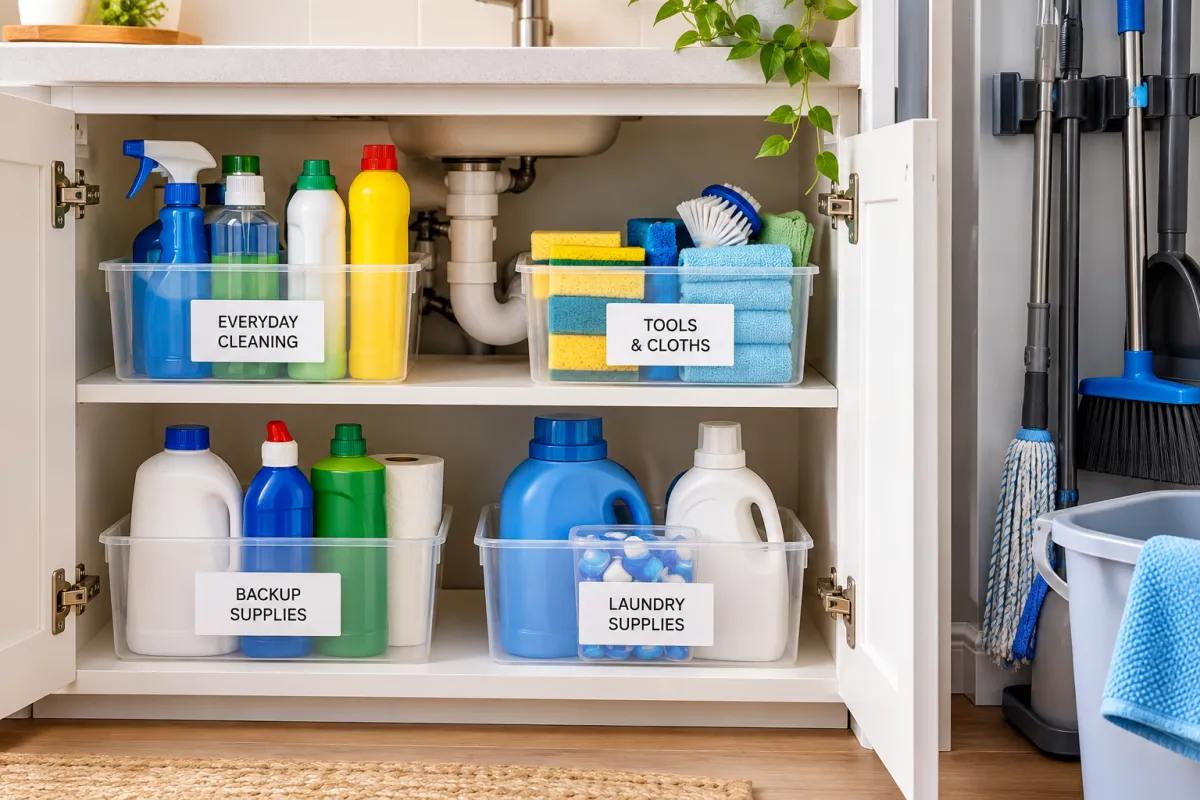
Use Under-Sink Storage Carefully
The cabinet under the kitchen or bathroom sink is often one of the few available storage areas in a small home.
It can be useful, but it should not automatically become the home for every cleaning product.
Whether a particular product belongs there depends on its label instructions and your household's circumstances.
If you use an under-sink cabinet, consider organizing it around a few principles:
- Keep products upright when appropriate for the product and container.
- Keep containers properly closed.
- Keep labels visible when practical.
- Avoid overcrowding the cabinet.
- Separate everyday items from backups.
- Keep products inaccessible to young children and pets.
- Use a child-safety lock where appropriate if young children can access the cabinet.
The American Cleaning Institute recommends storing cleaning products out of sight and reach of children and pets and using child-safety locks on cabinets when young children or frequent child visitors may have access.
An under-sink cabinet also should not become a place where unrelated household items are piled together. A smaller, controlled collection is easier to inspect and maintain.
Organize Cleaning Tools Separately From Products
Bottles are only part of a cleaning system.
Mops, brooms, brushes, dusters, microfiber cloths, sponges, and other tools can consume more physical space than the products themselves.
Treat tools as a separate category.
Store long tools vertically
If floor space is limited, vertical storage can be particularly useful for:
- Brooms
- Mops
- Dustpans
- Long-handled brushes
- Dusters
A narrow designated space can often hold several long tools without requiring a large cabinet.
The important thing is to keep them contained rather than leaning them randomly against walls or furniture.
Keep cloths together
Microfiber cloths and other reusable cleaning cloths are easier to manage when folded and stored together.
You do not necessarily need a special organizer. A small drawer, shelf section, or appropriately sized basket can work.
The goal is to prevent clean cloths from becoming mixed with used or damp ones.
Give sponges and brushes a drying routine
Wet cleaning tools should not simply be thrown into a closed container.
After use, allow reusable tools to dry appropriately before putting them away. This makes the storage system easier to maintain and avoids turning a small cabinet or container into a collection point for wet equipment.
The exact cleaning and care method depends on the particular tool and its material, so follow the manufacturer's instructions when available.
Make Safety Part of the Organization System
Good organization is not just about fitting more bottles into less space.
For cleaning products, the storage system should also reduce the chance of accidental access or misuse.
The American Cleaning Institute recommends reading and following product-label directions, keeping containers properly closed, retaining original labels, and storing cleaning products out of sight and reach of children and pets.
This means safety should influence where you put things.
A convenient shelf may not be the right shelf if a young child can easily reach it.
A decorative container may look better but should not replace the original labeled product container.
A frequently used product may be convenient to keep on a counter, but if children or pets can access it, that convenience may not be worth the risk.
Keep products in original containers
Do not transfer cleaning products into food or beverage containers.
Poison Control specifically advises against transferring caustic cleaning products into food or beverage containers and recommends keeping products in their original containers with child-resistant closures properly secured.
This is an important distinction for small-space organization.
You can use a basket, shelf divider, or cabinet organizer around a product without changing the product's container.
Do not treat decorative storage as chemical storage
Decorative organization works best around cleaning products, not instead of their original packaging.
For example, a labeled basket containing several original cleaning-product containers can create a cleaner-looking cabinet.
Pouring those products into matching unlabeled bottles creates a different situation and can remove information that the original label provides.
Keep Children and Pets in Mind
If children or pets live in the home, storage decisions should be made with access in mind.
Cleaning products should be stored out of sight and reach of young children and pets. Products should also remain properly closed and in their original containers.
For cabinets that children can access, a child-safety lock may be appropriate.
Do not assume that a product is safe simply because it is used frequently or because the bottle is small. Follow the product's label directions and use the storage precautions recommended for that product.
The same principle applies to cleaning buckets or containers holding cleaning solutions. The American Cleaning Institute advises keeping buckets and cleaning solutions out of reach of young children.
Give Backups a Less Convenient Location
Prime storage space should go to the things you use most.
In a small home, this can mean putting backup supplies higher, farther back, or in a secondary designated storage area when that location is appropriate for the product.
The purpose is not to hide supplies. It is to reserve the easiest-to-reach space for active inventory.
Think of your storage as three levels:
- Most accessible: everyday supplies and tools
- Secondary: occasional-use supplies
- Backstock: unopened extras and replacements
This creates a natural rotation system without requiring complicated labels or software.
When an active product runs out, move a backup into the everyday area and add that item to your shopping list.
Create a Simple Inventory System
You do not need an elaborate household inventory app to keep cleaning supplies under control.
A small-home system can be as simple as knowing:
- What products you currently use
- What backups you have
- Which products are nearly empty
- Where each category is stored
If you regularly discover unopened products you forgot you owned, your system needs better visibility.
One useful habit is to check your cleaning-supply storage before shopping for household products.
This is particularly helpful when products are stored in multiple locations.
Instead of asking, "Do I need this?" based on memory, you can quickly check the active and backup areas.
Organize by Task When It Makes Sense
There are several ways to categorize cleaning supplies.
You can organize by:
- Product type
- Room
- Cleaning task
- Frequency of use
For a small home, a hybrid system is often more practical than choosing one method rigidly.
For example, you might have one main storage zone but divide it into simple groups:
Everyday cleaning: frequently used household products.
Bathroom: products and tools primarily used for bathroom cleaning.
Laundry: laundry-related supplies.
Tools: cloths, brushes, sponges, dusters, and similar equipment.
Backups: unopened replacements.
Avoid creating a separate container for every possible task. Too many categories can make a small storage area harder to use.
The best organizational system is one you can understand quickly and reset easily.
Use Vertical and Awkward Space Strategically
Small homes often lack wide storage but have unused vertical space.
Depending on the storage area and product instructions, useful options may include:
- Narrow shelving
- Door-mounted organizers
- Vertical tool storage
- Shelf risers
- Small bins
- Adjustable cabinet organizers
But do not buy an organizer simply because it fits a small space.
First measure the area and identify what needs to be stored there.
An organizer that consumes half the available cabinet height may make the space less efficient rather than more efficient.
Also consider access and stability. A storage solution is only useful if items can be removed without knocking over other products.
Avoid These Common Organization Mistakes
Buying organizers before sorting
This is one of the easiest ways to waste space and money.
If you buy containers before knowing what you actually own, you may end up organizing unnecessary duplicates.
Sort first. Buy storage second.
Keeping everything within arm's reach
Not every product needs premium storage space.
Everyday supplies deserve convenience. Backups generally do not.
Spreading supplies across too many rooms
Keeping one product in every bathroom or bedroom can seem convenient, but it can also make inventory difficult to track.
Distribute only the items that genuinely benefit from point-of-use storage.
Removing original labels
Labels contain information about proper use, storage, and other precautions. Keep them intact.
Transferring products into decorative bottles
A coordinated set of bottles may look attractive, but cleaning products should remain in their original containers with their labels intact.
Overloading one cabinet
A storage area is not successful if it technically holds everything but becomes impossible to use.
Leave enough room to see and remove products without moving an entire collection.
Mixing incompatible cleaning products
Organization does not replace safe product use.
Never mix household bleach with other cleaners or disinfectants. The CDC specifically warns against mixing bleach with other cleaning products because dangerous reactions can occur.
When using bleach indoors, CDC guidance also recommends good ventilation and following the product's safety instructions.
You do not need to turn your storage cabinet into a chemical-safety laboratory. Just make sure basic product-use and storage instructions remain part of your system.
Build a Five-Minute Reset Routine
The best organization system is one that stays organized.
Once or twice a month, spend a few minutes checking your cleaning-supply area.
Look for:
- Empty containers
- Products that have moved out of their designated area
- New duplicates
- Backups that have become everyday supplies
- Damp or misplaced cleaning tools
- Overcrowded shelves
- Items that no longer belong in the area
Return everything to its designated zone.
You can also use the reset to update your shopping list.
For example, if you have one active bottle and one unopened backup, there is probably no reason to buy another one. If the active bottle is nearly empty and the backup has moved into service, that may be the right time to add a replacement to your list.
This simple cycle prevents the cabinet from slowly returning to its previous state.
A Practical Small-Home Setup
If you are starting from scratch, you do not need a complicated system.
A practical setup could look like this:
Zone 1: Everyday products
Keep the small group of products you use regularly in the easiest appropriate storage location.
Zone 2: Tools
Store cloths, brushes, sponges, and long-handled tools separately so they are easy to locate and maintain.
Zone 3: Backups
Keep unopened replacements together in a designated secondary area.
Zone 4: Laundry supplies
Keep laundry-related products organized separately when your storage arrangement allows it.
Zone 5: Occasional-use items
Use less accessible but still appropriate storage for products you rarely need.
The exact locations will differ from one home to another. The important part is the logic behind the system: frequent use determines accessibility, available space determines placement, and product instructions and household circumstances determine safe storage.
When to Reorganize Instead of Buying More Storage
Sometimes the problem is not a lack of storage.
It is too much inventory.
If your cleaning supplies occupy several cabinets, drawers, and corners of the home, buying another organizer may only postpone the problem.
Instead, ask:
- Do I have duplicates?
- Do I have unopened backups that I forgot about?
- Are products spread across too many locations?
- Are tools mixed with products?
- Is valuable space being used for occasional-use items?
- Can I create one clearly defined primary storage area?
If the answer to several of these questions is yes, reorganizing what you already own may create more usable space than purchasing another storage product.
What to Do With Your Cleaning Supplies Today
You can organize a small cleaning-supply collection without redesigning your entire home.
Start by gathering what you have and separating everyday products, occasional-use items, backups, and tools. Keep products in their original labeled containers and follow their individual storage instructions.
Then choose one primary storage zone that makes sense for your home. Give the most accessible space to frequently used supplies, create a separate location for backups, and keep cleaning tools organized so they can dry and be put away properly.
If children or pets are present, make access control part of the plan rather than treating it as an afterthought. Keep products properly closed and out of sight and reach, and use appropriate cabinet locks where needed.
Finally, maintain the system with a quick periodic reset. A small home does not need a large cleaning closet. It needs a clear system that makes it obvious what you have, where it belongs, what you use most, and how it should be stored safely.
Conclusion
The most effective way to organize cleaning supplies in a small space is to organize around use, available storage, and safety, rather than trying to fit every bottle into the same cabinet.
Start with what you already own. Remove unnecessary duplication from your active storage, separate everyday supplies from backups, keep tools organized separately, and use central storage for inventory while allowing limited point-of-use storage when it genuinely improves convenience.
Most importantly, let safety rules influence the system. Keep cleaning products in their original labeled containers, follow product-label storage instructions, keep containers properly closed, and store products out of sight and reach of children and pets where appropriate.
A well-organized small home is not one with the most containers. It is one where every cleaning supply has a clear, practical place—and where that system is simple enough to maintain.
Frequently asked questions
Can I put cleaning products into decorative containers?
Cleaning products should generally remain in their original containers with their labels intact. Instead of transferring products, use organizers such as bins or baskets around the original containers to make a small storage area easier to manage.
Is it safe to store cleaning supplies under the sink?
Under-sink storage can work in a small home, but it is not automatically appropriate for every product or household. Follow each product's label instructions and make sure products remain securely closed and inaccessible to young children and pets. Child-safety locks may be appropriate where young children have access to the cabinet.
Should I keep all my cleaning supplies in one place?
Not necessarily. A small home can benefit from a central storage area for most supplies while keeping a limited number of frequently used items near their point of use. The key is to avoid spreading products across the home without a clear system.
How should I organize cleaning supplies if I don't have a utility closet?
Use the safest practical storage area available, such as an appropriate cabinet, laundry-area storage, or another designated household storage zone. Separate frequently used supplies from backups and keep products in their original labeled containers.
How can I stop buying duplicate cleaning products?
Before buying more supplies, keep everyday products and backup stock clearly separated and review what you already have. A simple inventory check can help you use existing products before purchasing replacements.
Where should I store extra cleaning products?
Keep backup products together in a designated storage area rather than mixing them with everyday supplies. Store them according to their product-label instructions and away from children, pets, and food.
How should I store cleaning products if I have young children?
Keep cleaning products out of sight and reach of young children, keep containers properly closed, and consider child-safety locks on accessible cabinets. Products should remain in their original containers with labels intact.
How should I store cleaning supplies if I have pets?
1. Store cleaning products where pets cannot access them and keep containers securely closed. Follow the product label for storage instructions and avoid leaving cleaning products or cleaning solutions unattended where pets can reach them.
Ethan Parker writes practical guides about home, everyday living, household decisions, consumer products, organization, and practical lifestyle topics. His work focuses on helping readers compare options, understand comm...