How to Clean a Dishwasher Filter: Step-by-Step Guide
Learn how to clean a dishwasher filter safely and effectively. This step-by-step guide explains how to identify your filter type, remove and rinse it, gently clear debris, reinstall it correctly, and troubleshoot common problems like odors and dirty dishes. Cleaning frequency depends on your dishwasher model and owner’s manual.
 By Ethan Parker
In this article
- What Does a Dishwasher Filter Do?
- Does Every Dishwasher Have a Filter That Needs Cleaning?
- Manually cleaned filters
- Maintenance-free filtration systems
- Signs Your Dishwasher Filter May Need Cleaning
- Food particles remain on dishes
- The dishwasher has an unpleasant smell
- The dishwasher appears to clean less effectively
- Visible food debris has accumulated
- What You Need to Clean a Dishwasher Filter
- How to Clean a Dishwasher Filter Step by Step
- Step 1: Check the Owner’s Manual
- Step 2: Prepare the Dishwasher
- Step 3: Locate the Filter
- Step 4: Remove the Filter Carefully
- Step 5: Rinse the Filter Under Running Water
- Step 6: Gently Brush Away Stubborn Debris
- Step 7: Inspect the Filter
- Step 8: Reinstall the Filter Correctly
- Step 9: Confirm the Filter Is Secure
- How Often Should You Clean a Dishwasher Filter?
- Common Mistakes to Avoid When Cleaning a Dishwasher Filter
- Forcing a stuck filter
- Using abrasive cleaning tools
- Using unapproved cleaning products
- Reinstalling the filter incorrectly
- Running the dishwasher without the filter
- Assuming every cleaning problem comes from the filter
- Dishwasher Still Smells Bad or Does Not Clean Dishes Properly?
- Check the Spray Arms
- Review Dishwasher Loading
- Review Detergent Use
- Check the Drainage Area
- When to Call a Dishwasher Repair Professional
- Conclusion
A dirty dishwasher filter can contribute to food particles remaining on dishes, unpleasant odors, and reduced cleaning performance. Cleaning the filter is a simple maintenance task for many dishwashers, but the exact process depends on the appliance’s design.
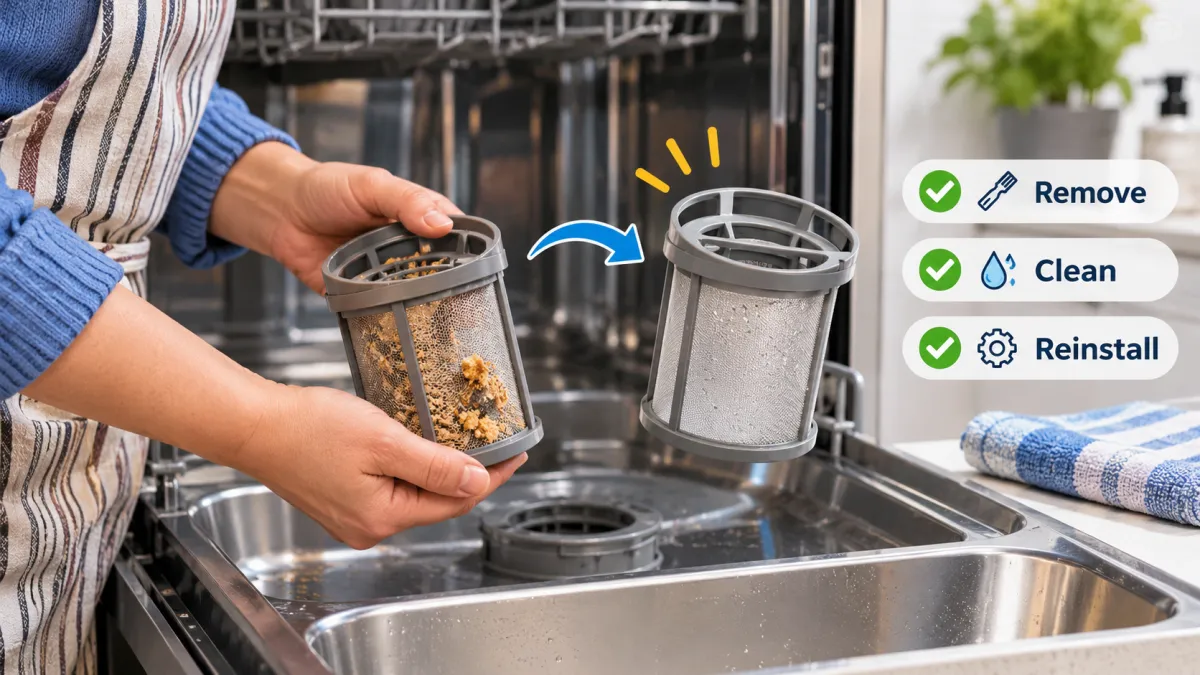
Most dishwashers with manually cleaned filters have a removable component near the bottom of the tub that collects food debris. You can often clean it by removing the filter, rinsing it under running water, gently brushing away residue if the manufacturer allows it, and reinstalling it securely.
Before you begin, check your dishwasher’s owner’s manual. Some models have maintenance-free filtration systems, while others require periodic manual cleaning. Filter locations, locking mechanisms, and cleaning recommendations can vary by brand and model.
This guide explains how to identify your dishwasher filter, clean it safely, reinstall it correctly, and troubleshoot common problems.
What Does a Dishwasher Filter Do?
A dishwasher filter helps capture food particles and debris during the wash cycle. It prevents larger pieces of food from circulating through the appliance and interfering with its cleaning process.
Depending on the dishwasher design, the filtration system may include a coarse filter, a fine mesh filter, or multiple connected components.
The filter is generally located at the bottom of the dishwasher tub, near the spray arm and drain area. In many models, it sits beneath the lower dish rack.
A clean filter helps the dishwasher manage food debris effectively. When residue accumulates, water may not circulate as intended, and food particles can remain on dishes or contribute to odors.
However, a dirty filter is not the only possible cause of poor cleaning. Spray arms, detergent use, loading practices, water supply, and drainage can also affect dishwasher performance.
Does Every Dishwasher Have a Filter That Needs Cleaning?
Not every dishwasher uses the same type of filtration system. Before attempting to remove anything, identify which system your appliance has.
Manually cleaned filters
Many dishwashers have removable filters that require periodic cleaning.
These filters may include:
-
A cylindrical or cup-shaped filter
-
A fine mesh screen
-
A coarse filter that catches larger debris
-
A locking mechanism that holds the filter in place
Some models use a single filter assembly, while others have separate components.
If your dishwasher has a manually cleaned filter, the owner’s manual should explain how to remove it, clean it, and reinstall it.
Maintenance-free filtration systems
Some dishwashers use filtration systems designed to require less routine manual cleaning.
These systems may handle food particles differently from removable manual-clean filters. A component that looks like a filter or debris cup may still need occasional inspection, depending on the appliance.
Do not assume that every dishwasher filter should be removed. If your model has a maintenance-free system, follow the manufacturer's maintenance instructions instead of attempting to disassemble it.
Signs Your Dishwasher Filter May Need Cleaning
A filter does not always look dirty from above. Food particles can collect in the mesh or beneath the filter assembly.
Here are some signs that cleaning or inspection may be useful.
Food particles remain on dishes
If dishes come out with small food particles, the filter may be holding accumulated debris. Check whether your dishwasher has a removable filter and whether the manual recommends cleaning it.
Poor cleaning can also result from blocked spray arms, overloaded racks, incorrect detergent use, or other issues.
The dishwasher has an unpleasant smell
Food residue trapped in a filter can contribute to a bad smell, particularly when the dishwasher is used frequently.
If the filter is visibly dirty, cleaning it is a reasonable first step. Odors may also originate from the drain area, door seals, or other components.
The dishwasher appears to clean less effectively
A dishwasher that leaves dishes gritty or dirty may need maintenance. Inspecting the filter is one useful step, but it does not establish that the filter is the cause.
Visible food debris has accumulated
If you can see food particles, grease, or residue around the filter area, inspect the filter according to your manual.
Cleaning frequency depends on the model, how often the dishwasher runs, and how much food debris enters the appliance.
What You Need to Clean a Dishwasher Filter
For many manually cleaned filters, you do not need specialized tools.
You may need:
-
A soft toothbrush or another soft cleaning brush, if permitted by the manual
-
A sink with running water
-
A clean, soft cloth or sponge, if appropriate for the filter material
-
Your dishwasher’s owner’s manual
Avoid wire brushes, abrasive scouring pads, or tools that could damage the filter mesh or plastic components.
Do not automatically use dish soap, vinegar, bleach, or other cleaning products. The manufacturer’s instructions should determine whether a cleaning product is appropriate for your specific filter.
How to Clean a Dishwasher Filter Step by Step
The following process applies to many dishwashers with removable, manually cleaned filters. Your appliance may use a different removal or cleaning procedure.
Step 1: Check the Owner’s Manual
Before removing the filter, locate the maintenance instructions for your dishwasher.
The manual can help you determine:
-
Whether the filter is designed to be removed
-
Where the filter is located
-
How the filter locks into place
-
Which components can be separated
-
How the filter should be cleaned
-
How often maintenance is recommended
This step matters because dishwasher filters are not interchangeable. A removal method that works for one model may damage another.
If you cannot find the printed manual, check the manufacturer’s official product-help website. Whirlpool and KitchenAid, for example, provide appliance support resources for their products.
Step 2: Prepare the Dishwasher
Make sure the dishwasher is not running and has completed its cycle.
Allow hot components and water to cool before handling them. If the appliance has recently completed a hot wash, give it time to cool down.
Open the door and remove the lower dish rack if necessary to access the filter.
You should be able to see the filter area at the bottom of the tub. Avoid reaching into areas where sharp debris may be present.
Step 3: Locate the Filter
Look at the bottom of the dishwasher, typically near the center or around the drain area.
In many manually cleaned systems, the filter assembly is cylindrical or cup-shaped and sits in a recessed section of the dishwasher floor.
Some designs have a separate flat mesh screen. Others combine the fine and coarse filters into one assembly.
Do not remove nearby components simply because they look similar to the filter. Use the diagram or instructions in your owner’s manual to identify the correct parts.
Step 4: Remove the Filter Carefully
Many dishwasher filters use a twist-lock mechanism.
If your manual specifies a twisting motion, rotate the filter in the indicated direction and lift it out. Other models may use a different release method.
Keep track of any separate filter pieces that are designed to be removed.
Do not force the filter if it feels stuck. Excessive twisting, pulling, or prying can damage the locking mechanism or surrounding components.
If the filter does not release using the method described in the manual, stop and consult the manufacturer's instructions.
Step 5: Rinse the Filter Under Running Water
Take the removable filter to the sink.
Rinse it under running water to loosen and remove food particles. Pay attention to the mesh openings, where debris can become trapped.
For many filter types, rinsing is sufficient to remove loose food residue.
If the filter has multiple parts, clean each removable component according to the manual. Do not separate components that are not intended to come apart.
Step 6: Gently Brush Away Stubborn Debris
If food residue remains after rinsing, use a soft brush only if the manufacturer permits it.
A soft toothbrush may help reach the mesh openings and remove stuck particles. Use gentle strokes rather than pressing hard against the filter.
Avoid:
-
Wire brushes
-
Metal tools
-
Abrasive pads
-
Aggressive scraping
-
Excessive pressure on fine mesh
The goal is to remove debris without damaging the filter.
Do not soak the filter in vinegar or another cleaning solution unless the manufacturer specifically recommends that method for your model.
Step 7: Inspect the Filter
After cleaning, check the filter for visible damage.
Look for:
-
Torn or damaged mesh
-
Cracks in plastic components
-
Broken locking tabs
-
Parts that no longer fit together correctly
If the filter is damaged, consult the manufacturer about the correct replacement part for your dishwasher model.
A damaged filter should not be treated as though cleaning alone will restore it.
Step 8: Reinstall the Filter Correctly
Place the cleaned filter back into its original position.
Follow the installation instructions in the owner’s manual. If your model uses a twist-lock mechanism, rotate the filter as directed until it is secured.
If the filter has separate components, make sure each part is correctly positioned.
A filter that is loose, misaligned, or incorrectly installed may affect the dishwasher’s operation. Do not run the dishwasher with a manually cleaned filter missing or improperly installed.
Step 9: Confirm the Filter Is Secure
Before replacing the lower rack, check that the filter sits properly in its housing.
Make sure it does not wobble or appear out of position. Use the manual’s installation guidance to confirm that the locking mechanism is engaged.
Once the filter is secure, replace the lower rack.
Your dishwasher is ready for normal use according to the manufacturer's instructions.
How Often Should You Clean a Dishwasher Filter?
There is no single cleaning schedule that applies to every dishwasher.
The recommended frequency depends on the filtration system, how often you run the appliance, the amount of food debris entering it, and the manufacturer's maintenance guidance.
Some manuals recommend cleaning intervals based on use. Others provide a specific schedule for particular models.
A practical approach is to:
-
Follow the owner’s manual first.
-
Inspect a manually cleaned filter periodically.
-
Check it more often if you frequently wash dishes with substantial food residue.
-
Clean it when visible buildup appears or when the manual calls for maintenance.
-
Avoid assuming that a maintenance-free system needs the same cleaning routine as a removable filter.
Scraping food from dishes before loading may also help reduce the amount of debris entering the dishwasher, depending on the appliance’s design and the manufacturer’s recommendations.
Common Mistakes to Avoid When Cleaning a Dishwasher Filter
Cleaning a filter is straightforward when you follow the correct procedure. Several mistakes can cause unnecessary damage or interfere with dishwasher operation.
Forcing a stuck filter
A filter may have a specific release mechanism. Forcing it can break plastic tabs or damage the filter housing.
If it does not come out easily, consult the manual instead of applying more force.
Using abrasive cleaning tools
Wire brushes and abrasive pads can damage fine mesh or plastic parts.
Use a soft brush only when the manufacturer allows it.
Using unapproved cleaning products
Vinegar, bleach, dish soap, and other household products are not universally appropriate for dishwasher filters.
Some products may damage components or leave residues. Use only cleaning methods approved for your model.
Reinstalling the filter incorrectly
A filter that is not properly secured can affect the dishwasher's operation.
Follow the installation instructions and verify that the filter is locked or seated correctly before running the appliance.
Running the dishwasher without the filter
Do not operate a dishwasher with a manually cleaned filter removed or incorrectly installed unless the manufacturer specifically directs you to do so for a maintenance procedure.
The filter is part of the appliance’s filtration system and should be in its proper position during normal operation.
Assuming every cleaning problem comes from the filter
A dirty filter may contribute to poor cleaning, but it is not the only possible cause.
If the dishwasher still leaves food on dishes after filter maintenance, inspect other areas according to the owner’s manual.
Dishwasher Still Smells Bad or Does Not Clean Dishes Properly?
If cleaning the filter does not resolve the problem, consider other possible causes.
| Problem | Possible cause | What to check |
|---|---|---|
| Food particles remain on dishes | Dirty filter, blocked spray arms, loading issues, or other cleaning problems | Inspect the filter, spray arms, and loading arrangement according to the manual |
| Dishwasher has a persistent odor | Residue in the filter, drain area, door seals, or other components | Check the manufacturer's cleaning instructions for these areas |
| Dishes remain gritty | Food debris, detergent issues, or water circulation problems | Review detergent use, loading, and spray-arm maintenance |
| Water remains in the dishwasher | Drainage issue or model-specific water retention | Consult the manual to determine what is expected for your model |
| Filter will not reinstall | Misalignment, incorrect assembly, or a damaged component | Review the installation diagram and inspect the filter parts |
| Water appears around the dishwasher | Possible leak or other water-related issue | Inspect the area carefully and refer to the appliance manual or a qualified technician |
Do not assume that every symptom has a single cause. Dishwasher designs differ, and troubleshooting should be based on the appliance’s specific instructions.
If you notice water around the appliance, you can also follow KnowBrook’s guide on how to check for water leaks around household appliances.
Check the Spray Arms
Spray arms distribute water during the wash cycle. If their openings are blocked, dishes may not receive adequate water coverage.
Inspect and clean them only as directed by your dishwasher’s manual.
Review Dishwasher Loading
Overloaded racks or dishes positioned incorrectly can interfere with water circulation.
Make sure dishes do not block the spray arms from rotating freely. Follow the loading guidance for your model.
Review Detergent Use
Using the wrong detergent or an inappropriate amount may affect cleaning results.
Follow the detergent instructions and your dishwasher manufacturer’s recommendations.
Check the Drainage Area
If water does not drain as expected, the problem may involve the drain area or another part of the drainage system.
Consult the manual before attempting to remove additional components. If drainage problems persist, professional service may be appropriate.
When to Call a Dishwasher Repair Professional
Routine filter cleaning is usually a maintenance task, but some problems require more than a rinse and brush.
Consider contacting a qualified appliance repair professional if:
-
The filter housing appears damaged.
-
The filter cannot be removed using the manufacturer’s instructions.
-
The filter will not lock into place.
-
The dishwasher repeatedly fails to drain.
-
Water continues to collect excessively in the tub.
-
You notice persistent leaks.
-
The dishwasher continues to perform poorly after basic maintenance.
-
You are unsure how to safely access a component.
Avoid disassembling parts of the dishwasher that are not identified as user-serviceable in the manual.
If the appliance is under warranty, check the warranty terms before attempting repairs that could affect coverage.
Conclusion
Cleaning a dishwasher filter can help remove accumulated food debris and support the appliance’s normal cleaning performance. For a dishwasher with a manually cleaned filter, the basic process is to locate the filter, remove it according to the owner’s manual, rinse it, gently brush away permitted residue, and reinstall it securely.
The most important rule is to follow the instructions for your specific dishwasher. Filter designs and cleaning schedules vary, and some models use maintenance-free filtration systems.
If odors, poor cleaning, or drainage problems continue after appropriate filter maintenance, investigate other possible causes rather than assuming the filter is responsible. When a component is stuck, damaged, or difficult to access, consult the manufacturer or a qualified repair professional.
Frequently asked questions
1. Do all dishwashers have a filter that needs to be cleaned?
Not all dishwashers have the same filtration system. Some models use removable, manually cleaned filters, while others have maintenance-free filtration systems. Check your dishwasher’s owner’s manual to identify the filter type and determine whether cleaning is required.
2. Can I run my dishwasher without its filter?
No. You should not operate your dishwasher without its filter properly installed unless the manufacturer specifically instructs otherwise for a particular maintenance procedure. A missing or incorrectly installed filter can allow food debris to circulate and may affect cleaning performance.
3. Can I use a toothbrush to clean my dishwasher filter?
A soft toothbrush may help remove debris from a removable filter if your owner’s manual permits it. Avoid wire brushes, abrasive pads, or tools that could damage the mesh or filter components.
4. What should I do if my dishwasher filter will not come out?
Consult your owner’s manual for the correct removal procedure. Filter designs and locking mechanisms vary by model. Do not force, twist, or pry a stuck filter, as this could damage its components.
5. Why does my dishwasher still smell bad after cleaning the filter?
Odors may come from food debris elsewhere in the dishwasher, the drain area, spray arms, door seals, or drainage issues. Check the manufacturer’s cleaning instructions for these components. If the odor persists, investigate possible drainage problems or seek professional service.
6. Is a little standing water in the dishwasher filter area normal?
The amount of water remaining near the filter area can vary by dishwasher model. Check your owner’s manual for model-specific guidance. If water is excessive, persists in the tub, or accompanies poor drainage, the dishwasher may need troubleshooting.
Ethan Parker writes practical guides about home, everyday living, household decisions, consumer products, organization, and practical lifestyle topics. His work focuses on helping readers compare options, understand comm...