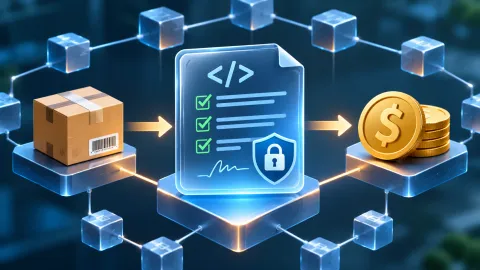
What Is Blockchain Technology? How It Works, Uses, and Limitations
Learn what blockchain technology is, how blocks and networks work together, and how blockchain is used beyond cryptocurrency. This guide explains its main types, benefits, security risks, limitations, and how it compares with traditional databases.
In this article
- What Is Blockchain Technology?
- A Simple Way to Understand Blockchain
- How Does Blockchain Work?
- 1. A Transaction or Record Is Created
- 2. The Transaction Is Shared With the Network
- 3. The Transaction Is Validated
- 4. Valid Transactions Are Grouped Into a Block
- 5. The Network Reaches Agreement
- 6. The Block Is Linked to Earlier Blocks
- 7. The Ledger Is Updated
- Key Components of Blockchain Technology
- Blocks
- Cryptographic Hashes
- Nodes
- Consensus Mechanisms
- Digital Signatures
- Smart Contracts
- Types of Blockchain
- Public and Permissionless Blockchains
- Private and Permissioned Blockchains
- Consortium Blockchains
- Real-World Uses of Blockchain Technology
- Supply-Chain Tracking
- Shared Business Records
- Digital Asset Management
- Smart-Contract-Based Processes
- Recordkeeping and Registries
- Blockchain vs. Traditional Databases
- When a Traditional Database May Be Better
- When Blockchain May Be Worth Considering
- Benefits of Blockchain Technology
- Shared Recordkeeping
- Tamper-Evident History
- Traceability
- Reduced Reliance on One Central Operator
- Automation Through Smart Contracts
- Limitations and Risks of Blockchain Technology
- Scalability and Transaction Speed
- Energy Consumption
- Privacy Challenges
- Data Accuracy
- Security Is Not Absolute
- Governance and Coordination
- Cost and Complexity
- How to Decide Whether Blockchain Is the Right Choice
- Conclusion

Blockchain technology is a way to record and share information across a network of computers using a structure designed to make records difficult to alter without detection. Instead of keeping a record in one central database controlled by a single organization, a blockchain can maintain synchronized records across multiple participants.
Blockchain is best known for supporting cryptocurrencies such as Bitcoin, but the technology can also be used for other purposes, including supply-chain tracking, shared business records, digital asset management, and certain automated agreements.
Understanding blockchain requires more than knowing that information is stored in digital blocks. The technology combines linked records, cryptographic techniques, network participants, and a process for agreeing on which records should be accepted. These features can provide useful advantages, but they also create tradeoffs involving speed, cost, privacy, energy use, and complexity.
This guide explains what blockchain technology is, how it works, its major types, practical applications, and the situations in which a conventional database may be a better choice.
What Is Blockchain Technology?
Blockchain technology is a type of distributed ledger technology (DLT) that records information in a sequence of connected blocks. Each block contains data and a cryptographic reference to an earlier block, creating a chain of records.
A distributed ledger is a record of information shared across multiple participants or systems. Depending on the blockchain, participants may operate computers that maintain copies of the ledger and help validate new transactions.
The key idea is that the network follows agreed-upon rules for adding records. Once records are accepted and linked into the chain, changing an earlier record becomes difficult because the change can affect the cryptographic links and may conflict with copies maintained by other participants.
Blockchain is therefore often described as tamper-evident or tamper-resistant. Those terms are more accurate than saying that every blockchain is completely immutable or impossible to hack.
A Simple Way to Understand Blockchain
Imagine several businesses need to maintain a shared record of shipments. Each business wants to see the same information, but no single business wants to be solely responsible for maintaining the master record.
A blockchain-based system could allow participating businesses to share a ledger. When a new shipment record is accepted, it becomes part of the ledger and is linked to previous records.
The participants can review the history and check whether records have been changed. The system's rules determine who may submit information, who may validate it, and how updates are accepted.
This example is hypothetical. Whether blockchain is appropriate for a real supply chain depends on the participants, the information involved, and the costs of operating the system.
How Does Blockchain Work?
Blockchain operation can be understood as a series of steps. The exact process varies by network, but many systems follow a general pattern.
1. A Transaction or Record Is Created
A participant submits a transaction or a piece of information to the blockchain network.
For example, a business might submit a record indicating that a shipment has moved from one stage of a supply chain to another. A cryptocurrency user might submit a transaction transferring a digital asset.
The submitted information is not automatically accepted. The network must determine whether it follows the system's rules.
2. The Transaction Is Shared With the Network
The transaction is communicated to relevant network participants. In many blockchain systems, these participants operate nodes—computers that take part in the network.
Depending on the blockchain, nodes may store records, relay transactions, verify information, or perform other functions.
Not every node necessarily performs every task. The roles and responsibilities depend on the network design.
3. The Transaction Is Validated
The network checks whether the transaction meets its rules.
Validation may involve checking digital signatures, account balances, permissions, transaction formats, or other conditions. In a permissioned blockchain, the system may also check whether a participant is authorized to submit a particular record.
Validation does not necessarily prove that the information is true in the real world. It primarily determines whether the submitted transaction follows the blockchain's technical and operational rules.
For example, a system may accept a shipment update submitted by an authorized user, but it cannot automatically guarantee that the shipment physically arrived at the reported location.
4. Valid Transactions Are Grouped Into a Block
In many blockchain systems, accepted transactions are collected into a block.
A block commonly contains:
-
A set of transactions or records
-
A reference to the previous block
-
A timestamp or other metadata, depending on the design
-
A cryptographic hash
-
Other information required by the network's rules
Blocks are not necessarily identical across all blockchain systems. Their structure depends on the technology being used.
5. The Network Reaches Agreement
Blockchain participants need a way to agree on which blocks should become part of the accepted ledger.
This process is called consensus. Different blockchains use different consensus mechanisms, such as proof of work or proof of stake. Permissioned networks may use other mechanisms designed for known participants.
Consensus helps the network coordinate its recordkeeping. It does not mean every participant independently verifies the truth of every real-world event described in a transaction.
6. The Block Is Linked to Earlier Blocks
A block includes a cryptographic reference—commonly a hash—to the previous block.
A hash is a value generated from data using a cryptographic function. If the underlying data changes, the resulting hash will generally change as well.
Because blocks reference earlier blocks, changing an old record can disrupt the links between blocks. In a distributed network, the altered history may also conflict with records held by other participants.
This structure helps make unauthorized changes detectable and difficult. The strength of that protection depends on the blockchain's design, consensus mechanism, network participation, and governance.
7. The Ledger Is Updated
After the network accepts a block according to its rules, participating nodes update their records.
The accepted information becomes part of the blockchain's history. Depending on the system, participants may be able to inspect the ledger publicly, access it through permissions, or view only certain information.
This process allows participants to maintain a shared record without necessarily relying on one central database administrator.
Key Components of Blockchain Technology
Blockchain combines several components that work together. Understanding them makes the technology easier to evaluate.
Blocks
Blocks are containers for records or transactions. They are linked together to form the blockchain.
A block may include transaction data, metadata, and a reference to a previous block. The exact structure depends on the network.
Cryptographic Hashes
A cryptographic hash converts data into a fixed-length value. Blockchain systems use hashes in ways that help connect blocks and detect changes.
A hash is not the same as encryption. Encryption is generally used to protect information by making it unreadable without the appropriate key. A hash is used to create a fingerprint of data.
Nodes
Nodes are computers or systems that participate in a blockchain network.
Their functions may include:
-
Maintaining a copy of ledger data
-
Relaying transactions
-
Checking transactions against network rules
-
Participating in consensus
-
Supporting network availability
The responsibilities of nodes vary between blockchain systems.
Consensus Mechanisms
Consensus mechanisms help participants agree on the accepted state of the ledger.
Two widely discussed approaches are proof of work and proof of stake. They differ in how participants contribute to the process and how the network's security and operation are organized.
Digital Signatures
Digital signatures can help establish that a transaction was authorized by the holder of a particular cryptographic key.
They do not necessarily reveal the real-world identity of the person or organization behind that key. Identity depends on the system and how participants are registered or verified.
Smart Contracts
Smart contracts are programs stored and executed within a blockchain environment that supports them. They can carry out actions when specified conditions are met.
For example, a smart contract might release a digital asset after certain conditions are satisfied. The contract's behavior depends on its code and the network's rules.
Smart contracts do not automatically know what is happening outside the blockchain. When they need external information, they may rely on mechanisms such as oracles. The accuracy and reliability of those external inputs remain important considerations.
Types of Blockchain
Blockchain networks can be classified by who can participate, who can access records, and who is allowed to validate transactions.
| Blockchain type | How it works | Common consideration |
|---|---|---|
| Public blockchain | Anyone may be able to view records or participate, subject to the network's rules | Open participation can make governance and coordination more complex |
| Private blockchain | Access and participation are restricted, often under one organization's control | Centralized control may reduce the need for some blockchain features |
| Consortium blockchain | Multiple organizations share responsibility for operating or governing the network | Participants must agree on governance, permissions, and operating rules |
These categories are not always mutually exclusive. A network may be permissioned, meaning participants need authorization, while still sharing data among several organizations.
Public and Permissionless Blockchains
A public blockchain is generally accessible for viewing. In a permissionless system, participants may be able to join the network or contribute to its operation without receiving approval from a central administrator.
This structure can support open participation, but it may also introduce challenges involving transaction throughput, governance, privacy, and resource consumption.
Private and Permissioned Blockchains
A private or permissioned blockchain limits participation to authorized users or organizations.
This can be useful when businesses need to share records while maintaining control over who can submit transactions or view information.
However, if one organization already controls the participants and data, a conventional database may provide the required functionality with less complexity.
Consortium Blockchains
A consortium blockchain is governed or operated by multiple organizations.
For example, several companies in a supply chain might jointly maintain a shared ledger. Each organization may have specific permissions and responsibilities.
The potential benefit is shared recordkeeping among organizations that do not want one participant to have complete control. The challenge is establishing governance and maintaining agreement about how the network should operate.
Real-World Uses of Blockchain Technology
Blockchain has applications beyond cryptocurrency. Its suitability depends on the problem being addressed, the participants, and the quality of the information being recorded.
Supply-Chain Tracking
A blockchain may be used to maintain shared records of products as they move through a supply chain.
Participating organizations could record events such as:
-
A product leaving a supplier
-
A shipment being received
-
A transfer between distribution locations
-
A product being processed or packaged
A shared ledger can make it easier for authorized participants to review the recorded history.
However, blockchain does not automatically verify physical events. If a participant submits inaccurate information, the system may preserve that inaccurate record. Reliable data collection and verification are still necessary.
Shared Business Records
Organizations that work together may need to maintain records that are consistent across several systems.
A blockchain may help participants coordinate updates to a shared ledger when no single organization should have exclusive control over the record.
This can be relevant to certain business-to-business processes, although a traditional shared database or other system may be more practical in many cases.
Digital Asset Management
Some blockchain networks support digital assets that can be transferred or tracked using the network's rules.
These assets may include cryptocurrency or other tokenized items. The meaning, rights, and practical value of a digital asset depend on the system and the arrangements surrounding it.
A blockchain record alone does not automatically establish every legal right associated with an asset.
Smart-Contract-Based Processes
Smart contracts can automate certain actions within a blockchain system.
They may be used to implement rules for transferring digital assets, recording transactions, or coordinating a process between participants.
Automation can reduce the need for some manual steps, but it also introduces risks. Errors in contract code or incorrect external inputs can lead to unintended outcomes.
Recordkeeping and Registries
Blockchain may be considered for some shared recordkeeping applications, including registries where several parties need to review a consistent history.
The suitability of a blockchain registry depends on privacy requirements, access controls, governance, and whether the participants benefit from distributed recordkeeping.
These applications should be evaluated carefully. Not every registry or recordkeeping problem requires blockchain.
Blockchain vs. Traditional Databases
Blockchain is not automatically better than a conventional database. The right choice depends on the requirements of the system.
A traditional database is often managed by a central organization or administrator. It can be designed to provide fast queries, controlled access, and efficient updates.
A blockchain is designed around a ledger structure and a process for accepting records among network participants. This may be useful when several parties need to share a record and have reasons not to rely entirely on one central operator.
| Feature | Blockchain | Traditional database |
|---|---|---|
| Record structure | Records are organized into linked blocks or ledger structures | Records may be stored in tables, documents, or other database structures |
| Control | May be distributed or governed by one or more organizations | Usually managed by a database owner or administrator |
| Updates | Often designed to make past records difficult to alter without detection | Records can generally be updated or deleted according to permissions |
| Performance | May involve consensus and additional coordination | Often optimized for fast queries and updates |
| Privacy | Depends on network design, permissions, and data handling | Can use access controls and other established privacy measures |
| Complexity | Can require network, governance, and consensus management | Often simpler when one trusted organization manages the data |
| Best fit | Shared records where distributed trust may matter | Applications requiring efficient centralized data management |
When a Traditional Database May Be Better
A traditional database may be the better choice when:
-
One organization is trusted to manage the records.
-
Data needs frequent updates or deletions.
-
Fast queries are a major priority.
-
Participants do not need independent ledger copies.
-
The system has straightforward access and ownership requirements.
For example, a small business managing its own inventory may not need blockchain. A database can store product quantities, sales, and supplier details without requiring a distributed consensus process.
When Blockchain May Be Worth Considering
Blockchain may be worth evaluating when:
-
Several independent organizations need a shared record.
-
Participants have a reason not to rely on one central operator.
-
A traceable history of accepted records is important.
-
The participants can agree on governance and operating rules.
-
The benefits justify the additional complexity and cost.
Even in these situations, blockchain should be compared with other approaches to shared databases and recordkeeping.
Benefits of Blockchain Technology
Blockchain can offer several advantages in appropriate circumstances.
Shared Recordkeeping
A blockchain can allow multiple participants to maintain or access a shared ledger. This may reduce disagreements about which version of a record is accepted by the network.
Tamper-Evident History
The links between blocks and the network's validation rules can make unauthorized changes easier to detect.
This is useful for maintaining a history of accepted transactions, but it does not guarantee that the original information was accurate.
Traceability
Blockchain records can support the review of transaction history. In some applications, participants can follow recorded events through a process or sequence of transactions.
Traceability is only as useful as the data being entered and the way the system is maintained.
Reduced Reliance on One Central Operator
Some blockchain networks distribute recordkeeping or validation responsibilities across participants.
This may be valuable when multiple organizations need to collaborate without giving one participant complete control. The extent of decentralization varies widely.
Automation Through Smart Contracts
Blockchain systems that support smart contracts can automate certain actions based on programmed rules.
Automation may reduce manual work in some processes, but contracts need careful design, testing, and oversight.
Limitations and Risks of Blockchain Technology
Blockchain has meaningful limitations. Understanding these tradeoffs is essential before adopting it.
Scalability and Transaction Speed
Some blockchain networks have limitations on how many transactions they can process or how quickly transactions are accepted.
Consensus and network coordination may add time or computational requirements. Different systems address these challenges in different ways, so performance should be evaluated for the specific network and use case.
Energy Consumption
Energy use varies by blockchain and its consensus mechanism.
Some proof-of-work systems require substantial computational resources. Other approaches, including proof-of-stake systems, are designed differently and can have different energy profiles.
It is therefore inaccurate to say that every blockchain consumes the same amount of energy or has the same environmental impact.
Privacy Challenges
A blockchain may expose transaction details to participants or the public, depending on its design.
Even when records use addresses or pseudonyms rather than names, information may sometimes be linked to real-world identities through other data.
Sensitive personal or business information should not be placed on a blockchain without considering privacy, access, and data-retention requirements.
Data Accuracy
Blockchain can preserve a record after it has been accepted, but it does not guarantee that the information entered was true.
For example, a shipment record might be submitted by an authorized participant but still contain an incorrect delivery status. The blockchain may preserve that entry unless the system has a way to correct or supersede it.
This is a central limitation: blockchain can help protect the integrity of recorded data, but it cannot independently guarantee the truth of external events.
Security Is Not Absolute
Blockchain's cryptographic design can provide protections, but blockchain systems are not completely immune to attacks.
Risks can involve:
-
Network participants
-
Wallets and private keys
-
Smart-contract code
-
User accounts
-
Applications connected to the blockchain
-
Governance and operational processes
A secure ledger does not automatically make every application built on top of it secure.
Governance and Coordination
Blockchain participants may need to agree on rules, permissions, software updates, and dispute handling.
In consortium or private networks, governance can become a major operational issue. Participants may disagree about changes or responsibilities.
Cost and Complexity
Building and maintaining a blockchain system may require specialized technical knowledge, infrastructure, governance, and security oversight.
If a simpler database can meet the requirements, blockchain may add cost and complexity without providing enough benefit.
How to Decide Whether Blockchain Is the Right Choice
Before adopting blockchain, an organization should identify the actual problem it wants to solve.
A practical decision framework includes the following questions:
1. Do multiple independent participants need to share records?
If one organization manages all the data and participants trust it, a conventional database may be sufficient.
2. Is there a meaningful reason to avoid a single central operator?
Blockchain may be more relevant when participants need shared control or a distributed process for accepting records.
3. Does the history of accepted records need to be tamper-evident?
If a traceable record is important, blockchain may offer useful characteristics. Other audit-log or database solutions should also be considered.
4. Can participants agree on governance?
A blockchain requires rules about who can participate, how transactions are accepted, and how the system is maintained.
5. What privacy requirements apply?
The organization should determine what information may be shared, who can access it, and whether sensitive data should be stored outside the blockchain.
6. Is the added cost justified?
Compare the total cost and complexity of blockchain with alternatives. Include development, operations, security, governance, and ongoing maintenance.
7. Is the source information reliable?
If the application depends on real-world events, the organization needs a dependable process for verifying the data before or when it is recorded.
A blockchain should be selected because it addresses a specific requirement—not simply because it is a newer technology.
Conclusion
Blockchain technology is a method of maintaining linked records across a network using cryptographic techniques and rules for accepting new information. Its structure can make records tamper-evident and support shared recordkeeping among multiple participants.
The technology can be useful for certain supply-chain processes, digital assets, shared business records, and smart-contract applications. However, it also comes with tradeoffs involving scalability, privacy, energy consumption, governance, data accuracy, cost, and complexity.
Blockchain is not a replacement for every database. When one trusted organization can manage records efficiently, a conventional database may be the simpler and more practical option. Blockchain is worth considering when distributed recordkeeping and shared control provide a meaningful benefit that justifies the added requirements.
The most important takeaway is to evaluate blockchain based on the problem, the participants, and the system's actual requirements. Understanding both its strengths and limitations leads to a more informed technology decision.
Frequently asked questions
1. Is blockchain technology the same as cryptocurrency?
No. Blockchain is a recordkeeping technology that stores information in linked blocks across a network. Cryptocurrency is one application of blockchain technology. Some blockchains support digital currencies, while others are used for business records, supply-chain tracking, and other purposes.
2. Can blockchain data be changed or deleted?
Blockchain records are generally designed to be tamper-evident and resistant to modification. However, they are not absolutely immutable. Whether records can be changed depends on the network's design, governance, and consensus rules. Some systems may also allow corrective records or other mechanisms.
3. Does blockchain technology require cryptocurrency?
No. Some blockchain networks use cryptocurrency or tokens to support transactions, incentives, or network operations. Other blockchain implementations can operate without a public cryptocurrency, depending on how the system is designed.
4. Who owns or controls a blockchain?
It depends on the blockchain. Public blockchains may be maintained by a distributed network of participants. Private blockchains may be controlled by a single organization, while consortium blockchains may be governed by multiple organizations. Control depends on the network's permissions and governance structure.
5. Can blockchain technology be hacked?
Yes, blockchain-related systems can face security attacks. Risks may involve the network, wallets, applications, user accounts, or smart contracts. Blockchain's tamper-resistant design does not make every part of a blockchain system secure or hack-proof.
6. Is blockchain technology environmentally friendly?
Its environmental impact depends on the network's design and consensus mechanism. Some blockchain systems can consume substantial electricity, while others use less energy-intensive methods. It is inaccurate to apply the same environmental claim to every blockchain.
7. Is blockchain technology useful for small businesses?
It can be useful when multiple businesses need to share and verify records without relying on a single trusted operator. However, a conventional database may be simpler and less costly when participants already trust one another. Small businesses should evaluate the actual problem before adopting blockchain.

Maya Thompson writes practical technology content covering consumer technology, software, online services, digital tools, cybersecurity basics, and everyday technology decisions. She focuses on explaining technical topic...