How Smart Contracts Work: Uses, Benefits, and Risks
Learn how smart contracts work on blockchain networks, from deployment and execution to real-world applications. Explore their benefits, security risks, transaction costs, oracle dependencies, and how their legal enforceability may be evaluated in the United States.
In this article
- What Is a Smart Contract?
- How Smart Contracts Work Step by Step
- 1. The Rules Are Defined
- 2. The Smart Contract Is Written in Code
- 3. The Contract Is Deployed
- 4. A Transaction or Trigger Activates the Contract
- 5. The Blockchain Executes the Instructions
- 6. The Result Is Recorded
- A Practical Example: Smart Contract Escrow for a Delivery
- What Are Smart Contracts Used For?
- Decentralized Finance
- Digital Asset Transfers
- Token Creation and Management
- Supply Chain and Business Processes
- Digital Ownership and Applications
- Benefits of Smart Contracts
- Automation
- Transparency
- Consistent Execution
- Reduced Reliance on Manual Processing
- Traceable Transactions
- Risks and Limitations of Smart Contracts
- Coding Errors and Security Vulnerabilities
- Irreversible or Difficult-to-Reverse Transactions
- Oracle and External Data Risks
- Transaction Fees and Costs
- Complexity and User Errors
- Legal and Consumer Risks
- Can Smart Contracts Be Changed After Deployment?
- Are Smart Contracts Legally Binding in the United States?
- The Role of Electronic Agreements
- Code and Legal Terms May Differ
- Smart Contracts vs. Traditional Contracts
- When Are Smart Contracts Useful?
- Are the Conditions Clear?
- Can the Required Action Be Executed on the Blockchain?
- Is the External Information Reliable?
- Is Automation Worth the Cost and Complexity?
- Conclusion
A smart contract is a computer program that runs on a blockchain and carries out specific actions when predefined conditions are met. It can help automate activities such as transferring digital assets, processing payments, managing decentralized applications, and recording transactions.
Despite the name, a smart contract is not necessarily a complete legal contract. It is software designed to execute rules. Whether an agreement involving smart contract technology is legally enforceable depends on the applicable law and the circumstances surrounding the agreement.
Smart contracts are useful because they can reduce the need for manual processing and make certain transactions more transparent. However, they also introduce risks, including coding errors, security vulnerabilities, transaction fees, and difficulties reversing completed transactions.
Understanding how smart contracts work requires looking at how they are created, deployed, triggered, and executed. It also means understanding their limitations, particularly when they interact with real-world events or legal agreements.
What Is a Smart Contract?
A smart contract is a program stored and executed on a blockchain. It contains instructions that define what should happen when particular conditions are satisfied.
For example, imagine a digital agreement that transfers a payment after a specified delivery condition has been confirmed. The smart contract can contain the rules for releasing that payment. When the required condition is met and the contract is triggered, the program executes the appropriate action.
The key idea is that the rules are encoded in software rather than handled entirely through manual processing.
Smart contracts can perform tasks such as:
-
Transferring digital assets between blockchain addresses.
-
Releasing payments when specified conditions are met.
-
Recording ownership changes.
-
Managing digital tokens.
-
Supporting decentralized applications.
-
Enforcing certain rules within blockchain-based systems.
A smart contract does not need to understand the meaning of an agreement the way a person does. It follows the instructions written into its code.
For instance, a program may be instructed to transfer a digital asset if a particular condition evaluates as true. The program does not independently determine whether the transaction is fair, reasonable, or legally appropriate.
This distinction is important: a smart contract automates programmed rules, but it does not automatically replace human judgment or legal protections.
To understand the broader technology behind smart contracts, readers can also explore how blockchain technology works.
How Smart Contracts Work Step by Step
Smart contracts follow a technical process that typically includes writing code, deploying it to a blockchain, triggering its execution, and recording the resulting changes.
The exact process varies by blockchain platform, but the following steps explain the general concept.
1. The Rules Are Defined
The first step is to determine what the smart contract should do.
Developers identify the conditions, actions, and restrictions that the program must follow. These rules are then translated into code.
Consider a hypothetical escrow arrangement involving a buyer and a seller.
The intended rules might be:
-
The buyer provides payment.
-
The payment remains held under the arrangement.
-
A specified delivery condition must be confirmed.
-
The payment is released to the seller after the condition is satisfied.
-
If the condition is not satisfied, the program follows the defined alternative process.
These are only example rules. A real escrow arrangement may require additional terms, dispute handling, identity checks, or legal protections.
The more complex the agreement, the more carefully its conditions must be designed.
2. The Smart Contract Is Written in Code
Developers use a programming language supported by the blockchain platform to create the smart contract.
On Ethereum, for example, Solidity is a commonly used programming language for smart contracts.
The code translates the intended rules into instructions the blockchain can execute. Developers must account for conditions, permissions, possible errors, and security risks.
A simplified illustration might be:
IF the required delivery condition is confirmed AND the payment is available THEN release the payment according to the contract rules.
This is a conceptual example, not executable code.
The actual contract must specify how the condition is checked, which address receives the payment, what happens if the condition is unavailable, and whether any other restrictions apply.
A poorly written contract may behave differently from what its creator intended.
3. The Contract Is Deployed
After development and testing, a smart contract can be deployed to a blockchain.
Deployment generally involves submitting a transaction that creates the contract on the network. On networks such as Ethereum, deployment consumes computational resources and normally involves a transaction fee.
Once deployed, the contract is associated with a blockchain address. Users or applications can interact with it through transactions or supported interfaces.
Deployment does not automatically mean the contract is running continuously. It means the program is available on the blockchain and can be executed when the appropriate interaction occurs.
4. A Transaction or Trigger Activates the Contract
Smart contracts generally execute when they are triggered by a transaction or another supported mechanism.
For example, a user might interact with a decentralized application, submit a transaction, or call a function within the contract.
The contract then evaluates the relevant conditions.
A smart contract typically does not independently monitor a delivery truck, a bank account, or a website. It needs a way to receive information or an interaction that causes the relevant code to run.
Some systems use automated services to initiate contract interactions when specified conditions appear to be satisfied. These services are separate from the smart contract itself.
5. The Blockchain Executes the Instructions
When a smart contract is triggered, the blockchain network processes its instructions according to the platform's execution rules.
The contract may:
-
Check whether a condition is satisfied.
-
Transfer a digital asset.
-
Update stored information.
-
Change token balances.
-
Reject an interaction that violates a rule.
The result depends on the contract's code and the blockchain's execution model.
On Ethereum, for example, transactions and contract execution are processed through the network's protocol. Ethereum-specific mechanisms should not be assumed to operate identically on every blockchain.
6. The Result Is Recorded
If execution succeeds, the resulting state changes are recorded through the blockchain's transaction process.
Depending on the contract, this may include a transfer of digital assets, an updated balance, or a change in stored contract information.
Blockchain records can make it easier to inspect certain transactions and verify that a particular operation occurred.
However, a public transaction record does not necessarily reveal every real-world detail behind the transaction. It may not establish whether a physical delivery happened, whether a person fulfilled a legal obligation, or whether an external data source was accurate.
The blockchain records what the system processed—not necessarily the complete real-world story.
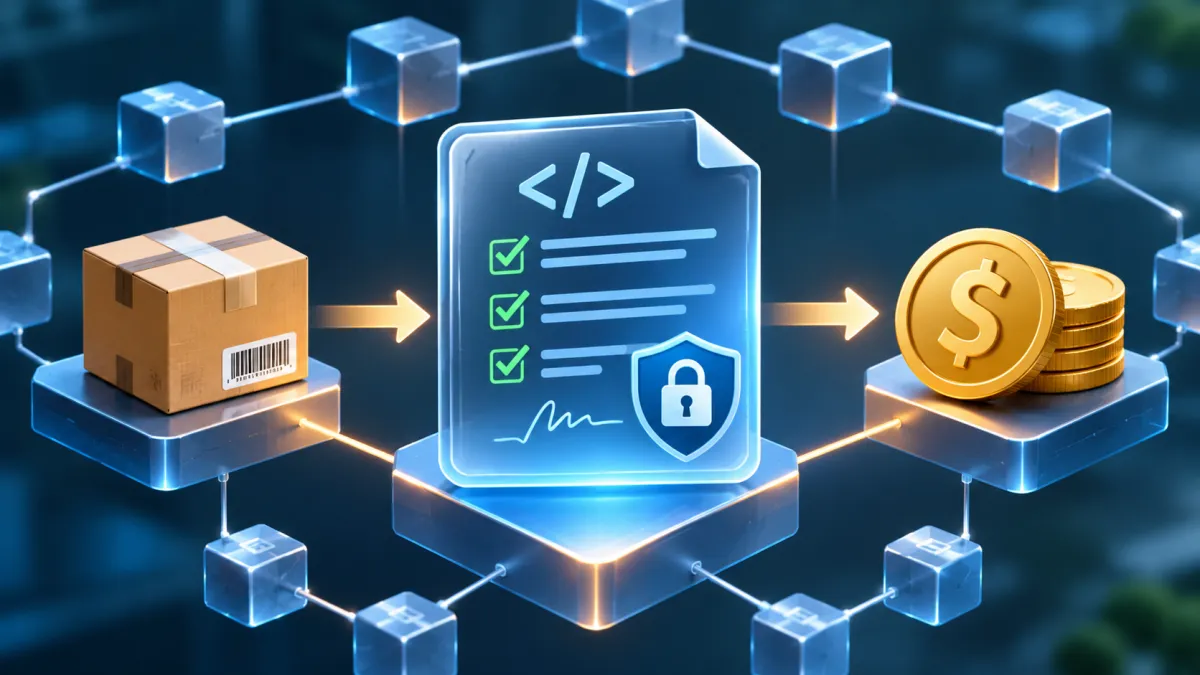
A Practical Example: Smart Contract Escrow for a Delivery
A hypothetical delivery-based escrow arrangement helps explain how smart contract technology can be used in a practical setting.
Suppose a buyer purchases a product from a seller. Both parties agree that payment should be released after delivery is confirmed.
The arrangement could involve these stages:
-
Buyer provides payment: The buyer sends the required digital asset to the smart contract under the agreed rules.
-
Payment is held according to the contract: The program applies the conditions defined for releasing the payment.
-
Delivery information is supplied: An external system or oracle may provide a delivery confirmation signal to the blockchain application.
-
The contract evaluates the condition: If the required condition is accepted by the program, the contract can execute the payment release.
-
The transaction is recorded: The blockchain records the resulting transfer according to its rules.
This is an illustrative process—not a description of a specific commercial service.
The smart contract can automate the payment condition, but it cannot independently determine whether a package was physically delivered unless it receives reliable information about that event.
A delivery confirmation might be incorrect. A package might be damaged. The buyer might dispute the delivery. The seller might claim that the buyer provided an inaccurate address.
These situations show why a real arrangement may need dispute-resolution rules, trusted data sources, or human intervention.
Automation can reduce manual steps, but it does not eliminate every problem associated with a transaction.
What Are Smart Contracts Used For?
Smart contracts have applications across several areas of blockchain technology. Their usefulness depends on whether the activity involves rules that can be expressed and executed through software.
Decentralized Finance
Decentralized finance, often called DeFi, uses blockchain-based applications to provide financial functions.
Smart contracts may support activities such as:
-
Lending and borrowing digital assets.
-
Exchanging tokens.
-
Managing liquidity pools.
-
Calculating and distributing payments.
-
Applying collateral rules.
For example, a lending application may use a smart contract to manage the relationship between supplied digital assets, borrowed assets, and collateral requirements.
The contract follows its programmed rules. It does not guarantee that the application is financially safe or that users will avoid losses.
DeFi applications can expose users to contract vulnerabilities, market volatility, liquidity issues, and other risks.
Digital Asset Transfers
Smart contracts can manage the transfer of digital assets.
A contract might transfer tokens when a specified condition is satisfied or distribute assets according to predefined rules.
This can be useful in applications where a transaction requires more than a simple transfer from one address to another.
However, the asset transfer still depends on the blockchain and the contract's code. An incorrect address, unintended interaction, or vulnerability can create significant problems.
Token Creation and Management
Smart contracts can support the creation and management of blockchain tokens.
A token contract may define:
-
How tokens are issued.
-
How balances are tracked.
-
How transfers are processed.
-
Which permissions apply.
-
Whether particular functions are restricted.
Some tokens represent digital assets within an application. Others may be designed to represent a claim or interest associated with an external arrangement.
The existence of a token does not by itself establish the legal rights of its holder. Those rights depend on the relevant terms and applicable law.
Supply Chain and Business Processes
Businesses may use blockchain-based systems to record selected information about goods, transactions, or processes.
A smart contract could apply predefined rules when a system receives a particular event or data input.
For example, a business application might record a change in the status of a shipment or initiate a payment after an approved condition is met.
The challenge is ensuring that the information supplied to the blockchain is accurate. If a physical event is incorrectly reported, the smart contract may still execute based on the incorrect input.
Smart contracts can automate a business process, but they do not make inaccurate information reliable.
Digital Ownership and Applications
Smart contracts are also used in blockchain-based applications involving digital ownership, collectibles, and other assets.
They may define how an asset is transferred, what permissions apply, or how an application responds to a user's interaction.
The rules encoded in a contract can help make certain operations consistent. However, the actual rights associated with a digital asset may depend on additional terms, services, or legal arrangements outside the blockchain.
Benefits of Smart Contracts
Smart contracts can provide useful advantages when a process involves clear rules and blockchain-based transactions.
Automation
One of the main benefits is the ability to automate certain actions.
Instead of relying entirely on a person to process a transaction manually, a smart contract can execute a programmed action when the relevant condition is satisfied.
This may reduce some administrative steps and help make a process more consistent.
Automation is most useful when the rules are clear, the inputs are dependable, and the outcome can be handled through code.
Transparency
Depending on the blockchain and contract design, users may be able to inspect contract code and transaction records.
This can make certain operations easier to verify.
Transparency does not mean that every participant understands the code or that every detail of a real-world transaction is publicly visible. Some information may remain off-chain, private, or inaccessible to ordinary users.
Consistent Execution
A smart contract applies its programmed rules during execution.
If the code is functioning as intended, the same conditions generally produce the same defined behavior under the blockchain's execution rules.
This can reduce inconsistencies that might otherwise arise from manual processing.
However, consistent execution is not the same as correct execution. If the code contains a mistake, the program may consistently produce an unintended result.
Reduced Reliance on Manual Processing
Smart contracts may reduce the need for some intermediaries or manual steps in specific blockchain-based processes.
For example, a payment condition might be handled by a contract rather than requiring a separate manual payment operation after the condition is confirmed.
This does not mean that every intermediary can be removed. Applications may still need developers, data providers, administrators, dispute-resolution services, or other participants.
Traceable Transactions
Blockchain transaction records may provide a way to trace certain digital asset movements and contract interactions.
This can be useful for reviewing how a transaction was processed.
The available information depends on the blockchain, contract design, and data recorded. A transaction record should not be treated as proof of every real-world event connected with it.
Risks and Limitations of Smart Contracts
Smart contracts can automate actions, but their technical design creates risks that users and developers should understand.
Coding Errors and Security Vulnerabilities
A smart contract is software, and software can contain bugs.
A coding error may cause the contract to behave in an unintended way. A vulnerability may allow an attacker to exploit the program's logic or permissions.
Depending on the contract, a security problem could result in unauthorized transfers, loss of digital assets, or disruption of an application.
Testing, code review, and independent security audits can help identify vulnerabilities. However, these measures do not guarantee that a contract is completely secure.
The Ethereum smart contract security documentation provides platform-specific information about common security concerns.
Irreversible or Difficult-to-Reverse Transactions
Blockchain transactions are generally designed to be difficult to reverse after they are finalized.
If a smart contract sends an asset to the wrong address or executes an unintended transfer, the contract may not have a built-in way to recover it.
Some applications include administrative controls, recovery processes, or dispute mechanisms. These features are not universal.
Even when a recovery option exists, it may depend on permissions, governance, or other conditions.
Users should understand the transaction and the contract's rules before interacting with it.
Oracle and External Data Risks
Smart contracts generally cannot directly access information from the physical world or ordinary websites.
They may rely on an oracle or another external data mechanism to provide information such as:
-
A delivery status.
-
A market price.
-
A weather condition.
-
An event outcome.
-
A particular external system's status.
An oracle acts as a bridge between external information and a blockchain application.
The smart contract can process the data it receives, but it cannot automatically determine whether that information is truthful or accurate.
If an oracle provides incorrect, outdated, or manipulated information, the contract may execute an action based on that input.
This is one reason the reliability of the external data source matters as much as the contract's code.
Transaction Fees and Costs
Executing a smart contract may require transaction fees.
On Ethereum, these fees are commonly described in terms of gas. Gas measures the computational resources required to process an operation.
The amount paid can vary based on network conditions and the computational complexity of the transaction.
A more complex operation may require more computational resources than a simple transfer. Network demand can also affect fees.
There is no single fixed smart contract transaction price that applies to all situations. Costs depend on the blockchain, the operation, and the conditions at the time of execution.
Complexity and User Errors
Smart contract applications may require users to understand wallet addresses, digital assets, transaction confirmations, permissions, and network fees.
A user may approve an unintended transaction or interact with a contract they do not understand.
An application interface can make these interactions easier, but it does not eliminate the underlying risks.
Users should be cautious when granting permissions or connecting a wallet to an unfamiliar application.
Legal and Consumer Risks
A smart contract may execute exactly as programmed even when a real-world dispute exists.
For example, the code may release a payment after receiving a delivery signal, but the buyer may claim that the product was defective.
The program does not necessarily have the ability to evaluate consumer rights, contractual defenses, or the fairness of a dispute.
Legal protections and obligations may exist outside the smart contract. A technical transaction should not be assumed to resolve every legal issue.
Can Smart Contracts Be Changed After Deployment?
Whether a smart contract can be changed depends on how it was designed.
Some contracts are deployed without a direct mechanism for modifying their code. Once deployed, their behavior may be difficult or impossible to change through ordinary interactions.
Other contracts use upgrade mechanisms that allow developers or administrators to modify how the application operates.
One approach is a proxy pattern. In a simplified design, a proxy contract handles user interactions while directing execution to another contract containing the implementation logic. The implementation can potentially be changed through an authorized upgrade process.
This can be useful when developers need to fix bugs, improve functionality, or respond to changing requirements.
However, upgradeability introduces tradeoffs.
If an administrator has the ability to change the contract, users may need to trust that the administrator will not misuse that permission. A compromised administrative key could also create security problems.
The important distinction is that a smart contract is not always permanently unchangeable, and the presence of upgrade controls may affect the trust assumptions of the application.
Before using a smart contract application, it can be helpful to understand:
-
Whether its code can be upgraded.
-
Who has permission to make changes.
-
How upgrade decisions are approved.
-
Whether administrative controls are restricted.
-
What happens if an upgrade introduces a problem.
These details vary across applications. It is not accurate to assume that every smart contract is immutable or that every contract can be freely modified.
Are Smart Contracts Legally Binding in the United States?
Smart contracts may be used as part of legally enforceable agreements in the United States, but their technical execution does not automatically establish legal enforceability.
A smart contract is software. A legal contract is an agreement that must satisfy applicable legal requirements.
Depending on the circumstances, relevant considerations may include:
-
Whether the parties intended to enter into an agreement.
-
Whether the agreement contains the necessary contractual elements.
-
Whether the parties had the legal capacity to agree.
-
Whether the agreement's terms are sufficiently clear.
-
Whether applicable laws or regulations affect the transaction.
-
Whether the parties can establish what they agreed to.
The use of blockchain technology does not eliminate these considerations.
The Role of Electronic Agreements
US law recognizes electronic records and signatures in covered circumstances.
The federal Electronic Signatures in Global and National Commerce Act, commonly called the E-SIGN Act, addresses the legal recognition of electronic records and signatures.
Under 15 U.S.C. § 7001, covered contracts and records generally cannot be denied legal effect solely because they are in electronic form.
However, this does not mean that every smart contract is legally binding. The law does not automatically validate every transaction, code-based arrangement, or agreement involving blockchain technology.
A smart contract may be one component of a broader agreement. The parties might also use written terms, electronic records, or other documents to define their rights and obligations.
Code and Legal Terms May Differ
A legal agreement may contain provisions that are difficult to express completely in code.
For example, a written agreement may address:
-
Disputes over performance.
-
Exceptions to a payment obligation.
-
Consumer protections.
-
Remedies for breach.
-
Events outside a party's control.
-
Termination rights.
A smart contract may automate one part of the agreement, such as releasing a payment. It may not be capable of handling every provision.
This can create a gap between what the code does and what the parties legally agreed to do.
For US readers, the practical takeaway is to avoid treating smart contract execution as a substitute for legal review when a transaction involves meaningful obligations or risk. Legal enforceability depends on the relevant law and facts, not simply on whether a program executed successfully.
The E-SIGN Act in the US Code provides the statutory context for electronic records and signatures. The American Arbitration Association's discussion of smart contract legal risks also offers context about legal considerations.
Smart Contracts vs. Traditional Contracts
Smart contracts and traditional contracts serve different functions, although they may be used together.
A traditional contract typically describes the agreement between parties using written or otherwise legally recognized terms. A smart contract is software that executes specific programmed instructions.
| Feature | Smart Contract | Traditional Contract |
|---|---|---|
| Main form | Computer program on a blockchain | Written, electronic, or other legally recognized agreement |
| How rules are applied | Programmed instructions execute through a blockchain | Parties perform obligations, often with human or institutional involvement |
| Execution | Can automate specified actions | Often relies on people, businesses, or other systems |
| Changes | Depend on contract design and upgrade mechanisms | Changes generally require an agreed process |
| Real-world information | May require oracles or external data mechanisms | Can rely on evidence, records, and human evaluation |
| Dispute handling | May require external processes or administrative mechanisms | May use negotiation, arbitration, courts, or other legal processes |
| Legal enforceability | Depends on applicable law and circumstances | Depends on applicable law and circumstances |
| Typical limitations | Coding errors, data inputs, fees, technical complexity | Manual processing, interpretation, administrative effort, and disputes |
A smart contract does not necessarily replace a traditional contract.
For example, a written agreement could define the obligations between a buyer and seller, while a smart contract automates a particular payment process.
The written agreement may provide terms for situations that the code cannot handle. The smart contract may provide a more automated way to execute a narrow part of the transaction.
In some situations, using both may be more practical than relying entirely on software or entirely on manual processes.
When Are Smart Contracts Useful?
Smart contracts are most useful when a process has clear conditions, the relevant actions can be handled through software, and the parties can reasonably rely on the required data.
They may be suitable for:
-
Automated digital asset transfers.
-
Token management.
-
Certain decentralized finance operations.
-
Repeated transactions involving defined rules.
-
Blockchain applications that need consistent execution.
-
Processes where transaction records and verification are valuable.
A useful way to evaluate a smart contract application is to consider the following factors.
Are the Conditions Clear?
The contract should have rules that can be expressed precisely.
If the intended outcome depends on subjective judgment, complicated exceptions, or uncertain facts, it may be difficult to automate the entire process reliably.
Can the Required Action Be Executed on the Blockchain?
Smart contracts are designed to execute blockchain-supported operations.
If the process requires physical delivery, a bank transfer outside the blockchain, or another real-world activity, additional systems may be needed.
Is the External Information Reliable?
If the contract depends on information from an external source, the data provider and delivery mechanism matter.
A contract may function correctly while still producing an undesirable result because the information it received was wrong.
Is Automation Worth the Cost and Complexity?
Smart contract development, deployment, security review, and ongoing management can require resources.
The application should provide a practical benefit that justifies those costs and risks.
For a simple transaction that can be handled safely through an established conventional process, a smart contract may not provide enough value to justify additional complexity.
Conclusion
Smart contracts are blockchain-based programs that execute predefined instructions when specified conditions are satisfied. They can automate digital asset transfers, support decentralized applications, and help manage transactions involving clear rules.
Their main advantages include automation, consistent execution, and the ability to inspect certain blockchain records. However, these benefits come with limitations. Smart contracts can contain bugs, depend on external data, require transaction fees, and make some completed transactions difficult to reverse.
They also do not automatically replace traditional contracts or establish legal enforceability. In the United States, the legal status of an agreement depends on its terms, applicable law, and the circumstances involved.
The most practical way to evaluate smart contract technology is to look beyond the promise of automation. Consider what the code actually does, how its conditions are verified, who can change it, what happens when something goes wrong, and whether the technology provides a meaningful benefit over a conventional process.
Frequently asked questions
1. Do smart contracts run automatically without anyone triggering them?
Not necessarily. A smart contract typically executes when a transaction or another supported mechanism triggers its code. It does not usually monitor the world independently. Some contracts rely on automated services or external systems to initiate execution when specified conditions are met.
2. Can a smart contract be changed after it is deployed?
Some smart contracts cannot be directly changed after deployment. Others use upgrade mechanisms, such as proxy contracts or administrative controls, that allow their behavior to be updated. These mechanisms can introduce additional trust and security considerations.
3. Can smart contracts be hacked or contain bugs?
Yes. Smart contracts can contain coding errors, security vulnerabilities, or weaknesses in their design. These problems may lead to unintended transactions or loss of assets. Testing, security reviews, and audits can reduce risks but cannot guarantee that a contract is completely secure.
4. Do smart contracts need cryptocurrency to work?
Not every smart contract application requires users to hold cryptocurrency in the same way. However, blockchain networks may require transaction fees, often paid using the network’s designated asset. The requirements depend on the blockchain and application.
5. Can a smart contract access a website or real-world event directly?
Generally, no. Smart contracts typically cannot directly retrieve information from websites or real-world events. They may use oracles or other external data mechanisms to receive information, but the accuracy and security of that data are important considerations.
6. Can a smart contract transaction be reversed if something goes wrong?
A completed blockchain transaction is generally difficult or impossible to reverse through the contract itself. Some applications may have administrative controls, dispute processes, or upgrade mechanisms, but these are not universal and may introduce additional trust assumptions.

Maya Thompson writes practical technology content covering consumer technology, software, online services, digital tools, cybersecurity basics, and everyday technology decisions. She focuses on explaining technical topic...