What Is an AI Agent? How AI Agents Differ From Chatbots and Automation
Learn what an AI agent is, how it works, and how it differs from chatbots, AI assistants, generative AI, and traditional automation, including real-world uses, limitations, and safety considerations.
In this article
- What Is an AI Agent?
- How Does an AI Agent Work?
- 1. The agent receives a goal
- 2. It interprets the request and context
- 3. It determines possible next steps
- 4. It uses tools or external information
- 5. It takes an action
- 6. It evaluates what happened
- AI Agent vs. Chatbot vs. Traditional Automation
- AI Agent vs. Generative AI
- AI Agent vs. AI Assistant
- What Is Agentic AI?
- What Can AI Agents Do?
- Research and information gathering
- Scheduling and organization
- Business workflows
- Document and data tasks
- Customer support
- Personal productivity
- When Is a Chatbot Enough?
- When Is Traditional Automation Better?
- When Does an AI Agent Make Sense?
- The goal is more important than a fixed sequence
- The task involves multiple steps
- The agent has useful tools
- The cost of mistakes is manageable
- Human review can be built into the process
- Do AI Agents Make Decisions on Their Own?
- What AI Agents Cannot Reliably Do
- Are AI Agents Safe to Use?
- How to Tell Whether Something Is Really an AI Agent
- AI Agents Are About Action, Not Just Intelligence
- The Bottom Line
- Conclusion
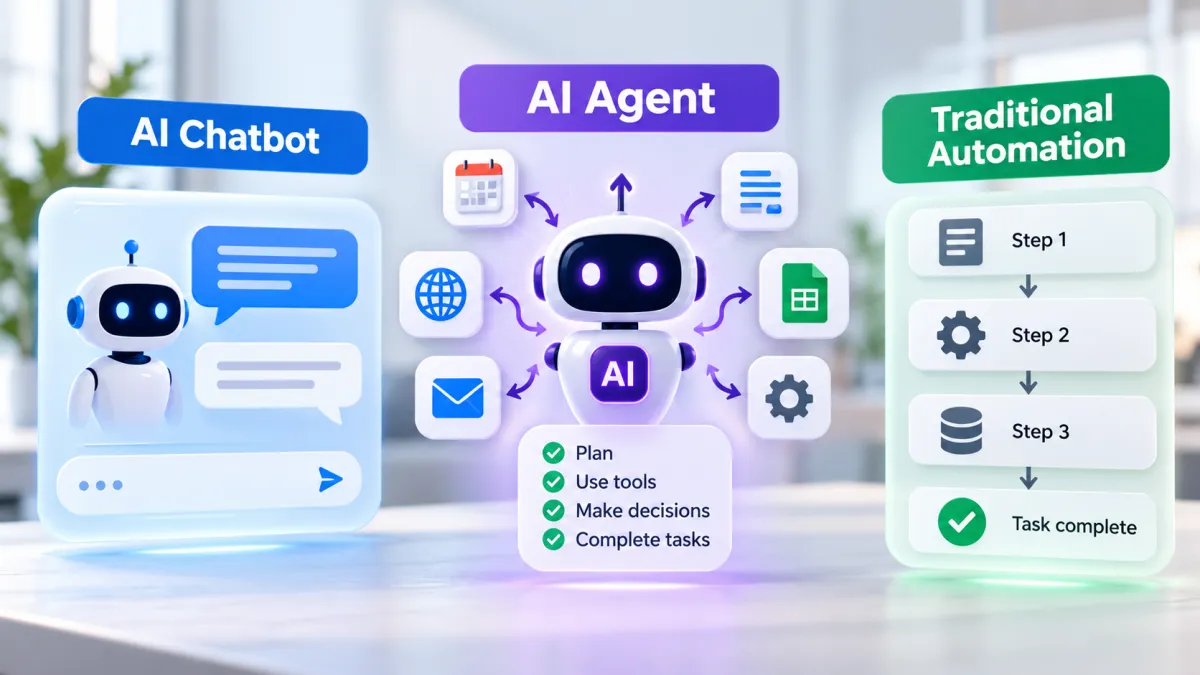
An AI agent is a software system that can pursue a goal by deciding what steps to take, using information or connected tools, and carrying out actions rather than simply generating a response.
That distinction is important because the term AI agent is now used for everything from simple assistants to systems that can complete multi-step tasks. Not every chatbot, AI assistant, or automated workflow is an AI agent.
A useful way to understand the difference is to ask one question:
Who decides what happens next?
With a basic chatbot, you ask a question and the system generates an answer. With traditional automation, a person or developer usually defines the sequence of steps in advance. An AI agent can have a goal and determine some of the steps needed to accomplish it, often using tools, external data, and feedback along the way.
For example, a chatbot might explain how to compare health insurance plans. An AI agent could potentially gather information from permitted sources, organize the options, apply criteria you provided, and prepare a comparison for you. The exact capabilities depend on how the agent is designed, what tools it can access, and what permissions it has.
Understanding that difference can help you decide when an AI agent is useful, when a normal chatbot is enough, and when predictable traditional automation may actually be the better choice.
What Is an AI Agent?
An AI agent is a software system designed to work toward a defined goal by interpreting information, reasoning about possible steps, using available tools or data, and taking actions within the permissions it has been given.
The important part is not simply that the system uses artificial intelligence. It is that the system has some degree of agency: it can determine or adjust what to do next instead of requiring a person to specify every individual step.
A simplified AI-agent workflow looks like this:
Goal → Understand context → Plan → Use tools or data → Take action → Check results → Continue or finish
Suppose you tell an agent:
"Help me organize my upcoming business meetings."
A basic chatbot might tell you how to organize a calendar. An AI agent with appropriate permissions could potentially inspect calendar information, identify conflicts, suggest changes, and make approved updates.
The agent does not necessarily perform every task independently. Its level of autonomy depends on its design.
Some agents may only recommend actions. Others may be allowed to execute certain actions automatically. Sensitive or irreversible actions may require human approval.
That is why AI agent does not mean unlimited independence.
An agent operates inside a defined environment with instructions, permissions, tools, security controls, and other limitations.
How Does an AI Agent Work?
Although implementations vary, many AI agents follow a similar basic process.
1. The agent receives a goal
The process begins with an objective supplied by a user, application, or another system.
The goal could be something relatively simple, such as organizing information, or something more complex, such as completing several related business tasks.
The important difference is that the request can describe an outcome rather than every individual action required to reach it.
2. It interprets the request and context
The agent needs to understand what the goal means in the current situation.
Context can include the user's instructions, previous interactions, available documents, application data, system rules, and information retrieved from permitted sources.
Good context matters because an agent can make poor decisions if it misunderstands the objective or lacks important information.
3. It determines possible next steps
The agent can reason about what needs to happen to move toward the goal.
For a multi-step task, that may involve breaking the objective into smaller actions.
For example, imagine an agent is asked to prepare a weekly sales summary. Depending on its available access, it might need to:
-
Retrieve the relevant sales information.
-
Identify the appropriate reporting period.
-
Organize the data.
-
Calculate or summarize relevant information.
-
Prepare the report.
-
Deliver the result or save it somewhere permitted.
A traditional automation workflow would generally have these steps explicitly designed ahead of time. An agent can have more flexibility in determining which steps are necessary.
4. It uses tools or external information
An AI model by itself mainly processes information and generates outputs. An agent can be connected to tools that allow it to do more.
Depending on the system, those tools might include:
-
Search or retrieval systems
-
Databases
-
Calendars
-
Email systems
-
Business applications
-
Spreadsheets
-
APIs
-
File systems
-
Internal company data
-
Other software services
Access to a tool does not automatically mean unrestricted access. A properly designed system should limit what the agent can see and what it can change.
5. It takes an action
After deciding what to do, the agent may perform an action through one of its available tools.
That action could involve retrieving information, creating a document, updating a record, sending information, or initiating another permitted operation.
This ability to move from generating an answer to taking an action is one of the most important characteristics that separates an AI agent from a basic chatbot.
6. It evaluates what happened
Some agents can inspect the result of an action and determine whether additional steps are necessary.
If the result does not satisfy the goal, the system may adjust its approach and continue.
This creates a feedback loop rather than a simple one-question, one-answer interaction.
AI Agent vs. Chatbot vs. Traditional Automation
These technologies can overlap, but they are not the same thing.
| Technology | Typical behavior | Who determines the next step? | Can use tools? | Can adapt during a task? |
|---|---|---|---|---|
| Basic chatbot | Responds to a user's message | Mostly the user | Sometimes | Usually limited |
| Generative AI | Generates content or answers | User provides the request | Sometimes | Limited unless integrated with other systems |
| Traditional automation | Follows predefined rules and steps | Workflow designer | Yes | Usually limited to predefined conditions |
| AI assistant | Helps a person complete tasks | User and system | Often | Varies |
| AI agent | Pursues a goal through multiple actions | System can determine some next steps | Often | Yes, within its design and permissions |
The boundaries are not perfectly standardized. Companies may use terms such as "assistant," "agent," and "automation" differently.
The table is therefore best understood as a practical way to distinguish common patterns rather than a strict industry classification.
AI Agent vs. Generative AI
Generative AI and AI agents are related, but they describe different things.
Generative AI refers to systems that can generate content such as text, images, audio, video, or code based on an input.
An AI agent may use a generative AI model as part of its reasoning or interaction system.
For example, a generative AI model might answer:
"Here are five ways to prepare for a job interview."
An agent could potentially be designed to pursue a broader goal such as helping prepare for an interview. With the appropriate tools, it might organize preparation materials, identify areas to study, create practice questions, and manage other permitted tasks.
The distinction is therefore not:
Generative AI = smart
AI agent = smarter
Instead, it is more useful to think of it as:
Generative AI focuses on producing outputs.
An AI agent uses AI as part of a system that can pursue goals and take actions.
A system can contain generative AI without being an agent.
AI Agent vs. AI Assistant
The terms AI assistant and AI agent can overlap, which is one reason the terminology can be confusing.
An AI assistant generally helps a person with requests. It might answer questions, summarize information, draft content, provide recommendations, or help perform tasks.
An AI agent places more emphasis on goal-directed action.
Consider a simple example.
You ask an AI assistant:
"Help me plan a weekend trip."
The assistant might suggest destinations, activities, restaurants, and a schedule.
A more agent-like system could potentially take the planning process further by gathering information, comparing options, checking permitted services, organizing the itinerary, and carrying out approved actions.
The difference is not simply whether the system is called an assistant or an agent. What matters is what it can actually do.
An assistant may be highly capable while still requiring the user to direct each major step. An agent may be designed to determine and execute several steps toward a broader objective.
What Is Agentic AI?
Agentic AI generally refers to AI systems designed with a greater ability to act toward goals, make decisions, plan steps, and interact with tools or environments.
The term is related to AI agents but is often used more broadly to describe the behavior or architecture of systems that exhibit greater autonomy.
A useful way to think about the relationship is:
-
AI agent: the software system or component that performs goal-directed work.
-
Agentic AI: a broader description of AI systems or behavior characterized by planning, decision-making, tool use, and action.
There is no single universally accepted boundary that determines exactly when a system becomes "agentic."
That is why marketing language should not be taken at face value. A product described as an "AI agent" might simply automate a small number of steps, while another system may genuinely perform complex multi-step tasks.
Looking at the underlying capabilities is more useful than relying on the label.
What Can AI Agents Do?
AI agents can be useful when a task involves several related steps and requires some judgment about what should happen next.
Potential applications include:
Research and information gathering
An agent can potentially gather information from permitted sources, organize it, compare findings, and prepare a result.
This can be useful when the task involves more than answering a single question.
Scheduling and organization
With appropriate calendar or scheduling access, an agent could potentially help identify conflicts, organize appointments, or coordinate a sequence of activities.
Actions that affect other people or create commitments may still need approval.
Business workflows
Companies can use agent-style systems to support processes involving customer service, document handling, internal research, data retrieval, or other repetitive multi-step work.
The exact implementation depends heavily on the organization's software, data, security controls, and approval requirements.
Document and data tasks
An agent may be able to retrieve information from permitted files or systems, organize it, summarize it, and produce a new output.
For example, a system might help turn information from several internal documents into a structured report.
Customer support
Some support systems can go beyond answering common questions by checking account information, retrieving relevant records, or initiating permitted actions.
However, access should be carefully controlled because customer accounts can contain sensitive information.
Personal productivity
Consumer-oriented agents may help with planning, organizing information, preparing documents, or coordinating tasks across connected services.
The usefulness depends heavily on the tools and permissions available to the particular system.
When Is a Chatbot Enough?
Not every task needs an AI agent.
A chatbot may be the better choice when you mainly need information, explanation, brainstorming, writing help, or a quick response.
For example, if you want to understand what a credit score means, there may be little benefit in giving an AI system access to your financial accounts. A conversational system can explain the concept without taking actions on your behalf.
A chatbot can also be preferable when:
-
The task is primarily informational.
-
You want to remain in control of every action.
-
No external tools are necessary.
-
The answer can be produced in one interaction.
-
You do not want to grant additional permissions.
-
The consequences of an action are significant.
The simplest technology that safely solves the problem is often the best choice.
When Is Traditional Automation Better?
AI agents are not automatically better than traditional automation.
Traditional automation can be extremely effective when the workflow is predictable.
For example, suppose a company has a rule that every time a specific form is submitted, the system should store the form, send a standard notification, and update a database.
There may be little reason to introduce an AI agent.
A predefined workflow can be:
-
Predictable
-
Easier to test
-
Easier to audit
-
Less dependent on model behavior
-
More consistent for repetitive tasks
Traditional automation is particularly attractive when the process has clear inputs, clear rules, and predictable outputs.
An AI agent becomes more useful when the task contains uncertainty, requires interpretation, or changes from one situation to another.
When Does an AI Agent Make Sense?
An AI agent may be appropriate when several conditions are present.
The goal is more important than a fixed sequence
If you can describe the desired outcome but the exact steps vary depending on circumstances, an agent may be useful.
The task involves multiple steps
Agents can be valuable when a person would otherwise have to repeatedly move between applications, gather information, make decisions, and continue the process.
The agent has useful tools
Without access to relevant information or tools, an agent may have limited ability to act.
The tools should be appropriate to the task and restricted to what is actually necessary.
The cost of mistakes is manageable
An agent should not automatically be given authority over high-impact decisions simply because it can perform the technical action.
For sensitive financial, legal, employment, medical, security, or account-related actions, additional safeguards may be appropriate.
Human review can be built into the process
A useful agent does not have to operate completely independently.
A system can pause before an important action and ask a person to approve it.
That can provide a practical balance between automation and human control.
Do AI Agents Make Decisions on Their Own?
AI agents can make decisions about what actions to take within the goals, instructions, tools, and permissions defined for them.
That does not mean they have unrestricted judgment or human-like understanding.
An agent might determine that it needs to retrieve information before completing a task. It may choose between available tools or decide that another step is necessary based on the result of an earlier action.
But those decisions happen within the system's boundaries.
For example, an agent with permission to read a calendar does not automatically have permission to send an email. An agent that can draft a payment instruction should not necessarily have permission to execute the payment.
This distinction matters because capability and permission are different things.
A well-designed agent should have only the access required to accomplish its intended tasks.
What AI Agents Cannot Reliably Do
AI agents can be powerful, but they are not infallible.
One major limitation is that an agent can make an incorrect decision while appearing confident.
If the information it receives is incomplete or wrong, the resulting action may also be wrong.
Agents can also encounter problems when:
-
Instructions are ambiguous.
-
Data is outdated or incomplete.
-
A connected tool behaves unexpectedly.
-
The system misunderstands the user's actual goal.
-
An action has consequences the system does not fully anticipate.
-
Multiple systems provide conflicting information.
-
Permissions are too broad.
-
The agent encounters malicious or misleading instructions.
An agent's ability to take action can make errors more consequential than a simple incorrect chatbot answer.
For that reason, the appropriate level of autonomy should depend on the task.
Are AI Agents Safe to Use?
AI-agent safety depends heavily on how the system is designed and used.
The risks are not limited to inaccurate answers. When an agent can access tools or external systems, additional risks can include inappropriate actions, excessive permissions, privacy problems, unauthorized data access, prompt injection, and misuse of connected tools.
One useful principle is least privilege: give an agent only the permissions it actually needs.
For consumers, that might mean avoiding unnecessary access to personal accounts or sensitive information.
For organizations, safeguards can include:
-
Restricted permissions
-
Authentication controls
-
Human approval for sensitive actions
-
Activity logging
-
Monitoring
-
Testing
-
Clear system instructions
-
Separation of sensitive systems
-
Limits on what an agent can change
The more consequential an action is, the more important oversight becomes.
An agent preparing a draft is very different from an agent authorized to send messages, modify financial records, delete files, or make irreversible changes.
How to Tell Whether Something Is Really an AI Agent
Because "AI agent" is widely used as a product term, it helps to look beyond the label.
Ask these questions:
Does it have a goal rather than only a prompt?
A system that only responds to individual requests may be closer to a chatbot or assistant.
Can it determine multiple steps?
An agent should have some ability to work through a task rather than simply provide an answer.
Can it use tools or external information?
Tool use is not mandatory in every conceptual definition, but practical agents commonly rely on tools to accomplish tasks.
Can it take actions?
There should be some meaningful ability to affect a system or complete work rather than only generate text.
Can it react to results?
A more capable agent can evaluate what happened and determine whether additional steps are necessary.
What permissions does it have?
An impressive demonstration does not tell you how much real-world authority the system has.
Where does human approval occur?
Understanding where a person remains in control is often more important than knowing how sophisticated the underlying model is.
This gives you a better test than simply asking whether a company calls its product an "agent."
AI Agents Are About Action, Not Just Intelligence
The easiest mistake is to assume that an AI agent is simply a smarter chatbot.
That misses the main distinction.
A chatbot can be very sophisticated while still primarily responding to what a person asks. A traditional automation system can complete tasks automatically while following a predetermined sequence. Generative AI can create remarkably useful content without independently managing a broader workflow.
An AI agent combines AI capabilities with a system that can pursue a goal, determine steps, interact with tools or information, and take actions within defined boundaries.
That makes the practical question less about "How intelligent is the AI?" and more about "What is the system actually authorized and able to do?"
This is also why connected tools and permissions matter so much.
For example, an AI feature built into consumer hardware may provide useful on-device or cloud-based assistance, while an agent connected to multiple applications may be capable of coordinating a much broader workflow. If you are exploring newer AI-powered computers, KnowBrook's guide to [Copilot+ PCs] can help explain how those systems differ from ordinary PCs.
Similarly, security should not be treated as an afterthought. Technologies such as [passkeys] can illustrate the broader principle that authentication and access controls matter when people interact with digital services.
The Bottom Line
An AI agent is a software system designed to pursue a goal by interpreting context, determining steps, using available tools or information, and taking actions within defined permissions.
The key difference from a basic chatbot is not simply that an agent uses a more advanced AI model. The more important distinction is that an agent can participate in a multi-step process and determine some of what happens next.
That does not make agents the right solution for every task. Chatbots remain useful for straightforward questions and conversations, while traditional automation can be more predictable for fixed, repetitive workflows.
The best choice depends on the job.
If you only need an explanation, a chatbot may be enough. If a process follows the same rules every time, traditional automation may be simpler. If you have a broader goal that requires multiple steps, changing decisions, connected tools, and carefully controlled actions, an AI agent may offer a useful middle ground between conversation and full workflow automation.
The most important thing is to look past the label. Before trusting an AI agent, understand what goal it is pursuing, what information it can access, what tools it can use, what actions it can take, and where human approval remains in control.
Conclusion
AI agents represent a shift from AI that mainly responds to AI systems that can work toward an objective.
They can interpret a goal, plan or select steps, use tools, act on information, and adjust their approach based on results. But their autonomy is never the same as unlimited independence. Their real capabilities depend on their design, available tools, data, permissions, and safeguards.
For consumers and businesses, that distinction provides a practical way to evaluate the growing number of products marketed as AI agents. Instead of asking only whether a product uses AI, look at what it can actually do on your behalf.
A useful AI agent should have a clear purpose, appropriate access, sensible limits, and meaningful human oversight when the consequences of an action matter. In many situations, the right solution will still be a chatbot or traditional automation. The value of an AI agent comes when its ability to reason through multiple steps and act toward a goal solves a problem those simpler approaches cannot handle as effectively.
Frequently asked questions
Is ChatGPT an AI agent?
ChatGPT can provide conversational assistance, but whether a particular ChatGPT capability qualifies as agentic depends on the features and mode being used. An AI agent generally goes beyond generating a response by pursuing a goal, using available tools, making intermediate decisions, and taking permitted actions. Specific ChatGPT capabilities should be checked at the time of publication because they can change.
Do AI agents make decisions on their own?
AI agents can make some decisions about how to pursue a defined goal, such as choosing among available steps or tools. Their decisions are still bounded by their instructions, available capabilities, permissions, and system design.
Can AI agents work without human supervision?
Some AI agents can complete multiple steps with limited human intervention, but autonomy varies by system. Human review can still be appropriate for sensitive, high-impact, or irreversible actions.
Do AI agents need access to my apps or accounts?
An AI agent generally needs an appropriate tool, integration, or permission to interact with an external application or account. It does not automatically have access to every service you use, and access should be limited to what the task requires.
Are AI agents safe to use?
AI agents can be useful, but they introduce risks beyond those of systems that only generate responses. Incorrect actions, hallucinations, excessive permissions, privacy problems, prompt injection, and misuse of connected tools are important concerns. Human oversight and appropriate permissions can reduce these risks.
What is the difference between an AI agent and an AI assistant?
An AI assistant generally helps a person with tasks in response to their instructions. An AI agent can be more goal-directed, determining some of the steps and tool calls needed to accomplish a task. The terms can overlap because products may combine assistant and agent capabilities.
Are AI agents more expensive than chatbots or automation?
There is no universal cost difference. Agent costs can vary based on model usage, tool calls, integrations, infrastructure, testing, and monitoring. For predictable repetitive tasks, traditional automation may be more cost-effective and predictable than an agent.

Maya Thompson writes practical technology content covering consumer technology, software, online services, digital tools, cybersecurity basics, and everyday technology decisions. She focuses on explaining technical topic...