How to Find Remote Jobs That Hire in Your State
Learn how to find remote jobs available in your state, understand location restrictions in job postings, and verify employer eligibility before applying. This guide covers remote job search filters, employer career pages, recruiter questions, and important schedule and time-zone requirements for US job seekers.
In this article
- Why Remote Jobs Are Sometimes Restricted to Certain States
- State Employment and Tax Requirements
- Professional Licensing Requirements
- Business Operations and Customer Coverage
- Time-Zone and Schedule Requirements
- Understand the Location Wording in Remote Job Listings
- “Remote — US” Does Not Always Mean Every State
- How to Find Remote Jobs That Hire in Your State
- Step 1: Start With Your State as the Location
- Step 2: Use Remote and Location Filters
- Step 3: Read the Full Job Description
- Step 4: Check the Employer's Official Career Page
- Step 5: Confirm Eligibility Before Applying
- Step 6: Keep Track of Eligible Opportunities
- Where to Search for Remote Jobs by State
- Indeed
- FlexJobs
- USAJOBS
- Remote Jobs That May Be Available in Different States
- Customer Service Representative
- Administrative Assistant
- Data Entry Specialist
- Marketing and Content Roles
- Healthcare-Related Remote Positions
- Remote Jobs for Applicants With or Without a Degree
- Common Mistakes to Avoid When Searching for Remote Jobs
- Assuming Every Remote Job Is Nationwide
- Applying Without Reading the Entire Listing
- Ignoring Time-Zone Requirements
- Treating Hybrid Work as Fully Remote
- Relying Only on Job Board Search Results
- Ignoring Job Scams
- A Practical Checklist Before Applying
- Conclusion
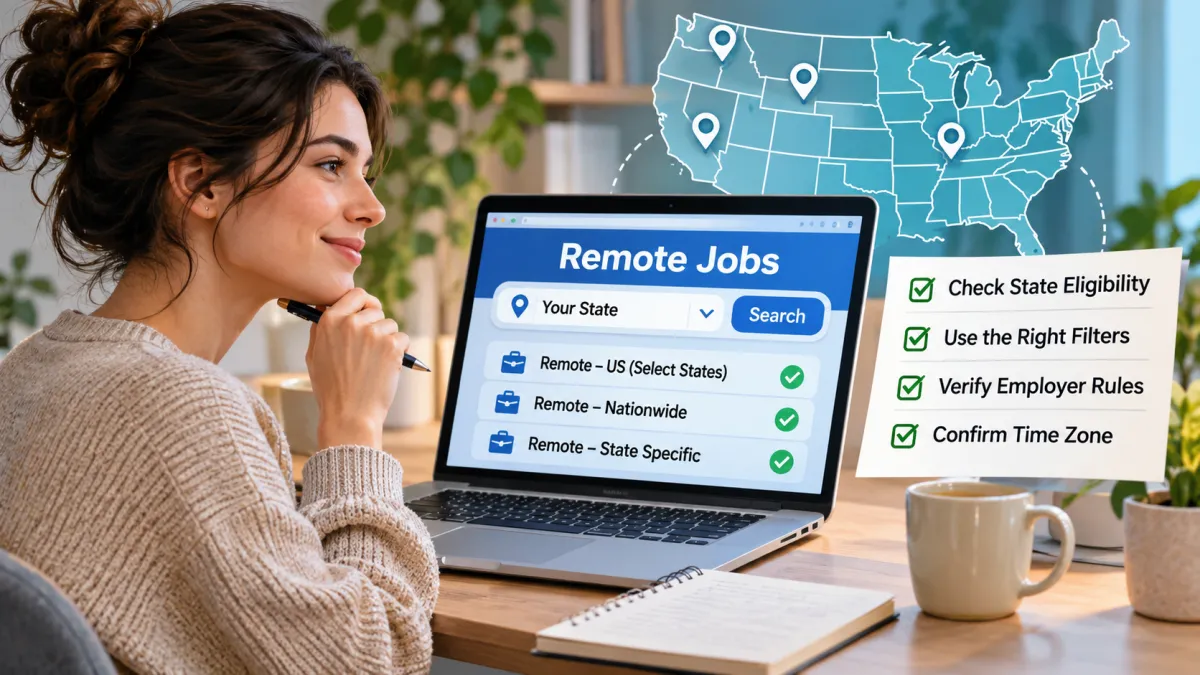
Finding a remote job in the United States is not always as simple as searching for “work from home” or “remote jobs.” Many employers advertise remote positions but limit applications to people who live in specific states. Others hire nationwide but require employees to work particular hours, attend occasional office meetings, or meet state-specific employment requirements.
If you are searching for remote jobs hiring in your state, the most important step is to verify where the employer allows you to live and work before applying. A job labeled “remote” does not automatically mean it is available to applicants in all 50 states.
You can improve your search by using location filters, checking employer career pages, understanding the wording in job descriptions, and confirming eligibility with recruiters when necessary. This guide explains how to find remote jobs available in your state, avoid misleading listings, and focus your applications on positions that match your location.
Why Remote Jobs Are Sometimes Restricted to Certain States
Remote work allows employees to perform their duties away from a traditional office. However, employers may still have geographic restrictions on where employees can reside.
A company might advertise a remote position but accept applications only from California, Texas, Florida, or a selected group of other states. Another employer may allow employees to work from anywhere in the United States.
These restrictions can exist for several reasons.
State Employment and Tax Requirements
Employers may need to comply with employment-related rules in the states where their workers live. Depending on the circumstances, hiring an employee in a new state may involve payroll registration, withholding, employment policies, or other administrative requirements.
Some businesses may not be set up to employ workers in every state. Instead of expanding their operations nationwide, they may limit hiring to states where they already have the necessary arrangements.
The specific requirements depend on the employer and the employee's circumstances. A job seeker should not assume that a company can legally or administratively hire someone in every state simply because the position is remote.
Professional Licensing Requirements
Some remote positions require a professional license or authorization that applies to a particular state.
For example, certain healthcare, counseling, insurance, legal, and other regulated roles may require the employee to hold a license valid in the state where the work is performed or where the customer or patient is located.
A remote position may therefore be available only to applicants who meet the applicable licensing requirements.
Business Operations and Customer Coverage
Employers may restrict remote hiring based on the locations they serve.
A customer support role might require employees to cover a particular region. A sales position may focus on customers in specific states. A company may also need employees close enough to attend occasional in-person meetings or training.
These requirements can affect where applicants are eligible to work, even when the job itself is performed from home.
Time-Zone and Schedule Requirements
Remote employees may be required to work during specific business hours.
For example, an employer headquartered on the East Coast might require employees to work an Eastern Time schedule. Another company may operate across several time zones and offer more flexible hours.
A time-zone requirement does not necessarily mean that the employer restricts hiring by state. However, it can make a position less suitable for applicants living in certain regions.
Understand the Location Wording in Remote Job Listings
Before applying, pay attention to how the employer describes the job's location.
The wording can provide useful clues, but it should not be treated as a universal rule. The complete job description and the employer's confirmation determine whether your state is eligible.
| Job listing wording | What it may mean | What you should verify |
|---|---|---|
| Remote — US | The position is remote within the United States | Whether all states are eligible |
| Remote — Nationwide | The employer may accept applicants across the country | Any exclusions, licensing, or schedule requirements |
| Remote — Eligible States | Hiring is limited to a specified group of states | Whether your state is included |
| Remote in [State] | The position is associated with a particular state | Whether residency in that state is required |
| Remote — [City or Region] | The role may be restricted to a local or regional area | Whether the employer accepts applicants outside that area |
| Hybrid | Employees work remotely and attend an office on certain days | Office location and required attendance |
| Telework Eligible | The job may allow some work away from an office | Whether remote work is full-time or subject to office attendance |
“Remote — US” Does Not Always Mean Every State
A listing that says “Remote — US” may appear to be nationwide. However, the description might include a separate list of eligible states or exclusions.
For example, a fictional employer could advertise a remote customer service position and state that applicants must reside in Arizona, Colorado, Georgia, or Ohio.
An applicant living in another state should not assume eligibility based only on the main location label.
Look for phrases such as:
-
Applicants must reside in one of the following states.
-
This position is available only in approved locations.
-
Employees must be located within the company's hiring footprint.
-
Certain states are excluded from consideration.
-
Candidates must be authorized to work remotely from their state of residence.
If the description does not clearly explain the restriction, contact the employer before submitting an application.
How to Find Remote Jobs That Hire in Your State
The following process can help you narrow your search and avoid spending time on positions that are not available where you live.
Step 1: Start With Your State as the Location
Begin your job search by entering your state, city, or ZIP code into the location field of a job search platform.
For example, if you live in Pennsylvania, you might search for:
-
Remote jobs in Pennsylvania
-
Work from home jobs in Pennsylvania
-
Pennsylvania remote customer service jobs
-
Remote administrative jobs in Pennsylvania
-
Remote jobs hiring in my state
You can also search by job title. If you are interested in data entry, customer support, bookkeeping, or marketing, combine the role with your state and the word “remote.”
A search such as “remote marketing jobs in Pennsylvania” can be more targeted than a general search for remote jobs.
However, location-based search results are not proof of eligibility. Job platforms may show listings associated with your location even when the employer has additional restrictions.
Step 2: Use Remote and Location Filters
Job search platforms often provide filters that help you narrow results.
Useful filters may include:
-
Remote or work-from-home
-
Location or state
-
Job title
-
Employment type
-
Experience level
-
Salary range
-
Date posted
Start with the remote filter and your state. Then narrow the results by job title, experience, or other relevant criteria.
Avoid relying on just one filter. A listing may appear in a remote search but still require employees to live in a specific state or attend an office occasionally.
Step 3: Read the Full Job Description
Once you find a promising listing, read the entire description before applying.
Do not stop after seeing the title, salary, or remote label.
Look for details about:
-
Eligible states
-
Residency requirements
-
Office attendance
-
Travel requirements
-
Working hours
-
Time-zone expectations
-
Professional licensing
-
Employment type
-
Required experience
Some location restrictions appear near the bottom of the job description or in a separate requirements section.
If your state is specifically listed as eligible, that is a helpful sign. If it is excluded, you should generally move on unless the employer confirms an exception.
Step 4: Check the Employer's Official Career Page
Job boards can be useful for discovering opportunities, but the employer's official career page is an important place to verify the details.
Search for the company name and the job title. Compare the official listing with the job board version.
Check whether:
-
The job is still open.
-
The location information matches.
-
Your state is eligible.
-
The employer has added any additional requirements.
-
The application process is handled through the official company website.
An official career page may contain more detailed location information than a third-party job listing.
If the job has been removed from the employer's website, be cautious about applying through an old or copied listing.
Step 5: Confirm Eligibility Before Applying
If the posting is unclear, ask the recruiter or hiring team.
You can use a short, professional message:
Hello, I’m interested in the remote [Job Title] position. I’m currently based in [State]. Could you confirm whether this position is open to applicants who reside in [State] and whether there are any location or in-office requirements? Thank you.
This question can help you determine whether it makes sense to continue with the application.
You do not need to wait until an interview to clarify a basic location requirement. Confirming eligibility early can save time for both you and the employer.
Step 6: Keep Track of Eligible Opportunities
If you are applying to multiple remote jobs, maintain a simple tracking sheet.
You can include the following columns:
| Company | Job Title | State Eligibility | Work Schedule | Application Status |
|---|---|---|---|---|
| Company A | Customer Support Representative | Your state confirmed | Eastern Time | Applied |
| Company B | Administrative Assistant | Eligible states listed | Flexible | Reviewing |
| Company C | Data Entry Specialist | Unclear | Not specified | Contact recruiter |
Use the actual company and job details in your tracker.
This helps you avoid applying repeatedly to positions that exclude your state and makes it easier to follow up with employers.
Where to Search for Remote Jobs by State
Several job search platforms can help you discover remote positions. Each platform has different search features, and none should replace checking the employer's actual requirements.
Indeed
Indeed allows job seekers to search by job title, keyword, and location. You can use terms such as “remote,” “work from home,” or a specific job title alongside your state.
Indeed also provides guidance for searching remote jobs:
https://indeed.zendesk.com/hc/en-us/articles/115005875163-Searching-for-Remote-Jobs
When searching, try combinations such as:
-
Remote customer service jobs + your state
-
Remote administrative jobs + your state
-
Work from home jobs + your state
-
Remote entry-level jobs + your state
If leaving the location field blank broadens your search, you may see more remote listings. However, broader results can include jobs that are not eligible for your state.
Use the job description and employer career page to verify the location requirement.
FlexJobs
FlexJobs focuses on flexible and remote work opportunities. It can be useful for people looking for remote, hybrid, part-time, or other flexible employment arrangements.
You can explore remote positions and review the details of individual listings.
FlexJobs also provides information about its services and job search process:
A platform's remote-work focus does not guarantee that every listed job is open to every state. Review each employer's eligibility requirements before applying.
USAJOBS
USAJOBS is the official federal government job site. It can be useful if you are interested in federal employment that offers remote work or telework arrangements.
Federal job postings may distinguish between remote work and telework.
The location and work arrangement details in the individual announcement matter. A position described as telework eligible may still require employees to report to a government office.
For help with location filters, review the USAJOBS guidance:
https://usajobshelp.opm.gov/hc/en-us/articles/52918569871251-How-to-filter-results-by-location
For remote and telework terminology, review:
https://help.usajobs.gov/how-to/search/filters/remote
Always read the complete federal job announcement, including its location, eligibility, and work schedule details.
Remote Jobs That May Be Available in Different States
Some types of work are commonly advertised as remote, although the availability of each role depends on the employer, qualifications, and state restrictions.
Customer Service Representative
Remote customer service roles may involve answering customer questions, resolving account issues, processing requests, or providing product support.
Employers may require:
-
Strong communication skills
-
Basic computer skills
-
Customer service experience
-
A reliable internet connection
-
Availability during specified shifts
Some employers hire across multiple states, while others limit hiring to selected locations.
Administrative Assistant
Remote administrative positions may involve scheduling, email management, document preparation, data organization, and coordination.
The job may require experience with office software, communication tools, or administrative systems.
Check whether the employer requires employees to work during standard business hours or attend occasional meetings.
Data Entry Specialist
Data entry roles can involve entering, reviewing, organizing, or updating information in databases and business systems.
Requirements vary. Some positions may be entry-level, while others require accuracy, typing skills, or experience with specific software.
Be especially cautious with data entry job offers that promise unusually high pay for little work or ask you to pay fees before being hired.
Marketing and Content Roles
Remote marketing jobs may include content writing, social media management, SEO, email marketing, or campaign coordination.
Employers may hire nationwide, but some roles require experience with particular industries, tools, or customer markets.
Location restrictions can still apply even when the work is fully digital.
Healthcare-Related Remote Positions
Some healthcare-related jobs can be performed remotely, such as certain medical records, billing, scheduling, or administrative roles.
However, requirements may vary based on the job duties, employer policies, and applicable licensing or compliance rules.
If you are exploring a medical records career, KnowBrook's guide to the medical records specialist career path may help you understand the role.
Do not assume that every healthcare-related remote position is open nationwide.
Remote Jobs for Applicants With or Without a Degree
Educational requirements can also affect your job search.
Some remote jobs require a college degree, professional certification, or specialized training. Other positions focus more on practical skills, communication, and relevant experience.
If you do not have a degree, you can narrow your search using terms such as:
-
Remote jobs without a degree
-
Entry-level remote jobs
-
Remote customer service jobs
-
Remote administrative jobs
-
Work from home jobs with no degree requirement
Read the qualifications carefully. “Entry-level” does not always mean that no experience is required.
KnowBrook's related guide, remote jobs without a degree, explores career options that may be suitable for people without a college degree.
Regardless of your education level, confirm that the employer accepts applicants who live in your state.
Common Mistakes to Avoid When Searching for Remote Jobs
A targeted search can become less effective when you rely on assumptions about remote work.
Assuming Every Remote Job Is Nationwide
This is one of the most common mistakes.
A job may be remote but restricted to a particular state or group of states. Always check the location requirements.
Applying Without Reading the Entire Listing
Important information about residency, schedule, licensing, and office attendance may appear outside the main job summary.
Read the complete description before submitting your application.
Ignoring Time-Zone Requirements
A remote job may require employees to work a fixed schedule.
For example, a company may require coverage during Eastern Time business hours. Applicants in other time zones should consider whether they can reliably meet those hours.
Treating Hybrid Work as Fully Remote
Hybrid jobs typically involve some in-person work. A listing may use remote-work language while still requiring attendance at a local office.
Check how often employees must report in person and where the office is located.
Relying Only on Job Board Search Results
Job boards are useful for finding opportunities, but they may not contain the full employer requirements.
Verify the listing on the company's official career page whenever possible.
Ignoring Job Scams
Remote job searches can expose applicants to fraudulent listings.
Be cautious if a supposed employer:
-
Requests payment to secure a job.
-
Sends a check and asks you to return part of the money.
-
Requests sensitive financial information before you have verified the employer and hiring process.
-
Uses suspicious email addresses or unofficial application websites.
-
Offers unusually high pay for minimal work without a credible job description.
Verify the company through its official website and use legitimate hiring channels. Do not pay an employer to obtain a job.
A Practical Checklist Before Applying
Use this checklist to review a remote job before spending time on an application.
This checklist is particularly useful when you are applying to several remote positions at once.
Conclusion
Finding remote jobs that hire in your state requires more than searching for “remote” or “work from home.” Employers may limit hiring based on state employment requirements, licensing, business operations, customer coverage, or work schedules.
Start by searching with your state and preferred job title. Use remote and location filters, read the complete job description, and verify the listing on the employer's official career page. If the location requirements are unclear, contact the recruiter before applying.
The most effective approach is to focus on jobs where your state eligibility is confirmed, your qualifications match the position, and the schedule works for you. This can help you spend less time on unsuitable listings and more time applying for remote opportunities that are genuinely available where you live.
Frequently asked questions
1. Can I apply for a remote job if my state is not listed?
You should confirm eligibility with the employer before applying. An unlisted state may be excluded, or the posting may not clearly explain its geographic requirements. Check the company’s career page and contact the recruiter to ask whether applicants residing in your state are eligible.
2. Does “remote — US” mean I can work from any state?
Not necessarily. “Remote — US” may indicate a US-based remote position, but the employer could still have state-specific hiring restrictions. Review the full job description for eligible-state lists or residency requirements, and confirm directly with the employer if the wording is unclear.
3. Can remote jobs require me to work in a different time zone?
Yes. A remote position may require employees to work during specified business hours, even if they live in another time zone. Check the job description for schedule requirements and ask the recruiter about expected working hours before accepting the position.
4. What is the difference between a remote job and a telework-eligible federal job?
A remote federal position generally does not require regular reporting to an agency office, while a telework-eligible position may require employees to work from an office on certain days. The specific arrangement depends on the job announcement, so review its work location and attendance requirements carefully.
5. Should I leave the location field blank when searching for remote jobs on Indeed?
Leaving the location field blank can broaden remote job search results on Indeed. However, it does not guarantee that every employer accepts applicants from your state. Always verify geographic eligibility through the full listing or the employer before applying.

James Collins writes practical content about work, business, careers, workplace trends, productivity, and professional development. His articles focus on helping readers understand everyday workplace decisions, business...