How to Compare Mortgage Loan Estimates From Different Lenders
Learn how to compare mortgage Loan Estimates from different lenders, including rates, APR, points, lender credits, loan costs, five-year costs, and rate locks, so you can evaluate comparable offers and make a better-informed choice.
 By Ethan Parker
In this article
- Start With Comparable Loan Estimates
- Why the comparison needs to be consistent
- Compare the Basic Loan Terms First
- Compare the Interest Rate and APR — But Don't Stop There
- Separate Lender Costs From Taxes and Other Prepaid Costs
- Look Closely at Points
- Understand Lender Credits
- Compare the Five-Year Cost
- Check the Monthly Payment Carefully
- Check the Rate-Lock Status
- Don't Choose Based Only on Cash to Close
- Put the Offers Into a Simple Comparison
- Use Competing Offers to Negotiate
- Be Careful When Loan Estimates Are Issued on Different Dates
- Remember That a Loan Estimate Is Not Final Loan Approval
- Common Mistakes When Comparing Mortgage Offers
- Comparing different loan scenarios
- Choosing the lowest interest rate automatically
- Comparing only cash to close
- Ignoring points and lender credits
- Ignoring the five-year comparison
- Forgetting about the rate lock
- Treating every fee as lender pricing
- Comparing estimates without checking their dates
- A Practical Order for Comparing Loan Estimates
- How to Decide Which Mortgage Offer Is Better
- Conclusion
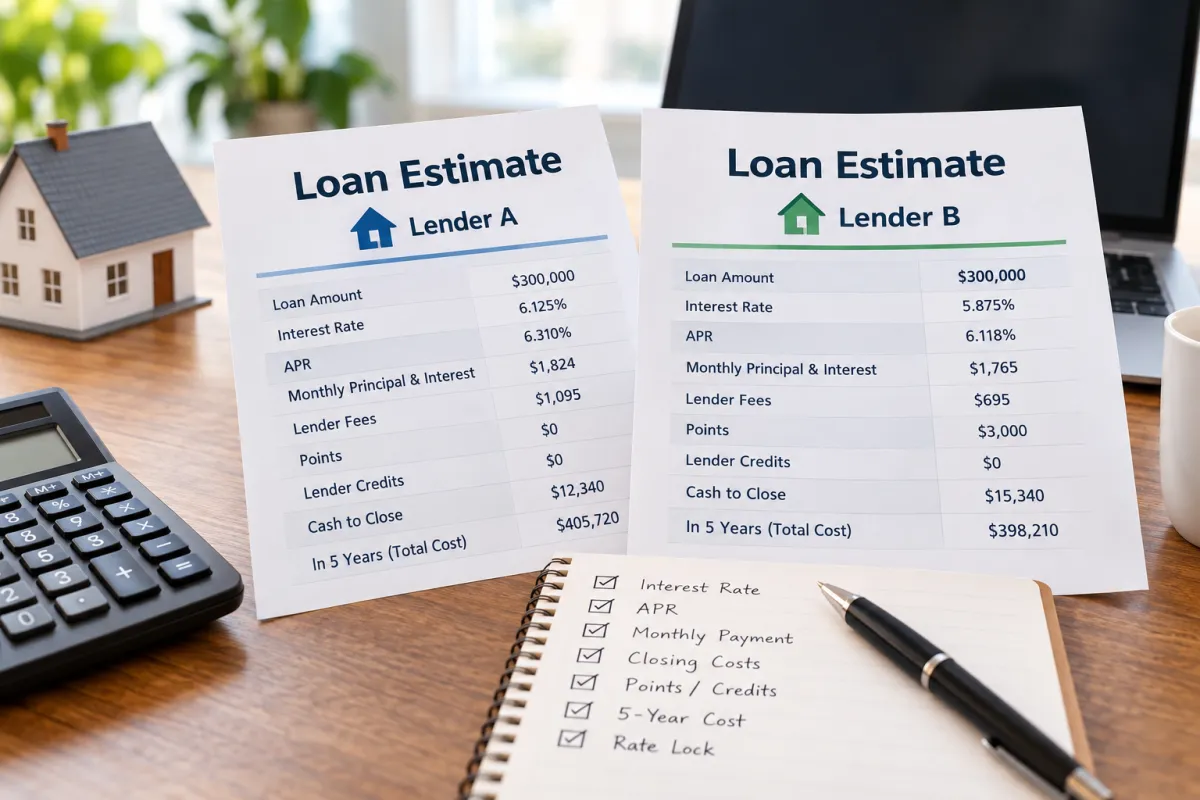
Getting mortgage offers from multiple lenders can save money, but only if you compare them on an apples-to-apples basis. A lower interest rate does not necessarily mean a lower-cost mortgage, and a smaller amount due at closing does not automatically make one offer better.
The best way to compare mortgage Loan Estimates is to first make sure the loan scenarios are comparable, then review the interest rate, monthly payment, lender-controlled costs, points, lender credits, five-year cost, rate-lock status, and cash to close.
A Loan Estimate gives you a standardized way to review these details. Instead of focusing on one attractive number, look at the complete offer and how its costs fit your plans.
Start With Comparable Loan Estimates
Before comparing numbers, make sure the lenders are quoting essentially the same loan.
For example, comparing a 30-year fixed-rate mortgage from one lender with a different loan type or different term from another lender will not give you a useful comparison. Differences in down payment, loan amount, loan type, rate-lock status, and other loan features can affect the numbers.
When requesting multiple Loan Estimates, try to provide each lender with the same relevant information, including:
- Purchase price
- Down payment
- Loan amount
- Property type
- Loan type
- Loan term
- Relevant loan features
- Whether you want to consider points or lender credits
The goal is to change as few variables as possible.
If one lender gives you an estimate based on paying points while another assumes no points, for example, the interest rates and upfront costs may look very different. That does not necessarily mean one lender is simply offering a better deal.
Why the comparison needs to be consistent
Mortgage pricing can change based on the details of the loan. Even relatively small differences in the scenario can affect the rate, payment, closing costs, and other figures.
A useful comparison therefore starts with this question:
Are these lenders actually offering me the same type of mortgage under comparable assumptions?
If the answer is no, fix the comparison before deciding which offer is better.
Compare the Basic Loan Terms First
Start near the beginning of each Loan Estimate and confirm that the basic terms match.
Look at:
This first check can reveal why two offers look different.
For example, one lender might show a lower rate because the borrower is paying points. Another might show a higher rate but provide lender credits that reduce certain upfront costs.
Neither offer can be judged properly from the interest rate alone.
Compare the Interest Rate and APR — But Don't Stop There
The interest rate is important because it affects the interest charged on the mortgage and the principal-and-interest portion of the monthly payment.
APR is a broader measure that incorporates certain loan costs. It can therefore provide additional information when comparing mortgage offers.
However, neither number should be used as the only deciding factor.
Consider two hypothetical offers:
- Offer A: lower interest rate but higher upfront costs
- Offer B: slightly higher interest rate but lower upfront costs
If you only compare the interest rates, Offer A may look better immediately. But if you expect to move or refinance relatively soon, the additional upfront cost could matter significantly.
The reverse can also be true. A higher upfront cost may make sense for a borrower who expects to keep the mortgage for a longer period, depending on the actual numbers.
The important point is to compare the complete cost structure rather than treating the lowest rate as the automatic winner.
Separate Lender Costs From Taxes and Other Prepaid Costs
One of the most useful parts of comparing Loan Estimates is identifying which costs are actually controlled by the lender.
A Loan Estimate can include many charges associated with buying a home. Not all of them are the result of the lender's pricing.
For comparison purposes, pay particular attention to lender-controlled costs while recognizing that other amounts may reflect taxes, insurance, prepaid expenses, or initial escrow requirements.
This distinction matters because a lender may appear more expensive simply because the estimates contain different assumptions about costs that are not primarily controlled by that lender.
When reviewing the estimates, look carefully at items such as:
- Origination charges
- Certain lender fees
- Discount points
- Lender credits
- Other lender-controlled charges
Then separately consider amounts such as property taxes, homeowners insurance, prepaid interest, and initial escrow amounts.
The objective is not simply to find the Loan Estimate with the smallest total number on every page. It is to understand why the numbers differ.
Look Closely at Points
Points can make mortgage comparisons more complicated because they involve paying more upfront in exchange for a lower interest rate.
Suppose one lender offers a lower rate but charges points while another lender offers a higher rate without the same upfront charge.
The lower rate may look attractive, but you need to consider the additional upfront cost and how long you expect to keep the mortgage.
Points can make more sense in some situations than others. The relevant question is not simply:
"Which lender has the lower rate?"
Instead ask:
"How much am I paying upfront for that lower rate, and how does that affect the total cost over the period I expect to keep this loan?"
Use the actual figures in the Loan Estimates to make that comparison rather than relying on a general rule about whether points are good or bad.
Understand Lender Credits
Lender credits work in the opposite direction.
A lender may provide credits that reduce certain upfront costs in exchange for a higher interest rate.
That can make an offer look attractive because the borrower may need less money upfront. But the higher rate can increase borrowing costs over time.
This creates another situation where focusing on a single number can lead to the wrong conclusion.
A Loan Estimate with a larger lender credit is not automatically better, just as a Loan Estimate with no lender credit is not automatically better.
Compare:
- The interest rate
- The lender credit
- The upfront lender costs
- The monthly payment
- The five-year cost
- How long you expect to keep the mortgage
This gives you a much clearer picture of the tradeoff.
Compare the Five-Year Cost
The five-year figures on the Loan Estimate can be especially useful when comparing mortgage offers.
The CFPB provides a method for using the "In 5 years" figures to estimate the interest and certain costs paid during the first five years of the mortgage.
This helps move the comparison beyond the question of what the mortgage costs today.
For example, imagine two hypothetical offers:
Offer A
- Lower interest rate
- Higher upfront points
- Higher initial cost
Offer B
- Higher interest rate
- Lender credits
- Lower initial cost
Looking only at the rate favors Offer A. Looking only at the cash needed upfront may favor Offer B.
The five-year comparison provides another perspective by helping you evaluate the cost of carrying each mortgage during the first five years.
That does not mean five years is the exact amount of time every borrower will keep a mortgage. Your actual plans matter. But it provides a standardized comparison point that can be useful when evaluating competing offers.
Check the Monthly Payment Carefully
Monthly payment is another important comparison point, but make sure you understand what is included.
The principal-and-interest payment is directly affected by the loan amount, interest rate, and loan terms.
Your total monthly housing payment can also involve other amounts, such as property taxes, homeowners insurance, mortgage insurance, or other applicable expenses.
When comparing two estimates, make sure you are comparing the same components.
A lower monthly payment can result from several different factors. It may reflect a lower interest rate, a different loan amount, different assumptions, or other differences in the loan structure.
Ask yourself:
- Are the loan amounts the same?
- Are the loan terms the same?
- Are the interest rates comparable?
- Are the same types of costs included?
- Is mortgage insurance treated the same way?
- Are taxes and insurance assumptions different?
This prevents you from treating a difference caused by assumptions as a difference in lender pricing.
Check the Rate-Lock Status
Mortgage interest rates can change, so rate-lock status is an important part of comparing Loan Estimates.
If one lender's rate is locked and another lender's rate is not, the offers are not necessarily equally protected from market changes.
The rate shown on an estimate can change when circumstances change or when a rate has not been locked.
When comparing estimates, find out:
- Whether the rate is locked
- How long the lock lasts
- What happens if the transaction takes longer than expected
- Whether the other loan terms are based on the same rate-lock assumptions
A rate that looks better today may not remain available if it is not locked.
This is another reason to avoid treating a Loan Estimate as a permanent promise of the final mortgage terms.
Don't Choose Based Only on Cash to Close
Cash to close matters because it tells you how much money you may need for the transaction, but it should not be the only basis for choosing a lender.
A lender credit, points, prepaid expenses, escrow amounts, and other costs can affect the amount shown.
Two Loan Estimates can therefore show different cash-to-close amounts without one necessarily being the better mortgage overall.
If one offer requires less cash upfront, investigate why.
For example, the difference could come from:
- Lender credits
- Points
- Different prepaid amounts
- Different escrow assumptions
- Other differences in the transaction
Think of cash to close as one part of the decision rather than the final answer.
Put the Offers Into a Simple Comparison
Once you have reviewed the individual Loan Estimates, create a side-by-side comparison.
You can use a simple worksheet like this:
The purpose of this table is not to create a complicated financial model. It is simply to put the important figures next to each other so differences are easier to see.
If one number looks dramatically different, investigate the reason instead of immediately assuming that lender is better or worse.
Use Competing Offers to Negotiate
Comparing lenders is not only about choosing among offers. The information can also give you an opportunity to negotiate.
If one lender has a more attractive rate while another has lower lender-controlled costs, you can ask whether the other lender can improve its offer.
For example, you might tell a lender that you have received another Loan Estimate with different pricing and ask whether it can offer more competitive terms.
Keep the comparison factual and specific.
Instead of saying:
"Your mortgage is too expensive."
You can focus on particular differences:
- The interest rate is higher.
- The lender-controlled costs are higher.
- Another lender is offering lender credits.
- The points structure is different.
- The five-year cost appears lower with another offer.
The purpose is to see whether the lender can improve the terms rather than negotiating based on vague promises.
Be Careful When Loan Estimates Are Issued on Different Dates
Mortgage pricing can change as market conditions change.
That means two Loan Estimates issued on different days may not be directly comparable in every respect, even when you requested the same loan.
A rate difference does not necessarily mean one lender is consistently more competitive. The estimates may simply reflect different market conditions at the time they were issued.
If you are comparing offers received at different times, note the dates and ask the lenders whether the quoted terms are still available.
This is particularly important if the market is moving quickly or one estimate is no longer current.
Remember That a Loan Estimate Is Not Final Loan Approval
Receiving a Loan Estimate does not mean your mortgage has been finally approved.
The Loan Estimate is used to provide information about the expected loan terms and costs. Your mortgage process can continue to involve underwriting, documentation, property-related requirements, and other steps.
The numbers can also change when certain circumstances change.
For example, a lender may issue a revised Loan Estimate after qualifying changes involving the borrower, property, loan, down payment, or rate lock.
If you receive a revised estimate, do not assume it is simply a replacement document to ignore. Review what changed and why.
Common Mistakes When Comparing Mortgage Offers
A few comparison mistakes can make a good mortgage-shopping process much less useful.
Comparing different loan scenarios
If the loan amount, term, loan type, or other important features are different, the comparison may not tell you which lender is actually offering better pricing.
Start by making the scenarios as similar as possible.
Choosing the lowest interest rate automatically
A lower rate can come with higher points or other costs.
Always look at the full offer.
Comparing only cash to close
A lower upfront cost may come with lender credits and a higher rate.
Consider both upfront and longer-term costs.
Ignoring points and lender credits
These features can materially change the relationship between the interest rate and upfront costs.
Make sure you understand what you are receiving or paying for.
Ignoring the five-year comparison
Looking only at today's costs can make it harder to understand the longer-term tradeoff between competing offers.
Use the available five-year figures as another comparison point.
Forgetting about the rate lock
A quoted rate may not have the same level of protection as a locked rate.
Confirm the rate-lock status for each offer.
Treating every fee as lender pricing
Taxes, insurance, prepaids, and initial escrow amounts are not the same as lender-controlled costs.
Separate these categories when evaluating differences.
Comparing estimates without checking their dates
Rates and mortgage pricing can change. Make sure you know when each estimate was issued and whether the terms are still available.
A Practical Order for Comparing Loan Estimates
If you have several Loan Estimates in front of you, you do not need to compare every line randomly.
A useful sequence is:
1. Confirm the loan scenarios match.
Check the loan amount, type, term, and other relevant features.
2. Check the interest rate and APR.
Understand the difference, but do not choose based on these figures alone.
3. Review the monthly payment.
Confirm that the assumptions and included costs are comparable.
4. Review lender-controlled costs.
Look for meaningful differences in lender charges.
5. Check points and lender credits.
Understand what you are paying upfront or receiving in exchange for the rate offered.
6. Compare the five-year cost.
Use the "In 5 years" figures to evaluate the longer-term cost of the offers.
7. Check rate-lock status.
Make sure you know whether the quoted rate is locked and under what conditions.
8. Review cash to close.
Understand why one offer requires more or less money upfront.
9. Ask questions about significant differences.
If a number is substantially different, ask the lender to explain it.
10. Use the offers to negotiate.
Once you understand the differences, competing offers can give you useful leverage when discussing terms.
This process makes the comparison more systematic and reduces the chance that one attractive number will dominate the decision.
How to Decide Which Mortgage Offer Is Better
There is no single Loan Estimate number that determines the best mortgage for every borrower.
The right comparison depends partly on your financial priorities and how long you expect to keep the loan.
For example, a borrower focused on minimizing upfront costs may evaluate lender credits differently from a borrower who expects to keep the mortgage for many years and is considering paying points for a lower rate.
That does not mean you should predict the future perfectly. Instead, understand the tradeoffs clearly.
A strong comparison should answer questions such as:
- Which offer has the more favorable loan terms?
- How much am I paying upfront?
- What lender-controlled costs am I paying?
- Is the lower rate associated with points?
- Are lender credits changing the upfront cost?
- How does the monthly payment compare?
- What does the five-year cost look like?
- Is the rate locked?
- Why is there a difference in cash to close?
- Can either lender improve its offer?
Once you can answer those questions, the decision becomes much clearer than simply choosing the lender with the lowest advertised rate.
Conclusion
Comparing mortgage Loan Estimates is about looking at the entire loan rather than chasing a single number.
Start by making sure the lenders are quoting comparable loan scenarios. Then compare the interest rate, APR, monthly payment, lender-controlled costs, points, lender credits, five-year cost, rate-lock status, and cash to close.
Pay particular attention to why the numbers differ. A lower rate may involve higher upfront costs, while a lower cash-to-close figure may come with lender credits and a higher rate. Taxes, insurance, prepaids, and initial escrow amounts can also affect the numbers without representing lender pricing.
Once you understand those differences, competing Loan Estimates become more than paperwork. They give you a practical way to evaluate mortgage offers, ask better questions, and negotiate before choosing a lender.
Frequently asked questions
Is the lowest mortgage interest rate always the best deal?
A lower interest rate does not automatically mean a lower-cost mortgage. Compare the rate along with points, lender credits, lender-controlled costs, monthly payment, and the five-year cost of borrowing before choosing an offer.
Can I get Loan Estimates from multiple lenders?
Yes. Comparing Loan Estimates from multiple lenders can help you evaluate different mortgage offers and negotiate. For a useful comparison, request the same type of loan with the same relevant features from each lender.
What is the difference between an interest rate and APR?
The interest rate is used to calculate the interest charged on the mortgage, while APR is a broader measure that incorporates certain loan costs. Neither number should be considered by itself when comparing complete mortgage offers.
Should I choose a mortgage with points or lender credits?
Points generally involve paying more upfront in exchange for a lower interest rate, while lender credits can reduce certain upfront costs in exchange for a higher rate. The better choice depends on the specific loan terms and how long you expect to have the mortgage.
What does “In 5 years” mean on a Loan Estimate?
The Loan Estimate's “In 5 years” figures help borrowers compare the projected cost of different mortgage offers over the first five years. The CFPB provides a method for using these figures to estimate interest and fees paid during that period.
Can a Loan Estimate change after I receive it?
Yes. A lender may issue a revised Loan Estimate when certain information or circumstances change, including qualifying changes involving the borrower, property, loan, or rate lock.
Ethan Parker writes practical guides about home, everyday living, household decisions, consumer products, organization, and practical lifestyle topics. His work focuses on helping readers compare options, understand comm...