Can You Get a Master’s Degree Without a Bachelor’s Degree?
Learn whether you can earn a master’s degree without a bachelor’s degree, how U.S. admission requirements normally work, which alternative pathways exist, and what to verify before applying.
 By Emily Carter
In this article
- Do You Normally Need a Bachelor’s Degree for a Master’s?
- When Can You Get a Master’s Without a Bachelor’s?
- Performance-based admission
- Professional experience pathway
- Case-by-case graduate admission
- Real U.S. Examples of Alternative Admission Pathways
- What If You Have an Associate Degree?
- What If You Have a Three-Year Bachelor’s Degree?
- Can Work Experience Replace a Bachelor’s Degree?
- Do Online Master’s Programs Have Different Requirements?
- How to Verify Whether You Qualify
- 1. Find the exact master's program
- 2. Look for the bachelor's requirement
- 3. Check whether the exception applies to your program
- 4. Check the alternative requirements
- 5. Ask the admissions office directly
- What Documents Might an Alternative Pathway Require?
- What If You Do Not Qualify for a Master’s Without a Bachelor’s?
- The Bottom Line
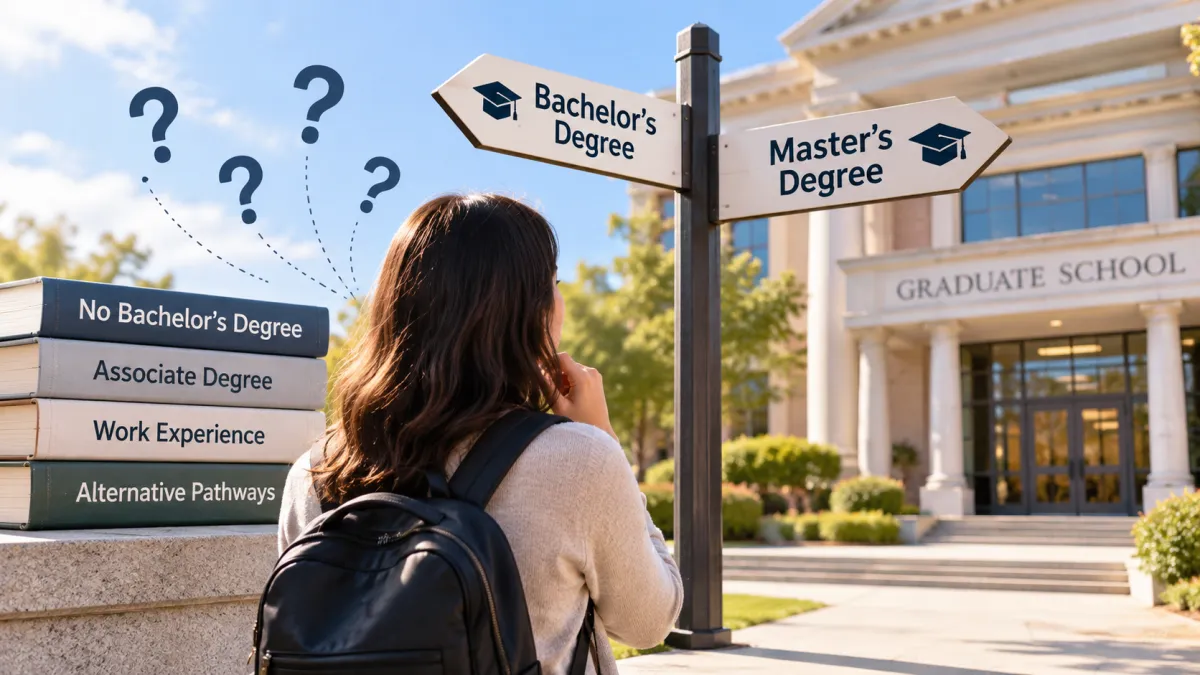
Yes, in some cases—but it is not the normal route.
Most U.S. master’s programs expect applicants to have completed a bachelor’s degree or an equivalent undergraduate credential before starting graduate study. For example, Stanford requires a U.S. bachelor’s degree or international equivalent for graduate admission.
However, a small number of U.S. programs have specific alternative admission pathways for applicants who do not have a completed bachelor’s degree. These pathways are not the same as simply having work experience and asking a university to waive its requirements. They are formal policies created by particular programs, and they can have strict eligibility conditions.
For example, the University of Colorado Boulder’s online Master of Science in Data Science uses performance-based admission and states that a bachelor’s degree is not required. Applicants can demonstrate readiness by completing a designated pathway of graduate-level courses with the required GPA.
The University of Michigan School of Social Work also has a Non-Baccalaureate Admissions pathway that can allow a limited number of applicants with extensive, successful social work experience to enter its MSW program without first earning a bachelor’s degree.
So the practical answer is: usually yes, you need a bachelor’s degree, but certain U.S. master’s programs offer legitimate alternatives.
Do You Normally Need a Bachelor’s Degree for a Master’s?
For most U.S. graduate programs, a bachelor’s degree is the standard academic foundation for master's admission.
Universities use the undergraduate degree requirement to establish that an applicant has completed a certain level of academic preparation before entering graduate-level coursework. The exact requirement can vary by institution, graduate school, and program.
Stanford, for example, says applicants must hold or expect to hold a U.S. bachelor’s degree or international equivalent before enrollment.
This is why you should be cautious with websites or advertisements that make it sound as though anyone with enough work experience can simply skip college and enroll in a master's program. There is no general U.S. rule that allows professional experience to automatically replace a bachelor’s degree.
Instead, the question is much more specific:
Does the particular master’s program have an approved admission pathway for applicants without a bachelor’s degree?
If the answer is no, you should generally expect to complete a bachelor’s degree first.
This distinction matters because several situations that sound similar are actually very different.
| Your situation | What it means |
|---|---|
| No bachelor’s degree | You have not completed an undergraduate bachelor’s program |
| Bachelor’s in another subject | You have completed a bachelor’s, but your major may differ from your master’s |
| Three-year bachelor’s | You have a bachelor’s, but the degree may require evaluation for U.S. graduate admission |
| Associate degree only | You have completed a lower-level undergraduate credential, not a bachelor’s |
| Incomplete bachelor’s | You started a bachelor’s program but did not finish it |
| Extensive work experience | Professional experience that may matter for a specific alternative pathway |
Understanding which situation applies to you can prevent you from applying to the wrong type of program.
When Can You Get a Master’s Without a Bachelor’s?
The most important point is that alternative admission pathways are program-specific.
A university may require a bachelor’s for most of its graduate programs while allowing an exception in one particular program. Another university may offer a formal pathway based on professional experience. Another may use performance-based admission rather than a traditional undergraduate credential requirement.
Several legitimate U.S. examples illustrate how different these pathways can be.
Performance-based admission
The University of Colorado Boulder’s online Master of Science in Data Science is one example.
The program explicitly states that applicants do not need a bachelor’s degree. Instead, it uses performance-based admission. Students complete a pathway consisting of three one-credit courses, and completing the pathway with a 3.0 GPA or better can result in admission to the degree program.
This is important because the applicant is not simply receiving a waiver because of work experience. The program has created an alternative way to demonstrate academic readiness.
The pathway also becomes part of the degree curriculum, rather than being merely an informal test of whether an applicant might succeed.
Professional experience pathway
The University of Michigan School of Social Work provides another example.
Its MSW program has a Non-Baccalaureate Admissions status that can allow up to 10 students each year to enter without first completing a bachelor’s degree. The university describes the pathway as an opportunity for people with extensive, successful social work experience to obtain the MSW without first earning a bachelor’s.
This is very different from saying that work experience generally replaces a bachelor’s degree.
The university has created a specific admission status for this purpose. Therefore, someone interested in the pathway needs to satisfy the program's requirements rather than assuming that several years of employment will automatically qualify them.
Case-by-case graduate admission
Some programs also evaluate applicants without a bachelor’s degree individually.
Baylor University's George W. Truett Theological Seminary, for example, states that applicants without a bachelor’s degree may apply to its master's programs. Such applicants are evaluated and admitted by the admissions committee on a case-by-case basis. The seminary also notes that a bachelor’s degree is required for its associated joint-degree programs.
This example shows why you cannot rely on a university-wide statement alone. A special admission policy may apply to one school or degree but not to another program at the same institution.
Real U.S. Examples of Alternative Admission Pathways
The examples below show the range of approaches used by U.S. institutions.
| University/program | Alternative approach | Key point |
|---|---|---|
| University of Colorado Boulder — MS in Data Science | Performance-based admission | Bachelor’s degree is not required; applicants can qualify through a three-course pathway with a 3.0 GPA or better |
| University of Michigan — MSW | Non-Baccalaureate Admissions | Limited admission for applicants with extensive, successful social work experience |
| University of Dallas — Gupta College of Business | Catalyst Pathway | Experienced professionals without a bachelor’s may qualify under specific work-experience and application requirements |
| Baylor Truett Seminary | Case-by-case evaluation | Applicants without a bachelor’s may apply and are evaluated individually |
The University of Dallas provides one of the clearest examples of a formal professional-experience pathway.
Its Gupta College of Business Catalyst Pathway is designed for working professionals who have not completed a bachelor’s degree. The current catalog specifies at least eight years of work experience, including at least two years in a supervisory capacity. Applicants must also provide undergraduate transcripts, a personal statement, and three letters of recommendation.
Students admitted through the Catalyst Pathway are admitted on probation and must maintain a 3.0 GPA with no grade lower than a B. The university states that Catalyst students earn the same degrees as students admitted through standard graduate admission.
This example is especially useful because it demonstrates what a legitimate alternative pathway can look like: clearly published eligibility rules, a defined application process, academic standards, and a specific degree-granting program.
It is not the same thing as a university informally ignoring the bachelor's requirement.
What If You Have an Associate Degree?
An associate degree is not the same as a bachelor’s degree.
If you have an associate degree but have not completed a bachelor’s degree, you generally should not assume that you can move directly into a standard U.S. master’s program.
Most graduate programs use a bachelor’s degree or equivalent as the normal academic prerequisite. An associate degree by itself does not automatically satisfy that requirement.
That does not mean your associate degree is useless. It may be an important step toward completing a bachelor’s degree.
For adults who have college credits or an associate degree and want to continue their education, a degree completion program can provide a practical route toward finishing a bachelor’s degree.
KnowBrook's guide to a degree completion program explains how these programs can help adults complete remaining undergraduate requirements.
You may also want to understand the typical credit requirements for a bachelor's degree before planning the next step. KnowBrook's guide to bachelor’s degree credit requirements provides additional context.
The important point is that an associate degree should not be presented as an automatic substitute for a bachelor’s degree. If a master’s program does accept applicants without a bachelor’s, that acceptance needs to come from the program's own published admission policy.
What If You Have a Three-Year Bachelor’s Degree?
A three-year bachelor’s degree is a different situation from having no bachelor’s degree.
If you completed a recognized bachelor’s degree that took three years, you have earned a bachelor’s credential. The question then becomes whether the U.S. university considers that credential equivalent to the undergraduate degree it requires.
This issue can arise particularly for international applicants because undergraduate degree structures vary between countries.
For example, Stanford refers to a U.S. bachelor’s degree or its international equivalent when describing its graduate eligibility requirement.
That means someone with a three-year international bachelor's degree should not automatically conclude either that they qualify or that they do not qualify. The university needs to determine whether the credential meets its equivalency requirements.
This is also why a three-year bachelor’s should not be grouped together with an associate degree or an incomplete college education.
If you want to understand the distinction between three-year and four-year bachelor's programs, see KnowBrook's guide to three-year bachelor’s degrees.
Can Work Experience Replace a Bachelor’s Degree?
Sometimes it can be part of an alternative pathway, but work experience alone does not generally replace a bachelor’s degree.
This distinction is one of the most important points in this topic.
A university may create a program specifically for experienced professionals who lack an undergraduate degree. In that situation, professional experience can be one of the eligibility requirements.
The University of Dallas Catalyst Pathway is a good example. Applicants without a completed bachelor’s degree can qualify if they have at least eight years of work experience, including at least two years in a supervisory capacity, along with the other required application materials.
But this does not mean an applicant can take eight years of experience to any university and demand admission to a master's program.
The same principle applies to the University of Michigan's MSW pathway. Extensive, successful social work experience is relevant because the school has specifically created a Non-Baccalaureate Admissions status.
Therefore, think of professional experience as a possible component of a specific admission pathway, not as a universal replacement for undergraduate education.
Do Online Master’s Programs Have Different Requirements?
An online master's program does not automatically have easier admission requirements.
Some online programs still require a bachelor’s degree just as their on-campus counterparts do.
However, an online program may also use a different admission model. The University of Colorado Boulder MS in Data Science is a good example because its online program uses performance-based admissions and explicitly says a bachelor’s degree is not required.
The key lesson is not that online programs waive bachelor's requirements. It is that delivery format and admission requirements are separate issues.
When comparing online programs, look for the exact wording used by the university.
Do not rely on statements such as:
-
"No bachelor's required"
-
"No degree necessary"
-
"Work experience accepted"
-
"No traditional application"
unless those claims come from the university's official program information and apply to the exact master's degree you want.
CU Boulder, for example, provides a specific process through which applicants demonstrate readiness through pathway coursework.
That is much more meaningful than a generic advertisement claiming that an online master's is open to everyone.
How to Verify Whether You Qualify
If you do not have a bachelor’s degree, verification should happen before you spend significant time or money on an application.
Start with the official program page rather than relying on a third-party article or advertisement.
1. Find the exact master's program
Do not stop at the university's general graduate admissions page.
Identify the exact degree you want—for example, an MS in Data Science, MBA, MS in Accounting, or MSW.
A university may have different admission rules for different graduate programs.
2. Look for the bachelor's requirement
Read the official eligibility or admission requirements carefully.
Look for phrases such as:
-
Bachelor's degree required
-
Bachelor's degree or equivalent
-
International equivalent
-
Bachelor's degree not required
-
Non-baccalaureate admission
-
Performance-based admission
-
Alternative admission pathway
The wording matters.
3. Check whether the exception applies to your program
An exception at one school does not necessarily apply across the university.
For example, Baylor's Truett Seminary permits applicants without a bachelor's degree to apply to its master's programs, while its FAQ specifically notes that a bachelor's degree is required for associated joint-degree programs.
That is why you need to verify the exact degree rather than relying on a university-wide assumption.
4. Check the alternative requirements
If the program offers an alternative pathway, identify every condition.
Depending on the program, you may need professional experience, supervisory experience, prerequisite coursework, a specific GPA, recommendation letters, a personal statement, pathway courses, or other documentation.
The University of Dallas Catalyst Pathway, for example, specifies both experience requirements and application materials.
CU Boulder instead uses pathway coursework and a 3.0 GPA requirement for performance-based admission to its online MS in Data Science.
5. Ask the admissions office directly
If the published information is unclear, contact the graduate admissions office or program admissions team.
A useful question is:
"I have not completed a bachelor's degree. Does your specific master's program accept applicants without a bachelor's degree, and if so, what alternative eligibility requirements apply?"
You can then ask whether the pathway leads to the same degree and whether there are additional academic prerequisites.
Getting the answer in writing can be particularly helpful when the program's website contains multiple admission pathways.
What Documents Might an Alternative Pathway Require?
There is no single document list for every program.
The requirements depend on the pathway.
For example, the University of Dallas Catalyst Pathway requires undergraduate transcripts, a personal statement, and three recommendation letters in addition to its work-experience requirements.
A performance-based pathway can work differently. CU Boulder does not use the traditional application process for its online MS in Data Science. Instead, students complete the required pathway courses and meet the specified GPA standard for admission.
This means you should not assume that every alternative program will evaluate your application in the same way.
Before applying, determine exactly what the university wants to see and how it determines eligibility.
What If You Do Not Qualify for a Master’s Without a Bachelor’s?
If you do not qualify for an approved alternative pathway, the most straightforward route is usually to complete a bachelor’s degree first.
That may take longer, but it can significantly expand your graduate-school options.
For someone who already has college credits, the path may be shorter than starting from the beginning. An associate degree or previous college coursework can potentially contribute toward a bachelor's degree, depending on the institution and transfer-credit evaluation.
You should also compare bachelor's completion options rather than assuming that a traditional four-year path is your only choice.
KnowBrook's associate degree vs. bachelor’s degree guide can help clarify the difference between these credentials and where each fits in the education pathway.
If you have already completed substantial college coursework, review how your credits may apply to a bachelor's program before enrolling. Policies vary by institution, so the school evaluating your transfer credits should provide the final determination.
Another possibility is choosing a master's program that accepts a bachelor's degree in a different field. That situation is much more common than being admitted without any bachelor's degree.
For example, a graduate program may accept students who earned their undergraduate degree in business, engineering, psychology, communications, or another subject, depending on the master's program's prerequisites.
In other words, you may not need a bachelor's degree in the same subject as your master's degree. You may simply need a completed bachelor's degree.
The Bottom Line
For most U.S. master's programs, a bachelor's degree or equivalent remains the normal admission requirement. Stanford, for example, requires a U.S. bachelor's degree or international equivalent for graduate study.
But the answer is not an absolute "no" if you do not have one.
A limited number of legitimate programs provide alternative routes. CU Boulder's online MS in Data Science uses performance-based admission without requiring a bachelor's degree, while the University of Michigan has a Non-Baccalaureate pathway for a limited number of applicants with extensive, successful social work experience. The University of Dallas also offers a formal Catalyst Pathway for qualifying experienced professionals without completed bachelor's degrees.
The safest approach is to evaluate the specific master's program, not simply the university or the general idea of graduate school.
If you do not have a bachelor's degree, look for an officially published alternative pathway, check every eligibility condition, and confirm the details directly with the program before applying.
And if no such pathway exists, completing a bachelor's degree—possibly through a degree completion route—will usually give you access to a much broader range of U.S. master's programs.
Frequently asked questions
Do you always need a bachelor’s degree to get a master’s degree?
A bachelor’s degree or equivalent is normally required for admission to U.S. master’s programs. However, some specific programs have documented alternative admission pathways, so the requirement is not universal across every program.
Can work experience replace a bachelor’s degree for a master’s program?
Sometimes, but only when a specific program has an alternative pathway that allows it. Work experience does not generally replace a bachelor’s degree for U.S. graduate admission. Requirements vary by program and may include substantial professional experience or other conditions.
Can you get a master’s degree with an associate degree but no bachelor’s?
An associate degree generally does not satisfy the standard bachelor’s-level requirement for graduate admission. If no alternative master's pathway applies, completing a bachelor’s degree, potentially through a degree completion program, is the usual route.
Does a three-year bachelor’s degree qualify you for a U.S. master’s program?
It can, depending on the university and how it evaluates the degree. A three-year bachelor’s is different from having no bachelor’s degree, and U.S. universities can have different policies for evaluating three-year international degrees.
Are there online master’s programs that do not require a bachelor’s degree?
Some specific online programs may use alternative admission methods that do not require a bachelor’s degree, but being online does not automatically remove the normal degree requirement. Applicants should check the official requirements for the exact program.
Is a bachelor’s in another subject different from having no bachelor’s degree?
Yes. A person with a bachelor’s degree in another field has completed an undergraduate degree, even if it is unrelated to the intended master’s program. That situation is different from applying without having completed any bachelor’s degree.
What should I ask a university before applying without a bachelor’s degree?
Ask whether the exact master’s program accepts applicants without a completed bachelor’s, what alternative qualifications are required, what documentation is needed, whether additional prerequisites apply, and whether the alternative pathway leads to the same master’s credential.
Emily Carter writes practical, reader-focused content about education, college planning, degrees, financial aid, career paths, and the transition from school to work. She focuses on making complicated education and caree...