3-Year Bachelor’s Degree Programs: How They Work and Whether They Save Money
Learn how three-year bachelor’s degree programs work in the U.S., how they differ from traditional four-year degrees, what they may cost, and what students should check before enrolling.
 By Emily Carter
In this article
- What Is a 3-Year Bachelor’s Degree?
- Why Are U.S. Colleges Offering Three-Year Bachelor's Programs?
- Students may want to enter the workforce sooner
- Colleges are looking for different ways to structure degrees
- Affordability is part of the discussion
- How Do Three-Year Bachelor's Programs Work?
- Reduced-credit programs
- Accelerated traditional-credit programs
- Summer or year-round study
- Using prior or transfer credits
- Does a Three-Year Degree Always Mean 90 Credits?
- Three-Year vs. Four-Year Bachelor's Degree
- Can a Three-Year Degree Actually Save Money?
- Compare the total cost, not just tuition
- Financial Aid Requires a Program-Specific Check
- Are Three-Year Bachelor's Degrees Legitimate?
- What About Graduate School?
- Who Is a Three-Year Bachelor's Degree Best For?
- Who May Be Better Off With a Four-Year Degree?
- What Happens If You Change Majors?
- What About Internships and Experiential Learning?
- Three-Year Bachelor's Degrees and Professional Licensing
- How to Evaluate a Three-Year Bachelor's Program
- 1. Check the total credits
- 2. Review the complete curriculum
- 3. Check the academic calendar
- 4. Verify accreditation
- 5. Check transfer and prior-credit policies
- 6. Compare total costs
- 7. Check graduate-school requirements
- 8. Check career and licensing requirements
- 9. Ask what happens if plans change
- 10. Look at what you give up
- A Simple Decision Framework
- Three-Year U.S. Degrees vs. Three-Year Degrees Earned Abroad
- What to Check Before You Enroll
- Where to Research a College Before Choosing a Program
- U.S. Department of Education Accreditation Database
- College Scorecard
- College Navigator
- Conclusion

A three-year bachelor’s degree can let a student complete an undergraduate degree in less time than the traditional four-year path. But “three years” does not describe one standardized type of program.
Some U.S. colleges are creating bachelor’s programs with fewer total credits, while others accelerate a more traditional curriculum through scheduling, summer study, transfer credits, or other approaches. As a result, finishing in three years does not automatically mean completing a 90-credit degree.
The difference matters if you are deciding whether an accelerated program is actually a better choice for you.
This guide explains how three-year bachelor’s programs work in the U.S., how they differ from traditional four-year degrees, when they may reduce costs, what to check before enrolling, and which students may be better served by a conventional four-year program.
What Is a 3-Year Bachelor’s Degree?
A three-year bachelor’s degree is an undergraduate degree program designed so that a student can complete the degree requirements in approximately three academic years instead of the more traditional four-year timeframe.
The important point is that the three-year timeline does not tell you how the program reaches that goal.
A college might:
-
Reduce the total number of credits required
-
Keep a larger traditional credit load but compress the schedule
-
Offer courses throughout the year
-
Use summer terms
-
Accept substantial AP, IB, dual-enrollment, or transfer credit
-
Reduce elective requirements
-
Combine several of these approaches
For example, some current U.S. programs use approximately 90 to 96 credits. Johnson & Wales University has three-year bachelor's programs structured around 90–96 credits and six semesters, while Arizona State University describes a three-year Bachelor of Education pathway with a minimum of 90 credits.
That does not mean every three-year bachelor's degree is a 90-credit degree.
The Federal Student Aid Handbook also recognizes that an undergraduate program's published length can be shorter or longer than the typical four-year bachelor's timeframe when the academic design of the program supports that length.
So when comparing programs, look beyond the phrase “three-year degree.”
The actual curriculum, total credits, academic calendar, and degree requirements are what determine what you are really getting.
Why Are U.S. Colleges Offering Three-Year Bachelor's Programs?
The three-year bachelor's degree is gaining attention in U.S. higher education because colleges and policymakers are looking for ways to make undergraduate education more flexible and potentially more efficient.
The American Association of Collegiate Registrars and Admissions Officers (AACRAO) reported that at least 70 U.S. institutions were offering or considering three-year bachelor's degree programs.
The U.S. Department of Education has also highlighted efforts by institutions to develop shorter undergraduate degree pathways, including work through the College in 3 Exchange.
Several states have been exploring reduced-credit bachelor's models as well.
There are several reasons behind the interest.
Students may want to enter the workforce sooner
Completing a bachelor's degree in three years instead of four can potentially allow a student to begin full-time employment, graduate school, or another educational path earlier.
That extra year can matter, particularly for students who have a clear career goal and do not need the additional flexibility of a traditional four-year curriculum.
Colleges are looking for different ways to structure degrees
Traditional bachelor's programs often include a combination of major courses, general education requirements, electives, and other academic experiences.
A three-year program may reorganize those requirements rather than simply asking students to move through the traditional curriculum faster.
Some programs reduce elective space or redesign the curriculum around a specific career or academic field.
Affordability is part of the discussion
If a student can genuinely eliminate a year of tuition, housing, meals, transportation, and other college expenses, the total cost of earning the degree may be lower.
But that outcome is not automatic.
A three-year program can have a different tuition structure, course load, financial-aid situation, housing arrangement, and other costs. The student needs to compare the complete financial picture rather than assuming that one fewer year equals one-quarter less cost.
How Do Three-Year Bachelor's Programs Work?
There is no single model.
Understanding the different structures is one of the most important parts of evaluating a three-year program.
Reduced-credit programs
One approach is to create a bachelor's degree that requires fewer credits than a traditional bachelor's program.
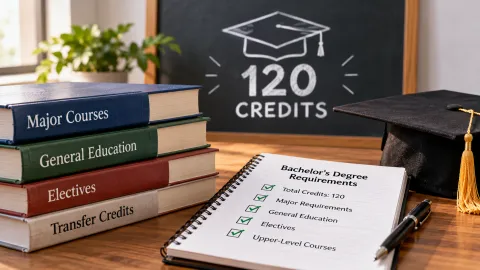
Some current programs use 90 or 96 credits instead of the traditional 120-credit structure commonly associated with bachelor's degrees.
Johnson & Wales University, for example, describes three-year bachelor's programs requiring 90–96 credits. Its three-year curriculum can reduce or eliminate some elective requirements while retaining required academic and experiential components.
Arizona State University similarly describes a three-year Bachelor of Education program with a minimum of 90 credits.
This model is different from simply squeezing a conventional 120-credit degree into three years.
The college has intentionally designed the academic program around a shorter completion period.
Accelerated traditional-credit programs
Another approach is to keep a larger credit requirement but arrange courses so students complete them faster.
For example, a college might use heavier course loads, additional academic terms, or other scheduling strategies.
In this situation, the degree may still involve a substantial number of credits even though the student completes them in roughly three years.
That is why students should not assume that “three-year” and “90-credit” are interchangeable terms.
Summer or year-round study
Some accelerated programs use summer coursework to reduce the amount of time needed to complete the degree.
Instead of treating summer as a long break, students may take required courses during summer sessions.
Other programs may be designed so that summer attendance is not mandatory.
For example, Johnson & Wales states that its three-year bachelor's programs do not require summer classes.
The only way to know what applies to a particular program is to examine its published academic calendar and degree plan.
Using prior or transfer credits
Students can sometimes reach the three-year finish line without taking an unusually large number of college courses each semester.
AP, IB, dual-enrollment, and eligible transfer credits can reduce the number of credits a student needs to complete after enrolling.
This can be particularly useful for students entering college with substantial qualifying credit.
However, colleges determine which credits they accept and how those credits apply toward a particular degree.
A credit that counts toward overall graduation requirements may not necessarily satisfy a specific major or prerequisite.
Does a Three-Year Degree Always Mean 90 Credits?
No.
This is one of the most important points to understand before comparing programs.
A three-year bachelor's degree describes the expected completion timeframe, not a universal credit requirement.
Some programs use 90 credits. Others use 96 credits. Some may use different credit structures or reach the three-year timeline through acceleration, prior credits, summer coursework, or other academic scheduling.
A traditional bachelor's degree is commonly associated with 120 credits in the U.S., but there is no universal rule that every three-year bachelor's degree must contain exactly 90 credits.
The safest approach is to ask the college for the official degree plan and determine:
-
How many total credits are required?
-
How many credits are required in the major?
-
How many general education credits are required?
-
How many electives are included?
-
How many credits can come from AP, IB, dual enrollment, or transfer?
-
Are summer courses required?
-
How many courses must be taken during each term?
Those answers tell you much more than the program's marketing description.
Three-Year vs. Four-Year Bachelor's Degree
The biggest difference is usually the amount of time and the structure used to reach graduation.
| Factor | Three-Year Bachelor's | Traditional Four-Year Bachelor's |
|---|---|---|
| Typical completion timeframe | About 3 years | About 4 years |
| Credit structure | Varies by program | Often around 120 credits |
| Course intensity | May be more concentrated | Usually more spread out |
| Summer classes | May or may not be required | Often optional depending on program |
| Electives | May be more limited | Often provides more room for electives |
| Flexibility | Can be more structured | Usually more time for exploration |
| Cost | May be lower, but not guaranteed | More years can mean additional expenses |
| Major changes | Can be harder to accommodate | Usually provides more time to change direction |
| Graduation timing | Earlier | Later |
| Graduate school | Depends on program requirements | Generally follows the conventional pathway |
The table is a general comparison, not a guarantee about every college.
Individual programs can differ significantly.
Can a Three-Year Degree Actually Save Money?
It can, but you should treat cost savings as a possibility rather than a guarantee.
The obvious potential advantage is time.
If a student completes a degree one year earlier, they may avoid some costs associated with another year of college. Depending on the student's circumstances, those costs could include:
-
Tuition
-
Mandatory fees
-
Housing
-
Meal plans
-
Transportation
-
Books and course materials
-
Other campus expenses
There may also be an opportunity-cost benefit.
A student who graduates earlier may be able to enter full-time employment sooner or continue into graduate education sooner.
But these potential savings need to be weighed against the actual cost of the three-year program.
Compare the total cost, not just tuition
Suppose two programs have different structures.
The three-year program may have fewer total credits, but the student could have a heavier academic schedule. Another program might have a different tuition model or financial-aid structure.
The relevant comparison is the total amount the student expects to pay and borrow—not simply the number of years printed on the program description.
Before enrolling, compare:
Total tuition + mandatory fees + housing + other major education costs − applicable financial aid
Do this separately for the three-year and four-year options.
Also consider whether living arrangements change after graduation.
For some students, the financial difference may be significant. For others, the difference may be much smaller than expected.
Financial Aid Requires a Program-Specific Check
A three-year program should not automatically be assumed to have the same financial-aid situation as a traditional four-year program.
Federal Student Aid rules depend on factors including the student's program, enrollment, eligibility, and institution.
The Federal Student Aid Handbook explains that undergraduate programs can have published lengths that differ from the typical four-year bachelor's structure when the academic design supports that length.
That means students should ask the college's financial-aid office how the specific three-year program is treated.
Questions to ask include:
-
Is the program eligible for the financial aid I expect to use?
-
How is enrollment status determined each term?
-
How does the program's academic calendar affect aid?
-
What happens if I need an additional semester?
-
How are transfer or AP credits treated?
-
What happens to my aid if I change majors?
Do not make a financial decision based solely on an advertised three-year tuition figure.
Are Three-Year Bachelor's Degrees Legitimate?
A three-year bachelor's degree can be a legitimate U.S. bachelor's degree, but legitimacy should be evaluated at the institution and program level.
The U.S. Department of Education does not directly accredit colleges. Instead, it recognizes accrediting agencies and maintains information about accredited institutions and programs.
That distinction matters.
A shorter degree is not automatically less legitimate because it takes three years. Likewise, a program should not be considered legitimate simply because a college calls it a “three-year bachelor's degree.”
Before enrolling, verify the institution's accreditation and understand whether your particular field has additional accreditation or professional requirements.
This is especially important for programs that lead toward regulated professions.
What About Graduate School?
A three-year bachelor's degree does not automatically prevent you from pursuing graduate school.
However, graduate-school eligibility is determined by the requirements of the specific institution and program.
A student planning to attend graduate school should check those requirements before committing to an accelerated undergraduate pathway.
Important questions include:
-
Does the graduate program require a bachelor's degree from an accredited institution?
-
Is there a minimum number of undergraduate credits?
-
Are particular prerequisite courses required?
-
Does the program require specific coursework in the intended field?
-
Are there professional or programmatic accreditation requirements?
-
Will the graduate school evaluate the degree structure differently?
This is particularly important if you already know that you want to enter a competitive or professionally regulated field.
Do not rely on a general statement that “three-year degrees are accepted.”
Check the exact graduate programs you are likely to apply to.
Who Is a Three-Year Bachelor's Degree Best For?
A three-year program may be a strong fit for a student who has a clear academic and career direction.
It may be worth considering if you:
-
Know what major you want
-
Are comfortable with a concentrated academic schedule
-
Want to graduate earlier
-
Have substantial AP, IB, dual-enrollment, or transfer credits
-
Prefer a structured curriculum
-
Have compared the total cost carefully
-
Have confirmed that the degree meets your future education or career requirements
-
Do not need a large number of electives
For example, a student who enters college with substantial prior credit and already knows the field they want to pursue may have less need for four years of academic flexibility.
A three-year program can also appeal to students who want to move into the workforce or graduate school sooner.
Who May Be Better Off With a Four-Year Degree?
A traditional four-year program may be a better fit if you want more room to explore.
That can matter when you are:
-
Undecided about your major
-
Considering changing majors
-
Interested in multiple fields
-
Looking for extensive elective coursework
-
Planning a study-abroad experience
-
Balancing school with other responsibilities
-
Interested in a program with substantial internship or experiential requirements
-
Unsure about graduate-school or professional requirements
Time has value beyond the cost of tuition.
An additional year can give a student more opportunities to take electives, change academic direction, complete internships, build relationships, or explore subjects outside the major.
A faster degree is not automatically a better degree if the compressed schedule removes opportunities that are important to your goals.
What Happens If You Change Majors?
Changing majors deserves special attention when evaluating a three-year program.
An accelerated degree can have a carefully sequenced curriculum. Courses may be offered only during particular terms, and the program may contain fewer elective credits.
In a traditional four-year program, a student may have more time to absorb the consequences of changing direction.
In a three-year program, changing majors could potentially mean that some completed courses do not apply efficiently to the new degree plan.
Before enrolling, ask:
-
What happens if I change majors?
-
Which completed courses would count toward another major?
-
Would changing majors add a semester or year?
-
Are required courses offered every term?
-
Can I switch into a four-year pathway without losing progress?
This is an especially important question for students who are not completely certain about their academic direction.
What About Internships and Experiential Learning?
Finishing sooner does not necessarily mean giving up practical experience.
Some three-year programs intentionally build experiential learning into the curriculum.
For example, Johnson & Wales University's three-year programs include work-integrated learning requirements, with its catalog describing 600 hours of work-integrated learning.
That illustrates an important point: the quality of a three-year program should not be judged solely by how many credits it removes or how quickly it gets students to graduation.
Look at what the curriculum actually includes.
A strong program should still provide an appropriate combination of academic coursework and relevant preparation for the student's next step.
Three-Year Bachelor's Degrees and Professional Licensing
Students entering fields with professional licensing requirements need to be especially careful.
Some careers have requirements that go beyond simply holding a bachelor's degree. Depending on the profession, students may need specific coursework, supervised experience, examinations, clinical hours, or other requirements.
That means a three-year program should be evaluated against the requirements of the career—not simply against the number of years required to graduate.
Before choosing an accelerated pathway, check the requirements of the relevant licensing authority or professional organization.
If the degree is intended to lead to a regulated profession, confirming those requirements before enrollment can prevent an expensive change of direction later.
How to Evaluate a Three-Year Bachelor's Program
A useful way to compare programs is to use the same checklist for every college you are considering.
1. Check the total credits
Do not assume that three years means 90 credits.
Find the exact graduation requirement.
2. Review the complete curriculum
Look at the major requirements, general education, electives, prerequisites, and experiential requirements.
A program can look short on paper while still requiring a demanding course schedule.
3. Check the academic calendar
Determine whether the program requires:
-
Fall enrollment
-
Spring enrollment
-
Summer courses
-
Additional terms
-
Heavy course loads
The schedule can affect both workload and cost.
4. Verify accreditation
Use reliable accreditation information and confirm the institution's current status.
The U.S. Department of Education provides an accreditation database that can help with this verification.
5. Check transfer and prior-credit policies
If you have AP, IB, dual-enrollment, or previous college credits, find out exactly how they will apply.
Do not assume every credit will satisfy a major requirement.
6. Compare total costs
Look at tuition, fees, housing, financial aid, books, transportation, and other significant expenses.
Then compare the expected total cost with a traditional four-year alternative.
7. Check graduate-school requirements
If graduate school is part of your plan, review the requirements of programs you may eventually apply to.
8. Check career and licensing requirements
For regulated professions, verify the relevant educational and professional requirements before enrolling.
9. Ask what happens if plans change
Find out whether you can switch majors, move to a four-year track, take a semester off, or extend the program without creating major problems.
10. Look at what you give up
A three-year degree may save time, but consider whether you are giving up electives, internships, study abroad, research opportunities, or flexibility that matter to you.
A Simple Decision Framework
If you are deciding between a three-year and four-year bachelor's degree, consider these five questions:
| Question | Why it matters |
|---|---|
| Can I handle the academic pace? | Accelerated programs may require a concentrated schedule. |
| Does the curriculum fit my career goal? | A shorter program is useful only if it provides the preparation you need. |
| Does the degree meet future requirements? | Graduate schools and licensed professions can have specific requirements. |
| Is the total cost actually lower? | Fewer years do not automatically mean proportionally lower costs. |
| Do I need the flexibility of four years? | More time can make changing majors and exploring options easier. |
If the answer to all five points is favorable, a three-year program may be worth serious consideration.
If several answers are uncertain, the traditional four-year route may provide more flexibility.
Three-Year U.S. Degrees vs. Three-Year Degrees Earned Abroad
The phrase “three-year bachelor's degree” can mean different things depending on the education system.
A three-year bachelor's program at a U.S. institution is not automatically equivalent to a three-year degree earned abroad.
Different countries can use different credit systems, academic structures, degree requirements, and recognition standards.
This distinction matters if you are evaluating a degree for:
-
U.S. graduate school
-
Employment
-
Professional licensing
-
Transfer to another institution
-
Credential evaluation
If you are comparing a U.S. three-year bachelor's program with a foreign degree, evaluate the specific credential and the requirements of the organization that will receive it.
Do not assume that the number of years alone determines equivalency.
What to Check Before You Enroll
Before signing up for a three-year bachelor's program, get the answers to these questions in writing from the institution when possible:
-
What is the exact total number of credits?
-
Is the degree specifically designed as a three-year program?
-
Is summer enrollment required?
-
How many credits are expected each term?
-
Which courses are required?
-
How many electives are available?
-
Which AP, IB, dual-enrollment, or transfer credits are accepted?
-
Can credits apply to major requirements?
-
What happens if I change majors?
-
What happens if I need an additional semester?
-
What financial aid is available for the program?
-
What is the estimated total cost?
-
Is the institution accredited?
-
Does my intended graduate program accept this degree structure?
-
Does my intended career or licensing pathway have additional requirements?
-
Are internships or experiential learning included?
If a college cannot clearly explain the program structure, cost, credit requirements, and pathway to graduation, that is a reason to slow down and investigate further.
Where to Research a College Before Choosing a Program
Several U.S. resources can help students perform basic due diligence.
U.S. Department of Education Accreditation Database
The Department of Education maintains an accreditation database that can help students verify institutional and program accreditation information.
Remember that the Department itself does not accredit colleges. It recognizes accrediting agencies and provides accreditation information.
College Scorecard
College Scorecard is a U.S. Department of Education resource for researching colleges and comparing information about institutions and their programs.
It can be useful as one part of the research process, particularly when comparing schools and investigating education and cost-related information.
However, students should still confirm current program details directly with the college because individual program structures and policies can change.
College Navigator
College Navigator, operated by the National Center for Education Statistics, is another resource for researching U.S. colleges.
It can help students investigate institutions and compare basic college information before narrowing their choices.
These resources are useful starting points, but they do not replace reading the college's current degree plan and speaking with the appropriate admissions, academic advising, or financial-aid office.
Conclusion
A three-year bachelor's degree can be a legitimate and useful alternative to the traditional four-year college path, but the phrase “three-year degree” does not tell you enough by itself.
Some programs reduce the number of required credits. Others accelerate a larger curriculum through scheduling, summer study, prior credits, or other approaches. Some programs provide a highly structured pathway designed around a particular major or career.
The potential advantage is clear: finishing earlier can give students more time to move into employment, graduate education, or the next stage of their lives, and it may reduce some of the costs associated with an additional year of college.
But neither outcome is guaranteed.
The best choice depends on the actual curriculum, total credits, schedule, financial-aid situation, total cost, flexibility, and your long-term education and career plans.
Before choosing a three-year bachelor's program, compare it directly with a four-year alternative and verify the details that matter most: what you will study, how many credits you will complete, what you will pay, what happens if your plans change, and whether the degree meets the requirements for whatever you want to do next.
Frequently asked questions
Is a 3-year bachelor’s the same as a 4-year bachelor’s?
A three-year bachelor’s can lead to the same level of undergraduate degree, but the program structure may be different. Some programs reduce the number of credits, while others accelerate a more traditional credit load. Students should check the specific institution’s curriculum, accreditation, and degree requirements.
Do all 3-year bachelor’s degrees require 90 credits?
No. A three-year bachelor’s does not automatically mean a 90-credit degree. Some current U.S. programs use 90 or 96 credits, while other programs may reach three years through accelerated scheduling, transfer or prior-learning credits, summer study, or other program structures.
Can you go to graduate school after a 3-year bachelor’s?
Potentially, yes, but graduate-school requirements vary by institution and program. Students planning to attend graduate school should check the specific program’s requirements before choosing a three-year bachelor’s, including any credit, degree, prerequisite, or professional-accreditation requirements.
Do 3-year bachelor’s programs require summer classes?
Not always. Some programs use summer classes or year-round schedules to accelerate completion, while others are structured around regular academic terms. Students should check the exact calendar and required enrollment schedule for the program they are considering.
Are 3-year bachelor’s degrees cheaper than 4-year degrees?
They can be, but shorter completion does not guarantee lower total cost. Students should compare tuition, fees, housing, financial aid, course requirements, and other expenses for the specific three-year and four-year programs.
Are 3-year bachelor’s degrees accepted by employers?
A legitimate, appropriately accredited U.S. bachelor’s degree can be considered by employers, but employer requirements vary by field and position. Students entering regulated professions should also check any applicable licensing or professional requirements.
Can AP, IB, or transfer credits help finish a bachelor’s degree in 3 years?Yes, depending on the institution and program. AP, IB, dual-enrollment, and eligible transfer credits may reduce the number of courses a student needs to complete at the college, but credit policies vary.
Yes, depending on the institution and program. AP, IB, dual-enrollment, and eligible transfer credits may reduce the number of courses a student needs to complete at the college, but credit policies vary.
Are U.S. 3-year bachelor’s degrees the same as 3-year degrees earned abroad?
1. No. A three-year U.S. bachelor’s program and a three-year degree earned in another country can have different structures, credit systems, and recognition requirements. Students should evaluate the specific degree and the requirements of any U.S. graduate school, employer, or licensing body they plan to apply to.
Emily Carter writes practical, reader-focused content about education, college planning, degrees, financial aid, career paths, and the transition from school to work. She focuses on making complicated education and caree...