Certificate vs. Certification: What’s the Difference and Which Should You Choose?
Learn the difference between an educational certificate, professional certification, and occupational license. This guide explains how each credential is earned, what it proves, whether it expires, and how to choose the right option for your education or career goal in the U.S.
 By Emily Carter
In this article
- Certificate vs. Certification: The Short Answer
- What Is a Certificate?
- Who Awards Certificates?
- What Does a Certificate Prove?
- Do Certificates Expire?
- What Is a Professional Certification?
- Who Issues Certifications?
- Do Certifications Require an Exam?
- Do Certifications Expire?
- Certificate vs. Certification: What Is the Real Difference?
- Certificate vs. Certification vs. License
- Can a Certificate or Certification Count Toward College Credit?
- Can a Certificate Prepare You for a Certification?
- Which Should You Choose: a Certificate or Certification?
- Choose a Certificate When Your Main Goal Is Education or Skill Development
- Choose a Certification When Your Goal Is Professional Competency Validation
- You May Need Both
- How to Check Whether a Certification Is Legitimate
- 1. Identify the Issuing Organization
- 2. Check the Eligibility Requirements
- 3. Understand How Competency Is Assessed
- 4. Check Renewal Requirements
- 5. Check Whether It Fits Your Target Career
- 6. Do Not Judge It by the Name Alone
- Common Mistakes to Avoid
- Mistake 1: Treating a Certificate and Certification as Synonyms
- Mistake 2: Assuming Certification Is Always Better
- Mistake 3: Assuming Every Certification Has the Same Requirements
- Mistake 4: Assuming a Certificate Automatically Gives College Credit
- Mistake 5: Confusing Certification With Licensing
- Mistake 6: Paying for a Credential Without Checking Its Career Relevance
- How to Make the Decision
- What About State Differences?
- Certificate vs. Certification: The Bottom Line
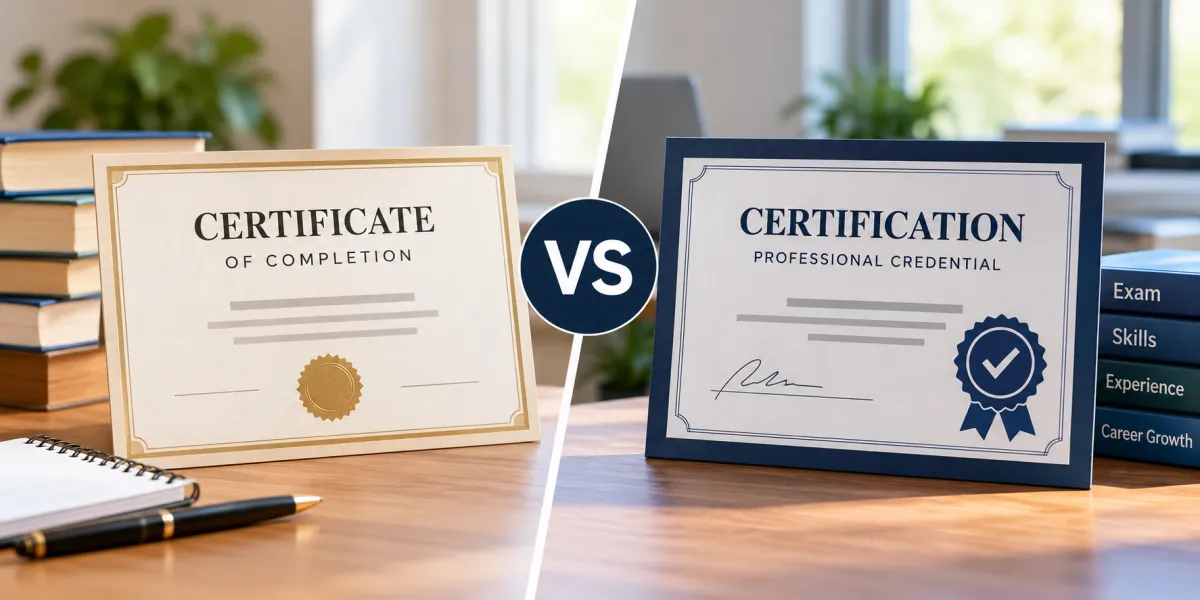
A certificate and a certification can sound like the same thing, but they serve different purposes in education and the workplace. In the U.S., an educational certificate generally shows that you completed a defined course or program, while a professional certification generally demonstrates that you met a defined competency standard through an examination or another formal assessment.
The difference matters because the credential you choose should match your actual goal. Someone trying to learn new skills may benefit from a certificate program, while someone who needs to demonstrate professional competence for a particular occupation may need a certification. Some people may benefit from earning both.
There is also a third credential that should not be confused with either one: an occupational license. A license is generally issued by a government agency and can provide legal authority to practice an occupation, while a professional certification generally does not.
Certificate vs. Certification: The Short Answer
The simplest distinction is completion versus competency.
An educational certificate generally documents that you completed the requirements of a particular course or program. The U.S. Department of Labor describes certificates as completion-based credentials associated with participation in a defined course of study.
A professional certification generally validates that an individual has demonstrated specified knowledge, skills, or abilities. Depending on the credential, this can involve an examination or another formal demonstration of competence, and some certifications also have work-experience or eligibility requirements.
That means neither credential is automatically "better." The right choice depends on what you are trying to accomplish.
| Feature | Educational Certificate | Professional Certification |
|---|---|---|
| Main purpose | Shows completion of a course or program | Demonstrates defined professional competence |
| Typical issuer | College, university, trade school, or training provider | Certification body, industry association, or professional association |
| How it is earned | Complete the required program or coursework | Meet eligibility requirements and complete the required assessment or other requirements |
| Exam | Not necessarily | Often involves an exam or formal competency assessment |
| Work experience | Usually depends on the program | Some certifications require experience |
| Renewal | Educational certificates typically do not expire | Professional certifications may require renewal |
| Main value | Education, training, and skill development | Validation of occupation-specific skills or competence |
| Legal authority to practice | No | Generally no |
| Best choice | When you need structured education or training | When a recognized professional credential is relevant to your career goal |
The exact rules always depend on the specific credential. A credential's name alone does not tell you everything about what it represents.
What Is a Certificate?
An educational certificate is a credential awarded after you complete the requirements of a defined educational or training program.
For example, a community college, university, trade school, or training provider may offer a certificate program focused on a particular subject or occupational area. Completing the program can give you a certificate documenting that achievement.
The U.S. Bureau of Labor Statistics distinguishes educational certificates from professional certifications and licenses. BLS describes educational certificates as credentials issued by an educational institution or training provider that certify completion of an occupation-specific program of study. Educational certificates typically do not expire.
The important word is completion.
A certificate can show that you completed a structured program, but it does not automatically mean that you have met a professional certification body's competency requirements.
Who Awards Certificates?
Educational certificates can come from institutions such as:
-
Community colleges
-
Four-year colleges and universities
-
Trade schools
-
Career and technical education providers
-
Other educational or training providers
The issuing organization matters. A certificate from an established educational institution may represent a substantial program of study, while another certificate might simply document participation in a short course.
That is why it is not enough to look at the word "certificate." You should investigate what the credential actually requires and who awards it.
What Does a Certificate Prove?
A certificate generally proves that you completed the requirements of the program that issued it.
That could mean completing a series of courses, meeting attendance or coursework requirements, completing practical training, or satisfying another set of program requirements.
However, the certificate does not automatically prove that you hold a professional certification or an occupational license.
This distinction can be especially important when an employer lists a specific certification or license as a requirement. Completing a related educational certificate program may help you prepare for that credential, but it does not automatically substitute for it.
Do Certificates Expire?
Educational certificates typically do not expire. BLS specifically distinguishes educational certificates from certifications and licenses that are time-limited in its credential classifications.
Still, you should check the specific credential rather than assuming every document called a "certificate" follows the same rule.
The word certificate is used in different contexts, and some credentials with similar terminology may have different purposes or requirements.
What Is a Professional Certification?
A professional certification is a credential intended to demonstrate that an individual has met a defined standard of knowledge, skills, or abilities in a particular occupational or professional area.
The U.S. Department of Labor describes certification as attesting to competency through a comprehensive examination or demonstration and notes that a certification may also have a work-experience requirement.
BLS similarly describes certifications as credentials issued by certification bodies, industry associations, or professional associations that acknowledge occupation-specific skills and abilities.
The key idea is that certification is generally about demonstrating competence, rather than simply documenting that you completed a course.
Who Issues Certifications?
Professional certifications are generally issued by organizations such as:
-
Professional associations
-
Industry associations
-
Certification bodies
-
Other recognized professional organizations
The organization behind the credential is important because certification requirements and recognition can vary significantly.
Before paying for a certification, look beyond the credential's name. Find out who administers it, what standards it uses, who is eligible, how competency is assessed, and whether the credential is relevant to the jobs you want.
Do Certifications Require an Exam?
Many professional certifications involve an examination, but it is not accurate to assume that every certification uses exactly the same process.
Depending on the credential, certification requirements may include:
-
An examination
-
A practical or skills demonstration
-
Education or training prerequisites
-
Work experience
-
Application requirements
-
Continuing education
-
Renewal requirements
The U.S. Department of Labor specifically notes that certifications may demonstrate competence through examination or demonstration and may include work-experience requirements.
This is one reason completing certification training and becoming certified are not necessarily the same thing.
A training course can prepare you for a certification examination, for example, but completing the training does not automatically mean that you have earned the certification.
Do Certifications Expire?
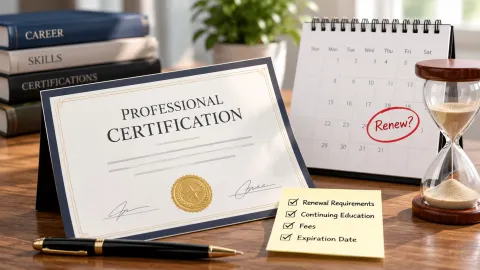
Professional certifications can be time-limited and may require renewal. BLS identifies certifications as credentials that expire if they are not renewed.
However, renewal rules are credential-specific.
A certification may require periodic renewal, continuing education, another assessment, or other conditions. Before choosing a certification, check its current requirements so you understand not only how to earn it but also what is required to maintain it.
Certificate vs. Certification: What Is the Real Difference?
The most useful way to compare the two is to ask what the credential is designed to demonstrate.
A certificate generally answers:
Did you complete this educational or training program?
A professional certification generally answers:
Have you demonstrated the knowledge or skills required by this certification standard?
Those questions can overlap, but they are not identical.
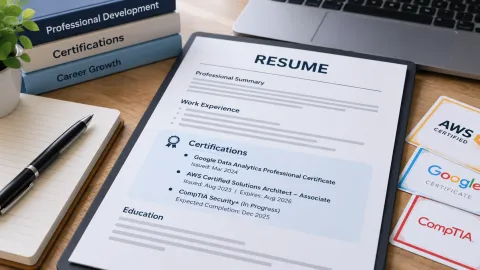
Consider someone who completes a six-month data analytics certificate program. The certificate can document completion of that program.
Now suppose that person also takes a professional certification examination administered by an industry certification organization and meets its eligibility requirements. The certification provides a different type of evidence: it indicates that the person satisfied that certification's competency requirements.
The two credentials can therefore complement each other rather than compete with each other.
Certificate vs. Certification vs. License
One of the most important distinctions is between certification and licensing.
A professional certification generally comes from a nongovernmental certification body and demonstrates competency. A license is generally issued by a government licensing agency and can provide legal authority to perform an occupation.
| Credential | Generally issued by | Main purpose | Legal authority to practice? |
|---|---|---|---|
| Educational certificate | Educational institution or training provider | Documents completion of a program | No |
| Professional certification | Certification body or professional association | Demonstrates defined competence | Generally no |
| Occupational license | Government licensing agency | Authorizes practice of a regulated occupation | Can provide legal authority |
| Degree | College or university | Demonstrates completion of a degree program | No, by itself |
Licensing requirements can also vary by state. CareerOneStop notes that occupational licenses are required by states for some jobs, while certifications are generally voluntary unless certification is incorporated into a licensing requirement.
This means you should not assume that earning a certification gives you permission to perform a regulated occupation.
If a job requires a license, research the licensing requirements for the state where you intend to work.
Can a Certificate or Certification Count Toward College Credit?
A certificate or certification does not automatically become college credit.
Whether a credential can contribute toward a degree depends on the specific college, program, and credential. Schools can have their own policies regarding transfer credit, prior learning, or other forms of credit recognition.
For students considering additional education, it helps to understand how college credits work before assuming that a certificate will shorten a degree program. KnowBrook's guide to college credit hours explains the basic concept of college credit and how it relates to academic programs.
Similarly, if your long-term goal is a bachelor's degree, review the specific bachelor's degree credit requirements for the program you are considering.
The safest approach is to ask the college directly:
-
Does the credential qualify for any academic credit?
-
Is the credit accepted for this specific degree program?
-
Is the credit transferable?
-
Are there limits on how much credit can be applied?
-
Does the school require an evaluation before awarding credit?
Do not pay for a certificate based solely on the assumption that it will automatically reduce the number of credits you need for a degree.
Can a Certificate Prepare You for a Certification?
Yes, a certificate program can sometimes be useful preparation for a professional certification.
For example, an educational program may teach the concepts and practical skills that you later need to demonstrate through a certification process.
But preparation and certification are different steps.
A useful way to think about the relationship is:
Education or training → preparation → certification requirements → certification
That sequence is not universal, but it illustrates an important distinction.
If a certification requires an examination, completing a related educational program may help you develop the necessary knowledge. You would still need to satisfy the certification organization's requirements.
Before enrolling in a certificate program for this purpose, compare the program's curriculum with the certification's actual eligibility and assessment requirements.
Which Should You Choose: a Certificate or Certification?
There is no universal winner.
The right credential depends on what you need the credential to accomplish.
Choose a Certificate When Your Main Goal Is Education or Skill Development
An educational certificate may make sense if you:
-
Want structured training in a specific subject
-
Need to build foundational knowledge
-
Are changing career direction and need additional education
-
Want a focused program without pursuing a full degree
-
Need training before pursuing another credential
-
Want to strengthen a particular skill set
For example, someone moving into a new field may choose a certificate program to gain structured knowledge before deciding whether additional credentials or a degree are necessary.
Choose a Certification When Your Goal Is Professional Competency Validation
A professional certification may make more sense when:
-
A target employer specifically values or requires it
-
The occupation uses a recognized certification standard
-
You already have the required education or experience
-
You need to demonstrate specific professional competencies
-
The certification is relevant to the work you actually want to perform
The important word is relevant.
A certification is not automatically valuable simply because it sounds professional. Its usefulness depends on its connection to the occupation, employer, and skills involved.
You May Need Both
There are situations where earning both can make sense.
A person might complete an educational certificate to develop knowledge and then pursue a professional certification to demonstrate competency against an industry or professional standard.
That combination can be especially logical when the certificate provides preparation for the certification but the two credentials serve different purposes.
The important thing is to avoid paying for credentials simply because you can collect them. Each credential should have a clear purpose in your education or career plan.
How to Check Whether a Certification Is Legitimate
The word "certification" by itself does not tell you whether a credential is worthwhile.
Before paying for a certification, investigate the credential carefully.
1. Identify the Issuing Organization
Find out exactly who awards the certification.
Is it a professional association, industry organization, certification body, educational institution, or another organization?
The issuing organization should be clearly identified.
2. Check the Eligibility Requirements
Look for specific requirements such as:
-
Education
-
Training
-
Work experience
-
Examination eligibility
-
Practical experience
-
Other prerequisites
A credible certification should clearly explain what candidates must do to qualify.
3. Understand How Competency Is Assessed
Find out how the certification determines whether someone has met its standard.
Does it use an examination? A practical assessment? A combination of requirements?
Do not assume that completing a course automatically results in certification.
4. Check Renewal Requirements
Determine whether the credential expires and what you must do to maintain it.
Possible requirements can include renewal applications, continuing education, additional assessments, or fees.
5. Check Whether It Fits Your Target Career
Ask whether the certification is actually relevant to the jobs you want.
Look at job postings in your target field and pay attention to the credentials employers mention. A credential that is highly relevant to one occupation may have little value for another.
6. Do Not Judge It by the Name Alone
This is an important point because credential terminology can be confusing.
BLS distinguishes credentials based on characteristics such as the issuing body and purpose rather than simply relying on the title used for the credential.
A credential called a "certificate" may have a different purpose from another credential using the same word. Likewise, the presence of the word "certification" does not by itself tell you how rigorous the credential is.
Look at what the credential actually requires.
Common Mistakes to Avoid
Choosing a credential becomes easier when you know what not to assume.
Mistake 1: Treating a Certificate and Certification as Synonyms
They can be related, but they generally serve different purposes.
A certificate usually documents completion of an educational or training program, while a professional certification generally validates defined competencies.
Mistake 2: Assuming Certification Is Always Better
Certification is not automatically better than a certificate.
If you need structured education, a certificate may be more appropriate. If an employer or profession values a specific competency credential, certification may be more relevant.
The decision should follow the career or education goal, not the perceived prestige of the word.
Mistake 3: Assuming Every Certification Has the Same Requirements
Certification requirements vary.
Some may involve examinations, while others may include additional eligibility requirements or demonstrations of competence. Work experience can also be part of the requirements for some certifications.
Always review the requirements for the specific certification.
Mistake 4: Assuming a Certificate Automatically Gives College Credit
A certificate and college credit are not the same thing.
If you want to use a certificate as part of a future degree pathway, confirm the school's policy before enrolling.
Mistake 5: Confusing Certification With Licensing
A certification generally demonstrates professional competence. A government-issued license can provide legal authority to practice a regulated occupation.
If the occupation is regulated, determine whether your state requires a license.
Mistake 6: Paying for a Credential Without Checking Its Career Relevance
A credential can require significant time and money.
Before enrolling, ask:
-
Will this credential help with the jobs I want?
-
Do employers in my target field recognize it?
-
Is it required, preferred, or simply optional?
-
What are the total costs?
-
How long will it take?
-
Does it expire?
-
What are the renewal requirements?
-
Does it require prior education or work experience?
These questions can prevent you from choosing a credential that looks useful but does not solve your actual problem.
How to Make the Decision
A simple decision process can help you narrow your options.
Start with the job or education goal, not the credential name.
If you are trying to learn a subject or build a new skill, investigate relevant certificate programs.
If you already have appropriate education or experience and need to demonstrate professional competency, investigate certifications used in your target occupation.
If the occupation is regulated, determine whether you need a state or other government-issued license.
Then compare the specific credentials based on:
| Decision Factor | What to Ask |
|---|---|
| Goal | What do I want this credential to help me accomplish? |
| Employer relevance | Do employers in my target field recognize or request it? |
| Requirements | What education, experience, training, or testing is required? |
| Assessment | How is competency or completion evaluated? |
| Cost | What will I pay for training, testing, applications, and renewal? |
| Time | How long will it take to complete? |
| Renewal | Does the credential expire or require maintenance? |
| Education pathway | Could it support a longer-term education plan? |
| Licensing | Is a government-issued license also required? |
| Recognition | Who issues the credential, and how relevant is that organization to the field? |
This approach is more useful than simply searching for the credential with the most impressive-sounding title.
What About State Differences?
State differences matter most when you are dealing with occupational licensing.
CareerOneStop notes that license requirements can vary by state and provides a License Finder for researching occupational licensing requirements.
For example, an occupation may have different licensing requirements depending on where you intend to work. A professional certification may be relevant to the occupation, but that does not necessarily mean it replaces a state license.
If you are entering a regulated profession, check the requirements in the state where you plan to work before choosing your education or certification pathway.
For a broader education pathway, you may also want to understand how adults can continue their education after completing prior coursework or credentials. KnowBrook's guide to degree completion programs explains one pathway for adults who want to continue toward a bachelor's degree.
Certificate vs. Certification: The Bottom Line
A certificate generally documents completion of an educational or training program. A professional certification generally demonstrates that you have met a defined competency standard, often through an examination or another formal assessment. A license is different again because it is generally issued by a government agency and can provide legal authority to practice an occupation.
The best choice depends on your goal.
If you need education or structured training, start by evaluating relevant certificate programs. If you need to demonstrate professional competence, research certifications that are actually recognized and relevant in your field. If the occupation is regulated, check whether you also need a state license.
Most importantly, do not choose a credential based only on its title. Look at who issues it, what it requires, what it demonstrates, whether employers value it, whether it needs renewal, and how it fits into your longer-term education or career plan.
A well-chosen credential should solve a specific problem in your career or education pathway—not simply add another line to your résumé.
Frequently asked questions
Is a certificate the same as a certification?
No. An educational certificate generally shows that you completed a defined course or training program. A professional certification generally validates that you meet a defined competency standard through an examination or another formal demonstration, depending on the credential. The exact requirements vary by certification.
Do you need an exam to earn a certification?
Many professional certifications use an exam or another formal competency assessment, but requirements vary by certification. Some may also require education, work experience, training, or other eligibility requirements.
Do certificates expire?
Educational certificates typically do not expire because they document completion of a program. However, requirements can vary by credential, so readers should check the specific certificate and issuing institution.
Can you earn a certificate and a certification at the same time?
Yes. A person can complete an educational certificate program and separately earn a professional certification if they meet the certification's requirements. Completing a certificate program does not automatically mean that you are professionally certified.
Is a certification the same as a professional license?
No. A professional license is generally issued by a government agency and can provide legal authority to perform an occupation. A certification is generally issued by a certification body, professional association, or industry organization and generally does not provide legal authority to practice an occupation.
Can a certificate or certification count toward college credit?
It depends on the college, program, and credential. A certificate or certification does not automatically transfer into college credit. Students should ask the specific college or program whether the credential can be applied toward its credit requirements.
Which is better for getting a job: a certificate or certification?
Neither is universally better. The better choice depends on the occupation, employer, job requirements, and purpose of the credential. A certificate may be useful for building knowledge or completing career-focused training, while a relevant professional certification may demonstrate that you meet a defined competency standard.
How can you tell if a certification is legitimate?
1. Check who issues the certification, what eligibility requirements apply, how competency is assessed, whether work experience or training is required, how renewal works, and whether employers or the relevant industry recognize the credential. Do not judge a credential only by whether its name contains the word “certificate” or “certification.”
Emily Carter writes practical, reader-focused content about education, college planning, degrees, financial aid, career paths, and the transition from school to work. She focuses on making complicated education and caree...