What Is Digital Marketing? Channels, Tools, and How It Works
Learn what digital marketing is, how its major channels work, and how businesses use SEO, social media, email, paid advertising, and analytics tools. This beginner-friendly guide explains organic vs. paid marketing, common metrics, and practical examples for US small businesses.
In this article
- How Digital Marketing Works
- 1. Identify the target audience
- 2. Set a marketing goal
- 3. Choose the appropriate digital channels
- 4. Create and distribute content
- 5. Encourage a meaningful action
- 6. Measure and improve performance
- Types of Digital Marketing Channels
- Search Engine Optimization (SEO)
- Search Engine Marketing and Pay-Per-Click Advertising
- Social Media Marketing
- Content Marketing
- Email Marketing
- Display and Video Advertising
- Affiliate Marketing
- Organic vs. Paid Digital Marketing
- When organic marketing may be suitable
- When paid marketing may be suitable
- Can businesses combine organic and paid methods?
- Digital Marketing Channels vs. Digital Marketing Tools
- Common Digital Marketing Tools
- Google Search Console
- Google Analytics
- Google Ads
- Content Management Systems
- Email and Social Media Management Tools
- A Practical Digital Marketing Example for a US Small Business
- Website and local search visibility
- Social media content
- Email marketing
- Paid advertising
- Measuring results
- How to Measure Digital Marketing Performance
- Website traffic
- Impressions
- Clicks and click-through rate
- Leads and conversions
- Conversion rate
- Cost per lead and return on advertising spend
- How to Choose the Right Digital Marketing Channels
- Start with the audience
- Define the primary goal
- Consider the budget and available time
- Match the channel to the content
- Review performance and adjust
- Common Digital Marketing Misconceptions
- Digital marketing does not guarantee immediate results
- More traffic does not always mean better performance
- Digital marketing is not only advertising
- Digital marketing tools do not replace strategy
- Every business does not need every channel
- Conclusion
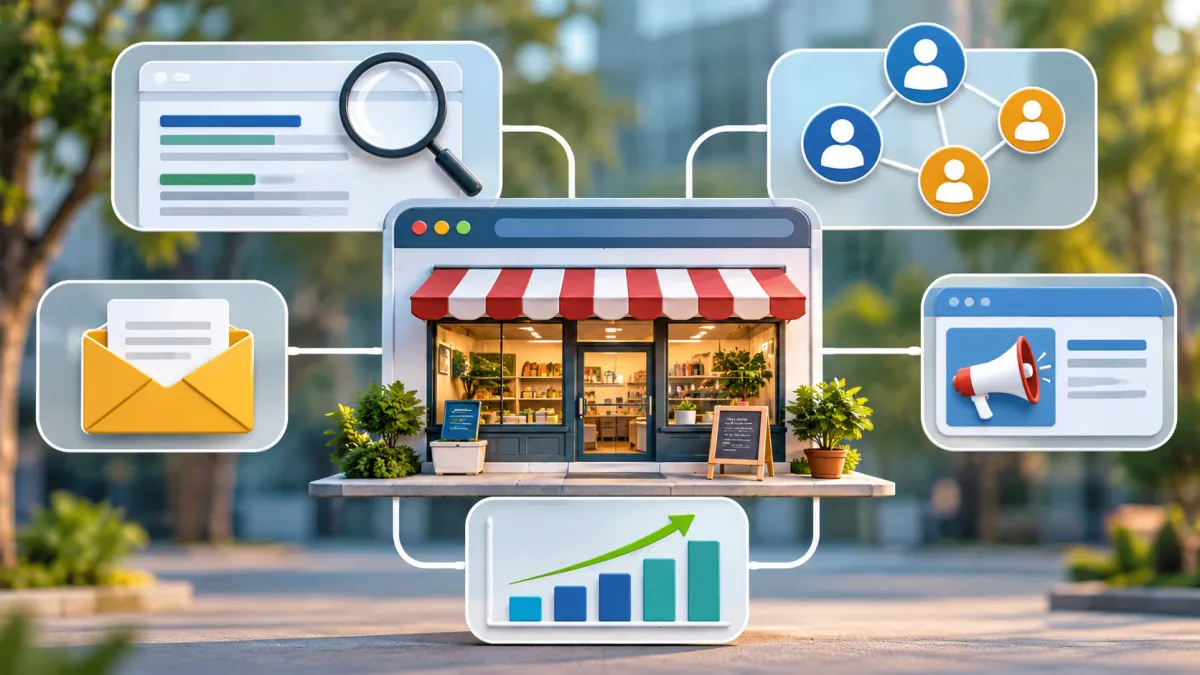
Digital marketing is the process of promoting products, services, or brands through digital channels such as search engines, websites, social media, email, and online advertising. It helps businesses connect with people who use the internet to find information, compare options, make purchases, or interact with brands.
For example, a local bakery in the United States might use Google Search to help nearby customers find its website, Instagram to showcase new products, email to announce seasonal offers, and online advertising to reach people in its service area. These activities are all forms of digital marketing, even though they use different platforms.
Digital marketing is not limited to large companies with extensive advertising budgets. Small businesses, nonprofit organizations, independent professionals, and individuals can use digital channels to reach specific audiences. The approach depends on the goal, available resources, and the people a business wants to reach.
Understanding how digital marketing works requires more than knowing the names of its channels. It also involves learning how those channels fit together, how businesses choose between organic and paid methods, which tools support marketing activities, and how results are measured.
How Digital Marketing Works
Digital marketing connects a business with an audience through online channels. A typical process involves identifying an audience, choosing appropriate channels, creating useful content or offers, encouraging a desired action, and measuring the results.
The process can be divided into several stages.
1. Identify the target audience
A business first needs to understand whom it wants to reach.
The target audience may be defined by factors such as:
-
Location
-
Age range
-
Interests
-
Needs or problems
-
Buying behavior
-
Search habits
-
Budget
For example, a home cleaning service in Chicago may focus on homeowners and renters in specific neighborhoods. A national online retailer may target customers across the United States.
Knowing the audience helps a business select relevant channels and create messages that address real needs.
2. Set a marketing goal
Digital marketing works best when activities are connected to a clear objective.
Common goals include:
-
Increasing website traffic
-
Generating leads
-
Selling products online
-
Getting more appointment bookings
-
Building brand awareness
-
Encouraging repeat purchases
-
Growing an email subscriber list
A business that wants more online sales may prioritize product pages, search visibility, and conversion optimization. A service business that relies on appointments may focus on local search, landing pages, and lead forms.
The goal influences which channels are worth using and which metrics matter.
3. Choose the appropriate digital channels
Businesses can use several channels, but they do not need to use all of them.
A company might use search engine optimization (SEO) to attract people looking for answers, social media to build awareness, email to communicate with existing customers, and paid advertising to reach a selected audience.
Channel selection should consider audience behavior, budget, the type of product or service, and the resources available to maintain each channel.
4. Create and distribute content
Digital marketing often involves creating content that helps or informs an audience.
Examples include:
-
Blog articles
-
Product descriptions
-
Videos
-
Social media posts
-
Email newsletters
-
Landing pages
-
Online advertisements
-
Guides and downloadable resources
Content should match the purpose of the channel. A detailed educational article may be useful for search traffic, while a short product video may work better on social media.
5. Encourage a meaningful action
Marketing content usually guides people toward a next step.
Depending on the goal, that action might be:
-
Visiting a website
-
Reading an article
-
Signing up for an email newsletter
-
Requesting a quote
-
Booking an appointment
-
Purchasing a product
-
Contacting a business
A clear next step helps connect marketing activity with a business objective.
6. Measure and improve performance
Businesses use analytics and reporting tools to understand how their marketing performs.
They may review website visits, search impressions, ad clicks, email engagement, leads, and sales. These measurements help identify which activities are contributing to the goal and where improvements may be needed.
Digital marketing is often an ongoing process. Businesses can test different content, adjust campaigns, refine their audience, or change their channel strategy based on results.
Types of Digital Marketing Channels
Digital marketing includes several channels, each with a different purpose. Some help people discover a business, others build relationships, and others encourage immediate action.
Search Engine Optimization (SEO)
Search engine optimization, commonly called SEO, is the practice of improving a website so that its pages can be discovered and understood by search engines and are useful to people searching for relevant information.
SEO can help businesses attract visitors from unpaid search results.
Common SEO activities include:
-
Creating helpful and relevant content
-
Using clear page titles and headings
-
Organizing website navigation
-
Improving page loading performance
-
Making pages accessible on mobile devices
-
Using descriptive internal links
-
Ensuring search engines can crawl important pages
-
Understanding the queries people use to find content
For example, a financial education website might publish an article explaining how a credit score works. Someone searching for that information may discover the article through Google Search.
SEO is not limited to blog posts. It can also apply to product pages, service pages, local business information, and other website content.
Organic search visibility is not guaranteed. Search rankings can change, and creating useful content does not automatically result in high rankings or traffic.
Search Engine Marketing and Pay-Per-Click Advertising
Search engine marketing often refers to paid efforts to gain visibility in search engines. One common approach is pay-per-click (PPC) advertising.
With PPC, an advertiser may pay when someone clicks an advertisement. Search ads can appear when people search for relevant products, services, or information.
For example, a plumbing company might run a paid search campaign for people looking for emergency plumbing services in its service area.
Paid search campaigns may involve:
-
Selecting relevant keywords
-
Writing advertisements
-
Choosing geographic or audience targeting
-
Setting a budget
-
Creating landing pages
-
Tracking conversions
PPC can provide visibility while a campaign is running, but it requires a budget. Advertising costs and results depend on factors such as competition, targeting, ad quality, and the offer.
Paid search is different from SEO. SEO focuses on earning visibility in organic results, while paid search uses advertising campaigns to gain sponsored placement.
Social Media Marketing
Social media marketing involves using platforms such as Facebook, Instagram, LinkedIn, TikTok, and other social networks to communicate with an audience.
Businesses use social media to:
-
Share content
-
Introduce products and services
-
Build brand awareness
-
Respond to customer questions
-
Share updates
-
Develop relationships with followers
-
Promote campaigns
A local bakery might publish photos of its cakes, share seasonal menu updates, and answer questions about custom orders.
Social media marketing can be organic or paid. Organic posts are shared without paying for advertising placement, while paid social campaigns use platform advertising systems to reach selected audiences.
The most appropriate platform depends on the audience and the type of content. A business does not necessarily need a presence on every social network.
Content Marketing
Content marketing focuses on creating and distributing useful, relevant content to attract and engage an audience.
Examples include:
-
Educational articles
-
How-to guides
-
Videos
-
Infographics
-
Case studies
-
Newsletters
-
Product comparison resources
Content marketing can support several other digital marketing channels. A blog article may attract visitors through SEO, be shared on social media, and become part of an email newsletter.
For example, a home improvement business might publish a guide explaining how homeowners can prepare their houses for winter. The guide can provide value to readers while helping them discover the company's services.
Content marketing is not simply publishing as much content as possible. The content should serve a specific audience and provide information that is genuinely useful.
Email Marketing
Email marketing uses email to communicate with subscribers, customers, or other people who have agreed to receive messages.
Businesses may send:
-
Newsletters
-
Product announcements
-
Promotional offers
-
Appointment reminders
-
Educational content
-
Customer updates
-
Follow-up messages
For example, a small online store might send an email announcing a new product collection to subscribers.
Email marketing can help businesses maintain communication with an existing audience. However, businesses should respect subscriber consent, applicable privacy requirements, and email marketing regulations.
A mailing list should not be treated as a collection of addresses to contact without permission.
Display and Video Advertising
Display advertising uses visual advertisements, such as banners or image-based placements, across websites and digital platforms.
Video advertising uses video content to promote a product, service, or brand. It may appear on video platforms, websites, social networks, or other digital placements.
These formats can help businesses communicate a message visually.
Examples include:
-
A banner promoting a seasonal sale
-
A video demonstrating how a product works
-
An advertisement introducing a service
-
A brand awareness campaign
Display and video advertising may be useful when a business wants to reach an audience beyond people actively searching for its product.
Performance depends on the audience, creative content, placement, budget, and campaign objectives.
Affiliate Marketing
Affiliate marketing is a marketing arrangement in which a business compensates an affiliate for generating specified results, such as sales or leads.
An affiliate may promote a product through a website, blog, social media account, or other digital channel.
For example, a website that reviews home appliances might include affiliate links to products. If a reader purchases through an eligible link, the website may earn a commission under the affiliate program's terms.
Affiliate marketing can help businesses work with publishers and creators who already have an audience.
Affiliates should disclose material relationships clearly and follow applicable advertising and consumer protection requirements.
Organic vs. Paid Digital Marketing
Digital marketing can be broadly divided into organic and paid activities.
Organic marketing focuses on earning attention without paying for each advertising placement. Paid marketing uses advertising budgets to obtain visibility or reach.
Neither approach is universally better. The right choice depends on the business goal, available budget, timeframe, and resources.
| Factor | Organic Digital Marketing | Paid Digital Marketing |
|---|---|---|
| Main approach | Earn visibility through content and engagement | Purchase advertising placement or reach |
| Examples | SEO, organic social posts, content marketing | Search ads, paid social, display ads |
| Direct advertising cost | Does not require paying for each placement | Requires an advertising budget |
| Other resources | Time, content creation, expertise, maintenance | Budget, campaign management, creative work |
| Visibility | May develop gradually and fluctuate | Can begin while campaigns are active |
| Control | Less control over search rankings and platform reach | More control over targeting, budgets, and campaign settings |
| Long-term potential | Useful content may continue attracting visitors | Visibility generally depends on continued campaign activity |
| Main limitation | Results are not guaranteed and may take time | Costs can increase without producing the desired outcome |
When organic marketing may be suitable
Organic marketing may be a good fit for businesses that want to build a long-term online presence and can invest in creating useful content.
A small business might begin by improving its website, publishing helpful articles, and maintaining a relevant social media presence.
Organic marketing is not entirely free. Content creation, website maintenance, and marketing expertise require time or money.
When paid marketing may be suitable
Paid marketing may be useful when a business needs to reach a defined audience, promote a particular offer, or test demand for a product or service.
For example, a local business may run a paid campaign to promote appointment availability during a specific period.
Paid advertising can generate visibility quickly, but it does not guarantee leads, sales, or profitability. Businesses should monitor campaign performance and avoid spending more than they can reasonably afford.
Can businesses combine organic and paid methods?
Yes. Many businesses use a combination.
A company may use SEO to build its website's organic visibility while running paid advertising for a particular promotion. Social media content may support brand awareness, while paid campaigns reach additional audiences.
The combination should be based on the business's goals rather than an assumption that every channel is necessary.
Digital Marketing Channels vs. Digital Marketing Tools
A digital marketing channel is the medium through which a business reaches an audience. A digital marketing tool is software or a service that helps the business perform, manage, or measure marketing activities.
The distinction is important because a tool does not automatically represent a marketing channel.
| Digital Marketing Channel | Example of a Supporting Tool | Purpose |
|---|---|---|
| Search engine optimization | Google Search Console | Understand search performance and indexing information |
| Website analytics | Google Analytics | Analyze website traffic and user interactions |
| Paid search advertising | Google Ads | Create and manage paid advertising campaigns |
| Email marketing | Email marketing platforms | Create, send, and manage email campaigns |
| Social media marketing | Social media management tools | Schedule, manage, or analyze social content |
| Content marketing | Content management systems | Create and publish website content |
A business may use several tools for one channel. For example, SEO work might involve a content management system, analytics software, and search performance reporting.
Likewise, one tool may support more than one marketing activity.
The tools a business needs depend on its size, objectives, budget, and technical requirements.
Common Digital Marketing Tools
Digital marketing tools help businesses manage campaigns, understand audiences, publish content, and measure performance.
The following resources can be useful for businesses and website owners.
Google Search Console
Google Search Console helps website owners monitor how their websites perform in Google Search.
It can provide information about:
-
Search clicks
-
Search impressions
-
Queries associated with website visibility
-
Page performance
-
Indexing issues
-
Certain technical search-related problems
Search Console is especially useful for website owners who want to understand how their content appears in Google Search.
However, it does not provide a complete picture of all marketing activities or every factor affecting a website's performance.
Google Analytics
Google Analytics helps businesses analyze website traffic and user interactions.
Depending on the setup, it can help a business understand:
-
Where visitors come from
-
Which pages people visit
-
How visitors interact with the website
-
Which events are recorded
-
Whether configured conversions occur
Analytics data depends on proper implementation and configuration. Businesses should not assume every visitor or conversion is captured perfectly.
Google Analytics can complement Search Console, but the two tools serve different purposes.
Google Ads
Google Ads is Google's advertising platform for creating and managing paid campaigns.
Businesses may use it to create search, display, video, and other supported advertising campaigns.
Google Ads can help advertisers manage budgets, targeting, and campaign performance. The available campaign formats and features may change over time.
Using Google Ads does not guarantee that a business will receive profitable traffic or sales. Campaign results depend on the offer, audience, competition, landing page, and other factors.
Content Management Systems
A content management system (CMS) allows users to create, edit, organize, and publish website content.
A business website may use a CMS to manage:
-
Blog articles
-
Product pages
-
Service pages
-
Landing pages
-
Images
-
Website navigation
A CMS is a publishing tool rather than a marketing channel. It supports the website that may be used for SEO, content marketing, paid campaigns, and other activities.
Email and Social Media Management Tools
Email and social media management tools can help businesses manage communications more efficiently.
Depending on the platform, features may include:
-
Email list management
-
Campaign creation
-
Content scheduling
-
Performance reporting
-
Subscriber management
-
Team collaboration
Businesses should choose tools that meet their needs instead of adopting software simply because it is popular.
A Practical Digital Marketing Example for a US Small Business
Consider a hypothetical neighborhood bakery in the United States that sells bread, pastries, cakes, and custom birthday orders.
The bakery wants to attract new customers and increase custom cake inquiries. It has a limited marketing budget and a small team.
A practical strategy might combine a few channels.
Website and local search visibility
The bakery creates a website with information about its products, business hours, location, and custom cake ordering process.
It publishes useful pages that explain its offerings. It also maintains accurate business information across relevant local platforms.
SEO and local visibility may help customers discover the bakery when searching for relevant products or services nearby. Visibility is not guaranteed, and local search results may vary.
Social media content
The bakery shares photos of its products, seasonal offerings, and decorating processes on a relevant social media platform.
Posts may help people learn about the bakery and see what it offers. The bakery can also respond to questions about orders and availability.
Email marketing
Customers who voluntarily subscribe to the bakery's email list may receive occasional updates about seasonal products, holiday orders, or special events.
The bakery should avoid sending messages to people who have not agreed to receive them.
Paid advertising
If the bakery wants to promote custom cake orders during a particular season, it might test a small paid advertising campaign targeting its service area.
The campaign could direct interested people to a page explaining the ordering process.
The bakery should monitor spending and the quality of inquiries before deciding whether to continue.
Measuring results
The bakery might track:
-
Website visits
-
Visits to the custom cake page
-
Calls or inquiry form submissions
-
Email sign-ups
-
Paid advertising clicks
-
Completed orders
These measurements help the bakery evaluate whether its marketing is supporting its goals.
This example illustrates an important point: the business does not need to use every digital marketing channel. It can begin with the channels that make sense for its audience, goals, and available resources.
How to Measure Digital Marketing Performance
Digital marketing metrics help businesses understand what is happening across their campaigns and websites.
The most useful metrics depend on the objective. A campaign intended to build awareness may require different measurements from a campaign intended to generate sales.
Website traffic
Website traffic measures visits or users, depending on the reporting system.
Businesses may examine traffic sources such as:
-
Organic search
-
Paid search
-
Social media
-
Email
-
Direct visits
-
Referral websites
Traffic can help show whether people are reaching a website. However, more traffic does not necessarily mean more customers or revenue.
Impressions
An impression generally represents an instance in which content or an advertisement is displayed.
Impressions may be useful for understanding visibility. They do not necessarily indicate that a person clicked, read, or interacted with the content.
Clicks and click-through rate
Clicks measure interactions that take people to a destination or engage with an item, depending on the platform.
Click-through rate (CTR) is commonly calculated as:
[
\text{CTR} = \frac{\text{Clicks}}{\text{Impressions}} \times 100
]
For example, if an advertisement receives 50 clicks from 1,000 impressions, its CTR is 5%.
CTR can help compare how often people click after seeing a particular result or advertisement. It should be interpreted alongside the campaign's objective and other metrics.
Leads and conversions
A lead is a potential customer who expresses interest in a business, such as by submitting a contact form or requesting a quote.
A conversion is a defined action that a business considers valuable. It might be a purchase, appointment booking, newsletter subscription, or lead submission.
Businesses should define conversions clearly and configure tracking appropriately.
Conversion rate
Conversion rate measures the proportion of users or visits that complete a desired action, based on the chosen measurement definition.
A simplified calculation is:
[
\text{Conversion Rate} = \frac{\text{Conversions}}{\text{Total Visitors or Visits}} \times 100
]
For example, if 20 people submit a form from 500 website visits, the conversion rate using visits as the denominator is 4%.
The denominator matters. A rate based on users may differ from a rate based on sessions or visits.
Cost per lead and return on advertising spend
For paid campaigns, businesses may also evaluate costs.
Cost per lead can be calculated as:
[
\text{Cost per Lead} = \frac{\text{Advertising Cost}}{\text{Number of Leads}}
]
Return on advertising spend (ROAS) compares advertising-attributed revenue with advertising cost:
[
\text{ROAS} = \frac{\text{Revenue Attributed to Ads}}{\text{Advertising Cost}}
]
ROAS is not the same as profit. It does not automatically account for product costs, labor, overhead, or other expenses.
A business should select metrics that help it make meaningful decisions rather than focusing on a single number.
How to Choose the Right Digital Marketing Channels
A business does not need to begin with a complex marketing strategy. It can make a more practical decision by considering its audience, objective, budget, and resources.
Start with the audience
Think about how potential customers discover products or services.
If people actively search for a solution, search marketing may be relevant. If they discover products through visual content or social networks, social media may be useful.
The audience's behavior should guide the channel choice.
Define the primary goal
A channel should be evaluated in relation to the intended outcome.
| Business Goal | Channels to Consider |
|---|---|
| Attract people searching for information | SEO and content marketing |
| Promote a time-sensitive offer | Paid search or paid social |
| Maintain communication with existing customers | Email marketing |
| Build awareness through visual content | Social media or video |
| Generate local service inquiries | Local search visibility, website landing pages, and targeted advertising |
| Explain a product or service in detail | Website content, video, or educational guides |
These are starting points, not guaranteed solutions. A business may need to test its approach.
Consider the budget and available time
Organic activities often require ongoing effort to create and maintain content. Paid advertising requires spending on placements and may also require campaign management.
A small business with limited resources may be better off maintaining a few channels consistently rather than spreading its efforts across many platforms.
Match the channel to the content
Different channels support different content formats.
A detailed article may be appropriate for explaining a complicated subject. A short video may help demonstrate a product. An email may be useful for communicating a direct update to subscribers.
The content should fit the audience and the purpose of the channel.
Review performance and adjust
Once marketing activities are underway, review the relevant metrics.
If a channel attracts visitors but does not lead to meaningful actions, the business may need to reconsider its content, offer, audience, or landing page.
If a channel consistently requires more resources than the business can maintain, it may be worth simplifying the strategy.
The goal is to develop a marketing approach that is useful, sustainable, and aligned with the business.
Common Digital Marketing Misconceptions
Digital marketing is often misunderstood, particularly by beginners. Several misconceptions can lead to unrealistic expectations.
Digital marketing does not guarantee immediate results
Paid campaigns can begin generating visibility while active, but meaningful results are not guaranteed.
Organic activities such as SEO and content marketing may require time, consistent effort, and adjustments. The timing depends on many factors, including competition, audience demand, and the quality of the work.
More traffic does not always mean better performance
A website may attract many visitors who are not interested in its products or services.
Relevant traffic and meaningful actions are generally more useful than traffic volume alone. Businesses should evaluate whether visitors are reaching the right pages and taking actions that support their objectives.
Digital marketing is not only advertising
Advertising is one part of digital marketing.
SEO, content marketing, email communication, social media engagement, website improvements, and analytics can also be part of a digital marketing strategy.
A business may use digital marketing without running paid advertisements.
Digital marketing tools do not replace strategy
Software can support marketing activities, but it cannot automatically determine the best audience, message, or business objective.
A business still needs to understand its customers, create relevant content, and evaluate its results.
Every business does not need every channel
Using more channels does not automatically improve performance.
A business should prioritize channels that are relevant to its audience and that it can manage effectively. Adding a channel without a clear purpose may create unnecessary work and expense.
Conclusion
Digital marketing is the use of digital channels to connect businesses, organizations, and individuals with relevant audiences. It includes SEO, search advertising, social media, content marketing, email, display and video advertising, and affiliate marketing.
Each channel serves a different purpose. Organic marketing can help businesses build visibility over time, while paid marketing can provide campaign-based reach. Tools such as Google Search Console, Google Analytics, and Google Ads help support and measure marketing activities, but they do not replace a clear strategy.
For a US small business, a sensible starting point is to identify its audience, choose a specific goal, select a few relevant channels, and track meaningful outcomes. A bakery may focus on local search, social media, and customer email updates, while a different business may need a different combination.
Digital marketing is most useful when it is built around the audience and the business objective—not around using every available platform or tool.
Frequently asked questions
1. Is digital marketing the same as online marketing?
Digital marketing and online marketing are often used interchangeably. Online marketing generally refers to promotion through the internet, such as search engines, websites, email, and social media. Digital marketing can sometimes be used more broadly to include digital technologies beyond internet-based channels. In everyday business use, the terms frequently overlap.
2. Can digital marketing be done without paid advertising?
Yes. Businesses can use organic approaches such as search engine optimization (SEO), helpful website content, unpaid social media posts, and email marketing to an existing audience. These methods do not require paying for each ad placement, but they still require time, effort, and sometimes software or other resources.
3. Is digital marketing only for businesses?
No. Individuals, creators, nonprofits, and organizations can also use digital marketing. They may use digital channels to share information, promote services, build an audience, support a cause, or communicate with people.
4. Does digital marketing require a website?
A website is useful but is not always required. Some individuals and businesses use social media profiles, online marketplaces, or other digital platforms to reach audiences. A website can provide greater control over content, customer experience, and business information.
5. Do digital marketing results happen immediately?
Not always. Paid campaigns may begin generating visibility soon after launch, while SEO and audience-building efforts often require more time. Results depend on factors such as the channel, audience, competition, budget, and execution. No channel guarantees a particular outcome or timeline.

Maya Thompson writes practical technology content covering consumer technology, software, online services, digital tools, cybersecurity basics, and everyday technology decisions. She focuses on explaining technical topic...