How Much Should You Budget for Groceries Each Month? A US Household Guide
Learn how much to budget for groceries each month based on household size, USDA food-cost estimates, and actual US spending data. Explore grocery budgets for individuals, couples, and families, calculate weekly spending limits, and find practical ways to manage food expenses.
In this article
- What Is a Reasonable Monthly Grocery Budget?
- Latest USDA Monthly Food-Cost Estimates
- Example monthly food costs for different age groups
- How to adjust USDA estimates for household size
- What the USDA estimates do not tell you
- How Much Should One Person Budget for Groceries?
- Why grocery shopping for one can cost more per person
- How Much Should a Couple Budget for Groceries?
- How couples can manage grocery costs together
- How Much Should a Family of Four Budget for Groceries?
- Why children's ages matter
- Make the family budget fit your actual routine
- USDA Estimates vs. What Americans Actually Spend
- Why the two sources can show different amounts
- How to Calculate Your Own Monthly Grocery Budget
- Step 1: Identify who the budget covers
- Step 2: Choose a USDA food-plan level
- Step 3: Calculate the household estimate
- Step 4: Review your grocery receipts
- Step 5: Choose a monthly target you can afford
- Step 6: Divide the monthly amount into weekly limits
- How to Fit Grocery Spending Into Your Income
- What Makes Grocery Costs Higher or Lower?
- Where you live
- What you buy
- How often you cook at home
- Dietary needs and preferences
- Food waste
- Practical Ways to Reduce Grocery Spending Without Sacrificing Nutrition
- Plan meals before making a shopping list
- Compare unit prices
- Use frozen and canned foods where appropriate
- Shop with a list and a spending limit
- Make leftovers part of the plan
- Limit shopping trips that are not planned
- Avoid cutting food quality just to meet a number
- How to Track Grocery Spending and Stay Within Budget
- Keep grocery spending separate from other purchases
- Record purchases throughout the month
- Use a budgeting app if it makes tracking easier
- Adjust your budget after reviewing actual spending
- Planning Groceries Around Biweekly Paychecks
- Official Resources for Building a Grocery Budget
- Conclusion
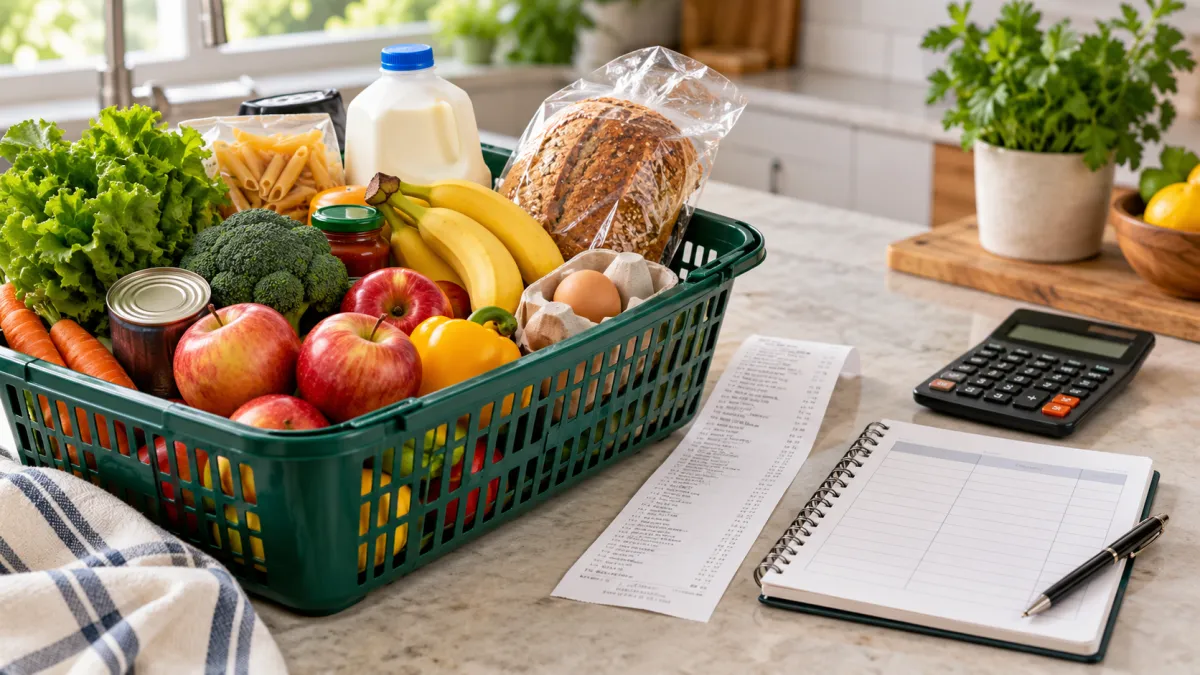
There is no single grocery budget that works for every American household. A single adult, a couple, and a family with children have different food needs, shopping habits, and costs. Your location, age, dietary needs, preferred stores, and how often you cook at home also affect what you spend.
A useful starting point is to compare your household's needs with the USDA's monthly food-cost estimates and then adjust the number using your actual grocery receipts. The USDA provides food-cost plans at different spending levels, while the Bureau of Labor Statistics (BLS) reports what consumer units actually spend on food at home.
These figures answer different questions: USDA estimates help you plan, while BLS data provide a picture of average reported spending. Neither figure automatically becomes the right budget for your household.
This guide explains how to estimate a monthly grocery budget for one person, a couple, or a family of four; how to turn a monthly amount into a weekly limit; and how to make the budget realistic without sacrificing balanced meals.
What Is a Reasonable Monthly Grocery Budget?
A reasonable grocery budget is an amount your household can spend on food prepared at home while covering its needs and staying within the money available after other essential expenses.
For a starting point, use the USDA food-cost plans. They provide four spending levels:
-
Thrifty: A lower-cost plan that requires careful meal planning and food choices.
-
Low-Cost: A relatively economical plan with more flexibility than the Thrifty plan.
-
Moderate-Cost: A middle spending level.
-
Liberal: A higher-cost plan with greater flexibility in food choices.
The USDA estimates are useful because they account for household members' ages and sexes rather than assuming that every person needs the same amount of food. However, they are planning estimates, not a guarantee of what groceries will cost at your local supermarket.
Your actual budget may be higher or lower depending on food preferences, local prices, cooking habits, and how much food your household wastes.
A practical approach is to:
-
Estimate your household's food needs.
-
Compare them with the appropriate USDA food-cost plan.
-
Review your recent grocery spending.
-
Choose a monthly amount that fits your take-home income.
-
Divide that amount into weekly shopping limits.
This gives you a starting budget based on both published estimates and your own circumstances.
Latest USDA Monthly Food-Cost Estimates
The US Department of Agriculture publishes a monthly report called the Cost of Food. It estimates the cost of food prepared at home under four food plans: Thrifty, Low-Cost, Moderate-Cost, and Liberal.
The September 2026 report is the latest report used for this article's research.
The USDA's figures are not simply a prediction of what every American will spend. They are calculated estimates based on food plans and household assumptions. They can help you understand how spending levels differ, but you should adjust them to reflect your household.
Example monthly food costs for different age groups
The following September 2026 figures illustrate the range of monthly costs for selected age groups.
| Household member | Thrifty | Low-Cost | Moderate-Cost | Liberal |
|---|---|---|---|---|
| Female, age 20–50 | $253.90 | $276.30 | $336.40 | $429.60 |
| Male, age 20–50 | $319.00 | $317.70 | $398.40 | $486.80 |
| Child, age 6–8 | $209.10 | $261.50 | $304.70 | $357.20 |
| Child, age 9–11 | $241.90 | $271.40 | $349.70 | $408.20 |
These are individual food-plan figures under the USDA's four-person household assumptions. They should not be treated as universal prices or used without considering household size.
One important detail: the figures for different household members are not necessarily a simple per-person recommendation for every household. The USDA applies household-size adjustments to account for differences in food costs when people shop and prepare meals together.
How to adjust USDA estimates for household size
The USDA's household-size adjustment method changes the combined food-plan estimate according to the number of people in the household.
| Household size | Adjustment |
|---|---|
| 1 person | Add 20% |
| 2 people | Add 10% |
| 3 people | Add 5% |
| 4 people | No adjustment |
| 5–6 people | Subtract 5% |
| 7 or more people | Subtract 10% |
To use this method, first add the relevant individual food-plan amounts. Then apply the adjustment for your household size.
For example, a one-person household does not simply use the same individual estimate as one member of a four-person household. The one-person adjustment increases the estimate by 20%.
This is important because smaller households may pay more per person for some grocery items. They may not use large packages before food spoils, and they have fewer people among whom to share the cost of ingredients.
What the USDA estimates do not tell you
The USDA figures are a planning reference, not a personalized shopping quote. Your actual spending can differ because of:
-
Local supermarket prices.
-
Food brands and product choices.
-
Dietary restrictions or preferences.
-
The amount of convenience food you purchase.
-
How frequently you eat at home.
-
Food waste and leftover use.
-
Household members' ages and food needs.
The USDA food plans focus on food prepared at home. Restaurant meals, takeout, and delivery should be planned separately rather than added to a grocery estimate without distinction.
How Much Should One Person Budget for Groceries?
A single adult's grocery budget depends on age, food preferences, location, and how often meals are prepared at home. The USDA's September 2026 estimates provide a useful starting point for adults ages 20–50.
For example, the monthly estimates for this age group range from $253.90 to $429.60 for women and from $319.00 to $486.80 for men, depending on the food plan. The one-person household adjustment is then applied to the combined estimate.
For a one-person household, the calculation is:
Individual monthly estimate × 1.20 = adjusted one-person estimate
Using the Thrifty Food Plan as an illustration:
-
Female, age 20–50: $253.90 × 1.20 = $304.68
-
Male, age 20–50: $319.00 × 1.20 = $382.80
These are USDA-based planning examples, not a required minimum or a promise that you can buy the same food for that amount in every location.
A person who cooks most meals, plans around store sales, and uses ingredients across several recipes may be able to keep spending lower. Someone who buys prepared meals, specialty products, or individually packaged foods may spend more.
Why grocery shopping for one can cost more per person
Shopping for one does not always mean spending half as much as a couple. Some products are sold in package sizes designed for multiple servings. If you cannot use the full package before it spoils, the unused portion can increase your effective cost.
For example, a large bag of fresh produce may have a lower price per pound than a small package, but it is not necessarily cheaper if some of it goes unused.
To make a one-person budget work:
-
Choose ingredients that can be used in several meals.
-
Freeze suitable portions before they spoil.
-
Compare unit prices, not just package prices.
-
Buy smaller quantities of foods you use infrequently.
-
Plan a few meals around the same fresh ingredients.
-
Keep a list of pantry staples before shopping.
A practical single-person grocery budget should reflect what you can realistically use, not simply the lowest price displayed on a shelf.
How Much Should a Couple Budget for Groceries?
A couple generally needs a larger grocery budget than one adult, but the cost per person may be lower because both people can share ingredients and package sizes.
For two adults ages 20–50, the USDA-based calculation begins by adding the estimates for the two household members and then applying the 10% two-person adjustment.
For example, using the Thrifty Food Plan:
| Household member | Monthly estimate |
|---|---|
| Female, age 20–50 | $253.90 |
| Male, age 20–50 | $319.00 |
| Combined estimate | $572.90 |
| Two-person adjustment | +10% |
| Adjusted monthly estimate | $630.19 |
This is an illustrative calculation using the September 2026 figures. A couple with different ages should use the relevant age-group estimates rather than copying this example.
The same method can be used with the Low-Cost, Moderate-Cost, or Liberal plan. The appropriate choice depends on the household's food preferences and available budget.
How couples can manage grocery costs together
Couples can often reduce unnecessary spending by planning meals jointly rather than shopping separately without coordination.
For example, both people can agree on:
-
Meals they will prepare during the week.
-
Shared breakfast and lunch staples.
-
Ingredients that can be used for more than one dinner.
-
A weekly grocery spending limit.
-
Which items are worth buying in bulk.
It also helps to distinguish shared household food from individual purchases. If one person regularly buys specialty snacks or drinks, tracking those separately can make the shared grocery budget easier to understand.
How Much Should a Family of Four Budget for Groceries?
A family of four needs a budget that reflects the ages and food needs of all household members. Two adults with two young children may spend differently from two adults with teenagers.
Consider a hypothetical family with:
-
One female adult, age 20–50.
-
One male adult, age 20–50.
-
One child, age 6–8.
-
One child, age 9–11.
Using the September 2026 USDA estimates, the family's monthly food-plan amounts can be calculated as follows.
| Family member | Thrifty | Low-Cost | Moderate-Cost | Liberal |
|---|---|---|---|---|
| Female adult, 20–50 | $253.90 | $276.30 | $336.40 | $429.60 |
| Male adult, 20–50 | $319.00 | $317.70 | $398.40 | $486.80 |
| Child, 6–8 | $209.10 | $261.50 | $304.70 | $357.20 |
| Child, 9–11 | $241.90 | $271.40 | $349.70 | $408.20 |
| Family total | $1,023.90 | $1,126.90 | $1,389.20 | $1,681.80 |
Because this is a four-person household, no household-size adjustment is applied.
These totals are useful planning comparisons, but they are not a universal family grocery bill. A family with teenagers, different adult age groups, special dietary needs, or different food preferences should use the corresponding estimates and adjust its budget accordingly.
Why children's ages matter
Children's food needs change as they grow. A household with a toddler will not necessarily have the same food costs as one with school-age children or teenagers.
The USDA tables separate age groups for this reason. When calculating a family budget, use the age category that applies to each household member rather than assigning every child the same amount.
Also consider practical household patterns. Children may eat school meals on some days, bring packed lunches, or have different appetites during growth periods. Those circumstances affect how much food the household needs to purchase for home preparation.
Make the family budget fit your actual routine
A family budget should account for the food that is genuinely needed at home. Before choosing a monthly amount, consider:
-
How many breakfasts, lunches, and dinners are prepared at home.
-
Whether children take packed lunches or snacks.
-
How often the family eats out.
-
Whether anyone has dietary restrictions.
-
Which foods are regularly wasted.
-
Whether bulk purchases are used before their expiration dates.
A family that plans meals and uses leftovers may manage its spending differently from a family that shops several times a week without a plan.
USDA Estimates vs. What Americans Actually Spend
The USDA food plans and the BLS Consumer Expenditure Survey are both useful, but they measure different things.
The USDA estimates how much selected food plans cost when their meals and snacks are prepared at home. The BLS reports average household expenditure based on consumer spending data.
According to the BLS Consumer Expenditures—2025 report, average annual spending was:
| Food spending category | Annual average | Monthly equivalent |
|---|---|---|
| Food at home | $6,491 | $540.92 |
| Food away from home | $4,142 | $345.17 |
| Total food | $10,633 | $886.08 |
The monthly figures are annual amounts divided by 12 and rounded to the nearest cent. The BLS reported that average food expenditure increased 4.6% in 2025 compared with 2024.
Food at home is the category most relevant to a grocery budget. It includes food purchased for consumption at home. Food away from home covers spending at restaurants and other food-service establishments, so it should not be treated as supermarket grocery spending.
The $540.92 monthly food-at-home figure is an average across consumer units. It is not a recommended budget for every household or a per-person amount. A household with more people may spend more, while a smaller household may spend less overall but more per person.
Why the two sources can show different amounts
The USDA and BLS figures should not be compared as if they were measuring the same household or using the same method.
| USDA food plans | BLS Consumer Expenditure Survey |
|---|---|
| Estimate the cost of defined food plans | Report average consumer spending |
| Focus on food prepared at home | Report food at home and food away from home separately |
| Provide different spending levels | Reflect reported spending patterns |
| Use age and household-size assumptions | Represent average spending across consumer units |
For example, a household may spend more than a USDA estimate because it buys convenience foods, shops at higher-priced stores, or lives in an area with higher grocery prices. Another household may spend less by cooking from basic ingredients and planning purchases carefully.
Use USDA estimates to build a starting target. Use your own receipts to determine whether that target is realistic.
How to Calculate Your Own Monthly Grocery Budget
A useful grocery budget should come from your household's food needs and actual spending—not from a number chosen only because it appears in a national average.
Follow these steps to create a starting amount.
Step 1: Identify who the budget covers
Write down everyone whose food you regularly purchase.
Include:
-
Adults.
-
Children.
-
Other household members whose groceries you pay for.
Use the relevant USDA age groups when comparing your household with the food plans. If your household has different ages or a different number of people, calculate the individual estimates first and then apply the appropriate household-size adjustment.
Step 2: Choose a USDA food-plan level
Decide which of the four plans is a useful comparison for your household:
-
Thrifty.
-
Low-Cost.
-
Moderate-Cost.
-
Liberal.
You do not have to follow one plan exactly. The purpose is to compare different spending levels and choose a realistic starting point.
A household trying to reduce expenses may begin by reviewing the Thrifty or Low-Cost estimates. A household that prefers more flexibility may compare the Moderate-Cost or Liberal estimates.
Step 3: Calculate the household estimate
Add the relevant monthly amounts for each household member. Then apply the household-size adjustment.
For instance, a two-person household adds the two individual estimates and increases the combined amount by 10%. A family of four adds its four estimates without a household-size adjustment.
Keep the calculation with your budget so you can update it when household circumstances change.
Step 4: Review your grocery receipts
Look at your recent grocery purchases rather than relying only on memory.
If possible, review several weeks of receipts or bank transactions. Separate supermarket food purchases from:
-
Restaurant meals.
-
Takeout and delivery.
-
Cleaning products.
-
Toiletries.
-
Pet supplies.
-
Other non-food purchases.
This helps you identify your actual food spending. It also prevents household supplies from making your grocery budget appear higher than it really is.
Step 5: Choose a monthly target you can afford
Compare your USDA-based estimate with your actual spending and available income.
If your recent spending is much higher than the estimate, do not assume you can immediately cut it to the lower figure. Identify which purchases are driving the difference and decide what changes are realistic.
If the estimate is higher than your current spending, you do not need to spend the extra amount. A food-plan estimate is a reference, not a spending requirement.
Step 6: Divide the monthly amount into weekly limits
A weekly target makes it easier to manage spending throughout the month.
Use this formula:
Monthly grocery budget × 12 ÷ 52 = weekly grocery budget
For example, if your monthly grocery budget is $600:
[
600 \times 12 \div 52 = 138.46
]
Your weekly target would be approximately $138.46.
This conversion accounts for the fact that a year has 52 weeks, not exactly four weeks per month.
You can also use the reverse calculation:
Weekly grocery budget × 52 ÷ 12 = monthly grocery budget
This is useful if you prefer to plan each shopping trip around a weekly allowance.
How to Fit Grocery Spending Into Your Income
Your grocery budget should fit alongside housing, utilities, transportation, insurance, debt payments, savings, and other necessary expenses.
There is no single grocery-spending percentage that works for every household. Someone living in a high-cost area or supporting several children may need to devote a different share of take-home income to food than a single adult with lower fixed expenses.
A practical way to set the limit is to start with your take-home pay.
-
Write down your monthly take-home income.
-
Subtract essential bills and required payments.
-
Account for savings goals and other planned expenses.
-
Set aside a realistic amount for groceries.
-
Check whether the remaining money covers your other spending needs.
For example, suppose a household has $4,000 in monthly take-home income. After accounting for housing, utilities, transportation, insurance, debt payments, and planned savings, it has $650 available for groceries and other flexible expenses. That does not mean the entire $650 should go to food. The household must still account for its other variable costs.
If your grocery target repeatedly forces you to rely on credit cards or skip other essential expenses, revisit the overall budget rather than treating the grocery amount as an isolated problem.
Households with changing paychecks may also need a different approach. The KnowBrook guide on how to budget when your income changes every month explains how to plan when monthly income is not consistent.
What Makes Grocery Costs Higher or Lower?
Two households with the same number of people can have very different grocery bills. The following factors help explain why.
Where you live
Grocery prices vary by location. Transportation costs, local supply, store competition, and regional price differences can affect what shoppers pay.
A national estimate is therefore a starting reference, not a precise local price list. Compare prices at the stores you actually use and adjust your budget based on your receipts.
The USDA also publishes separate Alaska and Hawaii estimates for the Thrifty Food Plan. These geographic estimates should not be confused with separate location-specific figures for all four food plans.
What you buy
Brand-name products, specialty ingredients, prepared meals, and individually packaged items can change the total quickly.
Compare unit prices when choosing between package sizes. A larger package may have a lower price per unit, but it is only a good value if your household can use it.
How often you cook at home
Households that prepare most meals at home may have different grocery costs from those that frequently purchase ready-to-eat food.
Cooking from basic ingredients can help control spending, but it still requires planning, time, and suitable storage. Convenience products may cost more per serving while helping a household manage a busy schedule.
Dietary needs and preferences
Food allergies, medical dietary requirements, religious or cultural food preferences, and personal choices can affect what a household buys.
A budget should account for these needs. It is not useful to choose a lower target that makes it difficult to purchase the foods your household can actually eat.
Food waste
Food that is purchased but never eaten still counts toward grocery spending.
Fresh produce, dairy products, meat, and other perishable items can become expensive if they regularly spoil before use. Planning meals around ingredients you already have can reduce this problem.
Practical Ways to Reduce Grocery Spending Without Sacrificing Nutrition
Reducing grocery costs does not have to mean removing nutritious foods or choosing the cheapest possible product every time. Often, the biggest improvements come from planning purchases, using food efficiently, and avoiding items that do not serve a clear purpose.
Plan meals before making a shopping list
Start by checking what is already in your refrigerator, freezer, and pantry. Then plan several meals around those ingredients.
For example, a household might use:
-
A bag of spinach in an omelet, salad, and pasta.
-
Rice as a side dish for multiple dinners.
-
Beans in soup, bowls, or tacos.
-
Roasted vegetables as a side dish and a lunch ingredient.
Using ingredients across multiple meals can reduce the number of separate products you need to buy.
Your meal plan does not have to cover every meal in detail. Even planning a few dinners and deciding what to use for breakfast and lunch can make shopping more organized.
Compare unit prices
The shelf price does not always tell you which product offers better value.
Compare the price per ounce, pound, or other standard unit when products come in different sizes. A larger package may cost more at checkout but less per unit.
However, consider how much your household will actually use. Buying a large package is not a saving if part of it goes to waste.
Use frozen and canned foods where appropriate
Frozen vegetables and fruit can be useful alternatives when fresh products are expensive or difficult to use before they spoil. Canned beans, vegetables, and other pantry foods can also help build meals from affordable staples.
Compare the cost, serving size, ingredients, and nutritional information rather than assuming one form is always cheaper or better.
Shop with a list and a spending limit
A shopping list helps separate planned purchases from impulse additions.
Before leaving for the store:
-
Check your meal plan.
-
Review what is already available at home.
-
List the ingredients you actually need.
-
Estimate the cost of the items.
-
Set a spending limit for the trip.
If the estimated total is too high, review optional items and consider substitutions before shopping.
Make leftovers part of the plan
Leftovers can become another meal instead of being forgotten in the refrigerator.
Plan how you will use extra portions before cooking. You might prepare enough dinner for the next day's lunch or freeze suitable portions for a later meal.
Store food safely and use it within appropriate time limits. A leftover only saves money if it is stored and eaten rather than discarded.
Limit shopping trips that are not planned
Frequent visits to the supermarket can make it easier to buy extra snacks, drinks, or convenience items.
A planned main shopping trip, supported by a short list of necessary fresh items later in the week, can make spending easier to monitor. The right schedule depends on your household's storage space, meal routine, and access to stores.
Avoid cutting food quality just to meet a number
A grocery budget should be sustainable. Cutting out foods your household needs or choosing products that do not fit your dietary requirements can make the plan difficult to maintain.
Instead, look for substitutions that work for your meals. Compare store brands, seasonal produce, frozen options, and different protein sources where appropriate. The goal is to manage cost while still buying food your household will use and enjoy.
How to Track Grocery Spending and Stay Within Budget
A grocery budget is more useful when you can see how much you have spent and how much remains.
You can track purchases with a notebook, spreadsheet, banking transaction records, or a budgeting app. The best method is one you will use consistently.
Keep grocery spending separate from other purchases
A supermarket receipt may include food, cleaning supplies, personal-care products, and other household items. If you want to compare your spending with USDA food-at-home estimates, separate food from non-food purchases.
You can use simple categories such as:
| Category | Examples |
|---|---|
| Groceries | Produce, meat, dairy, bread, pantry staples |
| Household supplies | Detergent, paper towels, cleaning products |
| Personal care | Shampoo, toothpaste, toiletries |
| Food away from home | Restaurants, takeout, delivery |
This makes it easier to understand whether your food spending is changing or whether the difference comes from household purchases.
Record purchases throughout the month
After each shopping trip, record the amount spent and update the remaining balance.
For example, a household with a $600 monthly grocery budget might track four weekly amounts of approximately $138.46. If one week costs more, the household can check whether the following week's planned shopping can be adjusted without leaving out necessary food.
Do not treat every week as an identical spending period. Some weeks may require larger purchases of pantry staples, while others may need only fresh ingredients.
Use a budgeting app if it makes tracking easier
A budgeting app can help organize transactions, categorize purchases, and compare actual spending with a monthly target. Some apps offer manual tracking, while others connect to financial accounts.
Features and costs differ, so choose a tool based on how you prefer to manage your money. KnowBrook's comparison of budgeting apps for tracking grocery expenses can help you compare free and paid options.
An app is not necessary if a simple spreadsheet or written record works better for you.
Adjust your budget after reviewing actual spending
At the end of the month, compare your target with what you actually spent.
Ask:
-
Did the household run out of important groceries before the end of the month?
-
Were there purchases that were not part of the meal plan?
-
Did food spoil before it could be used?
-
Were there unusually large pantry or bulk purchases?
-
Did the household eat at home more or less often than expected?
Use those answers to adjust the next month's target. A budget should reflect real spending patterns, not remain fixed when household needs change.
Planning Groceries Around Biweekly Paychecks
If you are paid every two weeks, your grocery budget may need to be coordinated with your pay schedule.
A monthly grocery allowance can be difficult to manage if most of your money arrives in two separate paychecks. Instead of treating the full monthly amount as available at the beginning of the month, divide the planned spending across pay periods.
For example, a household with a $600 monthly grocery target could set aside part of the amount from each paycheck. The exact allocation depends on when bills are due, when groceries are purchased, and whether the household receives two or three paychecks in a particular calendar month.
The important point is to avoid spending too much early in the month and leaving too little for later shopping trips.
For more help, see KnowBrook's guide to managing grocery spending between biweekly paychecks. It explains how to organize expenses around a biweekly pay schedule.
Official Resources for Building a Grocery Budget
Government and educational resources can help you check food-cost estimates and organize your calculations.
-
USDA Monthly Cost of Food Reports: Review the latest Thrifty, Low-Cost, Moderate-Cost, and Liberal Food Plan estimates. The reports are updated monthly and include age-based food costs.
-
BLS Consumer Expenditure Survey: Explore reported household spending, including food at home and food away from home. The 2025 report provides a useful national spending comparison.
-
Iowa State University Extension Grocery Budget Calculator: Look for grocery-budget planning resources from Iowa State University Extension to support your household calculations.
When using any calculator or published estimate, check what it includes. A food-at-home estimate should not be compared directly with a total that also includes restaurant meals and non-food household purchases.
Conclusion
The right monthly grocery budget depends on your household size, food needs, location, shopping habits, and take-home income. USDA food-cost plans offer a useful starting point, while BLS spending data show how much consumer units actually reported spending on food.
Begin by calculating an estimate for the people in your household, applying the appropriate household-size adjustment, and comparing the result with your recent grocery receipts. Then set a monthly target, convert it into a weekly limit, and track food purchases separately from restaurants and household supplies.
Review the amount at the end of each month. If it is consistently too low or too high, adjust it based on what your household actually needs and can afford. A useful grocery budget is not the smallest possible number—it is a realistic plan that helps you buy the food your household needs without losing control of the rest of your finances.
Frequently asked questions
1. Does the USDA grocery budget include eating out?
No. USDA Food Plans estimate the cost of food prepared at home. Restaurant meals, takeout, and food delivery are not included in these grocery estimates. If you want to calculate your total monthly food budget, track groceries and dining expenses separately.
2. Should household supplies like cleaning products and toiletries be included in a grocery budget?
It is better to track them separately. Items such as cleaning products, toiletries, paper towels, and laundry detergent may appear on the same supermarket receipt as groceries, but they are not food expenses. Separating these purchases helps you understand how much you actually spend on food.
3. Should your grocery budget be based on your income?
Yes. Your grocery budget should reflect your household's available income, essential expenses, savings goals, and food needs. Start with your monthly take-home income, account for necessary bills and financial priorities, and determine how much you can reasonably allocate to groceries. There is no single percentage that works for every household.
4. How often should you review and adjust your grocery budget?
Review your grocery spending at least once a month. Compare your planned budget with actual receipts and check whether food prices, household size, shopping habits, or dietary needs have changed. Adjust your allowance when your circumstances require it.
5. Does the USDA update its grocery cost estimates every month?
Yes. The USDA publishes monthly Cost of Food reports with estimates for its Thrifty, Low-Cost, Moderate-Cost, and Liberal Food Plans. Check the latest available report before using the figures because food-cost estimates can change over time.
6. Are USDA grocery budget estimates the same for Alaska and Hawaii?
No. The USDA provides separate geographic estimates for the Thrifty Food Plan for Alaska and Hawaii. Residents should consult the applicable regional figures rather than automatically using mainland estimates.
7. Why does cooking for one person sometimes cost more per person than cooking for a family?
Single-person households may have fewer opportunities to benefit from bulk purchases and larger food packages. Ingredients may also go unused before they expire. Planning meals around shared ingredients, freezing extra portions, and choosing suitable package sizes can help reduce waste. The USDA also applies a household-size adjustment when calculating food-plan estimates.

Daniel Brooks writes practical content about personal finance, budgeting, saving, credit, banking, taxes, and everyday money decisions. His work focuses on explaining financial topics in straightforward language and help...