AI in Education: Benefits, Risks, and How US Schools Use AI
Artificial intelligence is changing how students learn and teachers work in US schools. Explore how AI is used in K–12 and higher education, its benefits and risks, its impact on academic integrity and privacy, and practical ways students, parents, and educators can use AI responsibly.
 By Emily Carter
In this article
- What Is AI in Education?
- How US Schools and Colleges Use AI
- AI in K–12 Education
- AI in High School
- AI in Colleges and Universities
- Benefits of AI in Education
- 1. Personalized Learning Support
- 2. Immediate Feedback and Practice
- 3. Support for Teachers
- 4. Accessibility and Learning Assistance
- 5. Help With Study Organization
- Risks and Challenges of AI in Education
- 1. Academic Integrity and Plagiarism
- 2. Incorrect or Misleading Information
- 3. Reduced Critical Thinking
- 4. Student Privacy and Data Security
- 5. Bias and Unequal Access
- 6. Overdependence on Technology
- AI in Education: Benefits vs. Risks
- Does AI Improve Student Learning?
- AI Policies in US Schools
- How Students Can Use AI Responsibly
- Use AI to Understand, Not Just to Answer
- Check AI-Generated Information
- Protect Personal Information
- Follow Assignment Rules
- Maintain Independent Skills
- How Parents Can Support Responsible AI Use
- How Teachers Can Integrate AI Into Classroom Learning
- Set Clear Classroom Expectations
- Design Assignments That Encourage Reasoning
- Review AI-Generated Materials
- Teach AI Literacy
- AI Literacy: An Important Part of Education
- How to Evaluate an AI Education Tool
- The Future of AI in Education
- Conclusion

Artificial intelligence is becoming part of how students study, teachers prepare lessons, and schools support learning. From AI-powered tutoring tools to automated feedback and lesson-planning assistants, these technologies are changing educational practices across the United States.
AI in education refers to the use of artificial intelligence to support teaching, learning, assessment, administration, and student services. It can help students understand difficult concepts, assist teachers with routine tasks, and make some learning resources more accessible. However, AI also introduces concerns about academic integrity, student privacy, misinformation, bias, and the development of critical-thinking skills.
The impact of AI depends on how it is used. A student who uses AI to understand a challenging math concept may benefit from the technology. A student who uses it to complete an entire assignment without learning the material may miss an important educational opportunity.
For US schools, the goal is not simply to adopt AI. It is to use these tools in ways that support meaningful learning while preserving the essential role of teachers and students.
What Is AI in Education?
AI in education is the application of artificial intelligence technologies to educational activities. These technologies can analyze information, generate responses, recognize patterns, provide recommendations, and adapt certain learning experiences.
For example, a student might use an AI tool to receive a simpler explanation of a science concept. A teacher might use an AI assistant to develop practice questions for a lesson. A college may use an automated system to help students find relevant academic resources.
AI can be used in several ways:
-
Generative AI: Creates text, explanations, quizzes, lesson materials, images, or other content based on user instructions.
-
Adaptive learning systems: Adjust learning activities based on a student's performance or progress.
-
AI tutoring tools: Provide explanations, practice exercises, and feedback.
-
Automated assessment tools: Help evaluate certain types of assignments or responses.
-
Administrative AI: Supports tasks such as summarizing information, organizing resources, or responding to routine questions.
These technologies are not all the same. A traditional learning management system may organize assignments and grades without using AI. An AI-powered system may analyze student responses and recommend additional practice.
Generative AI is receiving particular attention because students and teachers can interact with it through ordinary language.
How US Schools and Colleges Use AI
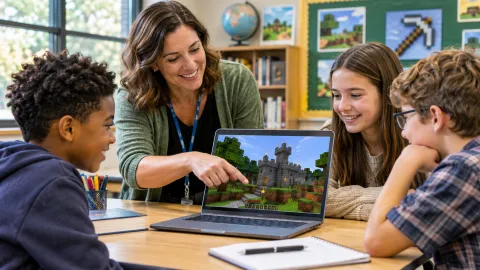
AI is being used across different educational settings, including K–12 schools, community colleges, universities, and online learning programs. Its role varies depending on the institution, available resources, and local policies.
AI in K–12 Education
K–12 education includes kindergarten through 12th grade. AI tools in this setting may support classroom instruction, learning activities, teacher preparation, and student accessibility.
Common examples include:
-
Creating reading passages at different difficulty levels.
-
Generating practice questions for math and science.
-
Providing explanations of difficult concepts.
-
Helping teachers prepare lesson plans.
-
Supporting language learning.
-
Assisting with certain accessibility needs.
A middle school student studying fractions, for example, could ask an approved AI learning tool to explain the concept using a pizza illustration. The student could then complete practice problems independently.
For younger students, however, adult supervision and age-appropriate tools are especially important. Schools and families should consider whether a tool is suitable for the student's age, protects personal information, and supports learning rather than replacing it.
AI in High School
High school students may use AI for research assistance, brainstorming, essay feedback, study planning, and exam preparation.
A student preparing for a history test could ask an AI tool to generate practice questions about a topic covered in class. After answering, the student could review explanations and identify areas that need more study.
AI can also introduce students to skills they may encounter in college and the workplace, such as evaluating generated information, understanding technology limitations, and using digital tools responsibly.
The important distinction is between using AI as a learning aid and submitting AI-generated work as if it were entirely one's own.
AI in Colleges and Universities
Higher education institutions may use AI in coursework, research, student support, and administrative services.
Examples include:
-
AI-assisted tutoring and study support.
-
Research brainstorming and literature exploration.
-
Writing feedback and editing assistance.
-
Coding explanations and debugging support.
-
Student advising and information chatbots.
-
Course material development.
College students may have greater independence when using technology, but they still need to follow their institution's academic integrity rules.
A professor may permit AI-assisted brainstorming while prohibiting AI-generated essays. Another course may allow certain AI tools if students disclose their use. Students should not assume that one college's policy applies to every course.
Benefits of AI in Education
AI can offer several potential benefits when it is used with appropriate supervision and instructional goals.
1. Personalized Learning Support
Students do not all learn at the same pace. Some may understand a topic quickly, while others need additional examples or practice.
AI tools can provide different explanations of the same concept. A student who struggles with a textbook explanation may request a simpler version, a step-by-step example, or a comparison with a familiar situation.
For example, a student learning photosynthesis might ask for:
-
A basic explanation suitable for a beginner.
-
A step-by-step description of the process.
-
A short practice quiz.
-
An explanation of why a previous answer was incorrect.
This flexibility can help students explore a concept without waiting for the next classroom session.
However, personalization is not automatically accurate. AI-generated explanations still need to be checked against course materials and reliable sources.
2. Immediate Feedback and Practice
Feedback is an important part of learning. AI tools may provide responses to practice answers, explain mistakes, or suggest areas for improvement.
A student solving algebra problems might ask an AI tool to identify the step where their reasoning went wrong. The student can then attempt the problem again.
This type of support may be useful during independent study, especially when a teacher is not immediately available.
The quality of the feedback depends on the tool and the task. AI may misunderstand a student's reasoning or provide an incorrect explanation, so it should not be treated as a perfect grader.
3. Support for Teachers
Teachers spend time preparing lessons, creating assignments, developing examples, and organizing classroom resources.
AI may help with some of these tasks. For example, a teacher could use it to:
-
Draft a lesson outline.
-
Generate practice questions.
-
Create alternative examples for a difficult topic.
-
Summarize a long document.
-
Develop a first draft of a classroom activity.
These outputs should be reviewed and adjusted by the teacher. AI-generated lesson material may contain errors, inappropriate examples, or content that does not match the students' needs.
The potential benefit is reducing routine preparation work so teachers can focus more on instruction, classroom interaction, and student support.
4. Accessibility and Learning Assistance
AI-enabled educational tools may support some students with disabilities or different learning needs.
Depending on the tool, features can include speech-to-text, text-to-speech, simplified explanations, language translation, and alternative ways to interact with learning material.
For example, a student who has difficulty reading a lengthy passage may benefit from a text-to-speech feature. A student learning English may use a translation tool to understand unfamiliar vocabulary.
These technologies can be useful, but they are not substitutes for a student's established accommodations or the professional support provided by a school.
5. Help With Study Organization
Students often need to manage several subjects, assignments, exams, and deadlines.
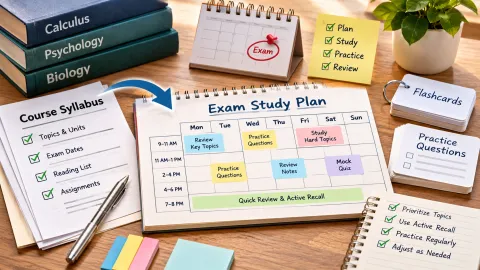
An AI tool may help create a study schedule, divide a large project into smaller tasks, or generate a revision checklist.
A student preparing for a biology exam could organize a week of study around cell structure, genetics, and ecology. The student would still need to use the teacher's syllabus and actual exam requirements when planning.
AI-generated schedules can be helpful starting points, but students should check that the plan is realistic and matches their priorities.
Risks and Challenges of AI in Education
AI offers useful possibilities, but schools, educators, parents, and students need to understand its limitations.
1. Academic Integrity and Plagiarism
One of the most significant concerns is the use of AI to complete assignments without permission.
Students may submit generated essays, answers, or project materials as their own work. This can undermine the purpose of an assignment, which may be designed to measure a student's knowledge, reasoning, or writing ability.
Academic integrity rules differ across schools, districts, colleges, and individual courses. AI use may be allowed for brainstorming but prohibited for final submissions.
Students should check assignment instructions before using AI. If disclosure is required, they should explain how the tool was used.
2. Incorrect or Misleading Information
AI tools can generate convincing answers that are inaccurate. They may misstate facts, misunderstand a question, invent references, or present uncertain information with confidence.
This is especially important in subjects such as science, history, mathematics, and government.
For example, a student researching a historical event may receive an explanation that leaves out important context. If the student copies it without checking a textbook or reliable source, the assignment may contain errors.
Students should verify important claims using course materials, official sources, and credible educational resources.
3. Reduced Critical Thinking
If students rely on AI to produce answers instead of thinking through problems themselves, they may lose opportunities to develop independent skills.
A student who asks AI to solve every math problem may finish homework quickly but still struggle during an exam without assistance.
The same issue can occur in writing. If AI generates every paragraph, the student may not practice organizing arguments, selecting evidence, or expressing ideas clearly.
AI is most useful when students remain actively involved in the learning process.
4. Student Privacy and Data Security
AI tools may collect or process information entered by users. Depending on the service, this could include prompts, uploaded documents, account details, or other data.
Students should avoid entering sensitive information such as:
-
Full names combined with personal details.
-
Student identification numbers.
-
Home addresses or phone numbers.
-
Private school records.
-
Medical or disability information.
-
Confidential classroom or assessment materials.
Schools should carefully evaluate the privacy practices of educational AI providers before adopting tools for students.
Families should also review the terms, age requirements, and privacy settings of tools that children use.
5. Bias and Unequal Access
AI systems can reflect biases in their training data or design. Generated examples, recommendations, or evaluations may not work equally well for every student.
Access is another challenge. Some students may have reliable internet connections, updated devices, and paid AI tools, while others may have limited access.
If schools depend heavily on technology without providing equitable alternatives, AI could widen existing educational differences.
A responsible approach should consider accessibility, fairness, affordability, and the needs of students with different backgrounds.
6. Overdependence on Technology
AI should not become the only way students learn or receive assistance.
Students still need to read, write, solve problems, discuss ideas, and develop relationships with teachers and classmates.
Technology can support these activities, but it cannot fully replace classroom interaction, human judgment, encouragement, or the social aspects of education.
AI in Education: Benefits vs. Risks
The following comparison summarizes the main considerations.
| Area | Potential benefit | Potential risk |
|---|---|---|
| Learning support | Offers alternative explanations and practice | May provide incorrect answers |
| Writing | Helps with brainstorming and feedback | Can encourage unauthorized generated work |
| Teaching | Supports lesson preparation | Materials may require substantial review |
| Assessment | Helps with certain feedback tasks | May misjudge student performance |
| Accessibility | Provides some assistive features | May not meet every student's needs |
| Privacy | Can support educational services | Student information may be exposed |
| Study planning | Helps organize learning tasks | Students may depend too heavily on AI |
| AI literacy | Builds technology awareness | Poor instruction may encourage blind trust |
The benefits are most likely to be meaningful when AI supports a clear educational purpose and its limitations are addressed.
Does AI Improve Student Learning?
AI can support learning, but using AI does not automatically mean a student learns more.
The outcome depends on the student's behavior, the quality of the tool, the subject, the instructional approach, and the type of task.
Consider two hypothetical students studying the same topic.
The first student asks AI to explain a concept, reviews the explanation, checks it against class materials, and completes practice problems independently.
The second student asks AI to generate all assignment answers and submits them without reviewing the material.
Both students have used AI. However, the first has actively engaged with the subject, while the second may have skipped the learning process.
This distinction matters because completing a task quickly is not the same as understanding it deeply.
Teachers can encourage productive AI use by designing assignments that require students to explain their reasoning, show their work, discuss sources, or demonstrate understanding in class.
AI Policies in US Schools
There is no single AI-use policy that applies identically to every US school, district, and college.
Rules may vary by state, school district, institution, teacher, course, and assignment. Some schools may allow approved AI tools for certain activities, while others may restrict their use.
Federal education guidance on responsible AI use should be understood in its specific context. It does not automatically grant students permission to use AI in every assignment or create a universal policy for all US schools.
For students, the practical steps are straightforward:
-
Read the assignment instructions.
-
Check the school's or college's AI policy.
-
Ask the teacher or professor if the rules are unclear.
-
Use only approved tools when required.
-
Disclose AI assistance when the assignment requires it.
-
Keep your own work and reasoning central.
Students should not rely on a classmate's interpretation of the rules. Requirements may differ even between courses at the same institution.
How Students Can Use AI Responsibly
Students can benefit from AI without allowing it to replace their learning.
Use AI to Understand, Not Just to Answer
Instead of asking AI to complete a question, ask it to explain the underlying concept.
For example, rather than requesting the final answer to a math problem, a student could ask:
"Explain the steps I should use to solve this type of equation. Do not give me the final answer yet."
This approach encourages the student to practice the process.
Check AI-Generated Information
Students should verify important facts, explanations, and references.
Useful sources may include:
-
Assigned textbooks.
-
Course notes.
-
Official government websites.
-
University resources.
-
Recognized educational organizations.
-
Peer-reviewed research when appropriate.
AI can help identify what to investigate, but it should not automatically be treated as the source of truth.
Protect Personal Information
Students should use school-approved tools when available and avoid sharing sensitive details.
Before uploading a document or entering information, consider whether it contains private data or material that should remain confidential.
Follow Assignment Rules
Students should understand whether AI is allowed for brainstorming, editing, research, coding, or drafting.
A useful rule is to treat the teacher's instructions as the authority for the assignment.
Maintain Independent Skills
Students should continue practicing writing, mathematics, reading comprehension, research, and problem-solving without AI.
These skills are important for exams, future education, and professional work.
How Parents Can Support Responsible AI Use
Parents do not need to become AI experts to help their children use educational technology safely.
They can begin by asking how AI is being used at school and whether the child understands its limitations.
Useful steps include:
-
Discussing the difference between learning assistance and copying answers.
-
Reviewing the age requirements of AI tools.
-
Encouraging children to verify generated information.
-
Checking whether the school recommends or approves a particular service.
-
Reminding children not to share personal or confidential information.
-
Encouraging offline learning, reading, and independent problem-solving.
Parents may also ask schools how AI tools are selected, whether student information is protected, and how teachers are trained to use the technology.
Open communication is more helpful than treating AI as either entirely beneficial or entirely harmful.
How Teachers Can Integrate AI Into Classroom Learning
Teachers can use AI as a support tool while maintaining control over instruction, assessment, and classroom decisions.
Set Clear Classroom Expectations
Students should know which uses of AI are allowed, which are restricted, and which require disclosure.
Teachers can provide examples of acceptable and unacceptable use. For instance, using AI to generate practice questions may be allowed, while submitting a fully generated essay may be prohibited.
Design Assignments That Encourage Reasoning
Assignments can emphasize the learning process rather than only the final answer.
Teachers may ask students to:
-
Show the steps used to solve a problem.
-
Explain why they selected a particular source.
-
Compare two explanations.
-
Reflect on how their understanding changed.
-
Present their reasoning orally.
-
Revise a draft using feedback.
These approaches can make independent understanding more visible.
Review AI-Generated Materials
Teachers should check generated lesson plans, questions, examples, and feedback before using them.
An AI tool may produce inaccurate information, inappropriate content, or questions that do not match the lesson objectives.
Teacher judgment remains essential.
Teach AI Literacy
Students should understand how AI works at a basic level, what it can do, and where it may fail.
AI literacy includes the ability to:
-
Understand AI-generated content.
-
Recognize potential bias.
-
Verify information.
-
Protect personal data.
-
Use AI ethically.
-
Evaluate whether a tool is appropriate for a task.
Common Sense Education provides AI literacy lessons and teacher resources that can help educators introduce these topics to K–12 students.
AI Literacy: An Important Part of Education
AI literacy is the ability to understand, evaluate, and use artificial intelligence responsibly.
It is different from simply knowing how to operate an AI tool.
A student who can write prompts may know how to use a tool. A student who can identify an incorrect response, recognize bias, protect personal information, and explain when AI should not be used demonstrates a deeper understanding.
AI literacy can be useful across many subjects.
In English classes, students may evaluate AI-generated writing. In science, they may compare an AI explanation with experimental evidence. In social studies, they may examine how generated content presents historical information.
The goal is not necessarily to make every student an AI programmer. It is to help students become informed users who can make sound decisions about technology.
How to Evaluate an AI Education Tool
Schools, teachers, and parents should evaluate AI tools before adopting them.
A useful decision framework is to consider the following factors.
| Evaluation factor | What to consider |
|---|---|
| Educational purpose | Does the tool address a specific learning need? |
| Accuracy | Can its output be checked against reliable sources? |
| Student privacy | What information does the tool collect and process? |
| Age suitability | Is the tool appropriate for the intended students? |
| Accessibility | Can students with different needs use it effectively? |
| Teacher control | Can educators review and guide its use? |
| Policy compliance | Does it meet school and assignment requirements? |
| Evidence of value | Does it support meaningful learning outcomes? |
A tool should not be adopted simply because it is popular or offers many features.
Schools should consider whether it genuinely supports instruction, whether its risks are manageable, and whether students can benefit from it without unnecessary dependence.
The Future of AI in Education
AI is likely to continue influencing education in the United States. Educational technology may become more personalized, interactive, and capable of supporting different learning activities.
Possible developments include improved tutoring systems, more adaptive practice, AI-supported accessibility features, and better tools for teachers to prepare educational materials.
However, the future of AI in education will not depend only on technological progress. It will also depend on teacher training, student AI literacy, privacy safeguards, policy development, and evidence that the tools improve learning.
Schools will need to make thoughtful decisions about which technologies to use and how to evaluate their results.
AI should remain a means of supporting education, not a replacement for the human relationships and intellectual effort that make learning valuable.
Conclusion
AI in education offers opportunities to support students, teachers, and schools across the United States. It can provide alternative explanations, generate practice activities, assist with lesson preparation, and support some accessibility needs.
At the same time, AI can introduce problems involving academic integrity, inaccurate information, privacy, bias, and overdependence on technology.
The most effective approach is to use AI with clear educational goals, appropriate supervision, and an emphasis on independent learning. Students should verify information and follow school policies. Teachers should review AI-generated materials and remain responsible for instruction. Parents should encourage safe and thoughtful use.
AI can be a valuable educational tool when it helps students understand more, think critically, and build skills. The priority should always be meaningful learning—not simply completing assignments faster.
Frequently asked questions
1. Can AI replace teachers in the classroom?
AI can support certain teaching tasks, such as generating practice questions, assisting with lesson planning, and providing feedback. However, it does not replace the human judgment, relationships, classroom management, and individualized support that teachers provide. AI is best understood as a support tool rather than a complete teacher replacement.
2. Can teachers tell if a student used AI for an assignment?
Teachers may identify possible AI use through writing patterns, assignment history, or AI-detection tools. However, AI detectors can produce false positives and false negatives. A detector's result alone should not be treated as definitive proof of academic misconduct. Teachers should consider the assignment requirements, student work history, and school policies.
3. Is it safe for students to use AI tools for schoolwork?
AI tools can be useful, but students should use school-approved tools when available, avoid sharing sensitive personal information, verify AI-generated information, and follow teacher instructions. AI-generated answers can contain errors or misleading information, so students should not rely on them without review.
4. Are AI tools allowed in US schools?
AI use rules vary across states, school districts, schools, teachers, and individual assignments. Some uses may be permitted while others may be restricted. Students should check their school or district policy and the specific instructions provided by their teacher before using AI for schoolwork.
5. What is the difference between AI in education and AI literacy?
AI in education refers to the use of artificial intelligence in teaching, learning, school administration, and educational support. AI literacy refers to the knowledge and skills needed to understand, evaluate, and use AI responsibly, including recognizing its limitations, risks, and potential biases.
6. Does AI help students learn better?
AI may help students with explanations, practice, feedback, and personalized support. However, completing a task more quickly or producing a better answer does not necessarily mean a student has learned the material deeply. Learning outcomes depend on how AI is used, the instructional approach, and whether students actively engage with the subject.
Emily Carter writes practical, reader-focused content about education, college planning, degrees, financial aid, career paths, and the transition from school to work. She focuses on making complicated education and caree...